Self-Healing Concrete: How Bacteria, Capsules, and Mineral Systems Repair Cracks
Self-healing concrete uses chemical, biological, or embedded-agent mechanisms to seal selected cracks and reduce the movement of water and aggressive substances. This guide compares autogenous healing, bacteria-based concrete, capsules, crystalline admixtures, and mineral systems while explaining testing, specification, cost, and practical limits.
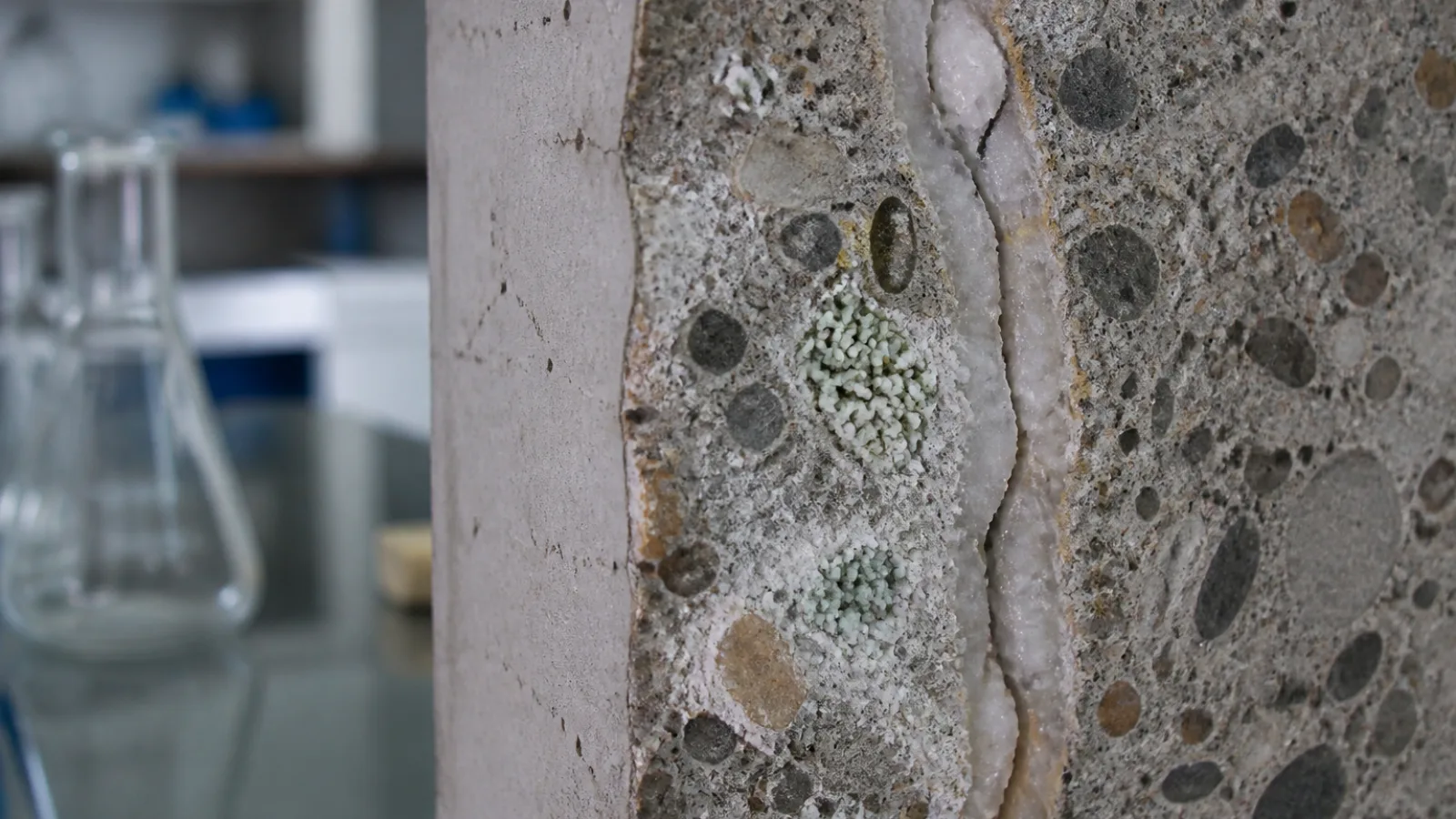
Cracks in concrete do not always indicate an immediate loss of structural capacity, but they can create a pathway for water, chlorides, gases, and other aggressive substances. That can increase reinforcement corrosion risk, leakage, freeze-thaw damage, and future maintenance demands. For structures where access is difficult, systems described as self-healing concrete may help limit those risks. Some crystalline concrete waterproofing systems are designed to react with moisture and help block capillaries and cracks, although their performance must still be evaluated for the specific concrete and exposure.
Self-healing concrete is not a single material or a universal repair solution. It is a family of formulations that use continued cement hydration, biological mineral precipitation, embedded capsules, crystalline reactions, or other mineral processes to seal or partially close cracks. In most cases, the practical objective is reduced permeability and improved durability rather than complete restoration of the original strength or stiffness.
This distinction matters when engineers, infrastructure owners, contractors, and specifiers evaluate whether the technology justifies additional material, testing, and quality-control costs. The relevant question is not whether concrete can heal in a laboratory, but whether a selected system can deliver a measurable benefit under the crack widths, curing history, moisture conditions, loading, and service environment of the project.
What Is Self-Healing Concrete?
Self-healing concrete is concrete designed or formulated to seal, close, or partially recover cracks through reactions already available in the cement matrix or through an intentionally added healing mechanism. Conventional concrete crack repair usually involves an external action, such as injecting resin, routing and sealing a crack, applying a surface treatment, or replacing damaged material. Self-healing seeks to activate from within the concrete after cracking.
Autogenous healing uses constituents already present in concrete. Continued hydration of unreacted cement and the formation of deposits can narrow or block small cracks. Autonomous self-healing concrete, by contrast, contains an intentionally introduced mechanism, such as protected bacteria, capsules, vascular channels, or reactive mineral additives.
Performance is strongly influenced by crack width, crack stability, moisture availability, concrete age, curing, temperature, chemical exposure, and the number of loading cycles. A narrow crack that remains static and periodically becomes wet presents a very different healing opportunity from a wide crack that opens and closes under traffic, thermal movement, settlement, or seismic action.
How Autogenous Healing Works
Continued hydration
Concrete may contain cement particles that have not fully reacted, particularly when the mixture has a relatively low water-to-cementitious-materials ratio or when hydration was limited by curing conditions. If water reaches a crack, these particles can hydrate. Additional calcium-silicate-hydrate, commonly called C-S-H, may form within or near the crack and reduce its open width.
This process is one reason young concrete can show more natural healing potential than older concrete. The available unhydrated material, crack geometry, and access to moisture all affect the result. Continued hydration can improve resistance to water movement, but it does not recreate the original continuous cement paste structure in a way that should automatically be treated as full mechanical recovery.
Carbonation and deposit formation
Calcium-bearing products can react with carbon dioxide and moisture to form calcium carbonate and other deposits. Particles loosened from the crack faces may also accumulate and obstruct the opening. These processes can reduce water flow and apparent crack width, particularly in narrow, relatively stable cracks.
Deposit formation should not be confused with complete structural repair. A crack may look closed at the surface while remaining partially open below it. Some deposits can also be brittle or discontinuous. For durability design, transport testing and inspection are therefore more informative than visual closure alone.
Practical limits
Autogenous healing is most credible when cracks are small, stable, and exposed to favorable moisture conditions. Intermittent wetting may support hydration and deposit formation, while a persistently dry environment can restrict both. Wide cracks, repeatedly moving cracks, cracks contaminated with oils or debris, and cracks associated with active structural distress are less likely to heal effectively.
Good mixture design and crack width control remain essential. Reinforcement detailing, curing, shrinkage management, joint design, and appropriate structural analysis generally provide more predictable control than relying on natural healing after a crack has formed.
Bacteria-Based Self-Healing Concrete
Bacteria-based concrete introduces microorganisms that can contribute to mineral precipitation when a crack allows water and oxygen to enter. In a typical concept, dormant bacteria become active in the presence of moisture and produce or promote calcium carbonate precipitation. The resulting mineral deposits can partially fill a crack and reduce permeability.
The microorganisms must be protected from the highly alkaline concrete environment, mechanical forces during batching, and the heat and pressure associated with placement and curing. Delivery methods may include porous carriers, lightweight aggregates, gel-based systems, or other protective matrices. No single carrier is universally superior; the best choice depends on the required survival, mixture proportions, strength, density, and production process.
Potential benefits include the possibility of delayed activation and useful crack sealing after the concrete has been in service for some time. If mineral precipitation reduces water transport, the process may also support concrete durability by limiting the movement of chlorides and other agents. However, a reduction in permeability is not the same as restoration of tensile capacity across a structural crack.
Important limitations include bacterial survival during mixing, compatibility with cement chemistry and admixtures, the effect of carriers on strength and density, moisture dependence, and the difficulty of confirming uniform distribution. Quality control must address the biological material, the carrier, batching conditions, curing, and the resulting concrete properties. Project-specific validation is particularly important because laboratory performance may not transfer directly to large-scale production or a dry, cold, chemically aggressive, or highly dynamic environment.
Encapsulated-Agent Systems
Encapsulated systems place a liquid, gel, resin, mineral precursor, or other reactive healing agent inside small reservoirs distributed through the concrete. Some concepts use discrete capsules; others use vascular networks or embedded channels. When a crack reaches and ruptures a reservoir, the agent flows into the opening and then solidifies or reacts with materials in the surrounding matrix.
The intended sequence is straightforward: a crack forms, the capsule or channel is broken, the healing agent is released, and a chemical or physical reaction seals the crack. In practice, each stage depends on careful material and structural design. Capsules must be large enough to contain a useful volume but small enough to distribute without creating unacceptable weak points. They must survive mixing and placement while remaining capable of breaking when a crack reaches them.
Most discrete capsule concepts are effectively one-use at a given location. A crack may activate one reservoir, but repeat healing depends on whether other reservoirs intersect later cracks and whether the agent remains available. Vascular systems may offer more opportunities for repeated delivery, but they introduce additional complexity in network design, filling, protection, and construction.
Key design challenges include capsule size, spacing, distribution, bond strength, storage stability, release behavior, and compatibility with the cement matrix. Capsules can affect compressive or tensile performance if they create voids or weak interfaces. For these reasons, microcapsule concrete may be more suitable for controlled precast elements or carefully engineered composites than for every conventionally cast structural member.
Crystalline and Mineral-Based Systems
Crystalline admixtures and other mineral-based systems use reactive components that interact with water and cement chemistry. Depending on the formulation, reactions may produce insoluble products, encourage crystal growth, or block pores and fine cracks. The resulting reduction in water movement can be valuable where leakage and ingress are primary concerns.
These systems should be distinguished from a claim of complete structural self-repair. A crystalline admixture may improve waterproofing or seal fine discontinuities without restoring reinforcement continuity, tensile strength, or the load-transfer behavior of a cracked member. Surface-applied sealing also cannot be assumed to repair internal structural damage.
Performance depends on dosage, cement chemistry, curing, crack geometry, moisture availability, and exposure. A system that performs well in a continuously damp basement wall may behave differently in a dry façade panel or a bridge deck exposed to deicing salts and repeated traffic loading. The specification should identify the intended sealing or transport-control objective rather than treating every crystalline admixture as a self-healing product.
Crystalline admixture concrete and related mineral systems may be attractive for basements, tanks, tunnels, retaining structures, water infrastructure, and other applications where permeability control is important. They still need to be integrated with waterstops, joints, drainage, reinforcement detailing, crack width control, curing, and inspection.
Comparison of Self-Healing Concrete Systems
The following table is a decision aid, not a universal ranking. Results vary with formulation, crack width, curing, exposure, and test method.
| System | Primary mechanism | Moisture dependence | Likely repeatability | Strongest use case | Principal limitation |
|---|---|---|---|---|---|
| Autogenous healing | Continued hydration and deposits | High | Limited by remaining reactive material | Small, stable cracks in well-cured concrete | Weak performance in wide or moving cracks |
| Bacteria-based | Biologically supported mineral precipitation | High, with oxygen often relevant | Potentially delayed or repeated, formulation-dependent | Durability-focused concrete where protected bacteria can survive | Survival, distribution, carrier, and validation challenges |
| Encapsulated agents | Release and reaction of stored healing agent | Varies by agent | Often one-use at each capsule | Controlled precast or engineered composite elements | Capsules can affect strength and may be damaged during mixing |
| Crystalline admixtures | Reactive products that block pores and cracks | Usually significant | Potential for renewed reaction when moisture returns | Water-excluding or water-retaining structures | Sealing does not equal structural repair |
| Mineral or supplementary systems | Additional hydration and mineral deposit formation | Usually moderate to high | Depends on available reactants | Permeability reduction and durability improvement | Evidence and behavior vary by formulation and exposure |
Where Self-Healing Concrete May Be Useful
Potential applications include water-retaining and water-excluding structures, tunnel linings, underground construction, bridge decks, marine and coastal infrastructure, precast components, façades, and assets where repair access is hazardous, disruptive, or expensive. The strongest business case often relates to reduced leakage, lower access and repair costs, protection against durability-related ingress, or an extended service life.
For underground structures and tanks, reducing fine water pathways may help manage leakage and protect reinforcement. For bridge decks and marine structures, reducing chloride transport may be more important than achieving a visually closed crack. In precast production, controlled manufacturing can make it easier to distribute capsules, carriers, or specialized mineral components consistently.
Self-healing should not be the primary strategy for highly dynamic cracks, major structural distress, or locations subject to severe thermal, seismic, settlement, or fatigue movement. Those conditions require conventional engineering controls, movement accommodation, structural repair, or replacement as appropriate. A self-healing mechanism may supplement those measures, but it should not be used to justify inadequate reinforcement design or joint detailing.
How Performance Is Tested
Crack closure measurements
Visual microscopy, digital image analysis, and repeated crack-width measurements can document whether a crack becomes narrower over a defined healing period. Tests should record how the crack was created, its initial width and depth, the specimen age, the applied loading, and the moisture or exposure history. Surface closure alone may overstate the degree of internal sealing.
Transport and watertightness tests
Water absorption, water permeability, leakage, sorptivity, and chloride or gas transport can indicate whether a healing process has reduced movement through the cracked zone. These methods answer different questions. A specimen may show visible closure but still permit significant transport, or it may reduce transport without recovering meaningful mechanical capacity. Concrete permeability testing should therefore be selected to match the project risk.
Mechanical recovery
Tensile, flexural, or compressive tests may be used to measure recovery after healing. Crack closure and strength recovery are separate outcomes. A deposit that blocks water may have limited ability to transfer tensile stress, while an agent that bonds crack faces may improve mechanical response under particular conditions. Test interpretation should account for the original cracking method, residual loading, specimen geometry, and whether the healed crack is reloaded in a representative direction.
Environmental and durability conditioning
Useful programs may include wet-dry cycles, immersion, freeze-thaw exposure, chemical exposure, repeated loading, temperature changes, and realistic curing histories. The selected conditioning should represent the intended environment rather than merely maximize healing potential. Control specimens are essential for separating the effect of ordinary autogenous healing from the contribution of an added bacteria, capsule, crystalline, or mineral system.
Test reports should define the healing period, crack widths, curing conditions, number of cycles, exposure chemistry, measurement method, and acceptance criteria. A laboratory result based on ideal curing and static cracks should not be transferred directly into a field specification without checking scale, reinforcement, workmanship, placement, and service conditions.
Specification and Cost Considerations
A project specification should identify the target crack width, the intended objective, the exposure class, the required test method, curing conditions, acceptance criteria, compatibility with reinforcement and other admixtures, and quality-control procedures. The objective might be reduced leakage, lower chloride transport, improved crack closure, or a defined level of mechanical recovery. These are not interchangeable requirements.
Cost evaluation should include more than the price of the healing component. Material costs may be higher, and batching can require additional controls. Capsules or carriers may affect placement and finishing. Biological or reactive materials may require storage and handling procedures. Additional trial batches, mock-ups, laboratory testing, inspection, and supplier documentation may also be necessary.
A higher initial cost may be justified for inaccessible assets, leakage-sensitive structures, or projects where corrosion, shutdowns, traffic control, excavation, or specialist access would make future repairs particularly expensive. It is not automatically justified for ordinary low-risk concrete where conventional mixture design, curing, detailing, and accessible maintenance already provide adequate performance.
For critical work, use trial batches and representative mock-ups before full production. Review supplier documentation, verify compatibility with the proposed concrete, and obtain independent performance evidence where the consequences of failure are significant. Acceptance should be based on measurable project requirements rather than on a general claim that the concrete is self-healing.
Limitations and Common Misconceptions
- Self-healing does not make concrete immune to cracking. Shrinkage, restraint, loading, temperature, settlement, and construction defects still require control. The American Concrete Institute provides detailed engineering guidance in ACI 224R-01: Control of Cracking in Concrete Structures, including methods for managing drying-shrinkage cracking.
- Crack sealing is not the same as restoring full structural capacity, stiffness, reinforcement bond, or durability in every direction.
- Healing agents are not guaranteed to activate under every moisture, temperature, chemical, or loading condition.
- Large, moving, contaminated, or actively leaking cracks may require conventional repair, injection, replacement, or structural intervention.
- Laboratory results should not be transferred directly to field specifications without considering scale, curing, reinforcement, workmanship, and exposure.
FAQ
Does self-healing concrete repair every crack?
No. Performance is conditional and is generally strongest for suitably narrow, stable cracks exposed to favorable moisture and chemical conditions. Wide, moving, dry, contaminated, or structurally significant cracks may not heal adequately.
Is bacteria-based concrete safe?
Engineered systems are intended to immobilize or protect microorganisms within the concrete matrix rather than release them into the occupied environment. Safety, handling, durability, and compatibility still depend on the selected organism, carrier, formulation, and project documentation. Supplier testing and project-specific review remain important.
Can self-healing concrete restore structural strength?
It may provide some mechanical recovery in a defined test, but crack closure, reduced permeability, and strength recovery are different outcomes. Full restoration of structural behavior should never be assumed without representative testing and engineering assessment.
Which self-healing concrete system is best?
Selection depends on crack behavior, exposure, moisture, access, required service life, structural demands, production method, and the quality of available testing evidence. Autogenous healing may be sufficient for some fine stable cracks, while bacteria, capsules, crystalline admixtures, or other mineral systems may be considered for more specific durability or access constraints.
Is self-healing concrete more expensive?
Initial material and quality-control costs can be higher. Lifecycle value may improve where repair access, leakage, corrosion, disruption, or shutdown costs are significant. The economic case should compare verified performance and expected maintenance consequences, not just the initial concrete price.
Conclusion
Self-healing concrete is a family of mechanisms rather than a single material. Autogenous healing uses reactions already available in concrete, while autonomous systems introduce bacteria, capsules, crystalline reactions, or other mineral components intended to respond after cracking. Each approach has different moisture requirements, repeatability, production risks, and evidence limitations.
The technology does not replace reinforcement design, crack width control, sound waterproofing detailing, curing, inspection, repair planning, or structural engineering judgment. Its value is greatest when a measurable reduction in water or contaminant transport, leakage, access requirements, or lifecycle risk can be demonstrated under representative conditions.
For practical adoption, specify a clear performance objective, validate the chosen formulation with trial batches and appropriate testing, and evaluate it against the project’s actual crack behavior and exposure. Treat self-healing as one part of a broader concrete durability strategy—not as a substitute for controlling the causes and consequences of cracking.