DC Buildings Explained: How Direct Current Networks Connect Solar Power, Batteries, and Modern Loads
DC buildings use direct-current networks to connect generation, storage, controls, and selected modern loads more directly. This guide explains the engineering opportunities, safety considerations, limitations, and practical role of hybrid AC/DC systems in commercial construction.
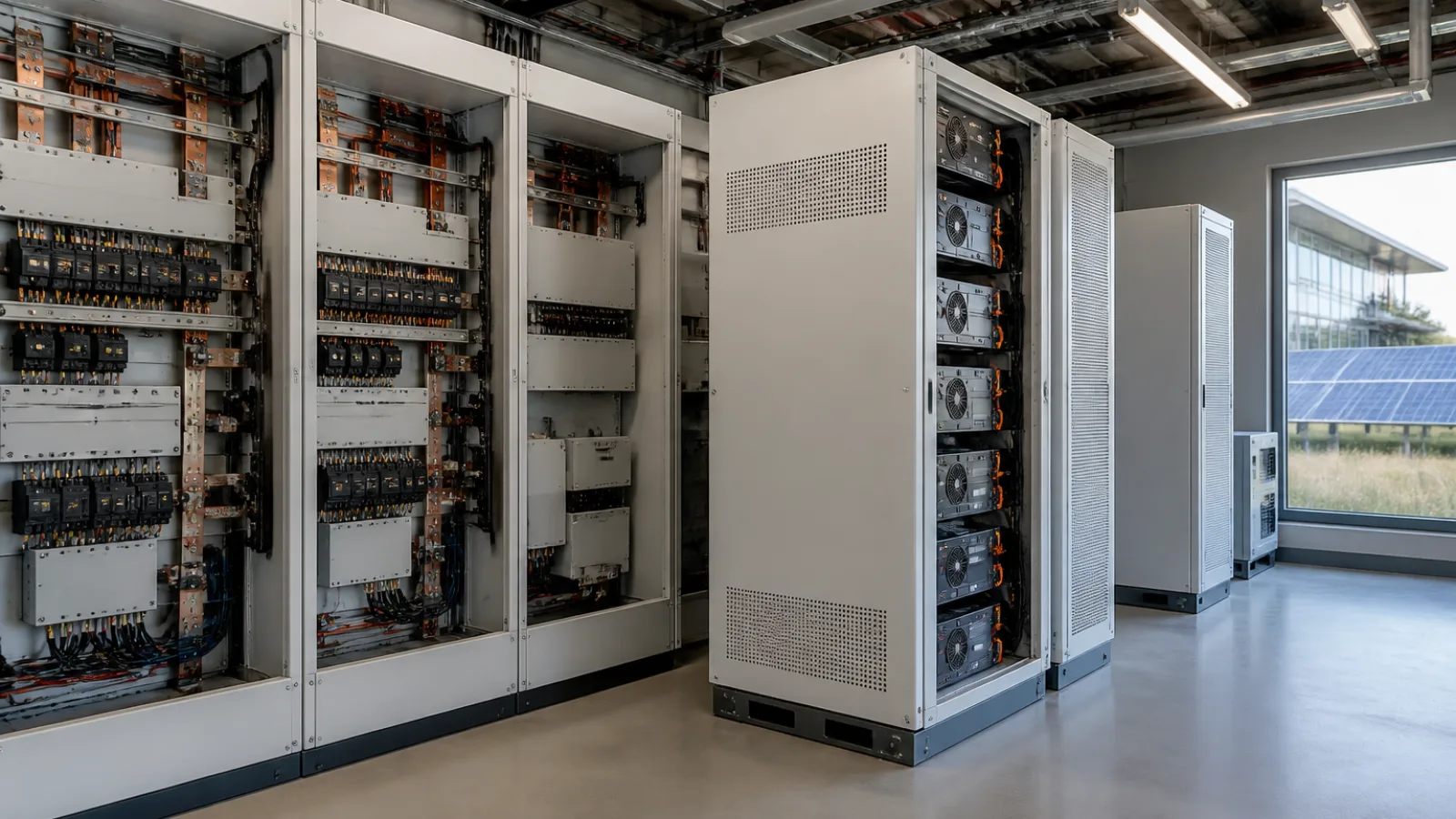
DC buildings use direct current to move electrical power between generation, storage, controls, and selected building loads. Rather than relying on alternating current for every stage, a project may use a dedicated DC distribution network, a DC zone, or a hybrid architecture that combines DC equipment with a conventional AC backbone.
Direct current is receiving renewed attention because solar panels, batteries, computers, networking equipment, LED lighting, electric vehicles, and many smart-building controls already use or internally create DC power. Data centers also require carefully coordinated infrastructure, including Vertiv’s data center power solutions, to support dense electronic loads, cooling, redundancy, and power quality. The opportunity is not to assume that every building should become fully DC, but to evaluate where a direct-current network can simplify the complete energy path.
Modern DC buildings sit at the intersection of electrical engineering, renewable energy, power electronics, construction coordination, and facility operations. Their value depends on the loads, voltage levels, distances, protection strategy, equipment availability, resilience objectives, and lifecycle requirements of each project.
What Is a DC Building?
Direct current flows in one prevailing direction, with voltage maintaining a relatively constant polarity. Alternating current periodically reverses direction and polarity. Utility grids and most conventional commercial electrical systems use AC because AC supported practical voltage transformation and long-distance transmission as the grid developed.
A DC building does not necessarily eliminate AC. In practice, the term can describe several arrangements:
- A building with a dedicated DC distribution network serving selected loads.
- A DC zone for lighting, controls, information technology equipment, or other compatible devices.
- A facility where solar generation, batteries, and DC loads share a common bus.
- A hybrid AC/DC architecture that keeps AC for general distribution and uses DC where it offers a clear technical advantage.
A typical energy path may begin with the utility service or renewable generation. Power then passes through conversion and protection equipment to a DC bus or distribution system. Batteries can charge or discharge through bidirectional converters, while compatible loads receive regulated DC power. Inverters can supply AC loads or synchronize with an AC utility connection. Controls monitor voltage, current, state of charge, demand, faults, and operating priorities across the system.
Why Direct Current Is Returning to Modern Construction
AC became dominant for sound historical and engineering reasons. Transformers make it practical to change AC voltage for transmission and distribution, and the electrical industry has built extensive standards, equipment supply chains, maintenance practices, and codes around AC systems. Most existing buildings also contain AC wiring, switchgear, receptacles, motors, emergency systems, and utility connections.
At the same time, many modern loads do not consume AC internally. Computers and networking equipment convert incoming AC to DC. LED luminaires use drivers to produce controlled DC current. Battery systems store DC energy, and variable-speed drives convert power electronically before controlling motors. Sensors, wireless access points, security devices, building automation controllers, and many appliances also operate on low-voltage DC inside their power supplies.
When a system repeatedly converts DC to AC and then back to DC, each conversion introduces losses, heat, equipment, and control requirements. A suitable DC network may reduce some of those repeated conversion steps. It can also make it more direct to connect photovoltaic generation, batteries, and compatible loads.
These benefits are not automatic. Actual performance depends on the selected voltage level, conductor sizing, distribution distance, load profile, converter efficiency, equipment quality, controls, ambient conditions, standby operation, and maintenance. A poorly designed DC system can create voltage-drop, protection, or conversion challenges that outweigh its theoretical advantages.
How Solar Power and Battery Storage Fit DC Buildings
Photovoltaic panels naturally produce DC power, while batteries store and discharge energy as DC. This makes them logical sources for a direct-current architecture. In a DC-coupled solar-plus-storage arrangement, PV arrays and batteries may connect on the DC side of an inverter through charge controllers and bidirectional converters. That configuration can reduce conversion stages in suitable applications and allow energy to move between generation, storage, and selected loads with fewer transformations.
A complete design still requires more than panels and batteries. Typical equipment can include DC disconnects, fuses or circuit breakers, charge controllers, bidirectional converters, inverters, contactors, monitoring devices, insulation monitoring, grounding or isolation equipment, and controls for safe startup and shutdown. The system must also manage overcurrent, reverse current, polarity, overvoltage, temperature, state of charge, and abnormal operating conditions.
Where a building connects to an AC utility, an inverter or other interface is generally required to serve AC loads and coordinate with the grid. Anti-islanding functions and interconnection controls help prevent an energized building system from unintentionally feeding a utility circuit during an outage. A project that operates as a microgrid may add islanding capability, but a DC building and a microgrid are not the same thing. A DC building can remain grid-connected without operating independently.
Designers should assess whether DC coupling improves the complete system rather than evaluating one piece in isolation. The analysis should include conversion efficiency, conductor losses, battery cycling, inverter loading, controls, maintenance, expansion plans, and the operational consequences of a fault or equipment outage.
DC Distribution and the Role of Power Electronics
A DC distribution system typically uses a bus, feeder, or branch network with converters that regulate voltage for different loads. Those converters may step voltage up or down, provide isolation, limit current, or create a stable output as source voltage and load demand change. Electronic protection can supplement or replace conventional interruption methods depending on the system design and applicable requirements.
Voltage selection is a central engineering decision. Lower-voltage DC may simplify some touch-protection and equipment interfaces, but it can require higher current for the same power, increasing conductor size and voltage-drop concerns. Higher-voltage DC can move power more efficiently over appropriate distances with lower current, but it increases insulation, clearance, enclosure, arc-interruption, and personnel-protection requirements. There is no single voltage that suits every building, load, or distribution distance.
DC arcs behave differently from AC arcs because a DC waveform does not naturally pass through zero in the same way. Conventional AC breakers may not be suitable for interrupting a DC fault. Purpose-designed DC breakers, fuses, contactors, disconnects, and electronic protection are essential. Designers must consider available fault current, clearing time, selectivity, conductor routing, enclosure ratings, and the behavior of connected converters.
AC equipment may still remain throughout the project. Inverters, motors, transformers, utility interfaces, and legacy distribution can introduce harmonics and other power-quality concerns. Harmonic mitigation, grounding, filtering, and compatibility studies remain important wherever AC conversion equipment and sensitive electronic loads operate together.
Where DC Buildings Make the Most Sense
Data centers
Data centers concentrate electronic loads in a controlled environment. Servers, storage equipment, networking systems, UPS equipment, battery systems, monitoring devices, and cooling controls all depend heavily on power electronics. This concentration makes data centers strong candidates for examining DC distribution, especially where renewable generation and storage are part of the energy strategy.
A DC approach may reduce selected conversion stages or allow power infrastructure to align more closely with server and battery requirements. However, data center design is governed by demanding requirements for reliability, redundancy, maintainability, fault isolation, serviceability, expansion, and power quality. The best architecture depends on the equipment platform, operating model, tenant requirements, utility service, cooling system, and resilience objective.
Google data centers and Microsoft data centers are global examples of organizations that have publicly explored advanced data-center energy, power, efficiency, and renewable-integration strategies. Those examples should not be interpreted to mean that all of their facilities are fully DC buildings. Large operators may use different electrical architectures across campuses, regions, and generations of facilities.
Office buildings and smart commercial buildings
Office buildings contain many compatible or predominantly electronic loads, including LED lighting, occupancy sensors, environmental sensors, access controls, wireless equipment, digital signage, building automation controllers, and small appliances. A hybrid design can retain a conventional AC backbone for general receptacles, kitchen equipment, elevators, and other legacy or high-power loads while using DC zones for digitally controlled systems.
Controls can coordinate lighting, storage, solar production, demand management, and critical loads. For example, a building management system may prioritize battery charging when renewable output is available, reduce nonessential loads during a demand event, and preserve energy for communications, security, or emergency operations. These functions require clear control authority, reliable communications, defined fallback modes, and commissioning that tests real operating conditions rather than only point-to-point signals.
Buildings with solar, storage, and electric vehicles
Buildings with rooftop PV, battery storage, and electric vehicle charging already contain several naturally DC-oriented assets. A coordinated architecture may route solar energy to vehicle charging, building loads, or storage based on availability and operating priorities. Bidirectional charging may eventually support additional flexibility where vehicles, chargers, utility rules, and owner policies allow it.
These systems can support resilience and microgrid strategies, but resilience is not automatic. Critical loads need a defined hierarchy, appropriate islanding equipment, fuel or energy-duration planning, tested controls, and a safe method for separating from and reconnecting to the utility. A building may use DC connections for some assets while still relying on AC distribution for most of its facility.
DC Buildings Compared With Conventional AC Buildings
| Comparison area | DC building or DC zone | Conventional AC building |
|---|---|---|
| Generation compatibility | Direct connection with PV and batteries may be practical, subject to converters and protection. | PV and batteries generally require inverters or AC-coupled interfaces. |
| Common loads | Electronic equipment, LED lighting, controls, batteries, and selected EV systems. | General receptacles, motors, appliances, legacy equipment, and mixed commercial loads. |
| Conversion steps | May reduce selected AC-to-DC or DC-to-AC conversions. | Uses established conversion equipment for electronic and renewable loads. |
| Existing infrastructure | May require new conductors, distribution equipment, interfaces, and procedures. | Broadly available utility, equipment, code, and maintenance infrastructure. |
| Protection approach | Requires DC-rated interruption, polarity control, isolation, and arc management. | Uses mature AC protection practices, with specialized requirements for certain loads. |
| Design maturity | Developing across building applications and often dependent on vendor ecosystems. | Highly standardized and familiar across most commercial construction. |
| Best-fit applications | Selected digital loads, data centers, solar-plus-storage systems, and controlled DC zones. | Most general commercial buildings and mixed or legacy load profiles. |
Benefits and Limitations of Direct-Current Building Systems
Potential benefits include fewer conversion stages, more direct coupling between renewable generation and storage, efficient service for digital loads, improved control of selected circuits, and simpler integration of batteries or DC charging equipment. In specific designs, fewer conversion devices may reduce heat, equipment footprint, or space allocated to electrical rooms. Those outcomes depend on the equipment and operating profile rather than on the label “DC” alone.
Limitations can be equally important. Equipment availability varies by voltage, current rating, application, and region. A project may need specialized converters, breakers, connectors, monitoring platforms, and replacement parts. Maintenance personnel may be more familiar with AC systems than with a particular DC architecture. Interoperability can suffer when equipment uses proprietary communication protocols or control logic.
Designers must also address voltage drop, conductor sizing, emergency systems, code compliance, fire and life-safety interfaces, selective coordination, and future expansion. A DC solution can increase coordination requirements among electrical, controls, renewable-energy, and equipment teams. Cost and energy savings should be calculated from the complete lifecycle, including installation, commissioning, training, spares, downtime exposure, and replacement strategy. Neither lower cost nor lower energy use is guaranteed.
Safety, Codes, and Construction Coordination
DC must not be treated as inherently safe because it lacks an alternating waveform. Depending on voltage and available current, DC systems can create severe shock, arc-flash, arc-fault, thermal, and fire hazards. Some faults may persist until a device or control system actively interrupts them.
Designs should address arc-flash and arc-fault risks, correctly rated disconnecting means, polarity, grounding or isolation, touch voltage, insulation monitoring, fire protection, equipment labeling, lockout and tagout, emergency shutdown, and responder access. Enclosures and connectors must prevent inadvertent contact and incorrect polarity. Procedures should identify stored energy in capacitors, batteries, and connected equipment even after a disconnect is opened.
Applicable local codes, standards, utility requirements, manufacturer instructions, and authority-having-jurisdiction approvals must guide the final design. Requirements can differ based on voltage, occupancy, equipment type, energy storage technology, and interconnection method.
Construction coordination is especially important. Electrical engineers, architects, MEP designers, controls specialists, equipment manufacturers, commissioning agents, general contractors, and facility operators should agree early on distribution routes, equipment clearances, access, labeling, controls ownership, testing, and maintenance responsibilities. BIM models and commissioning plans should represent the actual electrical and controls interfaces, not just the visible equipment.
What DC Buildings Could Mean for Future Construction
Near-term adoption is most likely through hybrid systems rather than full-building conversion. Potential applications include DC microgrids, data centers, solar-plus-storage facilities, smart-building zones, EV-integrated campuses, and purpose-built sites with a high concentration of electronic loads. Existing buildings may add targeted DC systems while preserving established AC infrastructure.
BIM, digital twins, advanced metering, predictive controls, and lifecycle commissioning can help teams understand how energy moves from generation to end use. Submetering can reveal where conversion losses occur and whether controls deliver the intended operating sequence. Digital records can also support troubleshooting, replacement planning, and future expansion.
Owners and design teams should ask practical questions before selecting an architecture:
- Which loads are truly DC, and which loads still require AC?
- Where do conversion losses, heat, and standby consumption occur?
- What resilience objective must the system meet, and for how long?
- How will faults be detected, isolated, and safely cleared?
- Who will maintain the equipment and respond to alarms?
- Can components be expanded, replaced, or sourced from more than one manufacturer?
- How will the system comply with codes, utility requirements, and emergency procedures?
Frequently Asked Questions About DC Buildings
What is a DC building?
A DC building uses direct-current distribution for some or all of its electrical loads. Most practical projects use a hybrid AC/DC architecture, with DC serving compatible equipment while AC remains available for other building systems.
Are DC buildings more efficient than AC buildings?
They can be more efficient for suitable load profiles when they reduce repeated conversion stages or improve coordination between solar, storage, and loads. Results depend on voltage, distance, equipment, controls, loading, and operating conditions, so efficiency must be demonstrated through project-specific analysis.
Do DC buildings eliminate the need for AC power?
No. Utility connections, motors, appliances, legacy equipment, and many commercial systems remain AC-based. A DC building may use a dedicated DC zone or network while retaining an AC service and distribution backbone.
Why are data centers interested in DC systems?
Data centers contain dense electronic loads, UPS systems, batteries, networking equipment, and power-electronic cooling controls. A DC architecture may align some of those loads more directly with storage and renewable generation, but reliability, redundancy, maintainability, and fault protection remain decisive.
Can solar panels and batteries connect directly to a DC building?
They can connect on the DC side in suitable designs, but the system still needs correctly rated converters, charge controls, protection, monitoring, isolation, and utility-interconnection equipment. An inverter may still be necessary for AC loads or grid connection.
Are DC electrical systems safe?
DC systems can be safe when engineered, installed, tested, labeled, and maintained correctly. They present serious shock, arc, stored-energy, and fire hazards, so DC-rated protection and trained procedures are essential.
Are DC buildings suitable for every commercial project?
No. DC systems are most compelling where loads, renewable generation, storage, and controls align. Conventional AC distribution may remain the better choice for mixed loads, existing buildings, widely available equipment, or projects where standardization and maintenance simplicity are priorities.
Conclusion
DC buildings are an electrical architecture option, not a universal replacement for AC. Their strongest opportunity lies in evaluating the complete energy chain—from solar generation and batteries through conversion, distribution, controls, and end-use loads—and selecting direct current where it provides a clear technical and operational advantage.
For owners and project teams, the right solution depends on load characteristics, resilience objectives, safety, code requirements, lifecycle cost, equipment availability, interoperability, and maintainability. In many future buildings, the practical answer will be a carefully coordinated hybrid system that combines the maturity of AC with the integration advantages of DC.