The AI Financing Boom: Why Meta, SpaceX and Gulf Funds Are Raising Record Capital
Record AI financing is colliding with a semiconductor sell-off. For construction and property markets, the result is a more selective race for power, land, cooling capacity and delivery certainty.
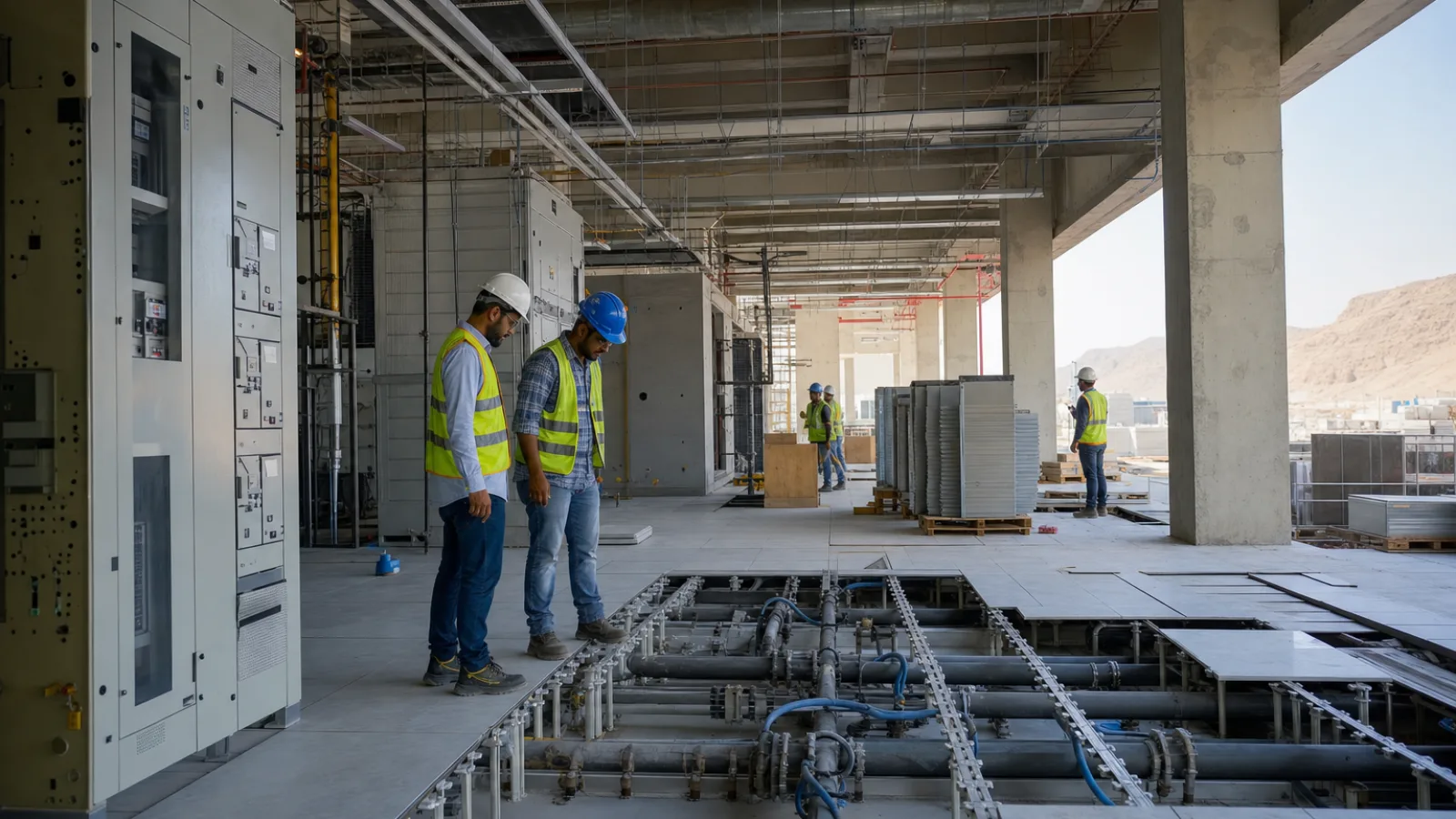
AI infrastructure investment is entering a more complicated phase. The capital being assembled for computing, data centers and semiconductor capacity is reaching extraordinary levels, even as chip stocks have weakened and some major expansion plans are being paused or reworked.
The supplied TechStartups report on the latest AI financing announcements describes three developments that illustrate the tension. Meta is reported to be planning up to $95 billion through stock offerings. SpaceX has disclosed a roughly $40 billion arrangement to lease data-center hardware and AI chips. In Oman, Mubbadrah Investment is leading a consortium associated with a $3 billion AI data-centre project.
At the same time, the semiconductor ETF cited in the briefing is about 25% below its high, while an Oracle and OpenAI expansion has reportedly been paused. For property and construction businesses, this is not simply a technology-sector story. Financing decisions determine which sites receive utility commitments, which contractors mobilize, how much cooling equipment is ordered and whether a proposed data center becomes a building site or remains a land option.
Key takeaways
- Large AI funding announcements can increase demand for data centers, but they do not automatically create construction starts.
- Equity and equipment financing transfer different risks to developers, landlords, utilities and contractors.
- Power availability, interconnection timing and cooling design are becoming as important as land acquisition.
- A semiconductor sell-off can coexist with strong AI infrastructure spending because chip valuations and physical deployment operate on different timelines.
- The Oman project shows how sovereign and regional capital can package AI infrastructure as a strategic real-estate and energy investment.
Why the financing figures matter to construction markets
A financing announcement is not the same as a completed data center. Capital may be allocated to chips, network equipment, leases, research, acquisitions or working capital rather than directly to new buildings. Even when funds are intended for infrastructure, the path from financing to concrete involves site control, environmental approvals, utility studies, equipment procurement and customer commitments.
That distinction matters because data-center construction is unusually dependent on long-lead infrastructure. A developer may secure a parcel but lack a substation. It may obtain a power reservation but face a multi-year transmission upgrade. It may order cooling equipment before the final server configuration is known. Financing therefore affects the pipeline in stages rather than through a single “approved” or “cancelled” decision.
Meta’s reported plan to raise up to $95 billion through stock offerings would provide a large pool of corporate capital if executed. For construction suppliers, however, the practical question is not the headline amount. It is how much is assigned to owned facilities, leased capacity, networking, power procurement and equipment, and over what period. The same applies to SpaceX’s reported roughly $40 billion hardware and chip lease: a lease can accelerate access to computing without producing an equivalent volume of new owned real estate.
AI infrastructure investment and the data-center pipeline
From capital commitment to construction start
Data-center projects generally pass through several commercial gates:
- Capital formation: an operator raises equity, debt, project finance or equipment finance.
- Capacity strategy: the operator decides whether to own, lease or colocate computing capacity.
- Site and power control: land, grid access, substations, water arrangements and permitting are secured.
- Technical definition: rack density, power usage, cooling architecture and network connectivity are specified.
- Procurement and delivery: transformers, switchgear, generators, chillers, heat-rejection equipment and servers are ordered.
- Construction and commissioning: the facility is built, energized, tested and accepted.
Each gate can slow or redirect the project. A strong balance sheet can help an operator negotiate equipment and power contracts, but it cannot eliminate local planning requirements or manufacturing lead times. Conversely, a project with land and permits may still be delayed if its financing depends on a customer whose AI deployment schedule changes.
Why leasing changes the property equation
Equipment leasing can make AI capacity available faster than building a wholly owned campus, particularly where an operator can use an existing facility. That may support demand for powered shells, retrofit projects and high-density colocation. It can also reduce the immediate need for the lessee to fund every building component.
For landlords, the risk profile is different. A conventional cloud lease may be assessed partly through contracted occupancy and tenant credit. An AI-oriented lease also raises questions about electrical density, liquid-cooling compatibility, floor loading, network routes, equipment replacement and the cost of restoring the property. Lease terms must allocate those risks clearly.
Power, land and cooling are the physical bottlenecks
AI servers can create a much higher concentration of electrical and thermal demand than older enterprise installations. The engineering response is not simply to install more air-conditioning. Projects may require liquid cooling at the rack, rear-door heat exchangers, warm-water loops, direct-to-chip systems or a combination of air and liquid technologies.
That changes building design. Mechanical rooms, pipe distribution, heat exchangers, pumps, water-treatment systems and maintenance access consume space and affect structural coordination. Electrical rooms must accommodate medium-voltage equipment, transformers, uninterruptible power systems, batteries and standby generation. The design must also address redundancy, fire protection, noise, fuel storage and the operating profile of the local grid.
Land with nominally available power is not necessarily construction-ready land. Developers need to distinguish between a marketing claim, a utility study, an executed interconnection agreement and an energized connection. The difference can determine whether a project proceeds, is phased, or is abandoned.
Cooling choices also affect location. Water availability, ambient conditions, energy prices and restrictions on water consumption can alter the preferred design. A site with inexpensive land may become less attractive if it requires extensive transmission work or a costly cooling system. Conversely, a site near reliable low-carbon power or established industrial infrastructure may command a premium.
What the semiconductor sell-off does—and does not—mean
The reported semiconductor ETF decline of about 25% from its high is a market signal, not a direct measure of data-center construction demand. Public-market investors price future earnings, competitive risks, inventory cycles and capital intensity. Construction projects respond to signed contracts, equipment availability, utility schedules and customer requirements.
This creates a possible divergence between financial markets and physical infrastructure. Chip valuations can fall while operators continue installing systems already purchased or committed. The reverse can also happen: a company can announce substantial financing while delaying a facility because demand, power availability or equipment delivery has changed.
Bull case: large financing rounds improve the ability of technology companies to reserve scarce power, secure chips and place long-lead orders. That can support data-center construction, electrical contractors, mechanical specialists and industrial property owners. Regional funds may also lower the financing barrier for projects that combine computing, energy and real estate.
Bear case: financing may outpace durable demand. If chip prices, AI service revenue or utilization assumptions weaken, operators could defer capacity, renegotiate leases or concentrate spending in fewer, more efficient sites. Contractors and developers exposed to speculative shells would then face slower starts, redesigns or a wider gap between announced and delivered capacity.
Neither view should be treated as a forecast. They are two ways to assess the same financing evidence. The relevant test for a project is whether funding is matched by a credible customer, a defined power path, an executable design and contracts that allocate delay and performance risk.
Oracle and OpenAI: why a pause matters to builders
The reported pause in an Oracle and OpenAI expansion is a useful example of how a high-profile AI project can affect the construction pipeline before or during delivery. A pause does not necessarily mean that the underlying need for computing has disappeared. It may reflect sequencing, financing, site readiness, equipment allocation, customer demand or a decision to use another form of capacity.
For owners and contractors, the lesson is to separate early announcements from binding commitments. A land option is not a building permit. A memorandum is not a notice to proceed. A purchase order is not always proof that a facility will be energized on the original schedule.
Due diligence should examine termination rights, milestone payments, utility obligations, equipment ownership, change-order mechanisms and the consequences of a delayed customer. These details matter more when project economics depend on rapid deployment and high rack densities.
The Oman AI data centre and Gulf financing model
The Oman project associated with Mubbadrah Investment and a reported $3 billion consortium illustrates a different capital structure from a single technology company funding its own expansion. Gulf-backed projects can combine institutional capital, strategic development objectives, real estate, energy infrastructure and digital capacity.
For construction markets, that combination can broaden the project scope. The development may involve not only a data hall but also substations, transmission links, roads, fiber routes, water systems, offices and security infrastructure. The commercial case may therefore depend on the performance of an integrated site rather than on server revenue alone.
Location-specific diligence remains essential. Investors and contractors need clarity on the source and reliability of electricity, the cooling approach, water availability, telecommunications redundancy, import logistics, local content requirements and the contractual division between public infrastructure and private facilities. The project’s reported $3 billion scale should be treated as a consortium or development figure until detailed capital allocation and construction packages are disclosed.
A practical test for property and construction stakeholders
| Question | Why it matters |
|---|---|
| Is the funding equity, debt, equipment finance or a lease? | Each structure places different repayment, ownership and cancellation risks on the project. |
| Is power contracted or merely expected? | Grid timing can control the actual construction and commissioning schedule. |
| What is the rack-density and cooling design? | It determines structural, electrical, mechanical and water requirements. |
| Who is the anchor customer? | Customer credit and utilization assumptions support—or weaken—project finance. |
| Which equipment has been ordered? | Long-lead transformers, switchgear and cooling systems can expose schedule risk early. |
| What happens if the AI deployment is delayed? | Contracts should define standby costs, termination rights and redesign obligations. |
For developers, the strongest projects are not necessarily those with the largest headline financing. They are the projects in which capital, power, equipment, permits and customer demand are aligned. For contractors, early technical involvement can expose whether a proposed design is buildable within the stated schedule. For property investors, the key issue is whether the site has durable utility and connectivity value beyond one tenant’s expansion plan.
Frequently asked questions
Does Meta’s reported $95 billion plan mean $95 billion of data-center construction?
No. The reported figure refers to a potential stock-offering plan and does not establish how the proceeds would be allocated. Some could support chips, networking, leases, research or other corporate needs rather than new buildings.
Can a semiconductor sell-off reduce data-center construction?
It can affect construction indirectly by changing equipment prices, corporate valuations, financing costs and deployment schedules. It does not automatically cancel projects already contracted or under construction.
Why does an AI data center need different construction planning?
High-density AI systems can require greater electrical capacity, more advanced liquid cooling, stronger network infrastructure and different equipment layouts than conventional enterprise facilities.
What should investors verify in the Oman AI data-centre project?
They should verify the consortium participants, capital commitments, land rights, utility agreements, permits, cooling and water strategy, customer contracts and the division between site infrastructure and data-hall construction.
Is equipment leasing less risky than building a data center?
Not necessarily. Leasing can reduce upfront ownership requirements, but it introduces obligations related to term, performance, maintenance, equipment obsolescence, power availability and the condition of the host facility.
Sources
- TechStartups, “Tech News Today: Nvidia, Meta’s $95B AI Funding Plan, SpaceX’s $40B Chip Deal, and Anthropic Security Breach,” October 26, 2026. Supplied editorial reference.
How to verify these figures yourself
Check Meta’s securities filings and investor disclosures for the proposed stock-offering structure and intended use of proceeds. Check SpaceX’s relevant corporate or transaction disclosures for the reported equipment and chip lease. For the Oman project, request consortium announcements, government approvals, land and utility agreements, and a project-level capital budget. For the semiconductor comparison, identify the ETF and review its official historical net asset value data rather than relying on a secondary chart.