Last Planner System in Construction: How Collaborative Planning Improves Workflow Reliability
The Last Planner System turns construction planning into a collaborative process in which trade partners help define ready work, make reliable commitments, and learn from missed promises.
A construction schedule can appear complete while the field still lacks approved drawings, materials, access, labor, equipment, or a finished predecessor activity. When planned work is not ready to start, crews lose time waiting, resequencing, or working around avoidable obstacles. The result is a schedule that records intended activity but does not reliably produce executable work.
The Last Planner System construction teams use addresses this gap by involving the people closest to the work in planning and commitment-making. Teams can support this process with visual boards or collaborative construction planning software, provided the tool supports clear ownership, constraint tracking, and transparent commitments. LPS complements rather than replaces the master schedule, critical-path method (CPM) planning, and contractual milestones.
At its core, the Last Planner System connects milestone planning, phase pull planning, lookahead screening, constraint removal, weekly work planning, and performance learning. It is designed to make promises more reliable—not to create another schedule for its own sake.
Key Takeaways
- The “last planner” is the person closest to the work who can make or influence a reliable commitment.
- Lookahead planning tests whether upcoming activities are ready before they enter the weekly plan.
- A weekly commitment should have a clear scope, location, prerequisite, completion condition, and accountable owner.
- Percent Plan Complete measures completed planned assignments, while variance reasons explain how the planning system can improve.
- LPS works best when missed commitments are treated as information for problem-solving rather than evidence for blame.
What Is the Last Planner System in Construction?
The Last Planner System is a collaborative production-planning method used in lean construction. “Last planner” refers to the person closest to the work who has the authority, knowledge, or influence to make a reliable commitment. Depending on the activity, that may be a trade foreperson, superintendent, general foreman, design coordinator, or another person responsible for directing the work.
LPS is a connected planning process, not a single meeting, report, or software product. It links long-range objectives to practical field decisions. The master schedule establishes the overall sequence and key dates. Phase planning develops the logic needed to reach a milestone. Lookahead planning checks whether activities are becoming ready. Weekly planning converts ready activities into specific promises, and the review process captures what the team can learn from performance.
This is different from simply assigning activities or updating a baseline schedule. A schedule may say that a crew will install ductwork next week. A reliable weekly commitment asks whether the area is accessible, supports are installed, drawings are approved, materials are available, inspections are coordinated, and the crew can complete a defined portion of work by a stated condition.
The Planning Levels That Make LPS Work
Master and milestone planning
Master and milestone planning establish the project’s major handoffs, phase boundaries, and completion targets. Examples include structural completion, building dry-in, energization, equipment setting, area turnover, commissioning, and owner occupancy. These dates provide direction without pretending that every field detail can be predicted accurately months in advance.
The master schedule remains important for contractual coordination, critical-path analysis, procurement strategy, and executive reporting. LPS adds a more frequent and collaborative mechanism for testing whether the work needed to support those dates is actually becoming ready.
Phase planning and pull planning
Phase planning works backward from a milestone. Instead of starting with a list of activities that managers push toward the field, the team identifies the handoffs required to achieve the milestone and asks each trade what must happen first. Participants clarify predecessor work, successor needs, crew interfaces, access requirements, and the sequence of information and materials.
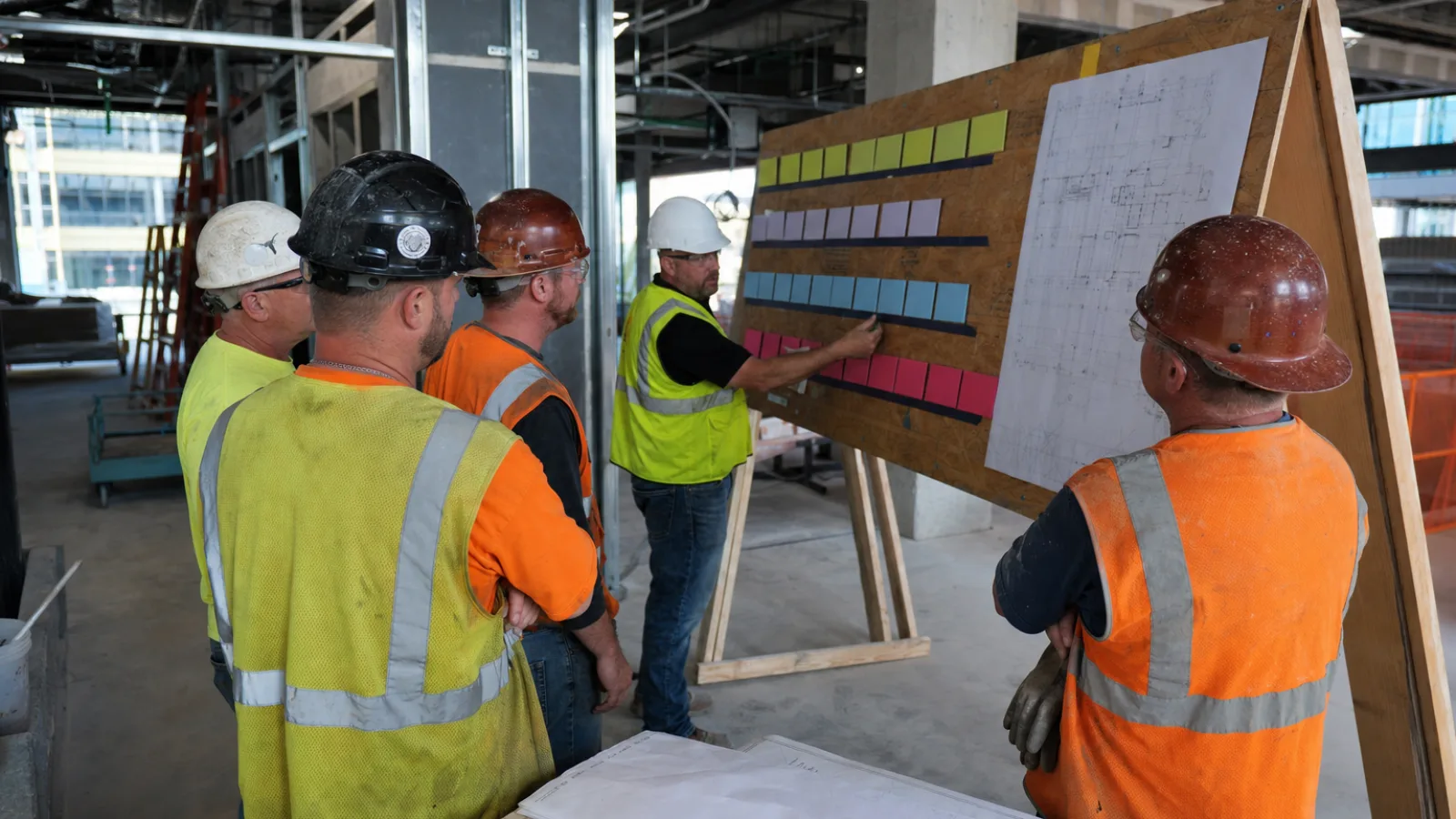
In a pull-planning session, teams may use sticky notes on a wall or a digital planning board. Each note represents a defined piece of work or handoff. Moving backward from the target can expose missing predecessors, unrealistic overlaps, late design decisions, and dependencies that are not visible in a high-level schedule. The value comes from the conversation and the agreed logic, not from the format of the notes.
Lookahead planning
Lookahead planning examines a rolling range of upcoming work, commonly three to six weeks, although the appropriate horizon depends on procurement lead times, design release cycles, project complexity, and trade needs. It is a planning range, not an inflexible rule.
The team screens upcoming activities for readiness. An activity that appears on the master schedule may still require approved information, materials, access, predecessor completion, permits, equipment, labor, or an inspection plan. The lookahead process identifies those conditions early enough for someone to remove them.
Weekly work planning
Ready tasks move into the weekly work plan as specific commitments. A sound commitment is achievable, clearly defined, measurable, and assigned to an accountable trade or person. “Continue electrical work” is difficult to evaluate. “Install and label conduit in Level 3 west corridor, ready for inspection by Thursday” is more useful because it defines location, scope, and completion condition.
Weekly work planning is not an opportunity to fill the board with every possible activity. It is a commitment plan made from work that has passed the team’s readiness test.
Constraint Removal: Turning Planned Work Into Ready Work
A constraint is a condition that prevents a planned activity from starting or finishing as intended. Common examples include incomplete design information, missing materials, access conflicts, required inspections, unavailable equipment, permits, unfinished predecessor work, or insufficient labor.
Identifying a constraint is only the first step. Effective constraint removal assigns a responsible party, a needed-by date, and a visible status. That converts a general concern into a management action.
| Constraint | Example | Responsible party | Needed-by date | Status |
|---|---|---|---|---|
| Design information | Approved detail required for wall penetration | Design manager | Before fabrication release | Open |
| Material | Fire-rated doors not delivered to Level 2 | Trade contractor | Before installation week | In transit |
| Access | Lift access conflicts with façade work | Site superintendent | Before mobilization | Coordination needed |
| Inspection | Electrical rough-in inspection required | Electrical foreperson | Before concealment | Requested |
Unresolved constraints should be escalated early rather than hidden inside the weekly plan. Including work that is known to be blocked creates a misleading promise and reduces trust in the planning process. Escalation may involve a design decision, procurement intervention, access change, revised sequence, or management decision about available resources.
How Weekly LPS Meetings Improve Workflow Reliability
A practical weekly meeting should be short enough to maintain field participation and focused enough to produce decisions. A typical sequence is:
- Review the previous week’s commitments.
- Record completed and incomplete work.
- Calculate Percent Plan Complete.
- Discuss reasons for variance without blame.
- Confirm constraints affecting upcoming work.
- Make new weekly commitments from ready tasks.
- Identify broader coordination or escalation needs.
Participants should include the superintendent or construction manager, relevant project managers and planners, and the trade forepersons or representatives who control the work. Trade participation matters because the people doing the work know whether an area is accessible, whether a crew can complete the promised quantity, and whether a handoff is genuinely ready.
The meeting should not become a reading of the entire master schedule. Its focus is commitments, readiness, handoffs, variance reasons, and problem-solving. Detailed schedule analysis, design reviews, and safety discussions may require separate forums, even though their outcomes can create or remove constraints.
Percent Plan Complete: Measuring Reliability, Not Productivity
Percent Plan Complete, or PPC, measures the proportion of planned assignments completed as promised. The formula is:
PPC = completed planned assignments divided by total planned assignments, multiplied by 100
PPC is a reliability measure. It does not directly measure worker productivity, installation speed, quality, profitability, or total project progress. A high result can coexist with poor productivity if commitments were too small, and a low result may reflect external constraints rather than poor effort.
Teams should record why commitments were missed. Useful categories include prerequisite work not finished, material delay, design change, inspection issue, equipment problem, weather, access conflict, or labor availability. The categories should be specific enough to reveal recurring system problems.
| Planned commitments | Completed as promised | PPC | What the result suggests |
|---|---|---|---|
| 10 | 8 | 80% | Two commitments require review; recurring causes matter more than the percentage alone. |
| 12 | 12 | 100% | All commitments were completed as defined; check that commitments were sufficiently meaningful and realistic. |
| 9 | 6 | 67% | Investigate whether readiness screening, constraints, or external changes affected the plan. |
These figures are illustrative, not industry statistics or universal targets. Trend analysis is more useful than treating one week’s PPC as a pass-or-fail grade. A team should examine whether performance is becoming more consistent and whether the same variance reasons recur. PPC is most valuable when it starts a discussion about improving the planning system.
A Practical Implementation Process for Construction Teams
Start with one phase or work area
Pilot LPS where handoffs and workflow uncertainty are visible—for example, a building zone with several mechanical, electrical, architectural, and inspection interfaces. Starting with one phase makes it easier to establish habits, clarify roles, and demonstrate how constraint removal affects weekly work.
Define commitments consistently
Write each commitment with a clear scope, location, prerequisite, accountable party, and completion condition. If a task cannot be measured or understood by the next trade, it is probably too broad. Break it into a useful unit of work without creating unnecessary administrative detail.
Establish a constraint log
Use a shared log with the constraint description, owner, needed-by date, current status, and escalation rule. Review open items before they affect the weekly plan. A constraint that has no owner is usually only a concern, not an active removal plan.
Standardize the weekly review
Use the same sequence each week: commitments, completion, PPC, variance reasons, constraints, new promises, and corrective actions. Consistency allows the team to distinguish a one-time disruption from a recurring planning weakness.
Expand without creating meeting overload
As the process grows, keep trade-level participation where decisions are made. Use a common structure and shared information, but avoid requiring every person to attend every discussion. Separate phase planning, lookahead review, weekly commitment meetings, and detailed technical coordination when their participants and purposes differ.
Common Last Planner System Mistakes to Avoid
- Treating LPS as a revised lookahead schedule only. LPS includes commitments, feedback, and learning—not just a shorter schedule.
- Allowing managers to dictate commitments without trade input. A promise is more reliable when the accountable party helps define it.
- Adding activities that are not ready. A long weekly plan is not useful if it contains known blockers.
- Measuring PPC without recording variance reasons. The percentage alone does not explain what needs to change.
- Using PPC to blame trades or manipulate reporting. This encourages under-committing and hides information.
- Failing to close the loop on constraints. Repeated open items indicate that ownership or escalation is ineffective.
- Making the process too complex for field adoption. If the system takes more effort than it returns, participation will decline.
- Confusing a full activity list with a reliable weekly plan. The weekly plan should contain ready, executable work.
Last Planner System Compared With Traditional Scheduling
| Planning characteristic | Traditional schedule-only approach | Last Planner System approach |
|---|---|---|
| Planning ownership | Often driven mainly by schedulers and project management. | Shared with the people closest to the work. |
| Level of detail | Activities may be detailed in the schedule but disconnected from field readiness. | Weekly commitments are defined at a practical, executable level. |
| Constraint treatment | Constraints may appear as notes, risks, or late impacts. | Constraints receive owners, needed-by dates, statuses, and escalation. |
| Weekly commitments | Planned dates may be treated as assignments regardless of readiness. | Only ready work is converted into accountable promises. |
| Feedback | Progress updates often focus on dates and percentages complete. | Teams review completed promises and reasons for variance. |
| Performance learning | Lessons may be captured after major delays or at project closeout. | Recurring causes are discussed weekly and used to improve planning. |
LPS works alongside CPM schedules, pull planning, daily coordination, BIM coordination, procurement tracking, and digital construction-management platforms. It does not automatically replace those systems. Its role is to connect higher-level plans with reliable field execution and continuous learning.
Focused FAQ
What does the Last Planner System mean in construction?
It means a collaborative planning system in which the people closest to the work help identify ready activities, make reliable weekly commitments, remove constraints, and learn from completed or missed promises.
Who is the “last planner” on a construction project?
The last planner is the person who can make or influence a reliable commitment for a specific piece of work. This is often a trade foreperson or general foreman, but the role can vary by activity and project organization.
What is a good PPC target for a project?
There is no universal PPC target that applies to every project or phase. Teams should establish a baseline, improve consistency, and investigate recurring reasons for missed commitments. The purpose is to improve workflow reliability, not to create a number that encourages under-commitment.
Is the Last Planner System the same as a lookahead schedule?
No. Lookahead planning is one part of LPS. It screens upcoming work for readiness and constraints. LPS also includes milestone and phase planning, weekly commitments, PPC review, variance analysis, and corrective action.
Can small contractors use the Last Planner System?
Yes. A small contractor can use a simple wall board, constraint list, and weekly review. The process does not require complex software. The essential practices are clear commitments, visible blockers, accountable owners, and honest learning from results.
Conclusion
The Last Planner System improves workflow reliability by connecting milestone planning, phase pull planning, lookahead screening, constraint removal, weekly commitments, and PPC review into a learning loop. It shifts attention from whether an activity appears on a schedule to whether the conditions exist for the work to be completed as promised.
For a practical start, choose one phase or work area, involve the people doing the work, define commitments precisely, and track constraints through closure. Use missed commitments to improve sequencing, readiness checks, and coordination—not to assign blame. Over time, that discipline can make the project’s plans more credible at the point where they matter most: the field.