Inside the Gateway Megaproject: TBM Tunneling, a Bridge Cutover and a 9-Day Tunnel Rebuild
Gateway is being delivered through a sequence of tightly controlled construction windows: a tunnel boring machine advances beneath the Hudson, Portal North Bridge moves toward final cutover, and Amtrak rebuilds a critical interlocking during one concentrated outage.
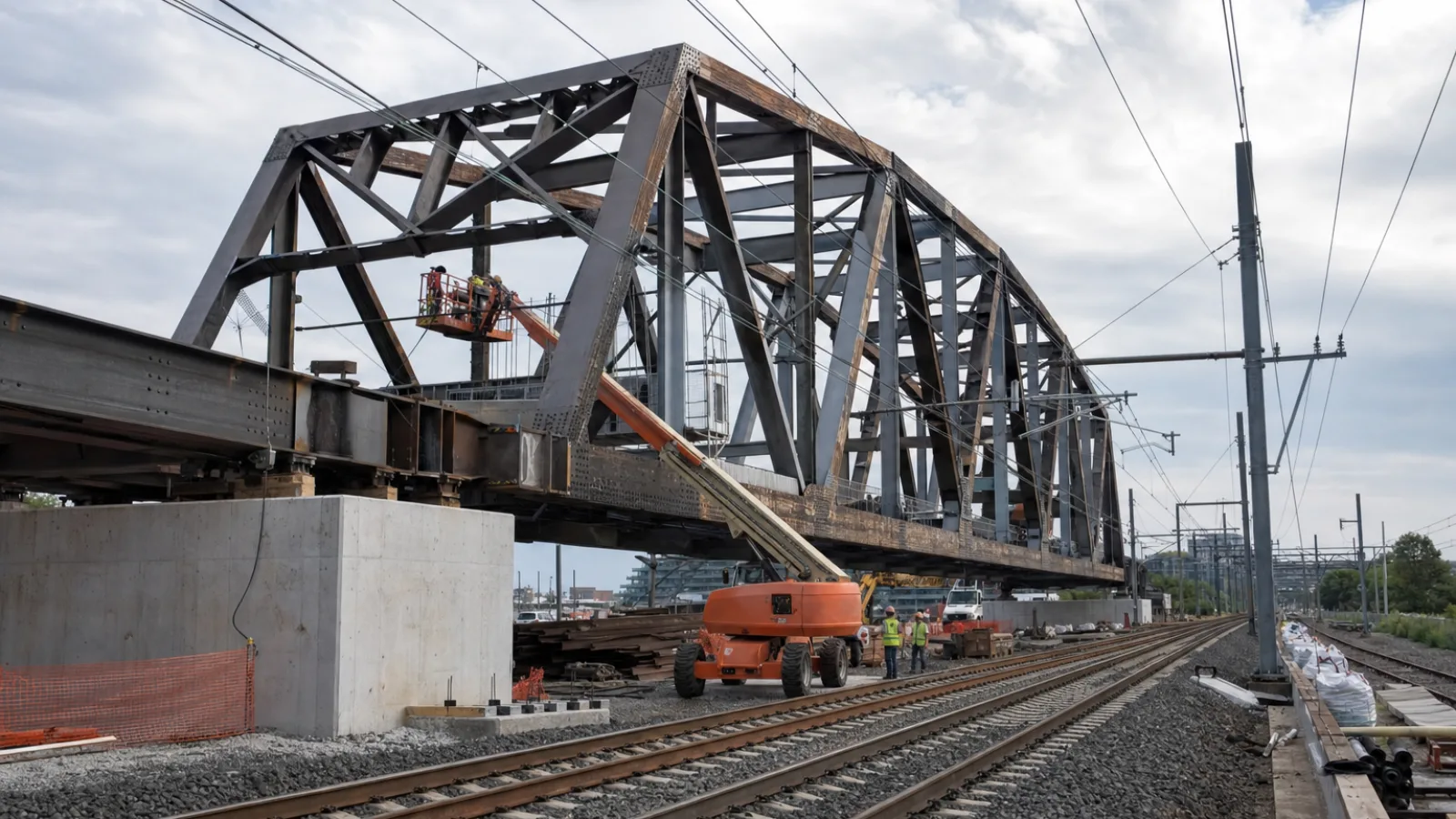
The Gateway megaproject is advancing through three different kinds of construction problem at once: excavating a new rail tunnel beneath the Hudson River, transferring trains onto a new high-level bridge, and rebuilding a complex interlocking during a tightly bounded service outage. Each requires a different delivery strategy, but all depend on the same discipline: complete as much work as possible before the operating window begins, then make the final connection with very little tolerance for delay.
On the Hudson Tunnel Project, the first tunnel boring machine is advancing at approximately 30 feet per day through an initial 5,100-foot segment, according to project information. The new tunnel is expected to open in 2035. At the same time, the Portal North Bridge has entered its final construction phase, while Amtrak completed a nine-day reconstruction of the A interlocking south of Washington Union Station on October 26. A contemporaneous infrastructure update on the Gateway work and A interlocking outage places these activities in the wider program context.
Key takeaways
- The Hudson Tunnel Project uses a tunnel boring machine to create a controlled underground excavation while installing a permanent segmental lining behind the cutter head.
- Portal North Bridge is not simply a bridge replacement. Its value depends on the cutover sequence that transfers active rail operations from the existing structure to the new one.
- A short, concentrated rail outage can be safer and more predictable than repeated smaller possessions when the work involves one connected interlocking system.
- Construction schedules are built around interfaces: tunnel portals, track geometry, signals, power, drainage, communications and testing must all align before service can resume.
Why the Hudson Tunnel Project needs a TBM
A tunnel boring machine is a purpose-built underground factory. At the front, a rotating cutter head breaks and removes soil or rock. Material is carried away through the machine, while hydraulic systems push the machine forward against the completed lining. Behind the cutter head, crews install precast concrete segments to form a circular structural ring.
That sequence is important in a dense rail corridor. A TBM limits the amount of ground exposed at any one time and allows excavation, spoil removal and lining installation to proceed as a continuous operation. It also reduces the need to open a long surface excavation through developed land, active tracks and transportation infrastructure.
The machine does not eliminate geotechnical risk. Operators must manage ground pressure, groundwater, settlement, cutter wear, spoil handling and the transition between different soil conditions. The machine’s performance is therefore measured not only by advance rate, but also by whether it maintains the specified alignment, protects surrounding assets and produces a stable tunnel profile.
What the reported advance rate means
An advance rate of about 30 feet per day is a production measure, not a promise that every calendar day will generate the same distance. A tunneling shift may include excavation, ring installation, maintenance, survey checks, material changes and planned stoppages. Initial drives can also include commissioning and calibration activities.
The initial 5,100-foot segment gives the project team a defined section in which to establish operating data. That information can be used to refine logistics, maintenance intervals, ground-control procedures and the supply of lining segments. In a major rail tunnel, predictable production is generally more valuable than a temporarily higher speed that creates downstream quality or safety problems.
Portal North Bridge: the cutover is the critical operation
Portal North Bridge is a new rail bridge within the Gateway program. Its construction is being delivered beside an operating railroad, which changes the engineering challenge. The bridge must be built to the required alignment and clearance while existing tracks continue to carry trains until the replacement route is ready.
The final construction phase culminates in a cutover. In practical terms, a cutover is the controlled transfer of service from the old configuration to the new one. It can include track connections, overhead power adjustments, signal and communications changes, protection-system testing, removal of temporary works and inspections before trains are permitted to use the new route.
Bridge cutovers are planned backward from the first safe train movement. Designers identify every physical and systems interface, while contractors preassemble components wherever possible. Track panels, signal equipment, power assemblies and connection details may be prepared in advance so that the possession is used for final installation rather than fabrication.
Why bridge work is more than steel and concrete
The bridge structure is only one part of the operating system. Rail infrastructure engineering must also account for track geometry, thermal movement, expansion joints, drainage, traction power, signal sighting, emergency access and the effect of construction tolerances on the track above the bridge.
The old and new alignments may be close in plan but different in elevation or curvature. That makes the transition zone especially important. A train does not experience the bridge as an isolated object; it experiences a continuous route. The approach tracks and their interfaces must therefore be surveyed, adjusted and tested as part of the cutover.
How a nine-day interlocking reconstruction is planned
An interlocking is the combination of track, switches, signals and control logic that prevents conflicting train movements. Rebuilding one is a systems project, not simply a track replacement. The A interlocking reconstruction south of Washington Union Station was completed by Amtrak after a nine-day outage that ended on October 26.
During an outage, crews can remove existing track and switch equipment, install new components, modify signal and power systems, complete wiring and perform integrated tests without trains occupying the work area. The work still has to be planned around the railway’s operating rules: a track is not returned to service merely because construction appears complete. It must be inspected, tested and formally released.
| Method | Why it is chosen | Primary risk |
|---|---|---|
| Tunnel boring machine | Provides a continuous, controlled excavation and supports installation of a permanent lining in constrained urban and river-crossing conditions. | Ground behavior, groundwater, equipment failure or settlement can reduce production and affect nearby assets. |
| New bridge beside an operating route, followed by a cutover | Allows much of the replacement structure to be built before service is transferred, reducing the time trains are exposed to construction. | Track, power, signal and structural interfaces may not align during the possession, delaying the return to service. |
| One concentrated interlocking outage | Creates uninterrupted access to a connected system and avoids repeatedly dismantling, testing and recommissioning the same railway territory. | A missed task or failed test can extend the outage and cause wider network disruption. |
| Phased reconstruction under partial service | Maintains some train movements while work proceeds in smaller stages. | More temporary configurations, protection arrangements and repeated changeovers increase interface complexity. |
Why Amtrak used one outage instead of several phases
The choice between a single outage and phased construction is not determined by duration alone. It depends on the topology of the interlocking, the number of usable tracks, the ability to isolate equipment safely and the extent to which new and old systems must be tested together.
For a connected interlocking, one outage can offer four practical advantages. First, crews have continuous access to the entire work zone. Second, switches, signal logic and track circuits can be tested as one system rather than in a series of temporary states. Third, the railroad avoids repeated transitions between partially rebuilt configurations. Fourth, materials, specialized crews and testing staff can be concentrated in one possession.
The trade-off is exposure: if a critical component arrives late, an installation takes longer than planned or a test fails, the recovery margin can disappear quickly. That is why short-outage work is normally preceded by design reviews, field surveys, procurement checks, work-package sequencing, contingency plans and a detailed reopening checklist.
The outage planning logic
- Define the operating limit. Establish exactly which tracks, switches, signals and power sections can be taken out of service.
- Freeze the design. Resolve constructability issues before the possession, including cable routes, access, drainage and equipment foundations.
- Pre-stage work. Deliver materials, tools and replacement assemblies near the work area without obstructing emergency routes or the live railroad.
- Sequence by dependency. Remove old assets before installing new ones, then connect power, communications and control systems in a logical order.
- Test before reopening. Conduct electrical, signal, switch-operation, track and route tests, followed by inspection and operating-authority release.
The common engineering problem: interfaces
The tunnel, bridge and interlocking are different assets, but their delivery risks are similar. Each has interfaces that can control the schedule. A tunnel portal must connect to surface track and systems. A bridge must connect to approach track, traction power and signals. An interlocking must communicate correctly with adjacent control territories.
Interface management is therefore a central business issue as well as a technical one. A delay in one package can strand labor, equipment or commissioning staff in another. Owners and contractors typically reduce that risk through interface registers, responsibility matrices, integrated schedules, design hold points and formal readiness reviews.
For investors, public agencies and passengers, the practical lesson is that headline construction progress does not necessarily equal operational readiness. A bridge may be structurally complete but unavailable until track and signal testing is finished. A tunnel drive may be advancing steadily while portal works, systems installation and emergency-access requirements remain on the critical path.
What the Gateway sequence means for delivery
The Gateway program illustrates why major rail projects are delivered in stages rather than as one uninterrupted construction activity. TBM excavation creates the underground asset. Bridge construction adds capacity and resilience at a vulnerable crossing. Interlocking reconstruction renews the control layer that allows trains to move through the corridor.
Each stage has a different productivity metric: feet advanced, structure completed, equipment installed or tests passed. The final measure, however, is integrated railway performance. The assets must connect physically, operate safely and be maintainable without creating another unacceptable disruption.
Frequently asked questions
What is the Hudson Tunnel Project?
It is the Gateway program component that will provide a new rail tunnel beneath the Hudson River, supporting additional and more resilient rail capacity between New Jersey and New York. The project is expected to open in 2035.
How does a tunnel boring machine install the tunnel lining?
After the cutter head excavates material, the machine advances and crews install precast concrete segments behind it. The segments form a ring that supports the ground and creates the tunnel’s permanent structural enclosure.
What is a rail cutover?
A cutover is the controlled transfer from an existing rail configuration to a new one. It may involve track, switches, signals, power, communications, testing and operating-authority approval.
Why not rebuild an interlocking in several smaller outages?
Phasing can preserve limited service, but it may require more temporary track and signal arrangements and repeated recommissioning. A single outage can be preferable when the work is tightly connected and the railroad can manage the temporary loss of capacity.
Does the TBM advance rate determine the tunnel opening date?
No. Excavation is one major activity, but tunnel completion also depends on lining, portals, track, power, signals, ventilation, emergency systems, testing and approvals.
Sources
- Gateway Development Commission, Hudson Tunnel Project project overview and construction information.
- Gateway Development Commission, Portal North Bridge project information.
- Amtrak, information on the A interlocking reconstruction and Northeast Corridor infrastructure work.
- Amtrak, Northeast Corridor infrastructure and capital program information.
How to verify these figures yourself
Check the Gateway Development Commission’s current Hudson Tunnel Project and Portal North Bridge project pages for the reported 5,100-foot segment, approximate 30-foot-per-day advance and 2035 opening target. Check Amtrak’s project notices or infrastructure updates for the A interlocking outage completion date and scope. Project figures can change as designs, schedules and field conditions develop.