Tunnels in Modern Infrastructure: Structure, Challenges, Innovations, and Strategic Value
A deep analysis of modern tunnel construction, covering the engineering complexities, project challenges, technological innovations, and long-term strategic value of underground infrastructure for developers and investors.
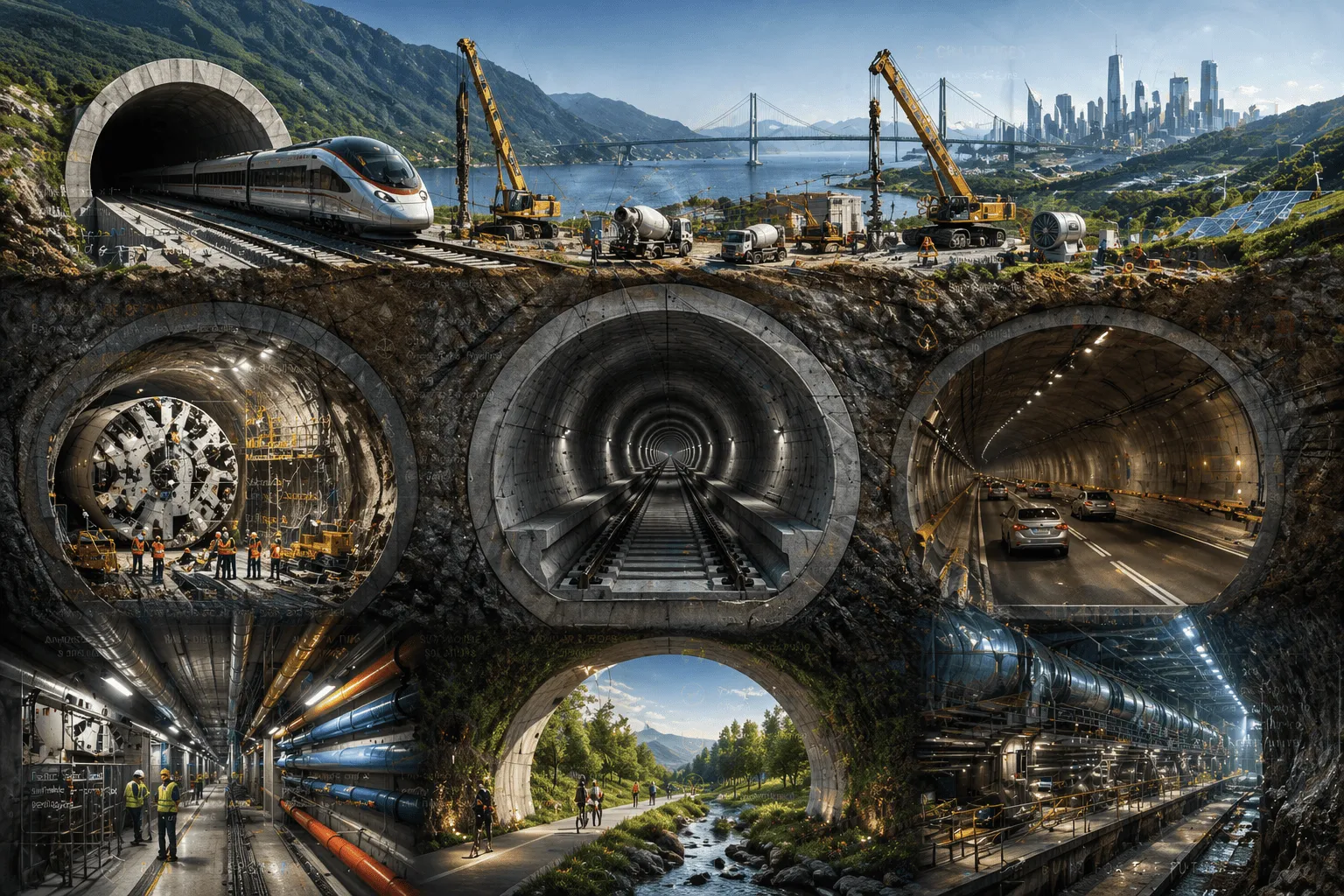
Mega-projects like the Brenner Base Tunnel or London's Crossrail capture public imagination, but for engineers and investors, they represent the pinnacle of complexity and financial risk. Modern tunnel construction is far more than excavation; it is a multi-billion-dollar orchestration of geotechnical science, structural engineering, and advanced logistics where a single geological anomaly can derail timelines and budgets. This article provides a professional analysis of the discipline, moving beyond surface-level descriptions to explore the strategic value, technical challenges, and innovations defining today's underground infrastructure.
The Strategic Importance of Tunnel Construction
Tunnels are fundamental strategic assets that reshape economies and urban landscapes. Their primary role is in creating high-capacity transportation corridors—metros, highways, and high-speed rail—that operate independently of surface-level constraints. By moving transit networks underground, we unlock immense value in urban centers.
This approach directly addresses urban congestion, freeing valuable surface land for commercial, residential, or green space development. The environmental and land-use benefits are significant. Tunneling avoids the disruptive and often politically contentious process of acquiring surface properties, preserving historical districts and natural landscapes.
Economically, the impact is profound. Tunnels connect major economic hubs, drastically reducing travel and logistics times. This enhanced connectivity acts as a powerful catalyst for regional growth, making areas more attractive for investment and creating a lasting return that far outweighs the initial capital expenditure.
Tunnel Structure and Engineering Design
A tunnel is an integrated system designed to safely transfer immense geological loads for a service life often exceeding 100 years. The core of any tunnel design is a deep understanding of the ground it passes through. Comprehensive geotechnical investigations are non-negotiable, as they dictate everything from the excavation method to the final support system.
Key components include:
- Lining and Support Systems: In TBM tunneling, precast concrete segments form a watertight, structural ring. In conventional methods like the New Austrian Tunneling Method (NATM), the primary support comes from shotcrete and rock bolts, mobilizing the surrounding rock mass to support itself.
- Waterproofing: This is critical for long-term durability. It involves high-performance gaskets between segments, spray-applied membranes, or PVC sheets designed to prevent water ingress, which can cause structural degradation and operational disruptions.
- Ventilation and Safety Systems: Modern tunnel design incorporates complex systems for air quality control and fire life safety. This includes longitudinal jet fans or transverse duct systems, emergency egress routes, and fire suppression technology, all engineered to protect users and the structure itself.
Structural stability is paramount. The design must account for overburden pressures, seismic activity, and groundwater forces. Every element is engineered to ensure the tunnel remains a safe, serviceable asset for generations.
Effort and Complexity in Tunnel Construction
The scale of a major tunnel construction project is immense, demanding flawless coordination across multiple engineering disciplines. The choice of excavation method is a primary driver of project logistics, cost, and timeline. Two dominant approaches define modern tunneling.
TBM Tunneling utilizes Tunnel Boring Machines—essentially mobile factories that excavate, remove spoil, and install the permanent lining in a continuous cycle. Earth Pressure Balance (EPB) and Slurry shields are selected based on ground conditions, managing face stability in soft soils and under high water pressure. A TBM operation is a 24/7 logistical feat requiring precise management of segment delivery, muck removal, and system maintenance.
Drill and Blast methods offer greater flexibility for variable rock conditions and non-circular profiles. This cyclical process involves drilling blast holes, loading explosives, detonation, removing the blasted rock (mucking), and installing primary ground support. While slower than TBMs in uniform geology, it remains essential for complex intersections, caverns, and short tunnel drives.
Executing these large infrastructure projects requires managing thousands of personnel and multi-billion-dollar budgets over several years. Success hinges on mitigating geological and logistical risks, where sourcing the right equipment is critical. Investing in advanced tunneling technology solutions is not just a capital expense but a strategic decision to control project outcomes, enhance safety, and ensure schedule adherence.
Challenges and Obstacles in Tunnel Projects
Despite meticulous planning, underground construction is fraught with inherent risks. The single greatest challenge is geological uncertainty. No matter how extensive the investigation, the ground can always present surprises, from unexpected fault zones and abrasive rock to mixed-face conditions that can damage or trap a TBM.
Groundwater poses a constant threat. Managing high-pressure water ingress requires specialized techniques like dewatering, ground freezing, or high-pressure grouting. In urban environments, uncontrolled water flow can lead to ground settlement, damaging nearby buildings and infrastructure.
These technical challenges are the primary drivers of cost overruns and delays, which plague many high-profile infrastructure projects. An unforeseen geological issue can halt progress for months, leading to cascading financial impacts. Safety risks, including collapses and water inundation, are ever-present and demand rigorous safety protocols and real-time monitoring.
Furthermore, urban constraints add another layer of complexity. Working beneath active cities requires managing noise and vibration, navigating a web of existing utilities, and minimizing disruption to the public—all of which place tight constraints on construction methods and working hours.
Modern Developments and Innovations
The field of tunnel engineering is continuously evolving to meet these challenges. Technology is at the forefront of this transformation, enhancing efficiency, safety, and predictability.
The evolution of TBM technology is a key driver. Variable density TBMs can now adapt on-the-fly to changing ground, transitioning between EPB and slurry modes. Innovations in cutterhead design and automated wear detection systems reduce downtime for maintenance, which is one of the most time-consuming aspects of TBM operations.
Automation and robotics are increasingly integrated into the construction cycle. Automated systems for placing concrete lining segments and robotic arms for installing rock bolts reduce human exposure to hazardous areas and improve installation quality. Remote operation of major equipment is becoming standard practice.
Digital monitoring has revolutionized risk management. Fiber optic sensors embedded in the tunnel lining provide real-time data on strain and temperature, offering a complete health profile of the structure. This data, combined with BIM (Building Information Modeling), creates a digital twin for the underground infrastructure, allowing for predictive maintenance and optimized asset management throughout its lifecycle.
Real Examples and Case Studies
Examining past projects offers invaluable lessons in both success and failure.
Gotthard Base Tunnel, Switzerland: A monumental success in tunnel engineering, this 57-kilometer rail tunnel was completed on time and within budget. Its success was rooted in exhaustive geological investigations, which allowed for precise planning. The project used four high-performance TBMs and conventional drilling to attack the alignment from multiple points simultaneously, a strategy that dramatically compressed the construction schedule. It stands as a benchmark for risk management and execution in complex mountainous terrain.
The Big Dig, Boston, USA: In contrast, Boston's Central Artery/Tunnel Project is a case study in the challenges of urban tunneling. The project successfully replaced an elevated highway with a state-of-the-art tunnel, transforming the city. However, it was plagued by massive cost overruns and delays. The difficulties stemmed from working in poor soil conditions, navigating a maze of historic foundations and utilities, and persistent water leaks post-construction. The project highlights how underestimating urban geological complexity and scope creep can severely impact major infrastructure projects.
Long-Term Value and Future of Tunnel Infrastructure
While the upfront investment in tunnel construction is substantial, the long-term value proposition is compelling. The lifecycle cost of a tunnel is often lower than that of surface infrastructure, which requires more frequent and disruptive maintenance. The return on investment extends beyond direct revenue, encompassing unlocked real estate value, reduced congestion costs, and broad economic growth.
Looking ahead, sustainability will drive the next wave of underground development. Tunnels will be essential for creating resilient cities, housing utility corridors, automated freight logistics systems, and water management infrastructure. As cities grow denser, the strategic use of subsurface space will become a defining feature of smart urban planning.
The demand for advanced tunnel engineering will only increase. Future projects will push the boundaries of what is possible, requiring even more sophisticated technology, integrated digital workflows, and a profound understanding of the complex interplay between structure and ground. For developers and engineers, mastering this domain is key to building the infrastructure of tomorrow.