Airbnb vs Long-Term Renting: Which Investment Generates Higher ROI in 2026?
Choosing the right rental strategy is critical for maximizing property investment returns. This data-driven analysis compares the Airbnb vs long-term rental ROI for 2026, breaking down profitability, operational costs, and market risks to guide your decision.
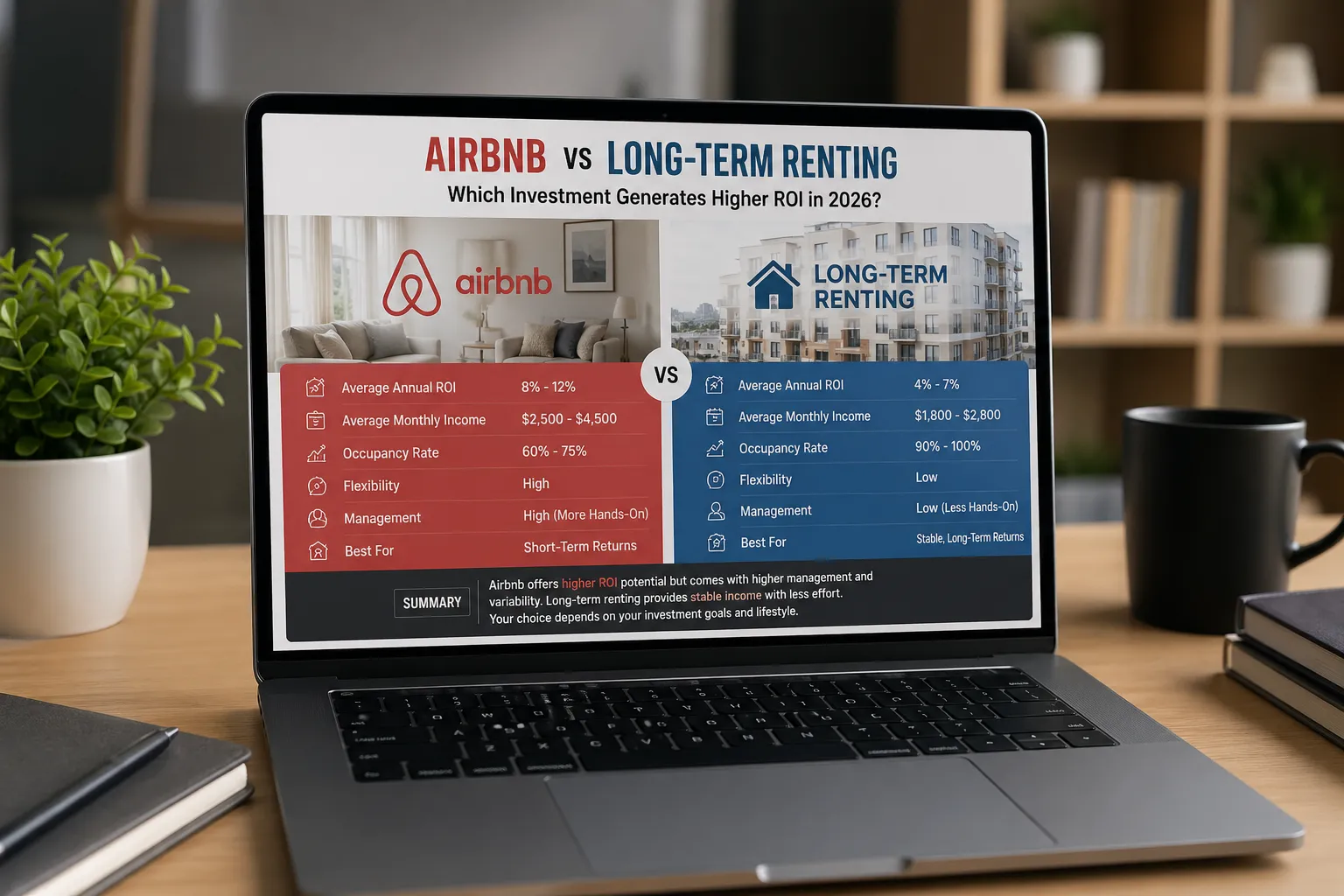
Many property investors leave significant money on the table simply by choosing the wrong rental strategy. A high-potential property in a prime location can underperform financially if its income model is misaligned with the market. The central debate for modern investors is the airbnb vs long term rental ROI—a decision that dictates everything from cash flow to operational workload.
Making this choice based on assumptions rather than data is a direct path to diminished returns. As we look toward 2026, understanding the financial mechanics, risks, and market trends associated with each model is not just advisable; it's essential for strategic success.
The Investment Dilemma: Airbnb vs Long-Term Renting
The core of the dilemma lies in a trade-off between higher potential revenue and greater stability. Investors are often caught between the allure of high nightly rates from short-term rentals (STRs) and the predictable, consistent income from long-term tenants.
Choosing incorrectly can lead to crippling vacancies, unexpected operational costs, or regulatory penalties. An Airbnb in a market saturated with competition and restrictive laws may yield less than a simple long-term lease. Conversely, a long-term rental in a booming tourist hotspot might sacrifice thousands in potential monthly income.
The short-term model, popularized by platforms like Airbnb and Vrbo, involves renting a property for short stays, from one night to a few weeks. The long-term model is the traditional approach: leasing a property to a single tenant for a fixed term, typically six months to a year or more.
How Airbnb Generates Income (Short-Term Model)
The income stream from an Airbnb is dynamic and variable. It is a function of three primary factors: the nightly rate, the occupancy rate, and seasonal demand. Unlike a fixed monthly rent, this model requires active management to optimize pricing and bookings.
Nightly rates can fluctuate dramatically based on holidays, local events, and weekdays versus weekends. A successful host uses dynamic pricing tools to maximize revenue, charging a premium during peak periods. The occupancy rate—the percentage of booked nights—is the most critical metric for success.
However, this higher revenue potential comes with significantly higher operational costs. These include:
- Cleaning Fees: Professional cleaning is required between every guest stay.
- Management Fees: Full-service management can cost 20-30% of gross revenue.
- Platform Fees: Airbnb typically charges hosts a service fee of around 3%.
- Supplies & Utilities: Hosts must furnish the property and cover all utilities, including high-speed internet, toiletries, and coffee.
These expenses directly impact the final short term vs long term rental profitability and must be meticulously tracked.
How Long-Term Rentals Generate Income
The long-term rental model is built on stability. An investor secures a tenant with a legally binding lease, guaranteeing a fixed monthly income for the duration of the contract. This predictability is a cornerstone of traditional real estate investment, making financial forecasting straightforward.
Operational effort is substantially lower. Once a tenant is in place, the landlord's primary responsibilities are handling major maintenance requests and collecting rent. There are no daily turnovers, guest communications, or restocking of supplies. This makes it a more viable option for achieving passive income real estate.
The risks, however, are different. A vacant month between tenants means zero income, whereas an Airbnb might only have a few empty nights. Tenant-related issues, such as late payments, property damage, or costly evictions, pose the greatest financial threat. While screening can mitigate these risks, they are never entirely eliminated.
ROI Comparison: Which Model Performs Better?
To determine which model offers superior property investment returns, we must conduct a direct ROI comparison. The formula remains the same for both: ROI = (Net Annual Income / Total Investment Cost) x 100. The key difference lies in the calculation of Net Annual Income.
For an Airbnb, Net Annual Income is `(Average Nightly Rate x Occupancy Rate x 365) - Total Operating Expenses`. For a long-term rental, it is `(Monthly Rent x 12) - Total Operating Expenses`. The expense categories differ significantly, with STRs carrying higher costs for management, cleaning, insurance, and utilities.
The deciding factor is often location. An urban apartment near a convention center may generate 2-3 times more gross revenue as an Airbnb than as a long-term rental, easily covering the higher costs. Conversely, a suburban home in a quiet school district will likely have stronger, more consistent demand from long-term tenants.
To project short-term rental income with precision, investors should leverage specialized tools. Comprehensive Airbnb data analytics and rental market insights can provide the granular data needed to model occupancy rates and pricing strategies accurately, turning a speculative guess into an informed financial projection. This data-driven approach is fundamental to any serious rental income comparison.
Real Examples and Case Studies
Abstract formulas are useful, but real-world scenarios illustrate the financial divergence between these two strategies.
Scenario 1: A Two-Bedroom Condo in a Coastal Tourist Town
An investor purchases a condo in a popular beach destination. As an Airbnb, the property commands $350/night during the peak summer season (90% occupancy) but drops to $150/night in the off-season (40% occupancy). After factoring in a 25% management fee, cleaning, and higher insurance, the net annual income is approximately $45,000.
The same property leased long-term might fetch a consistent $2,800 per month. After accounting for a 10% management fee, minor maintenance, and potential vacancy, the net annual income is around $29,000. In this case, the Airbnb model provides a significantly higher rental yield, but it comes with the stress of income volatility and reliance on the tourism industry.
Scenario 2: A Three-Bedroom House in a Residential Suburb
Consider a house near good schools and employment centers. As a long-term rental, it secures a stable family tenant at $3,500 per month, netting approximately $36,000 annually after expenses. The demand is consistent, and tenant turnover is low.
As an Airbnb, the same house might struggle to attract guests outside of local events or holidays. With an average nightly rate of $200 and a projected 50% occupancy rate, the gross revenue would be around $36,500. After deducting the much higher STR operational costs (25-35%), the net income would fall well below the long-term rental, making the traditional lease the clear financial winner.
Risks, Regulations, and Market Trends in 2026
The investment landscape is not static. Looking ahead to 2026, several factors will influence the airbnb vs long term rental ROI debate.
- Stricter Regulations: Major cities worldwide are imposing tough restrictions on STRs, including licensing requirements, caps on rental days, and zoning limitations. Investors must perform thorough due diligence on local laws before committing to an Airbnb strategy.
- Taxation Differences: Short-term rental income is often subject to hotel or transient occupancy taxes, adding another layer of cost and complexity not present with long-term rentals.
- Market Saturation: In popular destinations, the explosion of Airbnb listings has increased competition, which can suppress occupancy rates and force hosts to lower prices to stay competitive.
- Changing Traveler Behavior: The rise of remote work has created a new class of traveler seeking month-long stays. This blurs the line between short and long-term, opening opportunities for hybrid models that cater to these “digital nomads.”
Final ROI-Based Recommendation
The optimal choice is not universal; it depends entirely on the property's location, the investor's financial goals, and their tolerance for risk and operational involvement.
Choose the Airbnb (Short-Term) model if:
- Your property is in a high-demand tourist, business, or event destination.
- You have the capacity for active, hands-on management or can afford a professional manager (20%+ fee).
- Your financial strategy can absorb seasonal income fluctuations.
- Local regulations are favorable and stable.
Choose the Long-Term Rental model if:
- You prioritize stable, predictable cash flow and a more passive investment.
- Your property is in a residential area with strong demand from local tenants (e.g., near schools, hospitals, or corporate hubs).
- You have a lower tolerance for risk and prefer minimal operational complexity.
A hybrid strategy can also be effective. For example, leasing a property to a student for nine months and then running it as an Airbnb during the summer break can capture the best of both worlds. Ultimately, the investor who runs the numbers, understands their market, and aligns the strategy with their personal goals is the one who will achieve the highest returns in 2026 and beyond.