Local SEO for Contractors Is Changing in 2026
Local SEO for contractors is evolving in 2026 as AI-powered search changes how homeowners discover roofing and construction companies. Explore practical strategies for Google Business Profile optimization, customer reviews, local citations, structured data, and visibility across ChatGPT, Gemini, Perplexity, and Google AI Overviews.
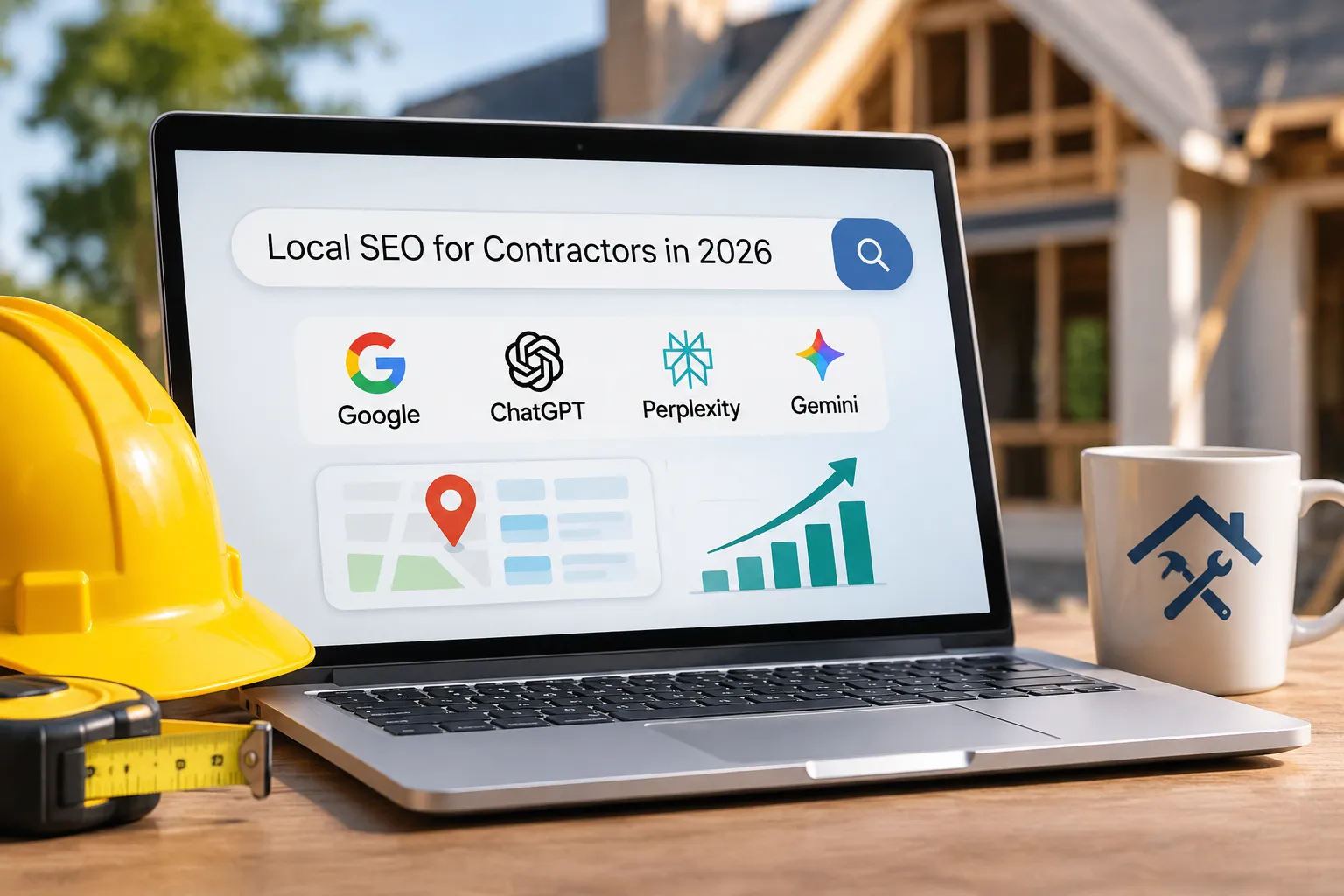
For years, local SEO for contractors meant one thing: rank your Google Business Profile, collect reviews, and show up in the map pack. That's no longer the whole game.
In 2026, a homeowner looking for a roofer asks Google AI Overview, ChatGPT, Perplexity, Claude, or Gemini, and each of these tools decides who's trustworthy using different data, from different sources, weighted in different ways. A contractor who ranks #1 in the traditional map pack can be invisible inside an AI Overview answer, and vice versa.
This shift is the new front door to your business. Let me tell you about it in more detail.
The Big Shift of Local SEO for Contractors in 2026
Search has become layered. Before a homeowner ever scrolls to a list of blue links or a traditional map pack, they hit an AI-generated answer first. That answer names a small handful of contractors, and if you're not one of them, you're skipped entirely.
The tricky part is that "AI search" isn't one system. Google AI Overview, ChatGPT, Perplexity, Claude, and Gemini each pull from different data sources to decide who to mention:
- Google AI Overview leans heavily on your Google Business Profile (GBP) and how the web talks about you.
- ChatGPT, Perplexity, and Claude can't read your GBP at all. They rely almost entirely on third-party platforms like Yelp, BBB, Angi, and Thumbtack.
- Gemini utilizes Google’s massive web index and search infrastructure to look up real-time information, check facts, and find external sources
That means "optimizing for local SEO" in 2026 is several processes run in parallel. The rest of this article breaks down each one.
Optimizing Local Search for Google AI Overview & AI Mode
Google AI Overview (and AI Mode) draws primarily on your Google Business Profile and on how your brand is discussed elsewhere online for queries like "roofer in [city]" and "roofing contractor near me".
Reviews: Context Is What Gets You Cited
Ask homeowners directly for reviews, or make it frictionless with NFC cards. But what makes you more likely to surface in an AI Overview is contextual reviews (reviews that mention specific services, neighborhoods, or project details).

Get the Profile Fundamentals Right
- Set your primary category to your contractor type, which is “Roofing Contractor”.
- Fill out the listing completely: directions, services (stick to what's relevant and to Google-suggested service categories), and service locations.

- Keep your service area realistic. Don't target an entire state; stay within roughly a 2-hour drive of your main location.
- Write your GBP description using the same brand positioning language as your website. Google is cross-referencing the two.
Build the Supporting Structure on Your Own Site
- Maintain dedicated service area pages alongside your service pages. One without the other weakens both.

- Add real project photos! And encourage homeowners to share photos with reviews.

- Link your social profiles for entity signal.

Differentiate And Say It the Same Way Everywhere
Spell out what makes you different from other roofers, and put that positioning on both your website and your GBP description - word-for-word consistent. This is what allows Google's AI to compare you against competitors and come out in your favor.

Claim Your Third-Party Profiles Too
Even though this section is Google-focused, claim your Yelp and BBB profiles. Google AI Overview and AI Mode treats certain sources as credible references: the same Yelp, BBB, magazines, forums, local publications, directories, and listicle content like "best roofers in [city]." If your business isn't mentioned in that layer of content, it's harder for AI Overview to validate you. Google AI Overview also factors in outside validation.

Optimizing for ChatGPT, Perplexity & Claude
This fact changes everything about how you think about this: your Google Business Profile is invisible to ChatGPT, Perplexity, and Claude. Google's own AI is the only one that reads it. These other systems buy data feeds and read other people's pages - Yelp, BBB, Angi, Thumbtack, and "10 best contractors in [city]" articles.
Third-Party Profiles Are Your Real Homepage Now
- Build out strong BBB and Yelp profiles - a sponsored listing on either is worth considering.
- Make sure both profiles are complete: phone number, services, address, and, most importantly, contextual reviews (not only star ratings).

- Show up on the directory sites AI models cite as sources - sites like HomeAdvisor, Angi, and niche players such as findtrustedroofers.com. If your competitors are listed and you're not, the AI has no reason to know you exist.

- Get your business named in listicle-style content ("best roofing contractors in [city]").
Make Your Own Website Earn Its Place
Your site plays a different, but important role here. It needs to be easy to read and needs to say something your competitors genuinely don't. Generic contractor-site copy won’t survive AI summarization, so you need a completely differentiated content.
ChatGPT's Map Layer Runs on Mapbox (Not Google)
ChatGPT's map data comes from Mapbox, not Google Maps. There's a public contribute portal at labs.mapbox.com/contribute where you can help ensure your business location and details are accurate in that system.

Technical Signals That Make You "Readable" to LLMs
- Zip codes: List your business and service-area zip codes on your website and in every directory listing description.

- Schema markup: Implement sameAs schema linking your website to your GBP, Yelp, BBB, Facebook, and manufacturer listings, plus LocalBusiness/RoofingContractor, areaServed, aggregateRating, and FAQPage schema.
- llms.txt file: A small (1-5 KB max) file that can give AI crawlers a clean summary of who you are and what you offer. There is no evidence that LLMs.txt affects AI answers, but it's better to have it.
- Concrete numbers: AI models extract specifics - years in business, number of roofs completed, square footage covered, response time - and skip vague marketing language entirely.
Don't Ignore Community Platforms
Reddit and Nextdoor threads get pulled into AI answers too. Being mentioned favorably in local community discussions carries real weight.

NAP Consistency Still Matters, Arguably More Now
Name, address, and phone number need to match exactly across every platform. Clean up duplicate listings because conflicting NAP data confuses both traditional search and AI retrieval.
Review Recency Over Review Volume
A 4.9-star profile with the most recent review from 15 months ago suggests a business that may no longer be active. Freshness and owner responses to reviews are signals that the business is alive and engaged.

Checkable Trust Facts
State your license number, insurance and bonding status, warranty length, and years in business as plain text on your site. These are the kinds of verifiable facts AI models look for when deciding whether a business is legitimate enough to recommend.
Optimizing for Gemini
Gemini doesn't mirror Google Search's citation behavior, and it doesn't mirror ChatGPT's either - it has its own source preferences, and the split by platform is stark:
|
Platform |
#1 Cited Source |
#2 Cited Source |
|
Google AI Mode |
Yelp (72.5% share, 6.5× Angi) |
Angi |
|
Perplexity |
Yelp (62.1% share, 4.9× lead) |
Angi |
|
ChatGPT |
BBB (68.6k citations) |
Angi (44.4k), Yelp only ranks 3rd |
|
Gemini |
Angi (18.9k citations) |
Yelp is basically absent (49 citations) |
So, the main takeaway is that Yelp dominates Google AI Mode and Perplexity, BBB dominates ChatGPT, and Gemini favors Angi.
For Gemini specifically, that means:
- Prioritize a fully built-out Angi profile - this is disproportionately important for Gemini visibility in a way it isn't for the other platforms.
- Don't assume that because you're strong on Yelp, you're covered across all AI search. Gemini is largely not reading Yelp.
- Keep the same core hygiene consistent here too: NAP accuracy, concrete numbers, license/insurance facts, and recent reviews - Gemini rewards the same trust signals, just sourced from a different platform mix.
The Bottom Line
Local SEO in 2026 has changed in a way that needs you to optimize for at least five overlapping discoveries. Google AI Overview reads your GBP. ChatGPT, Perplexity, and Claude read Yelp, BBB, Angi, and third-party directories. Gemini reads a source mix almost nobody is currently optimizing for.
The contractors who win visibility this year and later won't be the ones who "do SEO" in the old sense. They'll be the ones treating every platform - GBP, Yelp, BBB, Angi, their own website, even Mapbox - as its own surface that needs to be complete, current, and consistently telling the same story about who they are and why they're the better choice.