Smart Construction With Digital Twins: A Global Comparison of Heathrow, Crossrail, Singapore, and Smart Hospitals
Construction digital twins connect BIM, asset information, sensors, and operational systems to support better decisions before, during, and after construction. This comparison examines how airports, rail infrastructure, smart-city programs, and hospitals apply digital engineering differently, while highlighting governance, data, and implementation requirements.
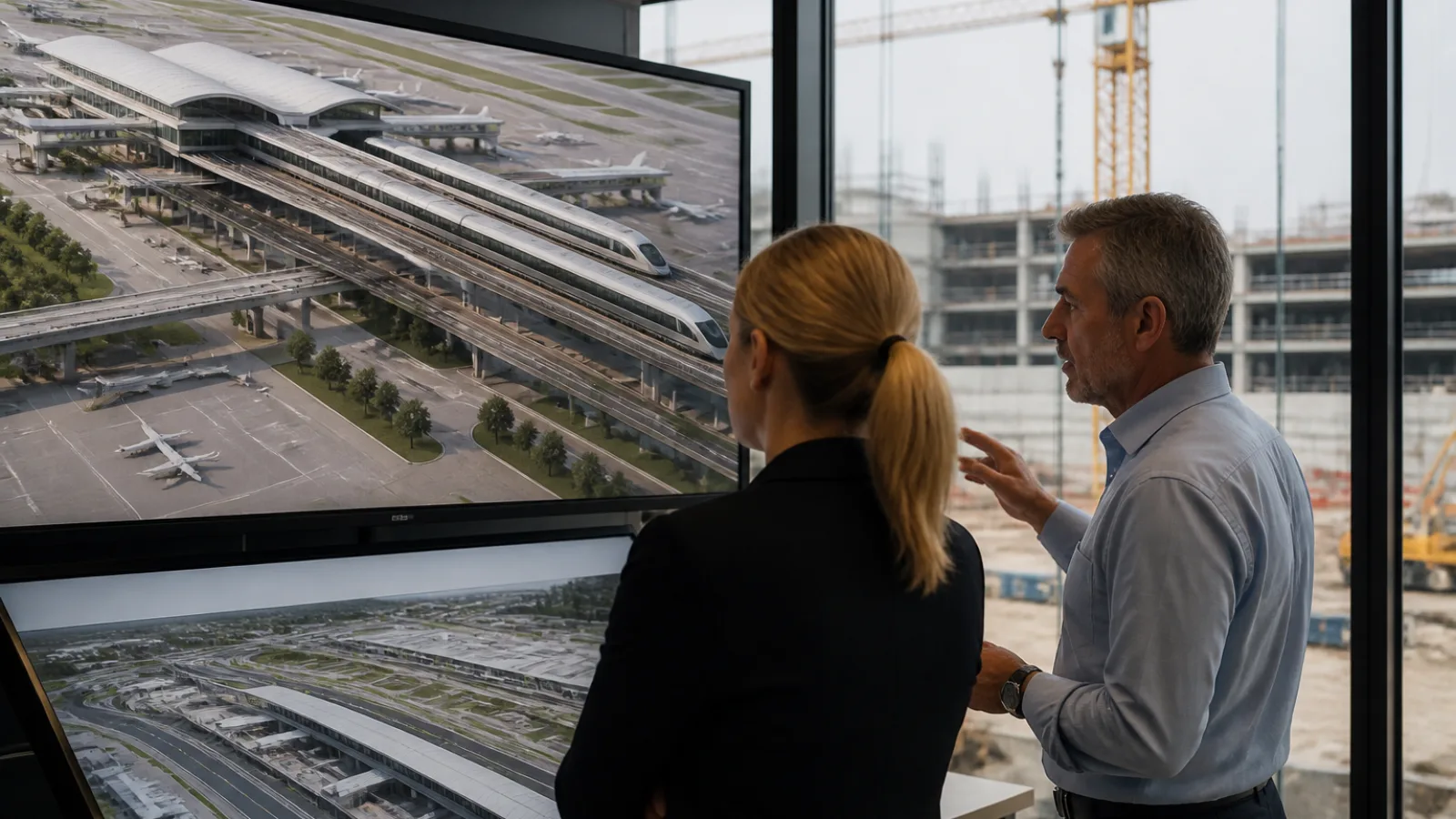
Construction digital twins are changing how owners, designers, contractors, and facility teams understand complex assets. By connecting digital engineering information with physical conditions, project teams can test decisions virtually, coordinate work more effectively, and continue using reliable asset information after handover. The operational layer may also connect asset information, maintenance workflows, and live performance data through systems such as the IBM Maximo asset management platform.
A digital twin is not simply a photorealistic model or a marketing label for a 3D environment. Its value depends on maintaining useful information, linking it to the asset or process it represents, and making that information available for specific decisions. Heathrow Airport, Crossrail, Singapore’s Smart Nation initiatives, and smart hospitals illustrate different levels and forms of digital twin maturity rather than four identical, fully integrated platforms.
What Are Construction Digital Twins?
A construction digital twin is a maintained digital representation of a physical asset, project, process, or operational environment. It can include geometry, specifications, schedules, asset identifiers, installation records, commissioning data, sensor readings, maintenance history, and spatial relationships. The representation becomes more valuable when information is updated over time and used to compare planned, installed, and operating conditions.
For a building, the twin may represent rooms, building-services equipment, access systems, occupancy conditions, energy use, and maintenance obligations. For a railway or airport, it may also include linear assets, stations, operational interfaces, security systems, utilities, and constraints imposed by continuous public use. During construction, the twin can function as a virtual project environment; after handover, it can support facilities management and lifecycle decisions.
Digital Twin vs BIM Model, 3D Model, and Smart Building Platform
A static 3D model primarily communicates form and spatial relationships. A BIM model adds structured information about building elements and supports design coordination, documentation, quantity analysis, and construction planning. BIM is therefore a strong information foundation for a twin, but a BIM model is not automatically a digital twin.
A common data environment, or CDE, manages the controlled sharing, approval, revision, and status of project information. It may contain models, drawings, specifications, submittals, and records, but it is not necessarily a live representation of a physical asset. A building-management system, or BMS, monitors and controls selected building services such as heating, ventilation, air conditioning, lighting, and alarms. It provides important operational data, but it normally covers only part of the asset and does not replace the broader information structure of a twin.
In practice, a digital twin may combine BIM, a CDE, GIS, a BMS, an asset-management system, reality-capture records, and selected IoT feeds. The distinction matters because owners should define the decisions they need to support rather than assume that purchasing a visualization platform will create a useful twin.
Why the Construction Phase Matters to the Twin
The construction phase establishes much of the information quality needed for operations. Design intent must be compared with approved changes, installed components, test results, commissioning records, warranties, and maintenance requirements. If these records are incomplete or inconsistent, the post-handover twin may look impressive while failing to answer basic questions about what was installed, where it is located, how it should be maintained, or which system it serves.
As-built updates, asset tags, product data, inspection records, and commissioning information should therefore be treated as project deliverables, not administrative extras. A construction digital twin can begin before work starts, but it must evolve through controlled information exchanges and field validation.
How BIM, IoT, and Digital Engineering Work Together
BIM provides structured geometry and information about spaces, systems, components, and interfaces. Digital engineering extends this approach across disciplines and asset types, using consistent data structures, analytical models, geospatial information, requirements, and systems-engineering relationships. The twin adds a connection to changing physical conditions and operational decisions.
The Data Layers Inside a BIM Digital Twin
A useful BIM digital twin commonly contains several connected layers:
- Geometry and spatial data: coordinated models, locations, zones, levels, alignments, rooms, routes, and service clearances.
- Asset metadata: unique identifiers, manufacturer information, specifications, capacities, serial numbers, warranty terms, and replacement requirements.
- Project information: schedules, work packages, cost associations, design responsibilities, approvals, changes, and construction status.
- Quality and handover records: inspections, test certificates, nonconformance records, commissioning results, operation manuals, and as-built updates.
- Operational information: maintenance tasks, alarms, energy use, occupancy conditions, environmental readings, work orders, and condition history.
These layers should be linked through stable asset identifiers and agreed information requirements. File formats and software can change, but an owner’s asset taxonomy, classification rules, naming conventions, and information responsibilities should remain understandable across the lifecycle.
Sensors, Reality Capture, and Live Operational Data
IoT sensors can provide temperature, humidity, vibration, pressure, flow, occupancy, energy, air-quality, water-leak, or equipment-status information. Site cameras, drones, laser scanning, photogrammetry, and other reality-capture tools can help verify progress, installation, quantities, and existing conditions. GIS connects the twin to land parcels, utilities, transport corridors, and wider urban context. BMS, supervisory control systems, and maintenance platforms add operational and work-order data.
Live data should be connected selectively. Every sensor needs a purpose, a maintenance plan, a calibration approach, a communications path, and a defined owner. Data quality, interoperability, cybersecurity, ownership, retention, and access controls must be addressed before information is treated as authoritative. A stream of unreliable readings can create more risk than a smaller set of validated data.
Managing a Project Virtually Before Construction Begins
One of the strongest uses of digital twins construction is decision-making before physical work begins. Designers and owners can compare options for massing, structural systems, plant locations, circulation, access, energy performance, maintainability, and operational resilience. The goal is not to predict every future condition, but to expose consequences while changes are still relatively affordable.
Model-based coordination can identify clashes between structure, architecture, mechanical services, electrical systems, fire protection, security, and specialist equipment. Constructability reviews can examine lifting routes, temporary works, access for installation, sequencing, storage, logistics, and interfaces between trade packages. A virtual building or infrastructure corridor can also support safety planning by testing exclusion zones, worker movements, emergency access, and high-risk activities.
Schedule and cost information can be associated with model elements to improve coordination between the programme, procurement, and construction method. Stakeholders who cannot attend a site can review spatial options through shared environments, marked-up models, or controlled virtual walkthroughs. This supports remote project management without suggesting that a virtual review replaces engineering judgment or site verification.
During delivery, the same environment can support progress verification, installation tracking, quality documentation, and change management. Reality capture can be compared with coordinated models to identify deviations. Site teams can link inspections and photographs to locations or assets. Distributed design, construction, commissioning, and client teams can work from a more consistent record, provided approval status and version control remain clear.
Global Comparison: Four Digital Twin Contexts
Digital twin maturity varies by project, asset, contract, and operating organization. The examples below should be understood as different combinations of BIM models, asset databases, operational systems, sensor networks, geospatial platforms, and digital programs. They are not necessarily single unified twins covering every function.
Heathrow Airport: Operational Continuity and Complex Asset Coordination
An airport has to coordinate buildings, terminals, runways, baggage systems, passenger-processing areas, security infrastructure, utilities, retail spaces, airside interfaces, and transport connections. Its highest-value digital twin applications are likely to involve operational continuity, asset access, phased construction, maintainability, and coordination around live passenger and aircraft operations.
Airport projects can use BIM and digital engineering to coordinate constrained spaces, test construction logistics, record installed systems, and manage interfaces between new work and operational assets. Asset registers, maintenance records, building systems, security information, and selected sensor data can support condition monitoring and service planning. However, access controls are particularly important because airport information may involve security-sensitive layouts, operational restrictions, and multiple organizations with different responsibilities.
Crossrail: Linear Infrastructure, Interfaces, and Systems Integration
Crossrail demonstrates the information demands of a major rail program: long linear routes, stations, tunnels, shafts, depots, track, power, communications, signaling, ventilation, fire systems, and interfaces with existing networks. The central challenge is not only modeling individual components but coordinating requirements and handoffs across many contracts, locations, disciplines, and operational systems.
BIM and common data practices can support design coordination, asset information, construction records, systems integration, and handover. A rail digital twin may need to connect geospatial alignment data with station models, engineering records, inspection information, and operational constraints. The most valuable decisions concern interface risk, access for maintenance, configuration control, safety, possessions, and the effect of work on network availability. Legacy railway systems and different asset owners make interoperability and information governance especially significant.
Singapore Smart Nation: City-Scale Data and Urban Planning
Singapore’s Smart Nation initiatives illustrate a city-scale context in which 3D geospatial environments, urban data, planning systems, transport information, environmental data, and public-sector services can support analysis. Platforms such as a national or city-scale 3D environment may help planners study land use, development scenarios, mobility, sunlight, environmental conditions, and infrastructure relationships.
This is broader than a building twin. City-scale digital twins must address data from many agencies, different update cycles, public and restricted information, privacy, and the changing behavior of urban systems. Their purpose is often scenario testing and policy coordination rather than detailed maintenance of every component. The governance challenge is to provide useful cross-agency insight without treating all datasets as equally accurate, current, or suitable for unrestricted access.
Smart Hospitals: Clinical Continuity, MEP Reliability, and Privacy
Hospitals combine complex buildings with critical clinical processes. A smart hospital twin may need to represent operating rooms, imaging equipment, intensive-care areas, laboratories, pharmacy systems, medical gases, electrical resilience, HVAC performance, infection-control requirements, and maintenance access. The primary objective is not visual sophistication; it is continuity of care, safety, reliability, and rapid response to faults.
BIM can provide room, equipment, and services information, while BMS data, medical-equipment records, environmental sensors, work orders, and commissioning documents support operations. Some information may be linked to occupancy or clinical workflows, but patient data requires strict privacy controls and should not be included merely because it is technically available. Hospital twins must distinguish facilities information from protected health information and align access with clinical, engineering, cybersecurity, and legal requirements.
| Asset context | Primary digital twin purpose | Key data sources | Highest-value decisions | Main governance challenge |
|---|---|---|---|---|
| Heathrow Airport | Coordinate complex assets while maintaining operational continuity | BIM, asset registers, BMS, security and utility systems, inspections, reality capture | Phasing, access, maintainability, disruption management, condition response | Security-sensitive information and multi-party operational ownership |
| Crossrail and rail infrastructure | Manage linear interfaces, systems integration, configuration, and handover | GIS, BIM, requirements, inspection records, systems data, schedules, maintenance records | Interface risk, possessions, safety, access, network availability | Legacy systems, contract boundaries, and consistent asset information |
| Singapore Smart Nation programs | Support urban planning, scenario analysis, and cross-agency coordination | 3D geospatial data, planning records, transport, environmental, and public-sector datasets | Land use, infrastructure planning, mobility, environmental and policy scenarios | Data sharing, update cycles, privacy, and differing levels of accuracy |
| Smart hospitals | Protect clinical continuity and improve facility and equipment reliability | BIM, room and equipment records, BMS, medical systems, sensors, commissioning, work orders | Resilience, environmental control, maintenance, infection-control support, capacity planning | Privacy, cybersecurity, safety-critical systems, and access separation |
From Construction Monitoring to Lifecycle Management
At handover, the twin should move from a project-centered record to an operational information service. This requires validated asset registers, approved as-built models, commissioning outcomes, product data, warranty information, maintenance strategies, space records, and links to relevant work-order systems. The owner should decide which information is authoritative and how changes will be captured after occupancy.
Once operational, a twin can support space and equipment records, energy and environmental monitoring, service requests, compliance inspections, refurbishment planning, and capital investment decisions. It can help facility managers locate equipment, understand dependencies, review access requirements, and assess the effect of a shutdown before issuing a work order. For infrastructure, the same principle applies to routes, structures, systems, and maintenance windows.
Predictive Maintenance and Condition-Based Decisions
Predictive maintenance uses historical and live data to identify patterns associated with deterioration or failure. For example, vibration, temperature, pressure, runtime, alarms, and maintenance history may help teams prioritize inspection of a pump, fan, transformer, escalator, or other asset. A digital twin provides context by linking the signal to the correct asset, location, system dependency, and maintenance procedure.
Prediction is not guaranteed by installing sensors. Models require consistent historical records, validated readings, suitable failure or condition data, and human review. In many cases, condition-based maintenance—changing an inspection or intervention when evidence indicates a need—will be more practical than fully automated prediction.
Virtual Project and Facility Management After Handover
After completion, remote teams can use the twin to review alarms, inspect documentation, assess proposed changes, and coordinate specialists before traveling to site. A facility manager may examine the relationship between a plant item and affected rooms, while a project manager planning refurbishment can test temporary routes, decanting requirements, shutdown sequences, and construction interfaces.
This creates a form of virtual project management across the asset lifecycle. It does not eliminate physical inspections, operational procedures, or accountable professionals. Instead, it improves preparation and gives decisions a clearer information trail.
A Practical Implementation Framework for Owners
- Define outcomes first. Identify the decisions the twin must improve, such as design coordination, progress verification, energy control, maintenance prioritization, or refurbishment planning.
- Establish information requirements. Specify the geometry, asset metadata, performance data, documentation, update frequency, accuracy, and approval status required at each project stage.
- Create a federated data environment. Connect models, documents, GIS, schedules, asset registers, operational systems, and analytics through controlled interfaces rather than forcing every function into one application.
- Map the asset taxonomy. Assign stable identifiers, classifications, locations, system relationships, responsibilities, and naming rules that can survive software and organizational changes.
- Connect live data selectively. Choose sensors, BMS feeds, cameras, drones, or reality capture according to defined decisions. Document calibration, connectivity, retention, and maintenance requirements.
- Validate information progressively. Compare design intent, approved changes, installed conditions, commissioning results, and operational readings. Use field checks and acceptance criteria before data becomes authoritative.
- Assign governance. Define ownership, access permissions, cybersecurity controls, privacy rules, change approval, data retention, and responsibilities for correcting errors.
- Measure operational value. Track outcomes such as reduced coordination issues, faster information retrieval, fewer avoidable site visits, improved maintenance planning, energy performance, or better decision lead time.
Common Challenges and Governance Questions
Digital twins can require significant setup cost, specialist skills, integration work, and ongoing data stewardship. Fragmented software and inconsistent handover data often create more difficulty than model production. Legacy infrastructure may lack reliable documentation or digital interfaces. Sensors can fail, drift, lose connectivity, or generate data that no one has agreed to review.
Cybersecurity must cover connected devices, identity management, networks, applications, vendors, and incident response. Owners should ask who can access sensitive layouts, operational controls, maintenance records, or hospital information. Data ownership can be complicated when designers, contractors, operators, tenants, utilities, and public agencies contribute information. Contracts should define deliverables, formats, update duties, rights of use, and responsibility for errors.
AI can assist with anomaly detection, predictive maintenance, schedule risk identification, automated classification, and scenario analysis. It can highlight unusual energy use, identify patterns in work orders, or compare planned and observed progress. However, AI depends on reliable, sufficiently representative data and clear decision rules. Human oversight remains necessary, particularly for safety-critical, clinical, security-sensitive, or financially significant decisions. A visually impressive model without trustworthy information, workflows, and accountable users is an operationally weak twin.
Frequently Asked Questions
Is a digital twin the same as BIM?
No. BIM is a structured method and information foundation for designing, coordinating, constructing, and documenting assets. A digital twin may use BIM data but also connects the representation to physical conditions, operational systems, maintenance records, or live sensor feeds. BIM can exist without a live operational connection, while a twin can include non-geometric data that is not normally contained in a model.
Can a digital twin be created before construction starts?
Yes. A twin can begin as a planning and design environment containing requirements, options, models, schedules, site data, and intended asset information. It can support design reviews, constructability, logistics, safety, and stakeholder decisions before work begins. Its representation should then be updated through construction with approved changes, installation records, commissioning results, and verified as-built information.
What sensors are used in construction digital twins?
Sensor selection should follow the decisions the owner needs to make. Common examples include temperature, humidity, vibration, pressure, flow, energy, occupancy, air quality, water leakage, equipment status, and structural or environmental monitoring devices. Cameras, drones, laser scanning, and photogrammetry also provide valuable reality-capture data. Every device should have a defined purpose, owner, calibration process, and maintenance plan.
How do digital twins support predictive maintenance?
A twin links condition data to the correct asset, location, system dependency, maintenance history, and operating requirements. Historical and live information can then be analyzed for abnormal patterns or deterioration indicators. Predictive maintenance requires validated data, suitable historical records, reliable sensors, and human review. Where evidence is limited, condition-based inspections may provide a safer and more practical first step.
Are digital twins practical for hospitals and infrastructure projects?
They can be practical when the use case is specific and governance is strong. Hospitals may prioritize clinical continuity, environmental control, equipment reliability, and privacy. Rail and airport projects may prioritize interfaces, access, security, configuration, and operational continuity. Both sectors require careful integration with legacy systems and strict control over sensitive information. A focused twin is usually more useful than an attempt to model everything at once.
Conclusion
The global comparison shows that construction digital twins are not defined by one software platform or by 3D visualization alone. Heathrow emphasizes operational continuity and complex asset coordination; Crossrail highlights linear interfaces and systems integration; Singapore demonstrates city-scale planning and data governance; and smart hospitals focus on clinical resilience, engineering reliability, and privacy.
For owners, the practical lesson is to begin with decision-ready information. Connect BIM, digital engineering, IoT, reality capture, GIS, commissioning, and maintenance data only where they support accountable actions. The value of a digital twin comes from trustworthy information that improves decisions across the asset lifecycle—from virtual planning and construction monitoring to predictive maintenance, refurbishment, and eventual decommissioning.