Building on Weak Ground: A Practical Guide to Soil Improvement Techniques for Modern Construction
Discover essential ground improvement techniques for building on weak or problematic soils. This guide covers soil stabilization methods from vibro compaction to deep soil mixing, helping construction professionals mitigate risks and ensure foundation stability.
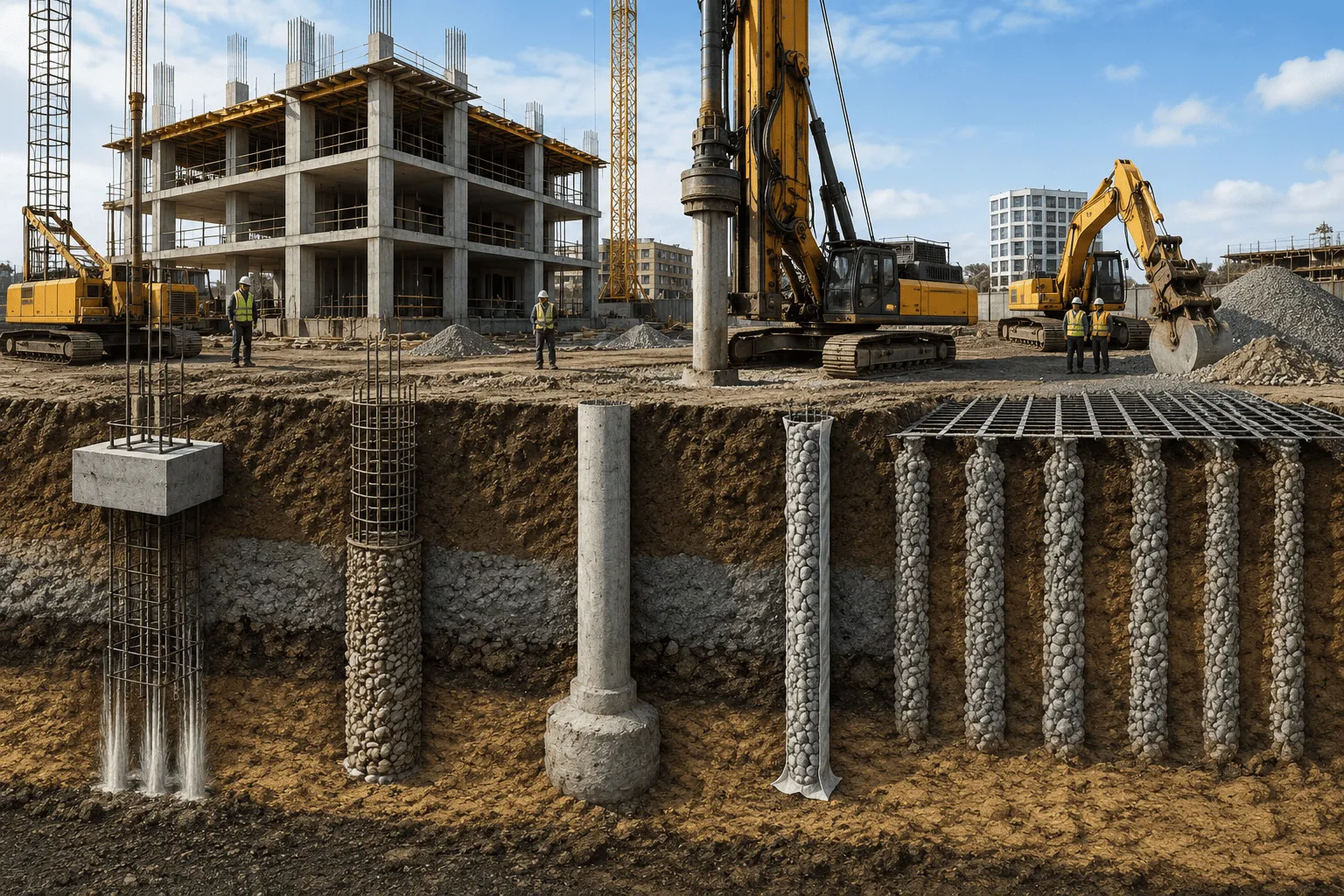
Introduction: The Hidden Risk Below – Why Soil is a Project's True Foundation
The most ambitious architectural designs, supported by advanced structural engineering, can fail if the ground beneath them is unstable. Below the concrete and steel lies the true foundation of any project: the soil. When dealing with problematic soils—such as soft clays, loose sands, or compressible organic layers—the risks are catastrophic. Issues like excessive settlement, bearing capacity failure, and structural instability can compromise a project's integrity, leading to costly remediation or complete failure. This guide is designed for construction professionals, providing a comprehensive overview of the essential ground improvement techniques that transform challenging sites into buildable, stable, and secure locations.
What is Ground Improvement and Why is It Non-Negotiable?
Ground improvement, also known as ground treatment, is the controlled modification of in-situ soils to enhance their engineering properties. It is a critical aspect of modern geotechnical engineering, applied when the existing ground conditions are unsuitable for supporting the planned structures. The primary goals of these soil improvement methods are to increase bearing capacity, reduce both total and differential settlement, and improve the overall stability of the soil mass. By altering the soil's mechanical behavior, we can ensure the long-term performance and safety of foundations, embankments, and other civil works.
Successfully implementing these solutions requires deep expertise in soil mechanics and construction logistics. Complex projects often necessitate collaboration with geotechnical specialist contractors who possess the specialized equipment and experience to design and execute the most effective ground treatment methods in construction. This proactive approach is not an optional expense but a non-negotiable step in mitigating foundational risk on sites with weak soil.
Identifying Problematic Soil Types and Their Common Risks
Understanding the type of soil on a site is the first step in any weak soil construction project. A thorough geotechnical investigation reveals the challenges that must be addressed. Common problematic soils include:
- Soft Clays and Silts: These fine-grained soils are characterized by high compressibility and low shear strength. They are prone to significant, long-term settlement under load as water is slowly squeezed out of the soil matrix.
- Loose Sands and Gravels: While granular soils can provide good support when dense, in a loose state they have low bearing capacity. They also pose a significant risk of liquefaction during seismic events, where the soil temporarily loses all strength and behaves like a liquid.
- Organic Soils (e.g., Peat): These soils contain a high percentage of decomposing organic matter. They are extremely compressible, have high moisture content, and continue to decompose over time, leading to unpredictable and severe settlement.
- Expansive Soils: Certain types of clay soils have the tendency to swell when they absorb water and shrink when they dry. This volumetric change exerts immense pressure on foundations, causing heaving, cracking, and significant structural damage.
Core Principles of Ground Improvement: Densification, Consolidation, and Reinforcement
Most soil improvement methods operate on one of three fundamental principles to enhance the ground's performance:
- Densification: This principle involves increasing the density of granular soils by reducing the void space between particles. By rearranging the soil grains into a more tightly packed state, densification increases shear strength and stiffness while reducing permeability and compressibility. Vibro Compaction is a classic example.
- Consolidation: Applied primarily to cohesive soils like clays and silts, consolidation accelerates the settlement process. By creating pathways for water to escape the soil matrix and applying a temporary load, the soil volume is reduced before the main structure is built, minimizing long-term settlement issues. Surcharging with Prefabricated Vertical Drains is a common application.
- Reinforcement/Mixing: This approach involves introducing stronger materials into the soil mass to create a composite ground with superior engineering properties. This can be done by installing stiff columns of aggregate (Stone Columns) or by mechanically mixing the soil with cementitious binders to create a hardened, stronger material (Deep Soil Mixing).
Deep Dive: Granular Column Techniques (Vibro Compaction & Stone Columns)
Vibratory techniques are among the most established and effective ground improvement solutions, particularly for granular and mixed soils. These methods use powerful, purpose-built vibrators to improve the soil at depth.
Vibro Compaction
Vibro Compaction is a densification technique used exclusively in granular soils like loose sands and gravels. The process involves a large, vibrating probe (a vibroflot) that is lowered into the ground. The intense vibrations reduce the inter-particle friction of the soil grains, allowing them to settle into a denser configuration. Granular backfill is added from the surface to compensate for the volume reduction. This method is highly effective for increasing bearing capacity, mitigating liquefaction risk, and reducing settlement for foundations of large structures like warehouses, industrial facilities, and storage tanks.
Stone Columns (Vibro Replacement)
When dealing with soft, cohesive soils like clays and silts, simple vibration is ineffective. Instead, Stone Columns, also known as Vibro Replacement, are used. In this method, the vibroflot penetrates the weak soil, displacing it laterally. The resulting void is then filled with imported, compacted granular material (crushed stone or gravel) in stages, creating a stiff, high-modulus column within the soft ground. These stone columns act as reinforcing elements that increase the overall stiffness and bearing capacity of the soil mass while also serving as drainage paths to accelerate consolidation.
Comparison Table: Vibro Compaction vs. Stone Columns
| Feature | Vibro Compaction | Stone Columns (Vibro Replacement) |
|---|---|---|
| Applicable Soil Type | Loose granular soils (sands, gravels) | Soft cohesive soils (clays, silts) and mixed soils |
| Primary Function | Densification | Reinforcement and Drainage |
| Equipment Used | Vibrating probe (vibroflot) | Vibrating probe (vibroflot) with a system for feeding stone |
| Typical Applications | Liquefaction mitigation, settlement control for tanks and embankments, foundation support on sandy sites | Foundation support for commercial buildings, warehouses, and infrastructure on soft clay sites |
Deep Dive: Grouting and Mixing Techniques (Jet Grouting & Deep Soil Mixing)
When soil needs to be solidified or transformed into a structural element, grouting and mixing techniques are employed. These methods introduce cementitious binders to create a high-strength composite material.
Jet Grouting
Jet Grouting is a versatile ground treatment method that uses a high-pressure (300-600 bar) jet of grout slurry to erode, mix, and replace the in-situ soil. A small-diameter drill string is advanced to the target depth, after which the grout is injected at high velocity as the string is slowly rotated and withdrawn. This process creates engineered columns of 'soilcrete' with predictable strength and permeability. Its precision makes Jet Grouting ideal for underpinning existing structures, creating groundwater cut-off barriers, and providing excavation support in confined urban spaces.
Deep Soil Mixing (DSM)
Deep Soil Mixing (DSM) is a powerful soil stabilization technique that mechanically blends the in-situ soil with cementitious binders (like cement, lime, or slag) using large, rotating mixing tools or augers. The binders are introduced through the hollow stems of the augers as they penetrate the ground. This process creates stabilized soil columns, panels, or blocks with significantly increased strength and reduced compressibility. DSM is highly efficient for treating large volumes of weak soil to support embankments, stabilize slopes, and provide foundation support for a wide range of structures.
How Deep Soil Mixing Creates Structural Elements In-Situ
One of the key advantages of DSM is its ability to construct structural elements directly within the ground. By overlapping individual columns, continuous stabilized walls can be formed. These can function as:
- Retaining Walls: DSM walls can be used for deep excavation support, eliminating the need for traditional sheet piling or secant pile walls in many cases.
- Foundation Support: Grids or blocks of DSM columns can create a reinforced ground mattress to support shallow foundations, reducing the need for deep piles.
- Liquefaction Mitigation: By creating a grid of stabilized soil, DSM can prevent the shear deformation associated with liquefaction, protecting critical infrastructure in seismic zones.
Deep Dive: Consolidation Techniques (Prefabricated Vertical Drains & Surcharging)
For soft, saturated clays, the primary challenge is long-term settlement. Consolidation techniques are designed to address this by accelerating the settlement process before construction begins.
Surcharging
Surcharging is one of the most straightforward soil improvement methods. It involves placing a temporary load, or surcharge—typically a large mound of soil—over the construction area. This added weight consolidates the underlying soft soils by squeezing water out, thereby pre-compressing them. Once the desired amount of settlement has occurred, the surcharge is removed, and the structure can be built on the improved ground.
Prefabricated Vertical Drains (PVDs)
The consolidation process in thick clay layers can take years or even decades. To speed it up, Prefabricated Vertical Drains (PVDs) are installed. These consist of a plastic core wrapped in a geotextile filter fabric. PVDs are pushed or vibrated into the ground in a grid pattern. When the surcharge load is applied, the drains provide short, easy escape paths for the pore water, drastically reducing the time required to achieve consolidation from years to months.
Specialized Solutions: Dynamic Compaction
Dynamic Compaction (DC) is a ground improvement technique that involves the repeated dropping of a heavy steel weight (typically 10 to 30 tons) from a significant height (10 to 30 meters). The high-energy impacts densify a wide range of soils, including granular soils, and can be effective at considerable depths. DC is best suited for large, open sites with non-sensitive adjacent structures due to the significant ground vibrations it generates. It is often used for large-scale land reclamation projects and industrial facilities.
How to Choose the Right Ground Improvement Method: A Decision Framework
Selecting the appropriate technique is a critical decision that impacts project cost, schedule, and long-term performance. A systematic approach is essential.
Analyze the Soil Profile
The first and most important step is a comprehensive geotechnical investigation. Cone Penetration Tests (CPT), Standard Penetration Tests (SPT), and laboratory testing of soil samples are required to understand the soil layers, their properties, and groundwater conditions. The soil type (granular vs. cohesive) is the primary factor in narrowing down suitable methods.
Define the Structural Loads
The nature of the proposed structure dictates the required performance of the improved ground. A heavy industrial facility with sensitive machinery requires much stricter settlement control than a flexible warehouse structure. The magnitude and distribution of foundation loads must be clearly defined.
Consider Project Constraints
Every project has unique constraints. The timeline may preclude slow methods like surcharging without PVDs. Site access and overhead clearance may limit the use of tall equipment required for Dynamic Compaction or DSM. Proximity to existing structures and environmental regulations regarding noise, vibration, and spoil disposal must also be considered.
Evaluate Cost vs. Performance
The ground improvement cost is a major consideration. While some methods may have a lower upfront cost, they might not provide the required level of performance or long-term reliability. It's crucial to balance the initial investment with the long-term benefits of reduced maintenance and mitigated risk. A detailed cost-benefit analysis should compare different viable techniques.
Quality Control and Verification: Ensuring the Improvement is Effective
Ground improvement is an engineered process that requires rigorous quality control and verification. After treatment, a program of in-situ testing is performed to confirm that the soil has met the design specifications. This typically includes post-treatment CPTs, load tests on single columns or trial areas, and other geophysical methods. This verification step provides the project owner and structural engineer with the confidence that the ground is ready to support the new structure.
The Financial Case: The Cost of Ground Improvement vs. The Cost of Failure
Project stakeholders sometimes view ground improvement as an added expense. However, it should be framed as an investment in risk mitigation. The cost of implementing a well-designed ground improvement program is a fraction of the immense financial and reputational cost of a structural failure, foundation repairs, or extensive long-term maintenance due to excessive settlement. Proactively addressing weak soil conditions is one of the most effective ways to ensure a project's long-term viability and success.
Conclusion: Building Confidence from the Ground Up
Modern ground improvement techniques have fundamentally changed the construction industry, turning previously undevelopable, challenging sites into valuable, viable opportunities. From densifying loose sands with Vibro Compaction to reinforcing soft clays with Stone Columns or creating structural elements with Deep Soil Mixing, there is a solution for nearly every weak soil problem. The key to success lies in a thorough geotechnical investigation and the careful selection of the right method based on soil conditions, structural requirements, and project constraints. By investing in the ground beneath, we build confidence, safety, and durability into every structure from the very first layer.
Frequently Asked Questions (FAQ)
How deep can ground improvement techniques go?
The effective treatment depth varies significantly by technique. Vibro Compaction and Stone Columns can typically reach depths of 15-20 meters, while Deep Soil Mixing can extend beyond 30 meters. Dynamic Compaction's influence can reach 10 meters or more, depending on the weight and drop height. Jet Grouting can be applied at virtually any depth required.
Is soil improvement a permanent solution?
Yes. When designed and executed correctly, ground improvement provides a permanent enhancement of the soil's engineering properties. The changes, whether through densification, reinforcement, or chemical stabilization, are designed to last the entire service life of the structure they support.
Can ground improvement be used underneath existing buildings?
Yes, certain low-vibration and small-access techniques are specifically designed for this purpose. Jet Grouting and other specialized grouting methods are commonly used to underpin existing foundations that are experiencing settlement, strengthening the ground without disrupting the structure above.
What is the typical environmental impact of these techniques?
The environmental impact varies. Techniques like Surcharging and Dynamic Compaction have a relatively low material footprint but can generate noise and vibration. Methods like Deep Soil Mixing and Jet Grouting use cement, which has a carbon footprint, but they also minimize the need for deep excavation and spoil disposal, reducing truck traffic and landfill use. Many specialist contractors are adopting sustainable practices and alternative binders to minimize environmental effects.