How Grain Storage Silos Are Built: Structural Engineering, Grain Pressure and Storage Technology
A grain silo is more than a cylindrical steel container. Its walls, foundation, aeration equipment and automated handling systems must work together to manage heavy granular loads and protect stored crops.
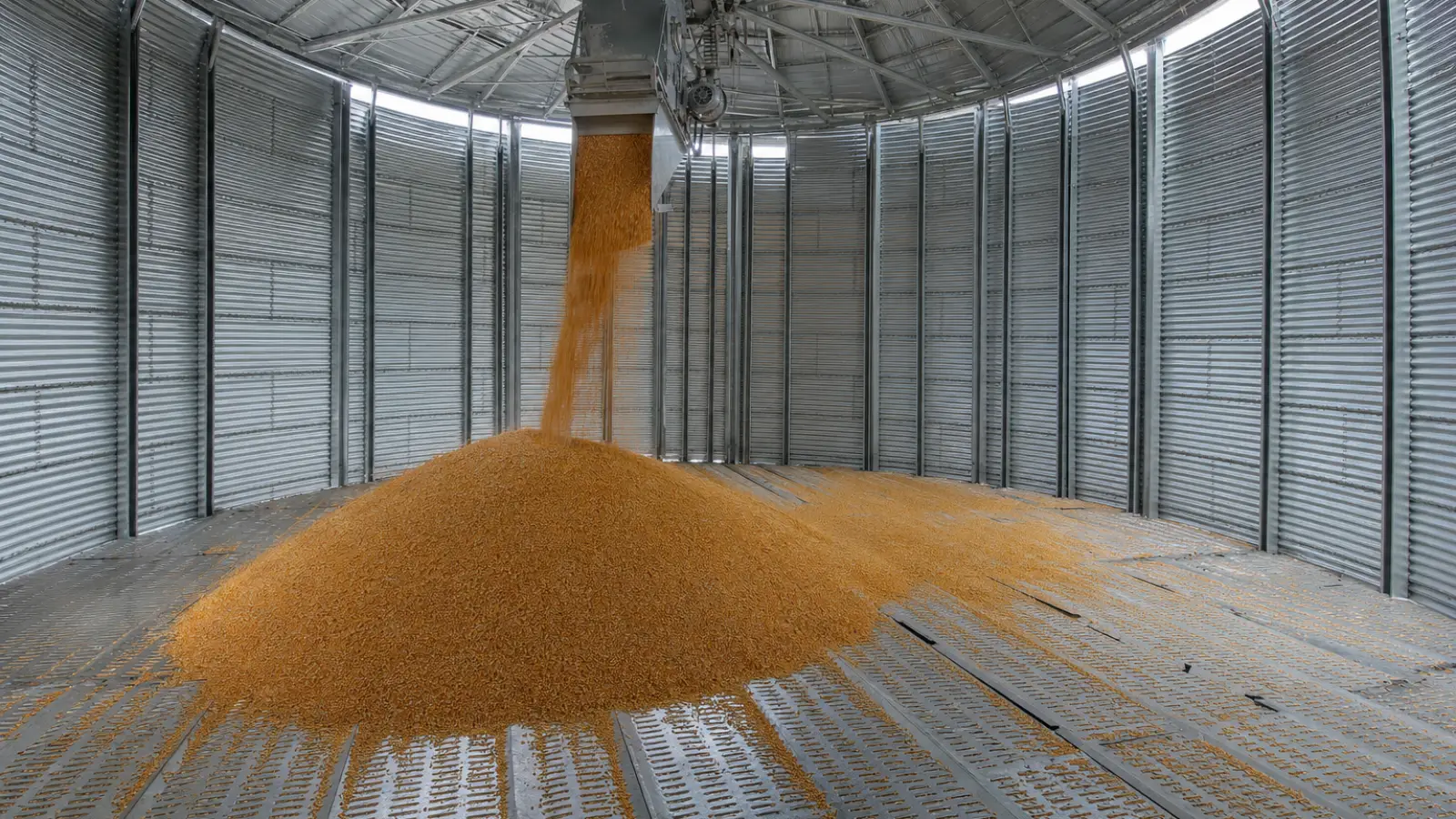
When the first load of corn enters a newly constructed grain bin, thousands of individual kernels fall through the filling system and begin forming a dense, moving mass. The scene may look straightforward, but it marks a major structural change: the empty steel shell is now receiving a substantial distributed load that will continue to change as the bin fills, settles, aerates and eventually discharges.
That transition is central to grain silo construction. A modern silo combines structural steelwork, reinforced concrete, geotechnical engineering, mechanical conveying equipment, ventilation and digital monitoring. Engineers must consider not only the weight of stored grain, but also the different forces created during filling and unloading. The result is agricultural infrastructure designed to preserve crop quality while remaining stable under demanding operating conditions.
Why Grain Storage Silos Are Usually Circular
The cylinder is an efficient shape for containing bulk granular materials. Grain pushes outward against the wall, creating circumferential or hoop stress. Because the pressure acts around the entire perimeter, a circular shell can distribute the load more evenly than a rectangular enclosure with large flat panels and heavily loaded corners.
A circular wall also avoids internal corners where grain can bridge, accumulate or become difficult to remove. Its repeated geometry supports modular fabrication: corrugated steel sheets, stiffeners, roof components and bolted connections can be manufactured in standardized sections and assembled progressively on site. The shape uses material efficiently while providing a large storage volume relative to the wall area.
These advantages do not mean that pressure is perfectly uniform in every operating condition. Eccentric filling, uneven discharge, wind, temperature changes and local equipment attachments can create nonuniform stresses. Circular geometry provides a strong starting system, but the complete silo still requires project-specific structural analysis.
Main Structural Components of a Grain Silo
A typical steel storage bin begins with a reinforced concrete foundation engineered for the site soil and the expected operating loads. Above it, galvanized corrugated steel wall panels form the cylindrical shell. Corrugation increases panel stiffness, while vertical structural stiffeners help carry axial forces and resist buckling, particularly in taller or heavily loaded bins.
Bolted horizontal and vertical joints connect the wall panels. Anchor bolts secure the shell and its base ring to the concrete foundation, transferring uplift, sliding and overturning forces caused by wind or other actions. The roof generally consists of lightweight steel panels supported by a roof structure, with vents and access openings arranged to support filling, aeration and inspection.
Inside the lower portion of the bin, an aeration floor or perforated duct arrangement allows air to pass through the stored grain. Unloading equipment, such as a sweep mechanism or conveyor arrangement, removes grain from the floor. External ladders, platforms, roof access systems and guardrails provide access for authorized maintenance work.
Modern agricultural storage facilities require more than a cylindrical steel enclosure. Manufacturers such as GSI develop commercial grain storage systems that integrate storage bins, grain distribution equipment, aeration floors, and unloading mechanisms to support efficient agricultural operations.
Temperature cables, level sensors and control panels complete the facility. These components are not merely accessories; they influence how the silo is filled, monitored, ventilated and emptied as an integrated system.
How Grain Pressure Acts on Silo Walls
Stored grain behaves differently from water. Water is a fluid that transmits pressure hydrostatically, with pressure generally increasing with depth. Grain is a granular solid: particles interact through friction, and some of the vertical load is transferred to the wall through friction between the grain and the shell.
Engineers therefore consider bulk density, internal friction within the grain, wall friction, the silo diameter and height, filling conditions and discharge behavior. Near the top of a full bin, the grain may exert increasing pressure with depth. At greater depths, however, wall friction can redirect part of the vertical load into the shell. This is the basis of the Janssen approach, which represents silo pressure as a balance between grain weight and frictional transfer to the walls.
During discharge, the stress pattern can change substantially. Flow may be relatively uniform, or a channel may form through the stored material. An off-center outlet or uneven flow can produce asymmetric pressure and local wall forces. A design that is adequate for static filling may not be adequate for every emptying scenario.
As an illustrative, not project-specific example, assume a simplified cylindrical bin contains grain with a bulk unit weight of 8 kilonewtons per cubic metre. If friction were ignored, a basic vertical-load estimate would multiply that unit weight by the grain depth. In reality, wall friction and the grain's internal friction alter the pressure distribution, so the actual design calculation must use an accepted silo-pressure model and the governing structural standard. The example demonstrates why storage depth alone cannot determine wall thickness or stiffener requirements.
Foundation Engineering for Large Grain Silos
The full grain load is ultimately transferred through the steel shell and base connection into the ground. Foundation design begins with a geotechnical investigation to identify soil layers, groundwater conditions, allowable bearing behavior, compressibility and potential hazards such as expansive or collapsible soils.
Depending on the site and bin arrangement, engineers may use a reinforced concrete ring foundation, a circular raft, a thick foundation slab or a combined system. The choice depends on the silo geometry, load magnitude, soil stiffness, settlement tolerance and relationship with adjacent conveyors and buildings. The foundation must also resist wind-induced uplift, sliding and overturning when the bin is empty.
Settlement is often as important as bearing capacity. Total settlement may be manageable if it is uniform, but differential settlement can distort the circular shell, misalign anchor bolts, overload bolted connections and interfere with unloading equipment. Accurate setting of anchor bolts and embedded components is therefore essential before steel erection begins.
Drainage, moisture protection and finished ground levels also matter. Water that reaches the foundation edge or accumulates beneath the slab can affect durability and soil performance. Proper detailing helps protect concrete, steel connections and the stored crop from avoidable moisture problems.
How Steel Grain Silos Are Constructed
Although methods vary by manufacturer and engineered system, grain bin construction commonly follows a controlled sequence:
- Site preparation: The contractor completes surveying, access preparation, excavation and subgrade treatment based on the geotechnical and civil design.
- Foundation work: Reinforcement, formwork, concrete, anchor bolts and embedded components are installed and checked for position and elevation.
- Roof and wall assembly: Steel panels and roof components are assembled using lifting equipment or a purpose-designed jacking system. Some systems build the roof first and raise it as wall courses are added.
- Stiffener installation: Vertical columns, base rings, splice plates and bolted connections are installed and tightened according to the engineered requirements.
- Internal equipment: Aeration floors, ducts, unloading equipment, temperature cables and access components are fitted as the shell progresses or after the main structure is complete.
- Mechanical and electrical integration: Receiving, conveying, distribution, fan, control and alarm systems are connected and tested.
- Inspection and commissioning: The finished installation is checked for alignment, connection condition, air paths, equipment operation and safe startup before grain is introduced.
Construction sequencing is itself a structural consideration. Temporary bracing, lifting points and partially completed wall sections must remain stable during erection. The final operating system should not be judged only by the appearance of the completed shell.
How Corn Enters a Grain Storage Silo
Incoming grain normally passes from a truck receiving area into a below-grade pit or hopper. From there, conveyors or bucket elevators lift it to the top of the storage bin. A distributor or grain spreader directs the flow into the bin, while dust-control equipment helps manage airborne particles around receiving and conveying points.
Controlled filling reduces segregation and helps maintain a more even load on the wall. An improperly positioned stream can create an off-center pile, increasing eccentricity and potentially affecting pressure distribution. Operators may use spreaders, flow controls and planned sequencing to distribute grain across the floor. Equipment capacity must also be coordinated so that receiving, conveying, filling and aeration systems operate without creating bottlenecks.
Aeration, Temperature and Moisture Control
Storage does not end when the bin is full. Grain continues to exchange heat and moisture with its surroundings. A perforated floor or aeration duct system allows fans to move air through the stored mass, while temperature cables provide information about developing hot spots.
Aeration primarily manages grain temperature and storage conditions. It should not be confused with grain drying, which uses appropriately designed heated or ambient-air equipment to remove moisture. Aeration can help equalize temperature and reduce migration-related condensation, but it is not a substitute for bringing grain to a suitable moisture condition for storage.
Moisture migration can occur when temperature differences develop between the grain and the bin environment. If ventilation is inadequate, condensation or localized heating may encourage mold, spoilage and loss of quality. Fan selection, airflow resistance, weather conditions, grain depth and operating schedules must therefore be considered together.
Structural Loads and Common Silo Failures
Silo structural engineering addresses more than the static weight of grain. Designs may include filling and discharge pressures, eccentric flow, wind on an empty shell, roof snow where applicable, seismic actions, thermal effects and loads from attached conveyors or platforms.
Thin steel shells are particularly sensitive to buckling. Localized damage, corrosion, missing bolts, excessive suction from poorly arranged ventilation or an unexpected pressure pattern can reduce stability. Differential settlement may introduce distortions that are not visible from a distance but affect the wall and its connections.
Failures can also result from operating conditions that differ from the design assumptions. An altered outlet, an unapproved attachment, uneven discharge or a modification to stiffeners may change the load path. Regular inspection and professional assessment are important when a bin has been damaged, modified or exposed to unusual loading.
Steel Silos Compared With Reinforced Concrete Silos
| Consideration | Steel silo | Reinforced concrete silo |
|---|---|---|
| Structural material | Corrugated or flat steel panels with stiffeners and bolted connections | Cast-in-place or precast reinforced concrete walls and roof systems |
| Construction method | Modular assembly, often using progressive lifting or jacking | Formwork, reinforcement placement and concrete casting or precast erection |
| Installation complexity | Fast, repeatable assembly but sensitive to alignment, bolting and corrosion protection | More substantial concrete operations and curing requirements |
| Foundation requirements | Requires carefully positioned anchors and control of settlement | Often imposes significant foundation and construction loads during erection |
| Maintenance | Requires inspection of panels, bolts, coatings, stiffeners and corrosion-prone areas | Requires attention to cracking, joints, water ingress and concrete deterioration |
| Typical applications | Farm, commercial and industrial storage where modular capacity is useful | Large, permanent facilities and applications requiring substantial mass and durability |
| Expandability | Often adaptable through additional modular bins and conveying equipment | Expansion can be more complex and closely tied to the original structural design |
| Durability considerations | Dependent on coating performance, drainage, inspection and corrosion control | Dependent on concrete quality, reinforcement protection, detailing and exposure conditions |
Neither system is universally superior. The appropriate choice depends on capacity, site conditions, construction logistics, operating requirements, maintenance capability and the intended life of the agricultural facility.
Automation and Modern Grain Storage Technology
Automation links the physical structure to day-to-day operating decisions. Temperature cables can identify developing hot spots before quality losses become obvious. Moisture sensors and grain-level instruments support inventory and condition monitoring, while programmable logic controllers coordinate conveyors, elevators, gates, fans and alarms.
Remote monitoring can provide operating staff with trends rather than isolated readings. Automated fan controls may respond to programmed temperature or weather conditions, subject to appropriate engineering and operating safeguards. Interlocks can prevent selected equipment from running in an unsafe sequence, although automation does not replace inspection, maintenance or human supervision.
Grain Silo Safety and Maintenance
Industrial grain storage contains serious hazards. Flowing grain can engulf a person in seconds, and a partially emptied bin may conceal unstable bridges or cavities. Confined-space atmospheres, combustible grain dust, moving conveyors, falls from ladders and roofs, electrical equipment and structural instability add further risk.
Personnel must not enter a grain bin while filling or unloading is taking place. Any entry requires appropriate authorization, isolation and lockout of hazardous equipment, confined-space procedures, atmospheric assessment, trained personnel and a rescue plan established by the responsible organization. Grain-bin entry and rescue should be managed by qualified teams using applicable workplace safety requirements; improvised entry or rescue attempts can endanger additional people.
Maintenance programs should include professional inspection of wall panels, stiffeners, bolts, anchor areas, foundations, roof vents, fans, aeration floors and conveyors. Corrosion, water ingress, deformation, damaged guards and unusual vibration should be addressed before they become operational or structural failures.
Why Grain Silo Construction Requires an Integrated Design
A newly filled grain bin illustrates the connection between structural mechanics and agricultural operations. The wall must carry changing granular pressures, the foundation must transfer those forces without harmful settlement, and the handling system must fill and empty the structure in a controlled manner.
Successful grain storage therefore depends on more than a strong shell. It requires sound geotechnical work, carefully detailed steel and concrete, reliable aeration, monitored temperature and moisture conditions, safe conveying equipment and disciplined operating procedures. When those elements are designed as one system, the silo becomes dependable agricultural infrastructure rather than simply a large container.