Swimming Pool Plastering: Materials, Application Techniques and Long-Term Durability
A technically grounded guide to swimming pool plastering, covering cementitious materials, substrate preparation, application workmanship, curing, water chemistry and long-term finish performance.
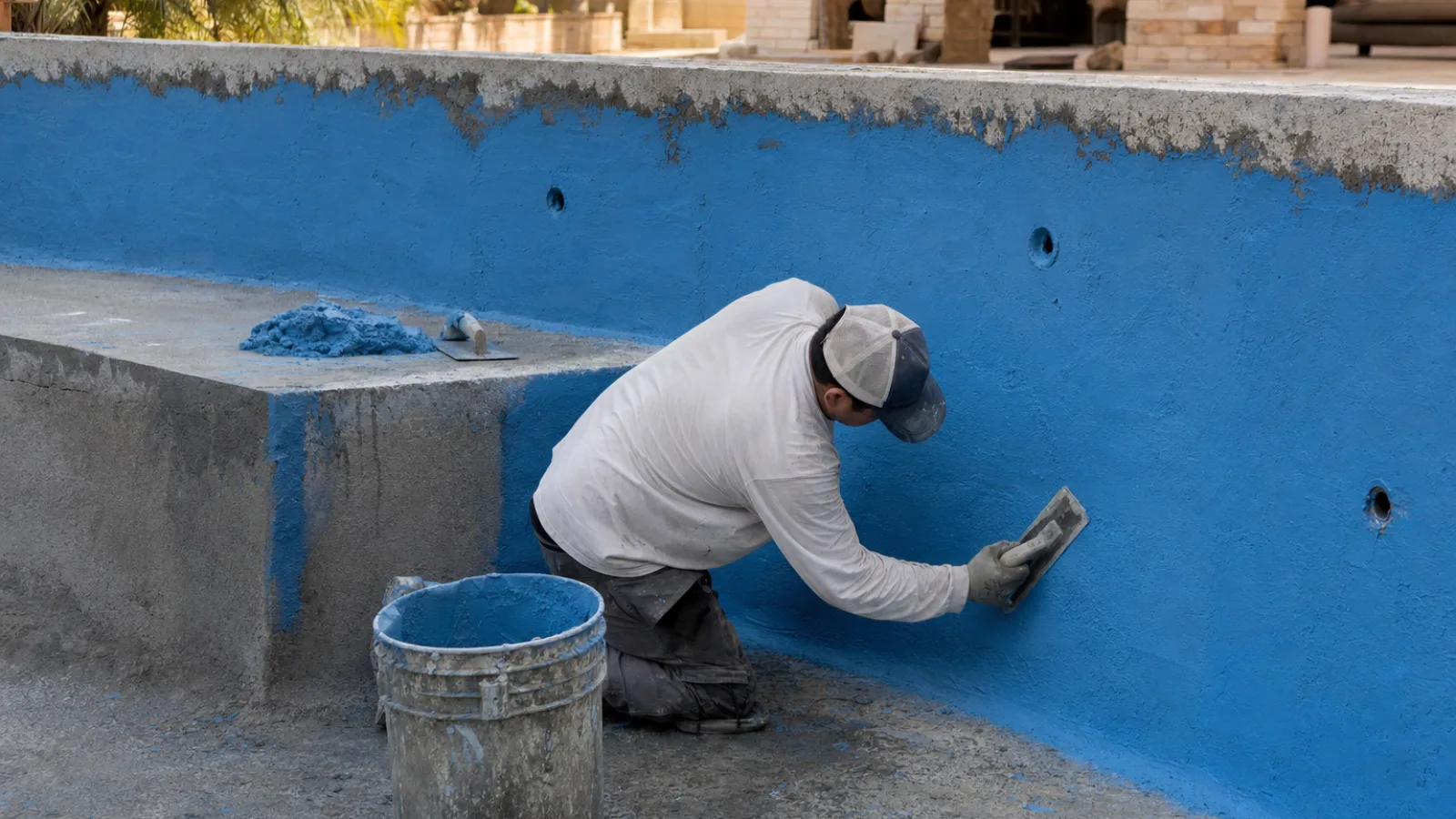
On a newly formed pool shell, the final few millimetres of interior finish can determine how the entire structure looks and performs. A trowel mark on a wall, inconsistent pigment in a bench, or poorly prepared concrete beneath the finish may remain visible for years. Swimming pool plastering is therefore more than spreading a decorative coating: it is a controlled cementitious finishing operation that depends on substrate condition, material compatibility, weather, workmanship and water chemistry.
The finish must create a smooth, comfortable surface while remaining compatible with continuous immersion. It must also follow the geometry of the pool, including walls, floors, steps, corners and built-in seating. This article explains the principal materials, application methods and quality controls that influence long-term performance.
What Is Swimming Pool Plastering?
Swimming pool plastering is the application of a cement-based interior finish over a prepared pool shell. Traditional systems commonly use white cement and finely graded marble aggregate or marble dust. Modern finishes may incorporate colored pigments, quartz, glass or other mineral aggregates to change appearance and improve surface character.
The plaster provides the visible, water-contact surface. It improves smoothness, gives the pool its chosen color and texture, and protects the underlying shell from direct exposure to pool water. It is not, by itself, a substitute for structural design or a complete waterproofing strategy.
A pool normally consists of several distinct layers and functions. The reinforced concrete shell provides structural strength. Joints, penetrations and any specified waterproofing system address water control. The interior plaster or aggregate finish provides the final appearance and bathing surface. Confusing these roles can lead to inappropriate repairs or the mistaken belief that a decorative finish can correct structural cracking or active leakage.
Materials Used in Swimming Pool Plaster
The cementitious matrix binds the finish together and hardens through hydration. Marble dust or fine marble aggregate has traditionally been used to produce a smooth, light-colored surface. Quartz and other mineral aggregates provide a more pronounced texture and can contribute to abrasion resistance, although performance still depends on the complete formulation and installation.
Pigments are used to create colored plaster. Their distribution, dosage and compatibility with the cement system affect color uniformity. Mixing water controls workability, but excess water can weaken the hardened matrix, increase shrinkage or encourage inconsistent coloration. Approved admixtures may modify setting, workability or bonding, but they should only be used where permitted by the selected product system.
Common finish categories
- Traditional white plaster: A relatively smooth, light-reflective finish with a familiar appearance and straightforward material profile.
- Colored plaster: Cementitious plaster containing compatible pigments or colored mineral components. It can produce blue, gray, tan or other visual effects, but is more sensitive to mixing and finishing consistency.
- Quartz finish: A cementitious matrix containing quartz aggregate. The exposed mineral surface generally creates more visual variation and texture than conventional white plaster.
- Exposed aggregate: A finish in which selected aggregate is exposed through the specified finishing process. It can provide a distinctive appearance but requires careful control of exposure, washing and uniformity.
Product names are not reliable substitutes for technical descriptions. A finish marketed as Tahoe Blue, for example, is not a universal material formulation. The actual composition, aggregate grading, pigment system, installation method and maintenance requirements depend on the product selected and its technical documentation.
Understanding Tahoe Blue Swimming Pool Finishes
A Tahoe Blue appearance may come from blue pigment, colored aggregate, or a combination of the two. The visual result is not determined by the plaster color alone. Water depth changes the way light is absorbed and reflected, so a shallow bench may look materially different from a deep wall even when the finish is continuous.
Sun angle, cloud cover and surrounding surfaces also influence perception. Pale paving, vegetation, nearby buildings and reflected sky can alter the apparent water color. A textured or exposed aggregate surface scatters light differently from a smooth plaster surface. For that reason, finish samples should be assessed under conditions reasonably similar to the intended pool environment, while recognizing that a sample cannot reproduce every field variable.
Preparing the Concrete Pool Surface
Good plaster work begins before any finish is mixed. The concrete shell should be inspected for loose material, laitance, contamination, honeycombing, irregular projections and areas of weak or debonded concrete. Dust, curing residues, oils and construction debris can interfere with adhesion and must be removed using a suitable cleaning and mechanical preparation process.
Preparation may include abrasive techniques, water cleaning, chipping, grinding or other methods appropriate to the substrate and specified bonding system. The objective is not simply to make the surface look clean; it is to expose sound material and create the surface condition required by the finish manufacturer.
Cracks require classification before plastering. A stable, non-structural surface crack may require a different treatment from a moving crack, a joint-related defect or a crack associated with settlement. Active leakage, damaged penetrations and structural defects should be investigated and addressed before the interior finish is installed. Covering a defect with plaster can conceal the symptom without resolving the cause.
Bonding requirements vary. Some systems are designed for direct application to a properly prepared substrate, while others require a bonding coat or approved bonding treatment. The pool contractor should confirm substrate moisture condition, cleanliness, profile and compatibility rather than relying on a generic preparation routine.
How Swimming Pool Plaster Is Applied
The construction sequence usually starts with final substrate inspection and preparation. Materials are then measured and mixed according to the selected product requirements. Consistency must remain stable from batch to batch; changes in water quantity, mixing time or aggregate distribution can produce visible differences across the pool.
Where specified, a bonding treatment is applied and allowed to reach the required condition. Fresh plaster is then spread with appropriate hand tools, commonly including steel finishing trowels. Applicators work systematically across the pool so that adjacent areas can be joined while the material remains workable.
Walls require particular control because the material must adhere without sagging. Floors, steps and benches demand careful attention to thickness, transitions and drainage around fittings. Internal corners and curved sections are difficult to finish uniformly because the trowel changes angle continuously. Built-in benches can also be difficult to access without disturbing nearby work.
The number of coats, application thickness, working time and finishing sequence depend on the material system. The applicator must maintain a consistent build without creating thin spots, ridges or abrupt changes. Final troweling closes and refines the surface, but excessive manipulation, retempering or the addition of water at the surface can alter texture and color.
Walls, steps and built-in benches
Vertical surfaces expose weak workmanship quickly. If the mix is too wet, it may slump; if it is too stiff, it may not fully contact the substrate. Tool marks can remain visible where adjacent passes are not blended at the correct time. On steps and benches, inconsistent thickness or poorly formed edges can affect both appearance and user comfort.
Professional application requires a planned sequence, clean tools and enough personnel to place, finish and inspect the material within its workable period. The goal is not to eliminate every natural variation in a mineral finish, but to prevent avoidable differences caused by poor batching, interrupted work or inconsistent technique.
Cold-Weather and Hot-Weather Plastering
Cementitious finishes depend on hydration, and hydration is affected by temperature, wind, humidity and direct sunlight. Cold conditions can slow setting and early strength development. Hot, dry or windy conditions can accelerate moisture loss at the surface, shortening working time and increasing the risk of plastic shrinkage, premature stiffening or uneven finishing.
Before work begins, the contractor should evaluate ambient conditions, substrate temperature, material temperature, wind exposure and the likelihood of rapid weather changes. In cold weather, the substrate and surrounding work area may need protection, and temperatures should be monitored in accordance with the product requirements. In hot weather, shading, careful scheduling and protection from drying winds may be necessary.
There is no universal application temperature limit that applies to every plaster product. The controlling requirements are those of the selected material system, together with accepted construction practice and the project specifications. Work should be postponed or modified when conditions make consistent placement and curing unreliable.
Pool Plaster Curing and Initial Water Filling
After finishing, the cementitious surface continues to hydrate and develop its properties. The initial filling process is therefore part of the installation, not an afterthought. Water should normally be introduced in the manner and timing specified for the material, with unnecessary interruption avoided where a continuous fill is required.
Start-up procedures commonly include controlled brushing, filtration and measured adjustment of the water chemistry. Brushing helps remove loose surface residues and keeps early precipitates from adhering. Filtration removes suspended material, while balanced calcium, alkalinity and pH conditions help limit aggressive water or scale formation. Chemical additions should be controlled and documented rather than applied by guesswork.
The National Plasterers Council's professional pool plaster start-up guidelines explain the importance of initial water filling, surface brushing, filtration, and water chemistry management in protecting newly installed cementitious pool finishes.
Manufacturer-specific start-up instructions take priority because different finishes may require different brushing schedules, chemical controls or equipment operation. The owner, builder and service contractor should agree in advance who will monitor the pool during this sensitive period.
Common Swimming Pool Plaster Defects
Surface cracking may result from shrinkage, rapid drying, movement, poor curing or an underlying substrate problem. Fine cosmetic checking is not automatically evidence of structural failure, but recurring, widening or localized cracking warrants technical investigation.
Delamination occurs when the finish loses bond with the substrate. Contamination, inadequate preparation, unsuitable bonding conditions, weak concrete or improper application can contribute. Hollow-sounding areas, lifting or localized failure should not be treated as ordinary color variation.
Rough surfaces may be linked to poor aggregate exposure, insufficient finishing, improper water management, surface deposits or premature deterioration. Uneven coloration can follow inconsistent batching, variable water content, interrupted placement, weather changes or uneven curing.
Staining and calcium scaling are often associated with water chemistry, metals, contaminants or deposits on the surface. Etching can occur when water is aggressive toward the cementitious matrix. Persistent discoloration, rapid loss of texture or widespread deterioration should be assessed by a qualified pool finish specialist rather than assumed to be a purely cosmetic issue.
Comparing Swimming Pool Finishing Materials
| Finish | Appearance and texture | Maintenance considerations | Installation complexity and durability considerations |
|---|---|---|---|
| Traditional plaster | Smooth, generally light-colored and visually uniform when well installed. | Requires consistent water chemistry and regular cleaning. | Usually a relatively straightforward cementitious finish; performance depends heavily on substrate preparation, curing and start-up. |
| Colored plaster | Colored cementitious surface with possible tonal variation and depth-dependent appearance. | Water balance and stain prevention are especially important to preserve appearance. | Requires disciplined batching and finishing because color differences can be conspicuous. |
| Quartz finish | More granular and visually varied, with mineral aggregate visible in the surface. | Requires routine chemistry control and cleaning suited to the texture. | Aggregate exposure and uniformity demand careful installation; complete system performance depends on the matrix and aggregate. |
| Exposed aggregate | Distinctive textured appearance with visible selected aggregate. | Texture may require attentive brushing and cleaning to limit deposits. | Exposure, washing and finishing must be controlled carefully; uneven exposure can affect appearance and service performance. |
| Pool tiles | Broad design range, from glazed units to glass or porcelain surfaces. | Grout, joints and fittings require inspection and cleaning. | More detailed installation with substrate, adhesive or mortar and joint considerations; localized tile failure can be repaired without replacing the entire finish. |
Quality Control and Long-Term Maintenance
Quality control should begin with records of substrate inspection and preparation. The project team should verify that loose concrete, contamination, leakage and unresolved defects have been addressed before plaster placement. During installation, checks should focus on material identification, batch consistency, water measurement, working time, coverage, thickness and the condition of tools and equipment.
Visual inspection should consider continuity across walls, floors, corners, benches and steps. It should also identify avoidable ridges, tool marks, thin areas, exposed substrate or abrupt color changes. Some tonal variation is inherent in cementitious and mineral finishes; the important distinction is between expected material character and evidence of inconsistent installation.
After filling, water chemistry should be monitored routinely. Balanced water reduces the risk of scale, staining and dissolution of the cementitious matrix. Regular brushing, filtration, cleaning and inspection around fittings help preserve the surface. Maintenance cannot correct poor bonding or structural movement, but it can prevent chemistry-related deterioration from shortening the useful performance of an otherwise sound finish.
Conclusion
Swimming pool plastering is a finishing trade with structural consequences for appearance and long-term serviceability, even though the plaster itself is not the pool shell or a complete waterproofing system. Durable results begin with sound concrete, properly treated defects and a compatible material system. They continue through controlled mixing, skilled trowel application, careful work on vertical and irregular surfaces, and protection from unsuitable weather conditions.
The final responsibility extends beyond the day of application. Correct initial filling, brushing, filtration and water chemistry establish the conditions in which the new finish can hydrate and mature. When material selection, workmanship, environmental control and maintenance are treated as one connected process, the pool interior has a much better chance of retaining its intended appearance and performance.