Building Maintenance Backlog Prioritization: How to Rank Repairs by Risk, Cost, and Consequence
A maintenance backlog is not simply a list of overdue work orders. It is a record of accumulated risk. This practical framework helps building teams rank repairs by safety, compliance, failure consequence, cost, and urgency.
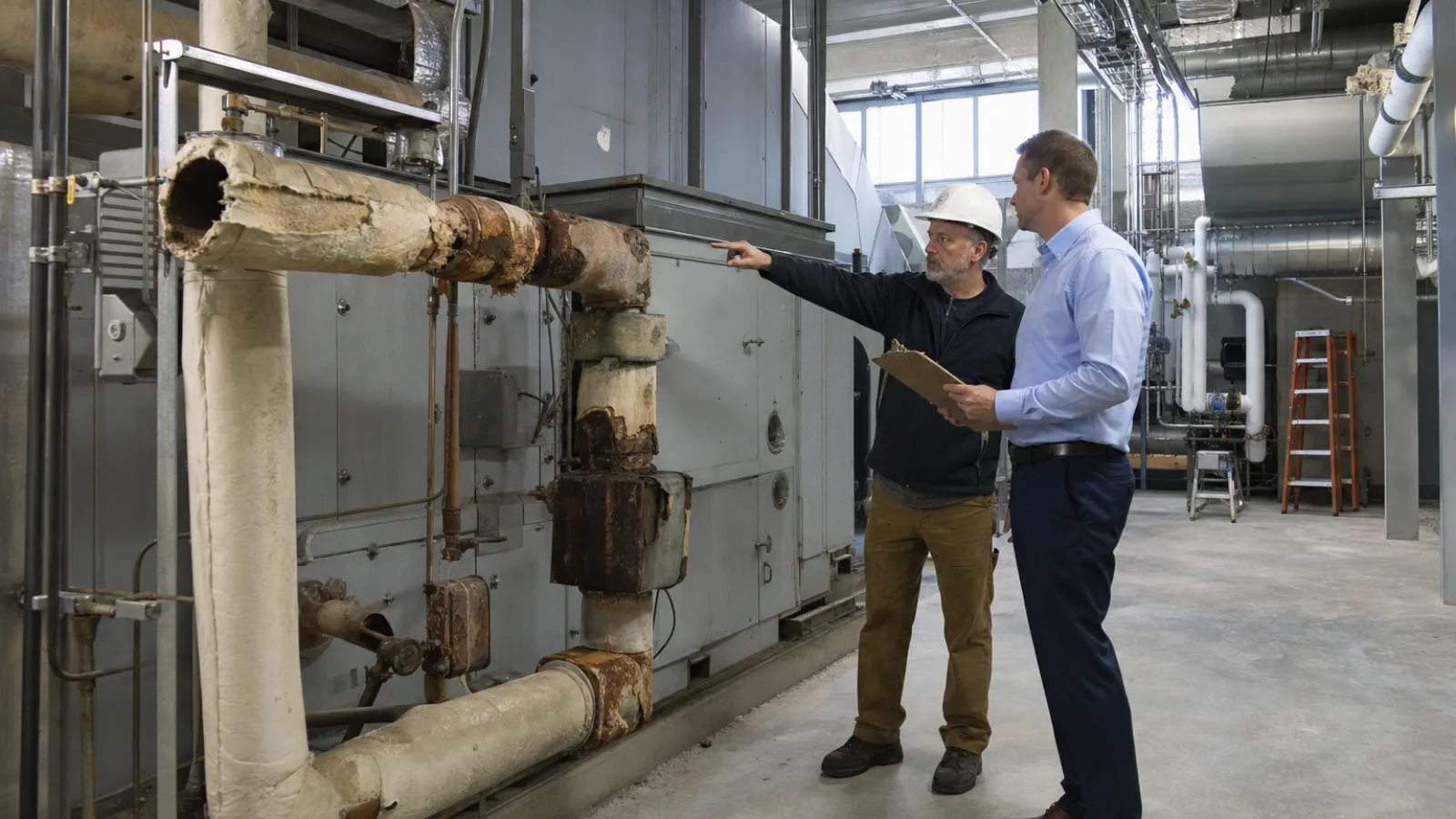
A building maintenance backlog is more than a list of old work orders. It represents accumulated exposure: safety hazards, declining asset performance, compliance gaps, service disruption, and costs that may increase when repairs are postponed. Effective building maintenance backlog prioritization turns that exposure into a clear sequence of decisions.
The process does not require every facility to buy new technology. It does require reliable information, consistent scoring, and a record of why one repair should come before another. Teams may use a computerized maintenance management system, spreadsheet, or asset management software, provided the system connects each issue to an asset, location, risk, estimated cost, and responsible action.
Key takeaways
- Separate immediate life-safety and compliance hazards from ordinary renewal work before applying a general ranking system.
- Score repairs using likelihood, consequence, urgency, service disruption, statutory obligations, and the cost of deferral.
- Record the confidence of the condition assessment; uncertain, high-consequence issues may require investigation before repair.
- Present funding scenarios that show both the work delivered and the residual risk left unfunded.
- Close work only after testing, documentation, asset-record updates, and confirmation that the original cause has been addressed.
Why a maintenance backlog is difficult to prioritize
Backlogs usually combine very different types of work. A leaking roof, an unreliable air-handling unit, damaged flooring, an outdated control panel, and a poor-quality paint finish may all appear as separate tasks. Their urgency cannot be judged by age or estimated cost alone.
Several common problems make prioritization unreliable:
- Incomplete information: The record may identify a symptom but not the underlying failure or affected asset.
- Inconsistent descriptions: Different inspectors may use different terms for the same condition.
- Visible defects receive too much attention: Cosmetic issues can overshadow concealed life-safety or water-ingress risks.
- Capital and maintenance work are mixed together: Routine repairs, replacements, compliance projects, and upgrades may require different approval paths.
- Budget pressure encourages false precision: A low-cost repair is not automatically a high-value repair if its failure consequence is minor.
- Conditions change: A backlog score becomes outdated when a leak worsens, occupancy changes, or a critical component fails.
The goal is not to create a permanently fixed ranking. It is to create a transparent decision model that can be updated as conditions, budgets, regulations, and operational needs change.
Establish a dependable backlog inventory
Before ranking repairs, standardize the information collected for every item. A useful backlog record should include:
- Building, floor, room, and precise asset location
- Asset type, manufacturer, approximate age, and system served where known
- Description of the observed condition and likely cause
- Photographs, inspection notes, test results, and supporting documents
- Current operational status, including whether the asset is functioning partially or not at all
- People, services, tenants, equipment, or areas exposed to the problem
- Temporary controls already in place
- Preliminary repair, replacement, investigation, access, and permit requirements
- Budget estimate, confidence level, and probable delivery duration
- Recommended review date and accountable owner
Separate facts from assumptions. “Water staining below the roof drain” is an observation; “roof membrane failure” is a diagnosis that may need confirmation. This distinction prevents teams from approving an expensive scope before the cause is understood.
Group duplicate and related work orders
Multiple complaints can point to one underlying problem. Several ceiling stains may relate to one failed roof detail, while repeated comfort complaints may arise from a single controls fault. Consolidating related work improves cost estimates and prevents the same condition from being ranked several times.
Separate immediate hazards from routine renewal
Some conditions should not wait for a portfolio scoring exercise. If a defect presents an immediate threat to life, structural stability, fire protection, electrical safety, security, or essential services, the first response should be to make the area safe, restrict access, isolate equipment, or obtain specialist advice.
After the immediate control is in place, the permanent repair can enter the backlog with its residual risk documented. A temporary barricade, shutdown, or patch is a risk-control measure, not proof that the underlying problem has been resolved.
Use priority bands before numerical scoring
| Priority band | Typical condition | Expected response |
|---|---|---|
| Immediate | Credible threat to life safety, major structural failure, uncontrolled water, loss of critical protection, or serious statutory breach | Make safe immediately; investigate and arrange permanent correction as soon as practicable |
| Urgent | Rapid deterioration, significant service disruption, high failure consequence, or condition likely to become hazardous | Scope and fund promptly, usually within the current planning period |
| Planned | Known defect with manageable risk, declining performance, or approaching end of useful life | Package with related work and schedule using available funding |
| Routine | Low-consequence defect, appearance issue, minor wear, or improvement with no material near-term risk | Complete through routine maintenance or a future renewal program |
Score repairs by risk, cost, and consequence
Once immediate hazards are separated, use a repeatable scoring method. A practical model can rate each item from 1 to 5 in several categories. The scale is less important than applying it consistently and recording the reason for each rating.
Recommended scoring categories
- Life-safety and health risk: Could the condition cause injury, illness, fire exposure, unsafe access, or dangerous environmental conditions?
- Statutory or regulatory obligation: Is there an inspection finding, legal duty, permit condition, accessibility requirement, fire requirement, or other mandatory obligation?
- Failure probability: How likely is the asset or condition to fail within the planning period?
- Failure consequence: What happens if it fails? Consider injury, property damage, loss of service, tenant displacement, equipment damage, and reputational impact.
- Business or service interruption: Would the repair affect housing, education, healthcare, production, customer access, income, or essential operations?
- Rate of deterioration: Is the condition stable, slowly declining, or worsening rapidly?
- Cost exposure: Could deferral increase the eventual repair scope or cause secondary damage?
- Resilience and dependency: Is the asset a single point of failure, or are reliable alternatives available?
A basic risk calculation is:
Risk score = likelihood of failure × consequence of failure
Other categories can modify the score or act as decision flags. A statutory obligation may require action even when the calculated failure risk is moderate. Similarly, a low-cost repair that prevents extensive water damage may deserve priority over a more expensive but lower-consequence improvement.
Use override rules for critical issues
Weighted averages are useful for sorting, but they can conceal a serious weakness. A repair with a low total score should not outrank a life-safety issue because several low-risk categories dilute the result. Set explicit rules such as:
- Any credible immediate life-safety risk enters the highest priority band.
- A confirmed statutory breach receives a minimum priority level.
- An active leak affecting electrical equipment or occupied areas receives an urgent flag.
- A failed component without redundancy is reviewed separately from ordinary asset deterioration.
Assess the cost of doing nothing
Repair estimates show what action costs today. They do not necessarily show what deferral costs. For each significant backlog item, compare the proposed intervention with the likely consequences of waiting.
Consider:
- Additional damage to finishes, structure, contents, or neighboring systems
- Emergency callouts, temporary accommodation, overtime, or expedited procurement
- Lost rent, interrupted operations, inaccessible areas, or reduced service capacity
- Higher energy or water consumption from poor equipment performance
- Insurance, contractual, legal, or compliance exposure
- Whether related work will become more difficult once access is lost or another project is completed
Lifecycle cost is particularly important for aging mechanical, electrical, roofing, envelope, and control systems. A low-cost patch may be appropriate when it safely extends service life. It may be poor value when it merely postpones a known replacement and requires repeated access or temporary repairs.
Build a defensible repair priority matrix
A priority matrix makes decisions visible to finance teams, senior management, occupants, and other stakeholders. The matrix should show more than a rank number. Include the condition, risk basis, recommended intervention, cost range, delivery constraint, confidence level, and consequence of deferral.
One practical structure classifies work across two dimensions:
- Risk and consequence: low, moderate, high, or critical
- Time sensitivity: stable, deteriorating, time-bound, or immediate
This prevents a high-risk but stable repair from being treated exactly like a lower-risk condition that is deteriorating rapidly. Both may require action, but the first may need planned capital funding while the second requires faster intervention.
Record confidence as well as priority
A ranking based on a recent specialist inspection is more reliable than one based on a short complaint description. Add a confidence rating such as high, medium, or low. Low-confidence, high-consequence items should often receive an investigation task before a final repair decision. Investigation itself may be the correct first action.
Turn rankings into funding scenarios
A ranked list is not yet a maintenance plan. Decision-makers need to see what can be delivered under different funding levels and what remains exposed if funding is limited.
Prepare at least three scenarios:
- Risk-control scenario: Addresses immediate hazards, statutory obligations, and repairs that prevent serious harm or damage.
- Balanced renewal scenario: Adds planned replacements, grouped projects, energy or reliability improvements, and work that reduces future backlog growth.
- Full-program scenario: Addresses the highest-priority work and lower-risk renewal items that are efficient to complete while access, design, or procurement is already available.
For each scenario, show the number and value of projects, expected disruption, major assumptions, residual risk, and work deferred to a later period. This is more useful than presenting one large total without explaining the consequences of approval or deferral.
Sequence work and manage operational disruption
Priority should guide sequencing, but it should not be the only factor. Combine related projects when doing so is safe and financially sensible. Examples include coordinating roof repairs with insulation work, combining access equipment for façade and window work, or completing controls upgrades alongside major plant replacement.
Before combining projects, confirm that bundling will not delay a critical repair. Also consider seasonal conditions, tenant communications, decanting requirements, permits, long-lead equipment, specialist availability, and opportunities to work during planned shutdowns.
Assign one clear action to every item
- Repair now
- Investigate further
- Monitor with a defined trigger
- Replace or renew
- Accept temporarily with documented controls
- Remove from the backlog because it is duplicate, completed, or no longer applicable
“Monitor” should never mean “ignore.” Set a review date, inspection method, escalation trigger, and accountable person. Otherwise, monitored defects tend to become invisible until they fail.
Verify completion and update asset records
Backlog management does not end when a contractor finishes work. Verify that the original cause was addressed, required testing was completed, records were updated, and temporary controls were removed. For building systems, confirmation may include commissioning, balancing, electrical testing, leak testing, fire-system documentation, or operational checks.
Close the item only when the evidence supports closure. Record the final cost, completion date, warranty information, replaced components, updated asset data, and any follow-up maintenance requirement. If the repair revealed a broader problem, create a linked action rather than treating the original work order as the end of the issue.
Common mistakes in maintenance backlog management
- Ranking by age alone: An old asset may be reliable, while a newer installation may have a serious defect.
- Ranking by cost alone: Expensive work is not automatically more urgent than a small repair that prevents major damage.
- Using one score without overrides: Critical safety and compliance matters require explicit safeguards.
- Ignoring temporary controls: A patch or shutdown changes risk but does not eliminate the underlying condition.
- Failing to revisit assumptions: Cost, condition, occupancy, regulations, and operational priorities change.
- Closing work without verification: An invoice or completion note does not prove that the defect was resolved.
FAQ about building maintenance backlog prioritization
What is building maintenance backlog prioritization?
It is the structured process of ranking deferred building repairs according to safety, compliance, likelihood of failure, consequence, urgency, cost, service impact, and lifecycle value. The result is a defensible plan rather than an unstructured list of complaints.
How often should a maintenance backlog be reviewed?
Review high-risk items whenever conditions change and review the wider backlog on a defined cycle, such as quarterly or at each budget-planning period. Trigger an earlier review after a major incident, inspection, occupancy change, system failure, or regulatory update.
Should low-cost repairs always be completed first?
No. Low-cost work can be attractive when it removes meaningful risk, but priority should reflect consequence and urgency. A higher-cost repair may be more important if failure could cause injury, major damage, extended disruption, or a statutory breach.
When should a facility manager investigate instead of repair?
Investigation is appropriate when the condition, cause, scope, or consequence is uncertain and the decision could materially affect cost or risk. High-consequence items with low-confidence information should usually receive an early technical assessment.
What makes a maintenance plan defensible?
A defensible plan documents the evidence, scoring method, assumptions, cost range, risk of deferral, funding scenario, decision owner, and review date for each major item. It should also show why urgent work was selected and what risk remains where funding is insufficient.
How to verify these figures yourself
The 1-to-5 scoring scale in this framework is an illustrative management method, not a universal statutory formula. Before adopting it, compare the categories and thresholds with the organization’s risk policy, applicable building and fire requirements, inspection procedures, insurance conditions, and asset-management framework. Validate repair costs through current quotations, measured scopes, recent contract rates, or professional estimates, and record the confidence and date of each estimate.
Sources
- International Organization for Standardization, ISO 55000: Asset management — Overview, principles and terminology.
- International Organization for Standardization, ISO 55001: Asset management — Asset management system — Requirements.
- National Institute of Building Sciences, Whole Building Design Guide, facility operations and maintenance resources.
- U.S. Department of Energy, Federal Energy Management Program, Operations and Maintenance Best Practices: A Guide to Achieving Operational Efficiency.
Build a backlog that supports better decisions
Effective maintenance backlog prioritization is a repeatable management process, not a one-time ranking exercise. Start with accurate asset and condition information, separate emergencies from planned work, score risk and consequence consistently, test the cost of deferral, and present funding options with residual risk clearly stated.
When repairs are verified and records are kept current, the backlog becomes a planning tool. It helps teams protect occupants, maintain compliance, reduce avoidable disruption, and direct limited funding toward the work with the greatest practical consequence.