Concrete Pile Driving With a Diesel Hammer: The Step-by-Step Site Process
This guide explains the conventional field process for driving an 80 cm diameter, 15 m long precast concrete pile with a DD105 diesel hammer and Sumitomo crane. It covers equipment roles, preparation, alignment, monitoring, safety controls, records, and common site problems.
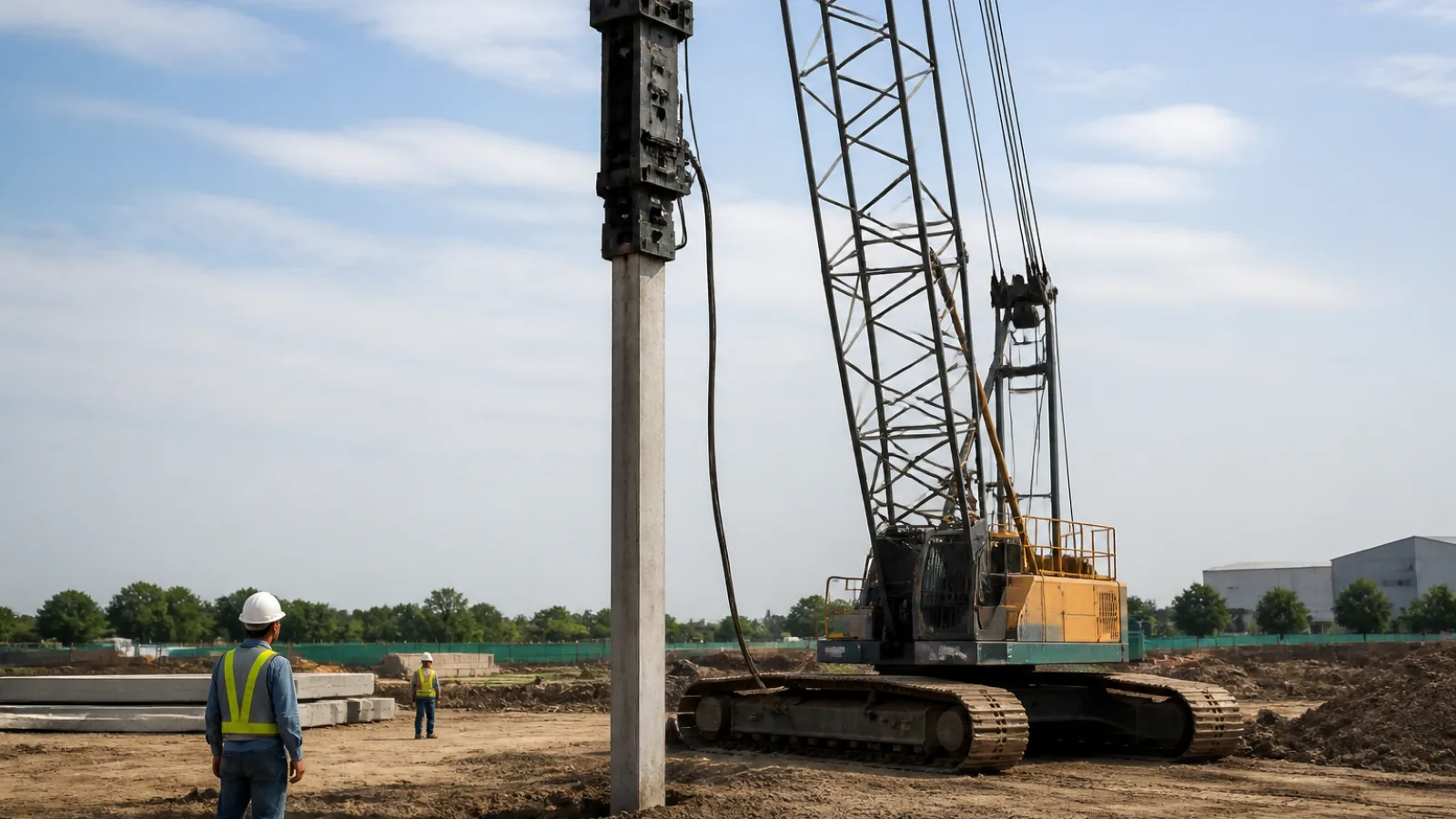
Driving a large precast concrete pile is a coordinated operation involving lifting, alignment, impact energy, survey control, and continuous observation. In the reference operation, an approximately 80 cm diameter and 15 m long concrete pile is positioned with a Sumitomo crane and driven using a DD105 diesel hammer. The sequence illustrates the basic principles used by a specialist piling equipment manufacturer, although the approved method, equipment settings, and acceptance criteria always depend on the project design, ground conditions, and manufacturer instructions.
The crane does more than lift the pile. It supports and positions the piling system, while the hammer delivers repeated impacts through a helmet or driving cap. The crew must keep the pile on its intended line, protect its head, monitor penetration, and stop when the engineer’s specified criterion has been achieved. The following sequence explains how those tasks fit together.
What the Equipment Does
The precast concrete pile
A precast concrete pile transfers structural loads through friction along its shaft, resistance at its toe, or a combination of both. Its diameter and length affect its weight, lifting arrangement, handling limits, and interaction with the soil. Before driving, the crew checks the pile for cracks, exposed reinforcement, damaged corners, dimensional defects, and clearly marked lifting points.
An 80 cm diameter pile is substantial, so the lifting plan must account for its actual mass, centre of gravity, rigging angles, and the available crane capacity at the working radius. The pile should be handled in the manner specified by the supplier or project engineer rather than dragged, shocked, or lifted from unsuitable points.
The DD105 diesel hammer
A diesel hammer uses a controlled combustion cycle to raise and drop a ram, producing impact energy at the pile head. The hammer is not simply left to strike an unprotected pile. A helmet, cap, and suitable cushion transfer the impact while reducing the risk of damaging the concrete. The hammer model identifies a particular equipment class, but its useful operating response still depends on fuel, adjustment, soil resistance, pile condition, and the manufacturer’s operating requirements.
Operators should use the approved manual and project method statement for starting, warm-up, fuel adjustment, lubrication, inspection, and shutdown. The article does not assign a universal stroke, fuel setting, blow rate, or allowable penetration because those values must be established for the specific hammer and installation.
The Sumitomo crane and piling leads
The crawler crane provides a stable mobile platform for lifting and positioning the pile and hammer. Piling leads or a similar guiding arrangement keep the hammer aligned with the pile while allowing the system to move vertically. The crane operator, hammer operator, surveyor, and ground crew must communicate continuously. The crane holds the system in position, but it should not be used to force a misaligned pile sideways during impact.
Pre-Driving Preparation
Good pile driving begins before the hammer starts. The supervisor reviews the foundation drawings, pile schedule, setting-out information, geotechnical report, approved installation method, and required acceptance criteria. The crew also confirms access routes, overhead clearances, underground services, nearby structures, exclusion zones, and any limits on vibration or noise.
The working platform is particularly important. A crawler crane and elevated hammer create high concentrated loads. The platform must be designed, inspected, and maintained for the equipment and ground conditions. Soft spots, standing water, steep edges, loose fill, or unsupported working areas can affect crane stability and pile alignment.
Before lifting, the team inspects the crane, tracks, wire ropes, sheaves, hooks, shackles, lifting accessories, leads, hammer, helmet, cushion, fuel system, and controls. Damaged rigging or a deteriorated pile cushion must be removed from service. The pile location is marked clearly, and the survey team establishes reference points that will remain visible after the equipment is positioned.
Step-by-Step Concrete Pile Driving Process
1. Set out the pile position
The surveyor marks the design centre of the pile using approved control points. The supervisor checks the pile identification and confirms that the planned sequence will not obstruct previously installed piles or destabilize the work area. In congested foundations, the order of installation can matter because driving one pile may affect the ground around another.
2. Prepare and stabilize the crane
The crane is positioned on the prepared platform with sufficient room for the boom, leads, pile, and hammer. The operator confirms the rated capacity at the planned working radius and checks that the machine is level within the limits set by the manufacturer. The lifting path is kept clear of people, vehicles, temporary works, and overhead hazards.
3. Lift and bring the pile into position
Tag lines and controlled signals help the crew guide the pile without standing beneath it or placing hands between the pile and fixed equipment. The pile is raised gradually and brought into the leads. The lifting crew checks that the pile is seated correctly and that no rigging, concrete edge, or connection detail is being overloaded.
4. Connect the hammer and align the pile
The helmet and cushion are placed on the pile head, followed by the hammer. The leads, hammer, and pile are aligned with the design axis before impact begins. Survey checks may be taken in two perpendicular directions. A small alignment error at the surface can become a significant position error as the pile penetrates, so the crew corrects the setup before driving rather than relying on the hammer to straighten the pile.
5. Start the diesel hammer carefully
The operator follows the approved starting procedure and confirms that all personnel are outside the exclusion zone. Initial impacts are controlled while the system settles and the crew observes the pile head, cushion, leads, and surrounding ground. The supervisor watches for unusual movement, smoke, leakage, loose connections, or signs that the pile is not receiving the impact centrally.
6. Control verticality during driving
Verticality is checked continuously or at the intervals required by the method statement. The crew can use visual reference lines, spirit or electronic inclinometers, laser equipment, or survey instruments, depending on the project controls. The crane maintains the system’s position, while the leads guide the hammer. Any correction should be gradual and coordinated; sudden side loading can damage the pile or the equipment.
7. Monitor penetration and driving response
The pile-driving crew records penetration, blow counts, interruptions, and changes in the soil response. Early penetration may be relatively rapid in loose or soft material, while resistance can increase in dense layers or at the design founding stratum. The crew should also observe rebound, hammer performance, pile movement, cracking, spalling, and changes in ground level around the pile.
Penetration per blow is useful only when interpreted with the hammer condition, operating setting, pile type, and project criteria. A low penetration rate does not automatically prove that the pile has reached the required capacity, and a high rate does not automatically mean that installation is complete. The engineer’s approved correlation, test-pile results, or specified final criterion controls the decision.
8. Reach the approved stopping criterion
Driving stops when the pile reaches the required toe level, approved final set, specified penetration response, or another project-defined condition. “Final set” generally describes the measured penetration associated with a defined number of hammer blows, but the exact method varies. The supervisor must not continue driving beyond the approved limits simply to make the pile look fully embedded.
If the pile reaches refusal early, remains above the required level, or behaves unexpectedly, the crew pauses and reports the condition. The engineer may require additional investigation, a revised sequence, a different pile solution, or controlled trimming. Such decisions should not be improvised at the hammer.
9. Complete cut-off, inspection, and records
After driving, the pile head is inspected for cracking, crushing, excessive spalling, and position errors. If the pile must be cut down, the cut-off method should protect the remaining concrete and reinforcement needed for the pile cap or connection. The as-built location and top elevation are surveyed, and any repair or nonconformance is documented before the next construction stage.
How the Crane and Diesel Hammer Work Together
| System or role | Main responsibility | Important control |
|---|---|---|
| Sumitomo crawler crane | Lifts and positions the pile, leads, and hammer | Capacity, radius, stability, and controlled movements |
| Piling leads | Guides the hammer and pile along the intended axis | Correct setup, secure connections, and alignment |
| DD105 diesel hammer | Delivers repeated impact energy to the pile head | Approved operation, maintenance, and energy transfer |
| Helmet and cushion | Distribute impact and protect the pile head | Correct fit, condition, and replacement when damaged |
| Survey and ground crew | Set out, monitor, communicate, and record the installation | Clear signals, exclusion zones, and timely measurements |
The crane and hammer therefore perform different jobs. The crane supplies controlled support and positioning; it does not replace the guide system or determine the pile’s capacity. The hammer supplies impact; it does not correct poor set-out or an unstable platform. Reliable installation depends on the complete system working together.
Key Controls That Protect the Pile and the Site
- Alignment: Check the pile in two directions before and during driving.
- Head protection: Use the specified helmet and cushion, and stop if the pile head begins to crush or spall excessively.
- Crane stability: Keep the crawler tracks on a verified working platform and monitor changing ground conditions.
- Exclusion zones: Keep workers away from the suspended pile, hammer, leads, ropes, and potential fall zones.
- Communication: Establish one signal system and one authorized person directing crane movements.
- Nearby assets: Monitor vibration, settlement, noise, and ground heave where buildings, utilities, or completed piles are close by.
- Weather: Suspend work when wind, lightning, poor visibility, or wet ground creates an unacceptable risk.
- Equipment checks: Inspect the hammer, crane, rigging, fuel system, and structural connections throughout the shift.
What the Crew Records
A useful installation record allows the engineer to compare actual performance with the design assumptions. It normally identifies the pile, location, date, crew, equipment, hammer model, start and finish levels, driving duration, penetration observations, blow counts or final-set measurements, interruptions, obstructions, pile damage, and final as-built position. Where required, the record also includes fuel or operating adjustments, cushion changes, survey readings, and photographs.
Records should be made as the work occurs rather than reconstructed from memory. Clear notes are especially important when the driving response changes, the hammer stops unexpectedly, or the pile requires repositioning.
Common Problems and Practical Responses
Very slow penetration or refusal
Possible causes include dense soil, rock, an obstruction, pile damage, insufficient hammer performance, or an incorrect pile location. Stop according to the project procedure, protect the equipment, and notify the responsible engineer. Do not increase energy beyond approved limits without authorization.
Pile deviation
Deviation can result from inaccurate set-out, an unstable platform, an obstruction, unsuitable leads, or an inclined soil layer. The crew should stop early, reassess alignment, and follow the approved correction method. Forcing the pile sideways with the crane can create damaging bending stresses.
Pile head damage
Crushing or spalling may indicate poor helmet fit, a worn cushion, misalignment, excessive impact, a defective pile, or an unsuitable driving condition. The hammer should be stopped and the head inspected. Repair, replacement, reduced energy, or another engineering response may be required.
Unstable working platform
Track rutting, sudden settlement, crane lean, or water emerging around the work area are warning signs. Suspend lifting and driving, make the area safe, and have the platform reassessed before continuing.
Final Takeaway
Concrete pile driving with a diesel hammer is a controlled sequence, not simply a matter of dropping a hammer onto a pile. For an 80 cm by 15 m precast pile, the crew must prepare the platform, set out the location, position the Sumitomo crane, align the DD105 hammer, protect the pile head, monitor verticality and penetration, and document the final result. The correct stopping point comes from the approved design and installation criteria, while safety depends on disciplined communication and equipment control at every stage.
Frequently Asked Questions
What is a diesel hammer?
A diesel hammer is an impact pile-driving machine that uses a combustion cycle to raise and drop a ram. The resulting impact is transferred through a helmet and cushion into the pile.
Why is a crane used with a pile hammer?
The crane lifts and positions the pile, supports the piling leads and hammer, and keeps the system in the working location. It does not replace the hammer’s impact function or the guide system’s alignment function.
How is pile verticality checked?
Crews may use visual reference lines, inclinometers, lasers, or survey instruments. Checks are made before driving and during installation in accordance with the project method statement.
What does final set mean?
Final set is a project-defined measurement of pile penetration associated with a specified number of hammer blows or a defined driving interval. Its interpretation depends on the hammer, pile, soil, and engineer-approved criteria.
Can every concrete pile be driven with a DD105 hammer?
No. Hammer suitability must be checked against the pile’s size, strength, reinforcement, cushion system, soil resistance, required capacity, nearby structures, and the manufacturer’s limits. The design engineer and qualified piling contractor should approve the equipment combination.