Why a Power Transformer Takes 2–4 Years: Lead Times, Steel and What Engineers Can Do
Power transformer lead times can extend to two to four years because demand is rising faster than manufacturing capacity, while grain-oriented electrical steel, windings, bushings and testing remain constrained. This guide explains the supply chain and gives engineers a practical way to improve specifications, procurement timing, spares planning and microgrid resilience.
Key takeaways
- A power transformer lead time of two to four years is now a credible planning risk for some high-capacity units, according to PwC analysts cited in the October 2026 market brief supplied for this article.
- The constraint is not one component. It runs from grain-oriented electrical steel (GOES) and copper through windings, bushings, core assembly, factory testing and transport.
- Engineers can reduce exposure by standardizing ratings, freezing interfaces early, qualifying more than one approved supplier and separating critical spares from project equipment.
- Microgrids and solid-state transformer technologies can improve flexibility, but they do not remove the need for conventional high-voltage transformation in most utility-scale projects.
Why the power transformer lead time has stretched
A power transformer is a highly engineered, low-volume asset. It is not normally produced from a warehouse stock list. The manufacturer designs the magnetic circuit, insulation system, windings, cooling arrangement, bushings and accessories around the purchaser’s voltage, capacity, fault-duty and site requirements.
That production model becomes difficult when several demand cycles arrive together. Utilities are replacing ageing equipment, renewable projects require generator step-up transformers, data centres are adding large electrical loads, and transmission operators are strengthening networks for electrification. The October 2026 PwC analysis cited in the project brief reported that demand for generator step-up transformers increased by 274% between 2019 and 2025. The same analysis placed some high-capacity transformer lead times at up to four years.
These figures should be treated as planning indicators rather than universal promises. A smaller distribution transformer, a repeat order from an established customer and a standard voltage class may be available much sooner than a large, custom-designed transmission transformer. Conversely, a technically unusual specification, an unqualified supplier or a congested factory test schedule can add months.
The central procurement mistake is to treat the transformer as a late-stage balance-of-plant item. For a major substation, it is often a schedule-driving item that should be defined during concept design. The U.S. Department of Energy's transformer supply chain analysis documents how material shortages, manufacturing constraints, and equipment standardization affect transformer availability.
How the transformer supply chain creates delay
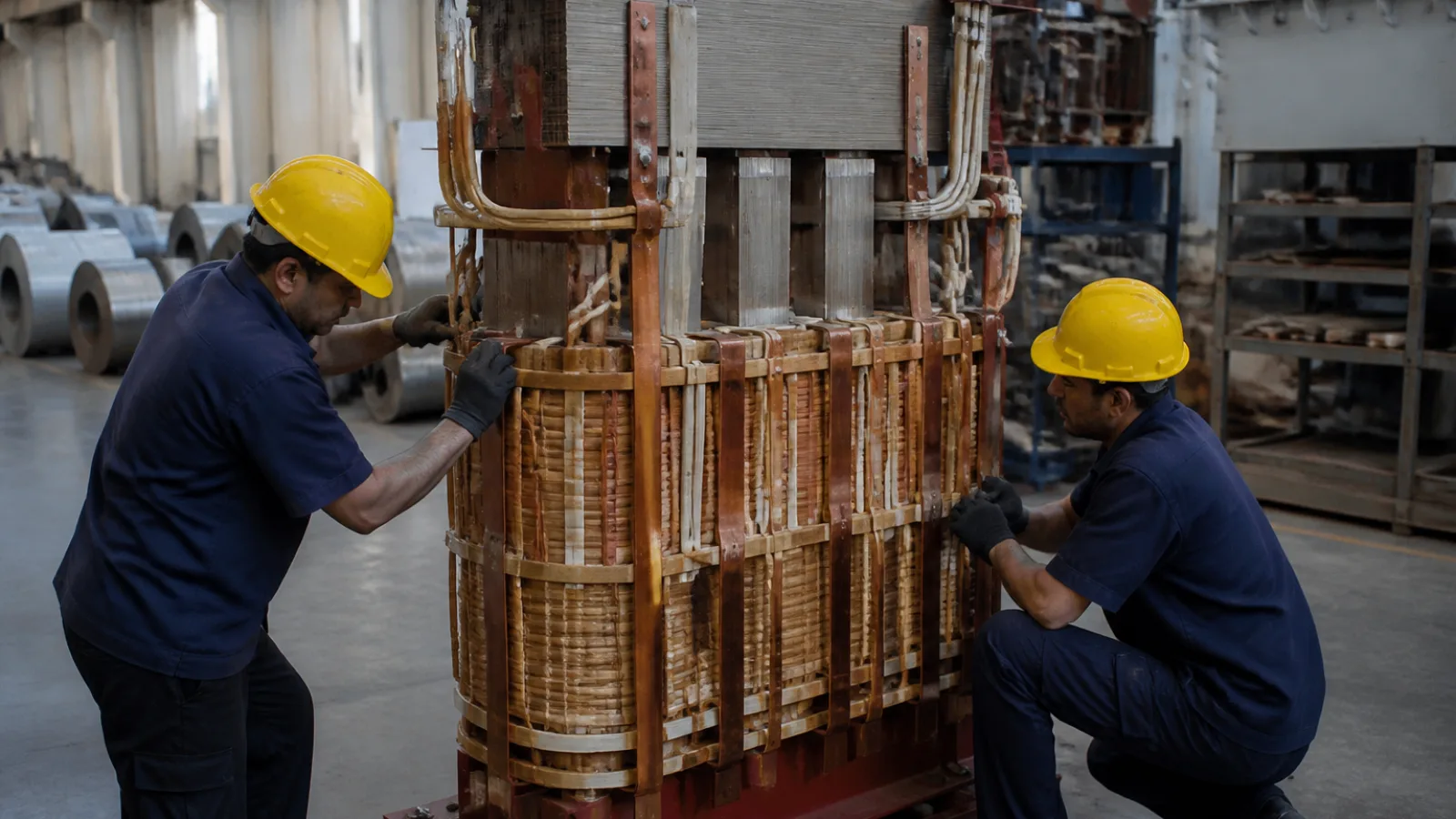
The supply chain begins with the magnetic core. The core is built from thin electrical steel laminations, usually grain-oriented electrical steel for high-efficiency power-frequency transformers. The material must meet specified magnetic, dimensional and loss characteristics. If the required grade or width is unavailable, the manufacturer cannot simply substitute ordinary structural steel.
Windings are the next major system. Copper or aluminium conductor is formed, insulated and assembled into coils. The winding design must manage voltage stress, mechanical forces during short circuits and heat removal under load. Special conductor dimensions, transposed conductors and insulation systems can all create additional procurement dependencies.
Bushings provide the insulated connection between the internal winding and the external network. They are safety-critical components, not generic fittings. Condenser bushings, tap-changer equipment, cooling fans, pumps, radiators, monitoring devices and protection accessories may each come from different specialist manufacturers.
After assembly, the transformer requires drying, oil filling or oil processing, electrical tests and final inspection. Factory acceptance testing can require high-voltage equipment, calibrated instruments and a dedicated test bay. A unit may be physically complete yet still waiting for a test slot. Once released, its size and weight can create another schedule risk: route surveys, permits, rail movements, heavy-haul vehicles and site lifting plans may be needed before delivery.
This is why a single missing bushing or a delayed steel batch can affect the delivery date of an otherwise complete transformer.
GOES steel is a strategic bottleneck
Grain-oriented electrical steel is engineered so its magnetic properties are especially favourable in the rolling direction. Transformer cores use carefully cut and stacked laminations to reduce no-load losses and control magnetizing behaviour. The material is therefore both a technical input and a supply-chain dependency.
Specialty transformer steel has become a trade flashpoint in Europe. The relevant issue is not simply whether steel exists globally; it is whether the required grade, thickness, coating, origin, tariff treatment and delivery window satisfy the manufacturer’s design and commercial requirements. Trade measures can change the relative cost and availability of imported material, while energy prices and plant outages can affect regional production economics.
For a project team, the practical implication is straightforward: do not approve a transformer design without understanding the manufacturer’s steel sourcing plan. Ask whether the proposed core material is already allocated, whether an alternative grade has been technically qualified and how a change would affect losses, sound levels, dimensions, weight and warranty.
Designers should also avoid unnecessary customisation. A unique core window, unusual impedance target or narrow loss guarantee may be justified, but every deviation from a manufacturer’s repeatable platform can reduce sourcing flexibility.
Real-world signals: Niagara and the European trade case
Capacity is beginning to expand, but new capacity does not provide immediate relief. Niagara Power Transformer broke ground on a $71 million expansion on October 22, 2026, according to the company announcement cited in the project brief. The investment is a useful example of how manufacturers are responding: the industry needs more plant, equipment, skilled labour and test capability, not only more purchase orders.
The timing matters. A factory expansion can require building work, production equipment, workforce training, process qualification and customer approval before it increases usable output. Projects that depend on new capacity should therefore obtain a documented ramp-up schedule rather than assume that an announced investment will shorten their own delivery date.
Europe provides a second warning through the trade dispute surrounding grain-oriented electrical steel. European trade authorities have used trade-defence measures and investigations to address concerns about imported specialty steel and market conditions. For transformer buyers, the case demonstrates how a material can become a commercial and geopolitical risk even when the final product is manufactured locally.
The lesson from both examples is to review the full bill of materials. A local transformer factory does not necessarily mean a local supply chain. Conversely, a global supplier may have strong production capacity but face import, transport or certification risks.
What engineers can do during design and procurement
Engineers cannot eliminate a constrained market, but they can reduce avoidable delay. The following checklist is suitable for concept design, front-end engineering and procurement planning.
- Standardize ratings where the network allows it. Use repeatable voltage ratios, capacity steps, impedance ranges, cooling classes and accessory packages. Standardization improves the chance that a supplier can use an existing design platform.
- Freeze the electrical basis early. Confirm load growth, short-circuit duty, tap range, vector group, insulation levels, sound limits and loss guarantees before issuing a binding request for quotation.
- Start procurement before final civil design is complete. The transformer outline, weight, oil volume, bushing positions and cooler arrangement affect foundations, fire protection, bunding, access roads and lifting plans.
- Prequalify more than one manufacturer. Evaluate proven voltage class, factory test capability, quality records, field service, steel sourcing and realistic production slots. A second approved supplier is useful only if the technical specification permits the supplier to bid.
- Control specification changes. Establish a formal change process for losses, impedance, accessories, monitoring systems and protection interfaces. Late changes can return a unit to engineering review or require new material.
- Separate project equipment from strategic spares. A spare transformer may use a deliberately standardized rating and connection arrangement so it can serve more than one site. Its value comes from interchangeability, not simply from being stored.
- Plan logistics at design stage. Confirm route restrictions, bridge capacities, turning radii, delivery windows, temporary storage, oil handling and site crane requirements before the factory release date.
- Define factory hold points. Witness core and coil assembly where appropriate, review test procedures early and agree how non-conformances will be resolved without restarting the entire approval cycle.
Worked example: a reusable procurement screen
Illustrative scenario: A developer needs one custom high-voltage transformer for a new substation and is comparing two procurement approaches. The figures below are planning assumptions, not market quotations.
| Decision item | Late-procurement approach | Early-procurement approach |
|---|---|---|
| Technical basis | Project-specific rating frozen after civil design | Standard rating and interfaces frozen during concept design |
| Supplier engagement | Single tender after permit approval | Two prequalified suppliers engaged before permit approval |
| Steel and long-lead review | Requested after purchase order | Confirmed during technical clarification |
| Spare strategy | No interchangeable spare identified | Shared spare compatibility reviewed across sites |
| Schedule exposure | High: delivery becomes a critical-path assumption | Lower: design, civil and logistics work can proceed against a defined envelope |
The reusable principle is to convert an uncertain delivery date into a series of early decisions: standardize what can be standardized, reserve manufacturing capacity, qualify alternatives and design the site around a known transformer envelope.
What this means for engineers, contractors and investors
Engineers
Engineers should treat the transformer as a system interface, not an isolated electrical symbol. The design must connect network studies, civil works, fire protection, transport, protection and commissioning. A technically elegant specification that only one factory can build may be less valuable than a slightly more standard design that two qualified manufacturers can supply.
Contractors
Contractors should place transformer procurement on the integrated master schedule and identify decisions that affect delivery. Site readiness must include foundations, cable trenches, oil containment, earthing, access, lifting and commissioning resources. A delayed transformer can create prolonged preliminaries and disrupt energization sequencing. Effective construction scheduling and predictive delay analysis can help project teams identify procurement risks before they affect critical milestones.
Investors and owners
Investors should test whether a project schedule assumes an unconfirmed transformer slot. Due diligence should request the purchase order status, approved manufacturer, factory location, long-lead material status, test date, logistics plan and contingency for replacement equipment. A grid connection date is not fully credible if the transformer path remains undefined.
Microgrids can reduce exposure in selected applications by allowing critical loads to operate with local generation, storage and controlled islanding. They are not a universal substitute for a transmission transformer, but they can reduce the consequences of a delayed grid connection. Our solid-state transformer article also explains how power-electronic conversion can support controllable, flexible distribution architectures. The technology should be selected on electrical, protection, thermal, maintenance and lifecycle grounds—not simply as a response to a shortage.
Frequently asked questions
Why do high-capacity transformers take so long to deliver?
They are custom-engineered assets that depend on specialist steel, conductor, insulation, bushings, tap changers, factory drying, high-voltage testing and heavy transport. Capacity at any one of those steps can become the constraint.
Does buying from a local manufacturer remove the risk?
No. Local assembly may still depend on imported GOES, bushings, tap changers, monitoring equipment or specialist manufacturing machinery. Buyers should assess the complete bill of materials and the factory’s confirmed production slot.
Can engineers specify substitute electrical steel?
Only after the transformer manufacturer confirms that the substitute meets the required magnetic, thermal, acoustic, dimensional and loss performance. A material change can affect the core design and warranty.
Should every project buy a spare transformer?
Not necessarily. A spare is most valuable when it is compatible with multiple sites and when the cost of an outage justifies storage, maintenance and transport. The decision should follow a consequence-of-failure and interchangeability study.
Can microgrids solve the transformer shortage?
Microgrids can reduce dependency on a single grid connection for critical loads, but they do not remove the need for suitable transformers in most medium- and high-voltage systems. They are a resilience and phasing option, not a universal replacement.
Sources
- PwC analysts, market analysis cited in the project brief, October 2026: high-capacity transformer lead-time and generator step-up transformer demand findings.
- Niagara Power Transformer, company announcement on the expansion groundbreaking, October 22, 2026.
- European Commission, trade-defence materials concerning grain-oriented electrical steel in Europe, consulted October 2026.
- U.S. Department of Energy, transformer and grid-equipment supply-chain materials, consulted October 2026.
- U.S. Energy Information Administration, electricity demand and grid investment data, consulted October 2026.
- U.S. Bureau of Labor Statistics, producer-price and industrial employment data relevant to electrical equipment manufacturing, consulted October 2026.
Editorial note: Lead-time figures vary by voltage class, capacity, design, manufacturer, factory location and confirmed material allocation. Procurement teams should obtain a written factory schedule rather than rely on an industry average.
How to verify these figures yourself: Check the original PwC analysis and Niagara announcement, then request a dated manufacturing schedule from each bidder. Confirm the GOES grade and allocation, bushing and tap-changer availability, factory-test date, shipping route and any assumptions behind the quoted delivery date.
Last updated: October 28, 2026.