Construction Equipment Demand in 2026: What Caterpillar’s Record Quarter and bauma CHINA Signal
Caterpillar’s latest quarter shows unusually strong equipment demand, but contractors still need to separate durable fleet requirements from short-term market momentum.
Construction equipment demand is entering 2026 with an unusual combination of strength and friction. Caterpillar reported third-quarter sales and revenues of $20.7 billion, up 17% year over year, while its Construction Industries segment increased 18% and North America rose 23%. The company also reported an all-time-high backlog of $78 billion.
Those figures do not mean every contractor should order a new machine. They do indicate that equipment manufacturers are seeing firm underlying demand from construction, infrastructure, energy and power-related projects, while constrained supply, tariffs and freight continue to influence delivered costs and lead times.
For fleet managers, the practical question is not simply whether the market is growing. It is whether a particular machine will generate enough productive hours, at an acceptable total cost, to justify buying, leasing or renting it.
What Caterpillar’s Q3 2026 results reveal about the market
The figures reported in Caterpillar’s third-quarter 2026 filing provide a useful market signal because they cover both sales activity and future commitments. The company’s total sales growth, an 18% increase in Construction Industries and a 23% increase in North America point to broad demand rather than a single isolated equipment category. The reported backlog of $78 billion adds evidence that customers are placing orders ahead of delivery.
Backlog should be read carefully. It represents orders that have not yet been delivered or recognized as revenue; it is not the same as current-quarter sales, and it can change through cancellations, delays, configuration changes and production constraints. Even so, a record backlog gives manufacturers more visibility into factory loading and gives contractors a reason to plan equipment requirements earlier than they might in a softer market.
The company’s Q3 results also reflect demand connected to power generation and data-center construction. That matters to the wider equipment market because large power, site-development and civil works projects consume more than generators. They require earthmoving, grading, aggregate handling, access equipment, service trucks and attachments. A boom in one project segment can therefore raise demand across several equipment classes.
For the reported figures and company disclosures, readers can consult Caterpillar’s SEC filings. The filing is the appropriate reference for reported sales, segment performance and backlog rather than promotional summaries or market commentary.
Why compact equipment is becoming a strategic capacity issue
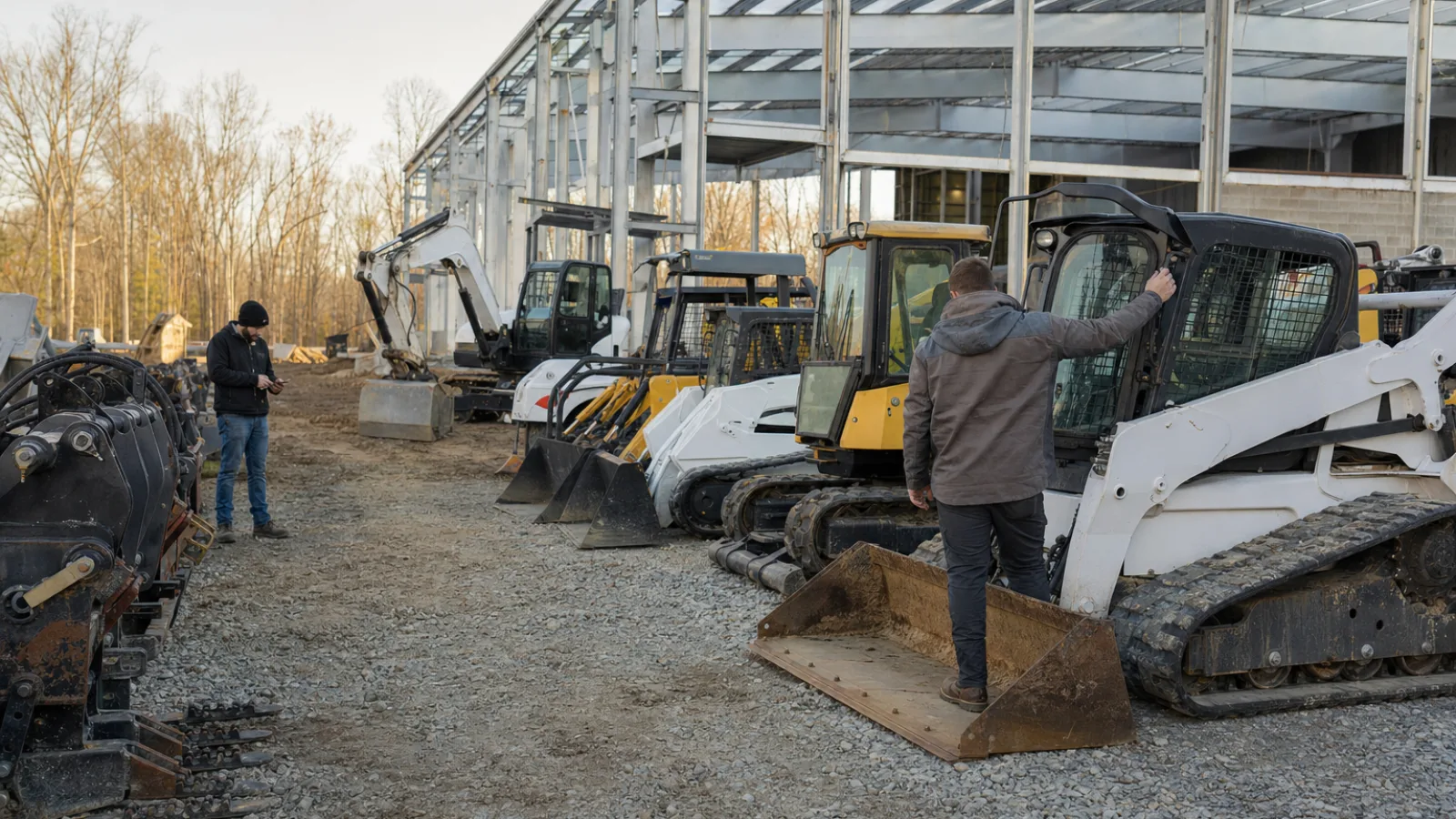
Caterpillar’s commitment of $1 billion to expand compact equipment capacity in North Carolina is one of the clearest signals in the update. Compact track loaders, small excavators, skid-steer loaders and related attachments are used across residential development, utility work, landscaping, road maintenance and interior demolition. Their appeal is not only purchase price. They can reach constrained sites, reduce ground disturbance and share attachments across several tasks.
Increasing compact-equipment capacity also reflects how contractors are changing the composition of their fleets. A large excavator remains essential for mass excavation, but a contractor may use several compact machines to keep crews productive on smaller or concurrent jobs. Rental fleets have reinforced this trend by making compact equipment available to contractors that need additional capacity without committing to ownership.
The tradeoff is utilization. Compact machines often have lower acquisition costs than full-size equipment, but their profitability still depends on productive hours, attachment compatibility, transport requirements and service support. A machine that sits unused between short jobs can be more expensive than a rental, even if its monthly payment appears manageable.
What bauma CHINA 2026 adds to the signal
bauma CHINA 2026 provides a different view of the market: not quarterly financial performance, but the direction of equipment technology and factory competition. Zoomlion’s planned display of a bipedal humanoid robot illustrates how manufacturers are using major trade shows to connect construction machinery with automation, robotics and intelligent jobsite systems.
A demonstration robot should not be confused with a machine ready to replace a construction crew. The more immediate significance is the industry’s interest in automation around repetitive, hazardous or data-intensive tasks. Contractors are likely to see faster progress in assisted operation, remote monitoring, machine-control systems, automated safety functions and software that coordinates assets than in fully autonomous general construction sites.
That distinction matters when evaluating new equipment. A machine with useful automation should reduce rework, idle time, operator burden or exposure to hazards. A feature that only adds screen complexity without improving those outcomes has limited operational value. Buyers should ask whether a system works with existing positioning hardware, cellular coverage, control software, attachments and service procedures.
Retail sales growth: what it means for contractors
Retail sales growth is more relevant to contractors than factory shipments alone. Retail sales generally refer to equipment sold through the dealer channel to end users, rental companies or other customers during the reporting period. When retail sales rise, dealers are moving more machines into customer fleets and jobsite applications. That can indicate stronger utilization expectations, fleet replacement or increased project starts.
It does not automatically mean that every contractor is experiencing higher margins. Sales can increase because customers are replacing aging machines, because rental companies are expanding fleets, or because a small number of large infrastructure and industrial projects are absorbing substantial capacity.
Contractors should translate the market signal into local operating data:
- Measure utilization: Track productive engine hours, not only possession days. A machine used for eight productive hours on a demanding shift has a different economics from one that spends most of the day idling or waiting.
- Separate replacement from expansion: Replacing a machine with high downtime may protect output without increasing fleet size. Expansion should be tied to signed work, credible bids or a repeatable pipeline.
- Check attachment demand: A compact loader becomes more valuable when buckets, forks, breakers, augers or grading attachments are interchangeable across jobs.
- Compare local availability: Strong national demand can reduce dealer inventory in particular regions. Confirm delivery timing, substitute models and parts availability before committing to a schedule.
- Calculate delivered cost: Include freight, setup, financing, insurance, taxes, telematics subscriptions, scheduled maintenance and expected resale value.
Tariffs and freight can change the purchase decision
Reported equipment sales do not capture the full cost pressure facing a buyer. Caterpillar’s filing discusses the effects of tariffs, supply-chain conditions and freight on costs and operations. The impact on a contractor can appear in several places: the base machine price, imported components, replacement parts, dealer handling, delivery charges and the cost of holding inventory while a machine is delayed.
Tariffs are not always passed through as a single visible line item. A manufacturer or dealer may absorb part of the increase, change sourcing, adjust pricing or alter product configuration. Freight can also behave unpredictably when equipment is oversized, routed through congested ports or moved between manufacturing, distribution and dealer locations.
Before signing an order, request a written breakdown of the price and its validity period. Confirm whether freight, assembly, inspection, software activation and attachments are included. Ask what happens if a tariff or transport surcharge changes before delivery, and identify which party carries the risk. For a contractor working on a fixed-price project, that protection can be as important as the nominal discount.
Parts cost deserves separate attention. A lower initial price is not attractive if filters, undercarriage components, hydraulic parts or electronic modules have long lead times. Ask the dealer for expected service intervals, common wear items and an emergency-parts plan appropriate to the machine’s duty cycle.
Fleet-buying checklist: own, rent or lease?
The right acquisition method depends on utilization, project certainty, cash requirements and the value of flexibility. The following checklist is intended as a decision framework, not financial advice.
Buy when utilization and ownership value are clear
- You expect consistently high annual utilization over several years.
- The machine is central to your operating capability or required for specialized work.
- You can support planned maintenance, repairs, storage, insurance and eventual disposal.
- You need full control over configuration, attachments and availability.
- The expected resale market is sufficiently liquid for the machine class.
Ownership can deliver the lowest cost per productive hour at high utilization, but the calculation must include depreciation, interest or opportunity cost, downtime and major component risk. A purchased machine is also an asset that must be transported, maintained and sold when its work profile changes.
Rent when demand is uncertain or highly seasonal
- The project is short, unusual or located far from the core fleet.
- You need to test a machine, attachment or technology before purchasing.
- Utilization is too low to justify ownership.
- A surge in workload is temporary and delivery timing is critical.
- You want the rental provider to carry more maintenance and residual-value risk.
Rental rates should be compared with the full cost of ownership, not only a monthly payment. Include transport both ways, fuel, damage waivers, cleaning, operator requirements, standby time and charges for exceeding the agreed hours. A rental can be economical even at a higher daily rate if it prevents a long-term asset from sitting idle.
Lease when access to newer equipment matters
- You need predictable payments and regularly updated equipment.
- Technology, emissions compliance or warranty coverage is changing quickly.
- You want to preserve cash for labor, materials or project mobilization.
- The contract clearly defines maintenance, excess hours, end-of-term condition and return logistics.
Leasing can improve fleet flexibility, but it may impose restrictions on hours, modifications, attachments and end-of-term use. Compare the total contractual cost with a purchase and a realistic rental alternative. Review the agreement with the person responsible for accounting and equipment operations; the cheapest monthly payment is not necessarily the lowest total cost.
Where telematics fits into the decision
Telematics is most useful when it turns machine data into an operating action. Basic systems can report location, engine hours, fault codes, fuel use, idle time and maintenance intervals. More advanced systems may support geofencing, utilization comparisons, remote diagnostics and service scheduling.
Before paying for a telematics package, define the decision it will support. A fleet manager may use idle-time data to change operator training, engine-hour data to schedule maintenance, or location data to reduce unauthorized movement and improve dispatch. Contractors should also verify data ownership, subscription duration, cellular coverage, integration with fleet software and the process for exporting records when equipment is sold.
The strongest business case is usually operational rather than futuristic: fewer missed services, better attachment allocation, less idle fuel consumption, faster fault diagnosis and more accurate estimates of available capacity. Those benefits can help a contractor decide whether a machine should be bought, rented or returned to the dealer.
A stronger market does not remove the need for discipline
Caterpillar’s Q3 2026 results, its expanded compact-equipment investment and the technology emphasis visible at bauma CHINA 2026 all point to an equipment industry preparing for sustained demand. The record backlog is encouraging for manufacturers, dealers and rental companies, but it also warns contractors that lead times and delivered prices may remain important planning variables.
The practical response is not to buy ahead of the market simply because sales are rising. It is to match equipment capacity to verified workload, calculate productive-hour cost, protect against delivery and tariff uncertainty, and use telematics to confirm whether the fleet is actually earning its keep. In a stronger market, disciplined fleet decisions become more valuable—not less.