From Waste Heat to Heat Networks: Data Center Cooling Is Becoming a Building Services Story
As AI servers raise rack densities, cooling is moving beyond the data hall. Liquid systems, heat rejection equipment and district heat connections are becoming part of a wider building-services strategy.
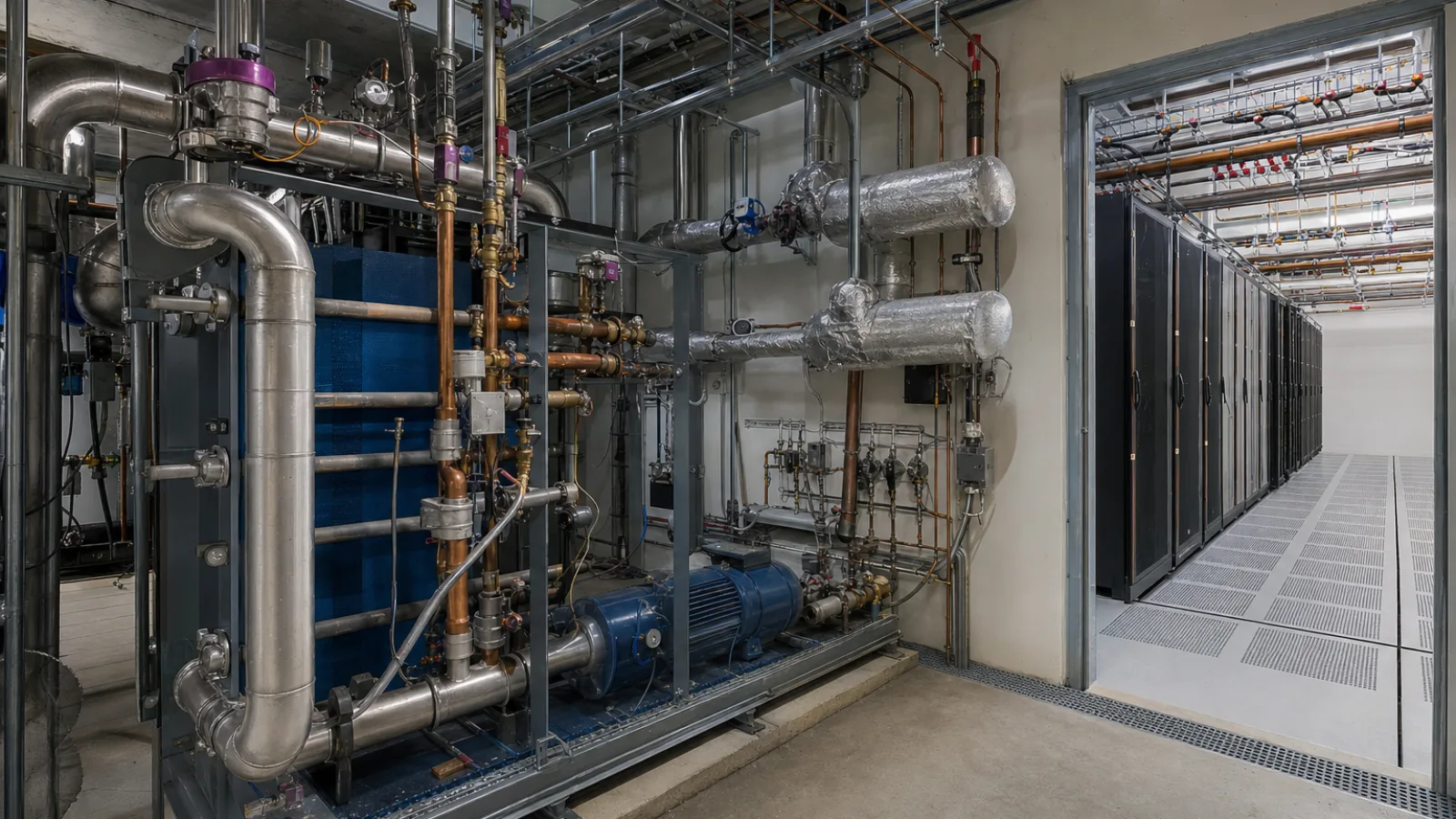
The most important change in data center cooling is no longer taking place only inside the server rack. As artificial-intelligence hardware pushes heat loads upward, operators are having to reconsider the entire chain: how heat reaches the facility water loop, how it is rejected, whether it can be upgraded to a useful temperature, and who can use it beyond the site boundary.
That makes data center liquid cooling a building-services issue as much as an IT equipment decision. Cooling distribution units, pumps, plate heat exchangers, controls, backup systems and heat-network interfaces increasingly need to be designed together. The practical question is no longer simply how to keep processors within their operating range. It is whether the resulting heat can be managed as an asset rather than treated solely as a waste stream.
Several signals point in that direction. The US Department of Energy’s COOLERCHIPS programme is aimed at improving cooling technologies for demanding computing environments, including systems capable of supporting very high rack-level loads. At the same time, reported interest in specialist cooling manufacturers, including reports that Samsung has considered acquiring US-based Modine, indicates how strategically important thermal management has become. These reports should be treated as market signals rather than confirmation of a completed transaction.
Why AI is moving cooling from air to liquid
Traditional data halls circulate air through raised floors, overhead systems or a combination of both. Computer-room air-handling units remove heat from the room, while chillers, dry coolers or evaporative equipment reject it outdoors. This arrangement remains practical for many conventional server loads, particularly where racks are moderately populated and the building was designed around air distribution.
AI accelerators change the design envelope. Their concentrated power draw produces more heat in a smaller physical area, making it harder to move enough air through the rack without excessive fan power, pressure drop and acoustic output. Air can still remove the heat, but the required airflow and cooling infrastructure may become disproportionate. Hot spots can also emerge before the average room temperature appears problematic.
Direct-to-chip cooling addresses this concentration by placing cold plates against the main heat-producing components, usually processors and accelerators. A water-glycol or treated-water loop carries heat away from the cold plates to a cooling distribution unit, commonly called a CDU. The CDU separates or manages the technology loop, controls flow and temperature, and transfers heat to the facility water system through a heat exchanger.
Immersion cooling takes a different approach. Servers or selected components are submerged in a non-conductive fluid. Single-phase systems retain the fluid in a liquid state, while two-phase systems use boiling and condensation to transport heat. Immersion can support high densities and reduce reliance on room airflow, but it changes maintenance procedures, hardware compatibility, fluid management, lifting arrangements and fire and environmental risk assessments.
Air, direct-to-chip and immersion cooling compared
No single cooling method is automatically suitable for every data center. The right choice depends on rack density, server design, water availability, energy targets, maintenance practice, floor loading, expansion plans and the condition of the existing mechanical plant.
| Cooling approach | Density potential | Water use | Retrofit difficulty | Typical building-services implications |
|---|---|---|---|---|
| Air cooling | Low to moderate, depending on airflow and rack design | None at the rack; may be used at cooling towers or evaporative heat rejection equipment | Lowest where air-handling and chilled-water systems already exist | Large airflow paths, containment, fan energy, room temperature control and potentially significant chiller capacity |
| Direct-to-chip cooling | Moderate to high; suitable for concentrated accelerator loads | Low at the server loop; facility water use depends on heat rejection equipment | Moderate to high, especially in occupied halls or mixed air/liquid environments | CDUs, pumps, filtration, leak detection, quick disconnects, heat exchangers and controls become critical |
| Immersion cooling | High, with the greatest change to server maintenance arrangements | Very low at the equipment; external heat rejection still determines wider water demand | High for existing facilities because tanks, service areas, fluid handling and hardware compatibility must be addressed | Tank layout, fluid management, extraction equipment, safety procedures and specialised service strategies |
The table describes general engineering tendencies, not guaranteed performance. Water consumption is particularly easy to misunderstand. A liquid-cooled rack may use little or no water directly at the server, while the connected cooling plant may still consume water if it relies on evaporative cooling towers. Conversely, a dry-cooled facility can avoid operational water consumption but may require more electrical or mechanical capacity in hot weather.
What a liquid cooling retrofit actually involves
Retrofitting direct-to-chip cooling is more than installing cold plates on new servers. Engineers must establish how the technology loop will connect to the facility water system, what fluid quality is required, how pressure will be controlled and how a leak will be detected before it reaches IT equipment.
A typical arrangement uses a CDU between the rack-side circuit and the building-side circuit. The unit may contain a plate-and-frame heat exchanger, pumps, expansion equipment, filters, sensors and control valves. The building loop supplies cooling water to the CDU; the CDU then circulates a separate, managed fluid through manifolds and cold plates. Separation helps protect servers from unsuitable chemistry, pressure fluctuations and contamination in the wider mechanical system.
Existing pipe routes are often the first construction constraint. A retrofit may need overhead distribution, new risers, additional plant-room headers or local pumping skids. Penetrations must be coordinated with fire stopping and water protection. The design also needs isolation valves and drainage points that allow a rack or row to be serviced without taking an entire hall offline.
Controls are equally important. The system must coordinate supply temperature, return temperature, pump speed, valve position, server load and the operating limits of the heat rejection plant. A low supply temperature can improve chip cooling but may increase condensation risk or reduce the opportunity to reuse heat. A higher return temperature can be valuable for heat recovery, but only if the IT equipment and cold-plate design support it.
For new facilities, these decisions can be embedded in the structural grid, plant-room layout and commissioning plan. For existing buildings, the engineering case may favour a phased deployment: a liquid-cooled test zone, a dedicated CDU, spare pipe capacity and an operating procedure for mixed air- and liquid-cooled racks.
How waste heat recovery connects to heat networks
Heat recovery begins with temperature, not just quantity. Data centers produce a large and relatively continuous heat stream, but the temperature of that stream may initially be too low for direct use in a district-heating network. The solution is usually a heat exchanger followed by a heat pump that raises the temperature to the level required by the network.
The basic chain is straightforward:
- Heat is collected from server cold plates, immersion tanks or the facility cooling loop.
- A heat exchanger transfers it to an intermediate water circuit, protecting the data center and heat-network systems from each other.
- A large heat pump increases the temperature and transfers the energy to the district-heating flow and return circuits.
- Controls match data center operation, heat-network demand, heat-pump capacity and available backup heat sources.
The useful temperature depends on the receiving network. A modern low-temperature network can accept heat more readily than an older system designed around much hotter water. If the network requires a high supply temperature, the heat pump must provide a larger temperature lift, which generally affects its coefficient of performance, electrical demand and project economics.
The connection also needs hydraulic separation, metering, isolation and redundancy. A data center cannot compromise its cooling availability because heat demand has fallen, and a district network cannot depend on a source that may be unavailable during maintenance. Heat recovery therefore works best as one element in a diversified heat supply, supported by thermal storage, auxiliary boilers, other low-carbon sources or sufficient network flexibility.
Bradford’s reported city heat-network development is a useful example of the direction of travel: heat networks are being planned as urban infrastructure capable of supplying multiple buildings rather than as isolated plant serving one property. For data center developers, that creates a potential commercial route for recovered heat, but only where the site, pipe network, demand profile and heat-pump economics align. A nearby heat network is not automatically a viable connection.
Why this matters to HVAC and construction teams
The growth of liquid cooling expands the opportunity for HVAC manufacturers, pump and CDU suppliers, controls companies and mechanical consultancies. It also changes the skills required during design and construction.
Mechanical engineers need to understand IT load profiles, rack manifolds and maintenance windows alongside familiar chilled-water calculations. Electrical engineers must coordinate the additional pump and heat-pump loads. Controls specialists need sequences that prioritise processor protection while allowing heat recovery when conditions permit. Commissioning teams must test low-load, peak-load, failure and changeover scenarios rather than relying only on room temperature readings.
Construction sequencing matters. A liquid-cooled hall may require pipe pressure testing, flushing, chemical treatment and leak detection before servers are energised. The clean installation of flexible connections and manifolds is not a cosmetic concern: poor alignment, unsupported pipework or inaccessible isolation valves can create maintenance and reliability problems later.
Owners should also distinguish between recoverable heat and theoretical heat. A facility may reject substantial thermal energy but still have no practical customer if the district network is too far away, seasonal demand is weak or the required temperature lift is expensive. A feasibility study should examine hourly data center load, network demand, pipe-route permissions, electrical capacity, plant redundancy, heat-pump operation and the commercial allocation of capital and operating costs.
Read cooling-market forecasts with caution
Commercial forecasts frequently place the data center cooling market at tens of billions of dollars within the next decade and assign it a double-digit compound annual growth rate. One widely circulated forecast from Wissen Research, for example, puts the market at approximately US$42 billion by 2031 and cites a 16.5% CAGR.
Such figures can help describe investor attention, but they are not engineering evidence. Market size depends on the report’s definition of cooling, geographic coverage, exchange-rate assumptions, replacement cycles and treatment of software, services and associated electrical equipment. Forecasts from vendors and market-research firms should therefore be read as scenario-based commercial estimates, not as proof that a particular technology will achieve a stated performance or adoption rate.
The stronger evidence is found in site-level requirements: measured rack loads, water and energy constraints, equipment warranties, network temperatures, available electrical capacity and the cost of construction. Those variables determine whether air, direct-to-chip, immersion or a hybrid arrangement makes sense on a particular project.
The next design decision is a system decision
Data center cooling is moving into the wider building-services conversation because heat no longer ends at the server. It passes through CDUs, pumps, heat exchangers, chillers, dry coolers and controls, and may ultimately enter a heat network serving homes, offices, hospitals or civic buildings.
That does not make waste heat recovery universal or automatically economical. It does mean cooling strategy should be considered early, alongside site selection, plant-room planning, utility capacity and the surrounding heat market. For AI-focused facilities, the most resilient approach may be a modular system that can support high-density liquid cooling today while preserving the hydraulic, control and spatial capacity needed for heat recovery tomorrow.