The Engineering of Site Safety: A Complete Guide to Trenching, Shoring, and Excavation
Excavation is one of construction's most hazardous tasks. This comprehensive guide details the engineering principles of trenching and shoring safety, from soil analysis and protective system selection to the critical role of the competent person in preventing collapses.
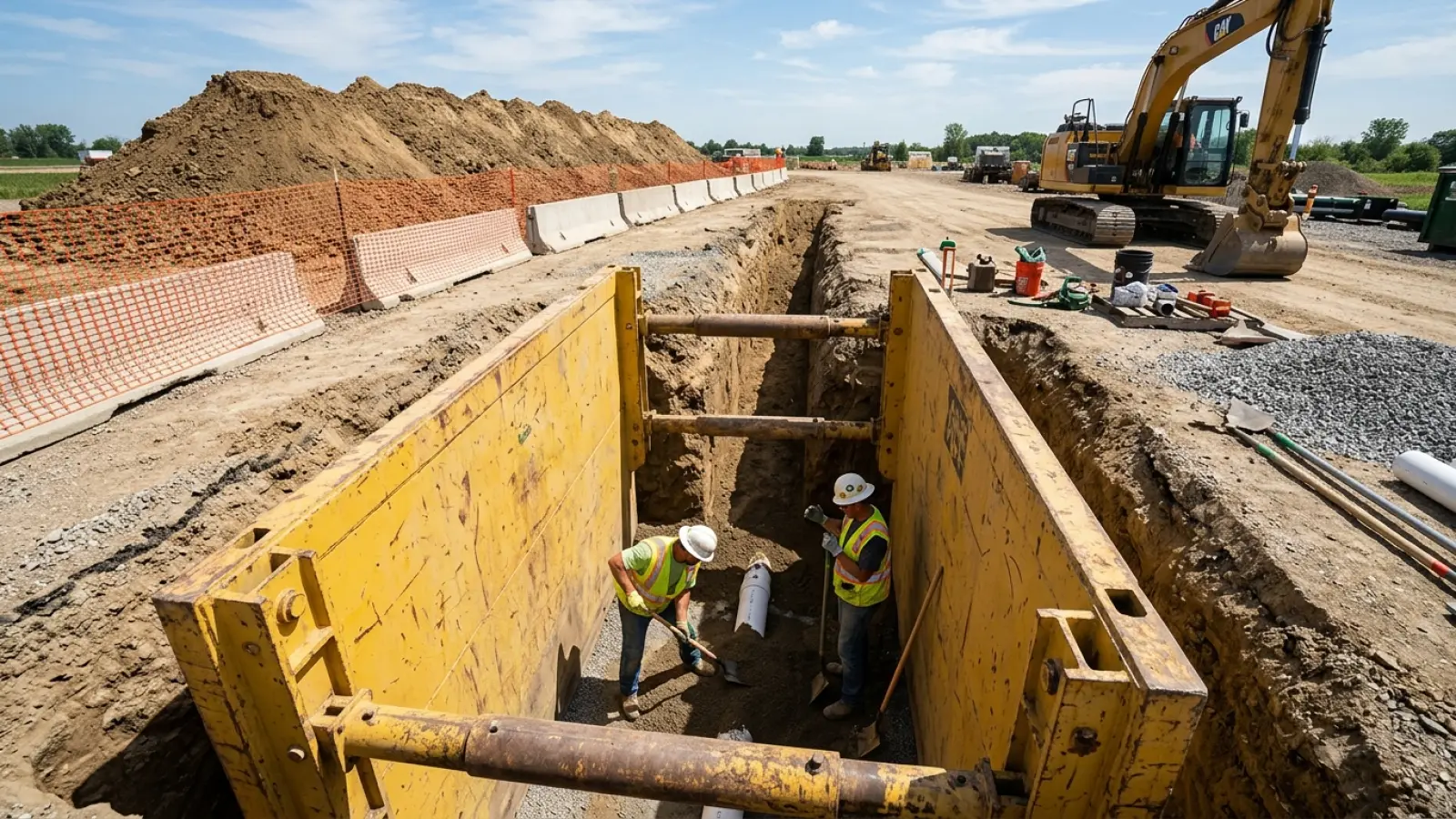
On any construction site, the act of digging a trench can appear deceptively simple. Yet, beneath the surface lies one of the industry's most profound and unforgiving hazards. Statistically, excavation work is one of the most dangerous activities in construction, with a fatality rate significantly higher than other phases of building. The purpose of this guide is to move beyond mere compliance and provide a systematic engineering and management approach to trenching and shoring safety, ensuring every worker goes home safe at the end of the day. Proper planning involves not just technique but also access to specialized trench safety equipment and a deep understanding of the forces at play. All trench collapses are preventable, but prevention requires knowledge, discipline, and an unwavering commitment to safety protocols.
Why Excavation is One of Construction's Most Hazardous Jobs
The primary risk in any excavation is the sudden, catastrophic collapse of trench walls. The sheer physics involved are staggering. A single cubic yard of soil can weigh between 2,700 and 3,500 pounds—roughly the weight of a mid-size car. When a trench wall fails, it doesn't crumble; it collapses with immense force and speed, often in a matter of seconds. This leaves workers with virtually no time to react or escape. Unlike other construction accidents where there might be a chance of survival, a trench collapse often results in burial and asphyxiation. The immense pressure of the soil makes rescue extremely difficult and dangerous for first responders. Understanding this raw power is the first step toward respecting the hazard and implementing the necessary controls for trench collapse prevention.
Understanding Soil Mechanics: Why Trenches Collapse
To engineer a safe excavation, one must first understand why soil fails. Soil is not a solid, uniform material; its stability depends on a complex interplay of internal forces. For a non-geotechnical engineer, the key concepts to grasp are soil cohesion and friction angle. Cohesion is the force that binds soil particles together, particularly prevalent in clay. The friction angle relates to how particles lock together, a key factor in granular soils like sand and gravel. The stability of a trench wall is a constant battle between these internal strengths and the downward force of gravity.
Several external factors can tip this balance toward failure. Water content is a critical destabilizer. It increases the weight of the soil and can reduce cohesion, creating hydrostatic pressure that pushes walls inward. Vibrations from nearby traffic, heavy machinery, or even pile driving can disrupt the interlocking of soil particles, reducing their frictional strength. Finally, the weight of excavated soil (known as the surcharge load) placed too close to the trench edge adds significant downward pressure, increasing the likelihood of a shear failure. A competent person must assess all these factors to understand the real-time risk profile of an excavation.
The Role of the "Competent Person" in Excavation Safety
According to regulatory bodies like the Occupational Safety and Health Administration (OSHA), a "Competent Person" is a mandatory requirement on any excavation site. This is not just a title; it's a critical safety function. An excavation competent person is defined as an individual who is capable of identifying existing and predictable hazards in the surroundings or working conditions which are unsanitary, hazardous, or dangerous to employees, and who has authorization to take prompt corrective measures to eliminate them.
Their specific responsibilities are extensive and non-delegable:
- Daily Inspections: They must inspect trenches daily and before the start of each shift, as well as after any event that could increase hazards, such as a rainstorm.
- Soil Classification: They are responsible for analyzing the soil to determine its type (A, B, or C) to inform the selection of protective systems.
- Protective System Design and Oversight: They must select and ensure the proper installation and maintenance of trench protective systems like shoring, shielding, or sloping.
- Hazard Identification: They must identify potential atmospheric hazards, issues with water accumulation, and unsafe surcharge loads.
- Corrective Authority: Crucially, they must have the management authority to immediately halt work and implement corrective actions, such as removing workers from a hazardous trench until it is made safe.
Step 1: Soil Classification (Types A, B, and C)
The foundation of all trenching and shoring safety is accurate soil classification for excavation. OSHA and other standards use a tiered system—Types A, B, and C—to categorize soils from most to least stable. This classification directly dictates the type and design of the required protective system. The competent person must perform at least one visual and one manual test to classify the soil.
| Soil Type | Description | Examples | Key Characteristics |
|---|---|---|---|
| Type A | Cohesive soils with a high unconfined compressive strength (1.5 tons per square foot or greater). | Clay, silty clay, sandy clay, hardpan. | Most stable. Can be sloped steeply. Becomes Type B if fissured, previously disturbed, or subject to vibration. |
| Type B | Cohesive soils with moderate strength (0.5 to 1.5 tsf); or granular cohesionless soils. | Silt, sandy loam, angular gravel, previously disturbed soils not classified as C. | Moderately stable. Requires less steep slopes than Type A. |
| Type C | Cohesionless soils with low strength (0.5 tsf or less). | Gravel, sand, loamy sand, submerged soil, or soil from which water is freely seeping. | Least stable. Prone to collapse. Requires the most conservative protective measures. |
Manual tests can include the thumb penetration test, where a competent person attempts to press their thumb into the soil, or using instruments like a pocket penetrometer or shearvane to get a quantitative strength reading.
Step 2: Choosing the Right Protective System
Once the soil is classified and site conditions (like proximity to structures, traffic, and water sources) are assessed, the competent person must select an appropriate protective system. This is a critical decision point where engineering principles meet practical application. It's important to note that for any trench 20 feet (6 meters) or deeper, the protective system must be designed by a registered professional engineer. This ensures that the complexities of deeper excavations, including higher soil pressures and potential for multiple soil layers, are properly accounted for in a formal engineering design.
Protective System 1: Sloping and Benching
Sloping involves cutting the trench wall back at an angle away from the excavation. The angle of the slope is determined by the soil type. Benching is a similar method that involves excavating the sides of an excavation to form one or more horizontal levels or steps, usually with vertical or near-vertical surfaces between levels. This is a simple and cost-effective method when the job site has enough space to accommodate the wide footprint of a sloped excavation. According to OSHA trenching and excavation standards, the maximum allowable slopes are 3/4:1 for Type A soil, 1:1 for Type B, and 1 ½:1 for Type C. A key rule is that benching systems are not permitted in Type C soil due to its inherent instability.
Protective System 2: Shoring Systems
Shoring is a proactive trench protective system designed to prevent a collapse from happening in the first place. It works by applying pressure to the trench walls to counteract the external soil and hydrostatic pressures. Designing a trench shoring system involves calculating these forces and selecting components strong enough to resist them.
Timber Shoring
This is the traditional method of shoring, built in place using timber components like uprights, wales, and cross braces. While effective, it is labor-intensive and requires a high degree of skill to install correctly. The design must be based on OSHA-approved tables or be engineered for the specific site conditions.
Hydraulic Shoring
Hydraulic shoring is a modern, efficient alternative that uses hydraulic pistons to extend aluminum or steel rails against the trench walls. These systems are pre-engineered, lightweight, and can be installed and removed quickly and safely from outside the trench, making them a popular choice for many utility and repair jobs.
Pneumatic Shoring
Similar to hydraulic systems, pneumatic shoring uses compressed air to activate pistons that extend shores against the trench walls. It operates on the same principle of applying active pressure to prevent soil movement and is another efficient, reusable option.
Protective System 3: Shielding Systems (Trench Boxes)
Shielding is a passive system that does not actively prevent a collapse but is engineered to protect workers from the crushing forces if a collapse occurs. The most common form of shielding is a trench box. These are heavy-duty structures, typically made of steel or aluminum, that workers can stand inside while performing their tasks. It's crucial to understand the difference: shoring prevents the collapse, while shielding protects workers if a collapse happens. Trench boxes are not designed to support the full pressure of a major collapse but to create a survivable space. They are often dragged along the trench as work progresses.
Essential Site Safety Protocols Before and During Excavation
Beyond the primary protective system, a robust safety plan includes numerous essential protocols that must be followed without exception:
- Call 811 / local utility location service: Before any digging begins, all underground utilities must be located and marked to prevent catastrophic strikes.
- Establish safe entry and exit points: Ladders, stairways, or ramps must be located within 25 feet of lateral travel for any worker in a trench 4 feet or deeper.
- Keep spoils and equipment back: Excavated soil and heavy equipment must be kept at least 2 feet from the trench edge to prevent surcharge load and material from falling onto workers.
- Conduct daily inspections: The competent person must inspect the excavation for any signs of distress, such as tension cracks, bulging, or seeping water, before every shift.
- Never work under suspended loads: Materials and equipment should never be lifted over workers in a trench.
- Ensure proper dewatering: Water must be controlled and removed from trenches. Dewatering systems must be monitored by the competent person to ensure they are functioning correctly.
Atmospheric Hazards in Trenches: More Than Just Collapse
While collapse is the primary hazard, trenches can also harbor dangerous atmospheric conditions. In excavations near landfills, sewers, chemical storage, or in areas with decaying organic matter, hazardous atmospheres can develop. These include oxygen deficiency (below 19.5%), the presence of toxic gases like hydrogen sulfide or carbon monoxide, or flammable vapors like methane. In any excavation where such hazards could reasonably be expected, the atmosphere must be tested before workers enter and monitored continuously. Proper ventilation or respiratory protection may be required.
Integrating Digital Tools for Safer Excavations
Modern technology is providing powerful new tools to enhance excavation safety. Ground-penetrating radar (GPR) offers a non-destructive way to identify underground utilities and anomalies before digging begins, supplementing official utility marking. Drones can be used for initial site surveys and monitoring excavation progress from a safe distance. For complex projects, specialized software for designing a trench shoring system can model soil pressures, surcharge loads, and structural requirements with a high degree of accuracy, allowing engineers to create more robust and efficient designs.
Conclusion: Building a Culture of Below-Ground Safety
The engineering of site safety for excavations is a non-negotiable discipline. It is a process that begins long before the first bucket of dirt is moved. It relies on a designated competent person excavation expert, a thorough analysis of the soil, and the correct selection and implementation of trench protective systems. While the statistics are sobering, the solution is clear: every trench collapse is preventable. By treating every excavation with the respect its inherent dangers demand and by rigorously applying these engineering and safety principles, we can ensure that the ground we break does not break us.
Frequently Asked Questions (FAQ)
What is the most common cause of trench collapse?
The most common cause is the failure to use an adequate protective system. This is often compounded by factors like changes in weather (especially heavy rain), vibrations from nearby traffic or equipment, and placing excavated soil (surcharge load) too close to the edge of the trench.
At what depth is a protective system required for an excavation?
According to OSHA standards, a protective system (sloping, shoring, or shielding) is required for any trench or excavation that is 5 feet (1.5 meters) deep or greater, unless the excavation is made entirely in stable rock. A competent person may require protection in shallower trenches if hazardous conditions exist.
Can a trench box be used in any type of soil?
Yes, a trench box (shielding system) can be used in any soil type (A, B, or C). However, its purpose is to protect workers in the event of a collapse, not prevent it. The box must be rated for the depth and pressures it will be subjected to, and workers must stay within the confines of the shield to be protected.
Who is responsible for inspecting a trench on a construction site?
The designated "Competent Person" is responsible for inspecting the trench and surrounding areas. This inspection must occur daily before the start of work, throughout the shift as needed, and after any hazard-increasing event like a rainstorm or vibration.
What's the difference between shoring and shielding?
Shoring is an active system designed to prevent a collapse by applying pressure to the trench walls to hold them in place. Shielding (like a trench box) is a passive system that does not prevent a collapse but is designed to protect workers inside it if a collapse occurs. Shoring stops failure; shielding provides a safe zone during a failure.