EI&C Contractors: What They Do in Industrial Plants
A single pump can depend on an MCC, a variable frequency drive, a PLC, a pressure transmitter and a flow meter, all installed by different people and shown on different drawings.
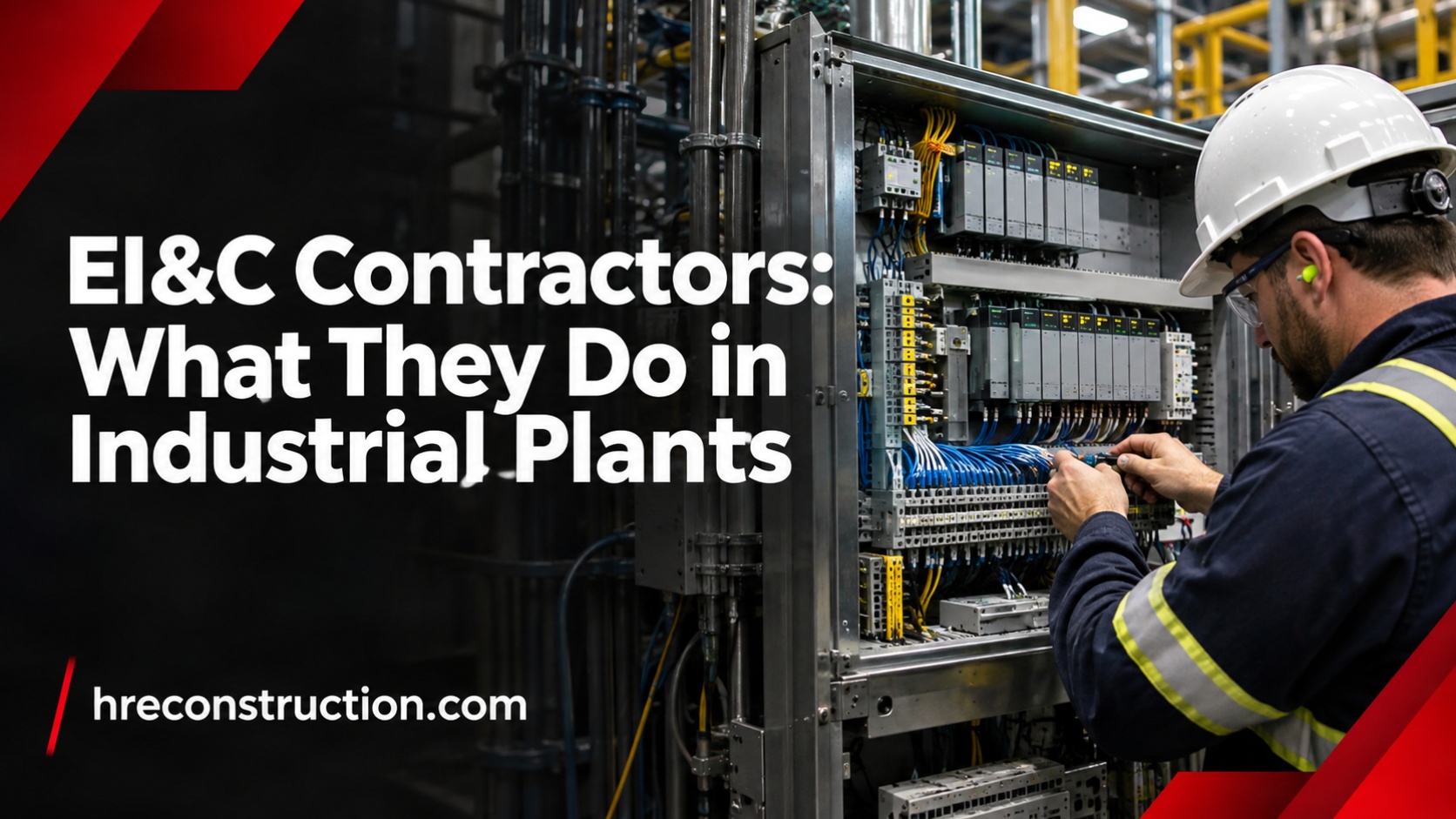
In an industrial plant, very little runs on power alone. A single pump can depend on an MCC, a variable frequency drive, a PLC, a pressure transmitter and a flow meter, all installed by different people and shown on different drawings. When those pieces don't line up, the problems usually surface at startup.
The work that ties them together is called EI&C: electrical, instrumentation and controls. It is also written as E&I, I&E or EC&I.
The Three Parts of EI&C
Electrical: Switchgear, transformers, panelboards, motor control centers, drives, feeders, raceway, grounding and lighting.
Instrumentation: Pressure, temperature, level and flow transmitters, analyzers, control valves and positioners, instrument tubing, junction boxes and calibration.
Controls: PLCs, distributed control systems, remote I/O, control panels, HMIs, plant networks, programming and integration.
Where Projects Go Wrong
According to a Control Engineering analysis of plant upgrades, EI&C design is rarely more than 10 to 15 percent of total capital cost, but it causes a disproportionate share of startup problems. In practice, most of those problems happen at the hand-offs between trades:
- Field wiring landed to an older drawing than the one the PLC programmer used
- A transmitter ranged one way in the field and scaled another way in the PLC
- Signal cable picking up noise because it shares a route with power cable
- Separate drawing sets from each trade that never get reconciled
When one EI&C team owns the scope, those interfaces stay with one group and one set of documents.
What a Full EI&C Scope Looks Like
- Design review: P&IDs, instrument index, I/O lists and loop diagrams, many of them following ISA-5.1 symbols and ISA-5.4 loop diagram practice.
- Panels: Industrial control panels under NEC Article 409, including a short-circuit current rating that meets the available fault current at the installation.
- Raceway and cable: Type TC tray cable for power and control, and Type ITC instrumentation tray cable under NEC Article 727 for circuits of 150 volts or less and 5 amperes or less. The 2023 NEC also reorganized power-limited circuits: Class 1 moved to Article 724, Article 725 now covers Class 2 and Class 3, and general cable requirements moved to Article 722.
- Instrument installation: Correct mounting, process connections and the right measurement technology for each service.
- Testing and commissioning: Insulation resistance testing, point-to-point I/O checkout, loop checks with range and scaling verification, drive setup and functional testing of interlocks and alarms.
- Turnover: As-built drawings, loop sheets, calibration records and program backups that match what is installed.
When One EI&C Team Makes Sense
A single EI&C scope is usually worth it when a project adds both power and process controls, when a PLC migration includes new field wiring, when a new line or skid has to start up on a tight schedule, or when drawings no longer match the field. For a small, single-trade job, one trade may be all you need.
About HRE Construction
HRE Construction provides industrial electrical installation, instrumentation installation, PLC programming and integration, and testing and startup services for manufacturing and processing facilities.
Read the full article, including questions to ask an EI&C contractor and a four-question FAQ, on the HRE Construction blog: https://hreconstruction.com/blogs
Planning an electrical, instrumentation and controls project? Contact HRE Construction: https://hreconstruction.com/contact-us