Industrial Waste Heat Recovery: How to Match Sources to Useful Demands
A practical guide to evaluating industrial waste heat recovery by matching source temperature, quality, timing, and location with useful process demands.
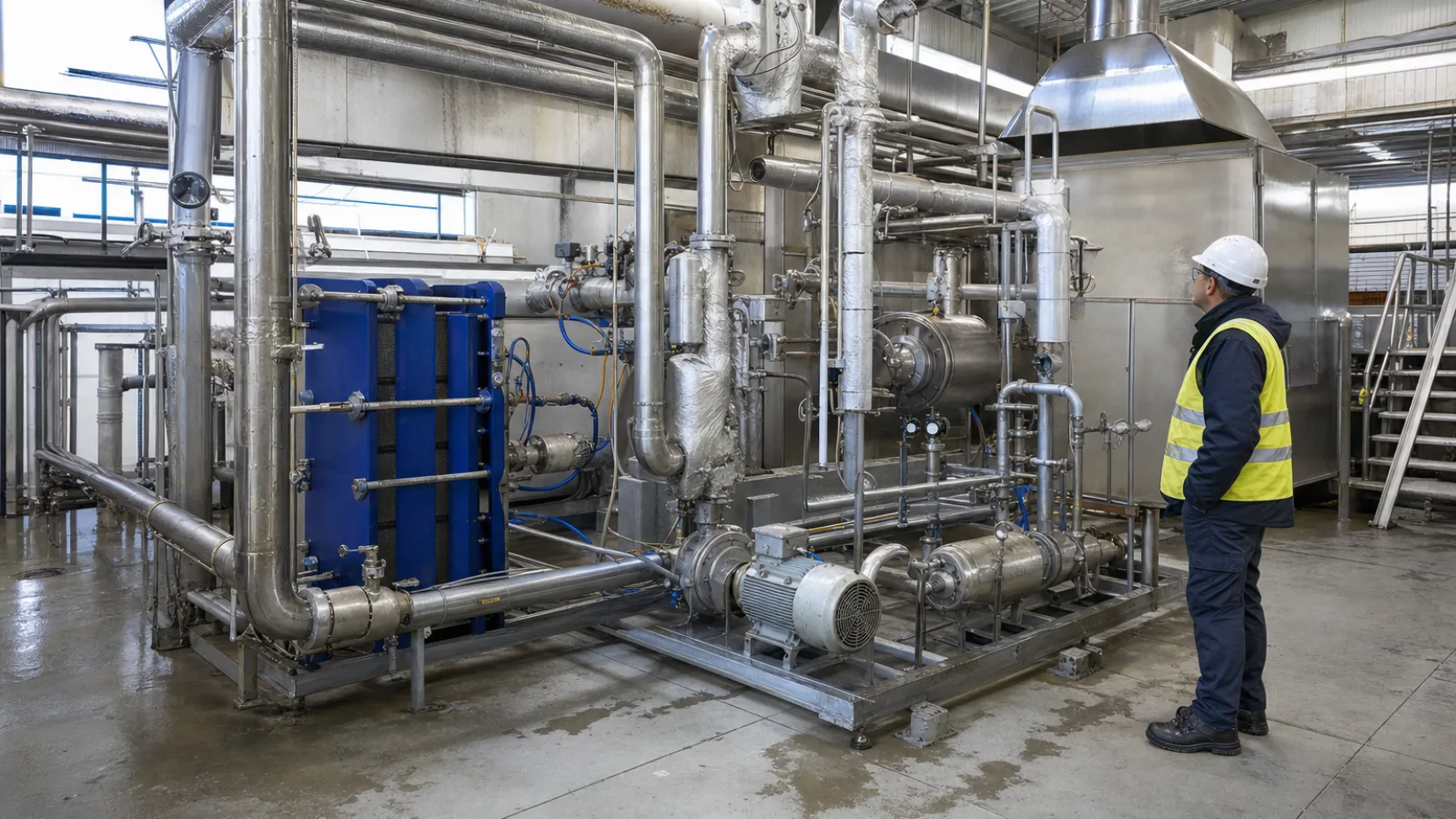
Industrial waste heat recovery is most valuable when a facility can connect a reliable heat source with a demand that needs the right temperature, at the right time, and in the right form. Exhaust gases, hot process water, condensate, cooling circuits, compressors, furnaces, kilns, dryers, and refrigeration systems may all contain recoverable energy. However, the presence of heat alone does not make a project practical. The recovery system must fit the process without reducing product quality, equipment reliability, or operating flexibility. Selecting industrial heat-transfer equipment is therefore only one part of a broader source-to-demand assessment.
A disciplined evaluation begins by mapping where heat is released and where heat is purchased or generated. It then compares temperature, flow, contamination, operating schedules, and control requirements. This approach helps teams prioritize opportunities that can deliver useful heat consistently rather than pursuing theoretical energy savings that cannot be integrated into production.
Key takeaways
- Start with a measured map of waste heat sources and process heat demands, not with equipment selection.
- Compare temperature, flow, contamination, operating schedules, and distance before estimating project value.
- Use direct heat exchange where possible; consider heat pumps or storage when temperature or timing does not align.
- Design for fouling, corrosion, pressure drop, bypass operation, maintenance, and production continuity.
- Verify savings against a documented baseline and include electricity, maintenance, downtime, and utilization in the business case.
What industrial waste heat recovery means
Waste heat is thermal energy discharged from a process, utility system, or piece of equipment without being used for its intended purpose. Common examples include hot flue gas leaving a furnace, warm cooling water from a compressor, flash steam from a condensate system, hot air from a dryer, and heat rejected by a chiller or refrigeration plant.
Recovery does not necessarily mean returning heat to the same process. A high-temperature exhaust stream might preheat combustion air, feedwater, raw materials, or a lower-temperature process. A warm water loop might support cleaning, space heating, boiler makeup-water preheating, or an industrial heat pump. The strongest opportunities often connect different parts of a facility through a cascade of temperature levels.
The practical question is not simply, “How much heat is available?” It is, “How much heat can be delivered to a useful demand without unacceptable cost, risk, or operational disruption?”
Start with a heat-source and heat-demand map
A heat map is a structured inventory of sources and sinks across the plant. Build it from measurements, operating records, process diagrams, and discussions with production and maintenance teams. Avoid relying only on equipment nameplate ratings or design conditions, because actual loads may vary with product mix, season, shift pattern, and production rate.
Record source conditions
For every potential source, document:
- Medium, such as exhaust gas, water, steam, oil, refrigerant, or process air.
- Inlet and outlet temperatures across the available recovery point.
- Mass flow or volumetric flow and how it changes over time.
- Operating hours, start-up behavior, shutdown periods, and batch cycles.
- Pressure, allowable pressure drop, and whether the stream is pressurized.
- Contaminants, moisture, particulates, oils, chemicals, or corrosive compounds.
- Existing heat losses, cooling requirements, and minimum outlet conditions.
Temperature should be treated as a profile rather than a single number. A flue-gas stream may be hot at the outlet but unsuitable for deep cooling if condensation creates an acidic or corrosive liquid. Similarly, cooling water may appear to offer a stable source while its temperature and flow fall whenever production slows.
Characterize useful demands
List heat demands using the same level of detail. Typical demands include boiler feedwater, hot-water generation, process baths, washing and sanitation, drying, evaporation, space heating, combustion-air preheating, thermal-oil systems, and low-temperature process loops.
For each demand, identify the required supply temperature, return temperature, flow, load profile, operating hours, and minimum acceptable capacity. Also note whether the demand is continuous, batch-based, seasonal, or dependent on a specific production line. A demand that requires high-temperature heat may not be served directly by a warm cooling circuit, but it could still be served through a heat pump or by using the warm circuit for a lower-temperature load.
Compare temperature and timing
Temperature compatibility is a first screening test. The source must be sufficiently hotter than the demand to provide useful heat through a heat exchanger. The required temperature difference depends on the exchanger type, approach temperature, fouling allowance, and control range. A source that is only slightly warmer than the target may require a large exchanger or a heat pump.
Timing is equally important. A continuous source paired with an intermittent demand may need a buffer tank or another sink. An intermittent source may be difficult to use unless it aligns with batch operations or can charge thermal storage. Mapping hourly or shift-level data is often more useful than comparing annual energy totals. Where the plant is complex, pinch analysis can help identify heat cascades and temperature-level mismatches before detailed design.
Screen opportunities before selecting equipment
Estimate recoverable heat
For a preliminary estimate of sensible heat, use:
Recoverable heat rate = mass flow × specific heat × usable temperature drop
For phase changes, steam, condensation, or evaporation, latent heat must also be considered. The usable temperature drop is not the full difference between the source inlet and ambient conditions. It must preserve process requirements, prevent unsafe condensation, maintain equipment limits, and leave enough temperature difference for heat transfer.
Apply availability and utilization factors to avoid overstating the opportunity. A source may be available for much of the year, while the receiving process operates only during selected shifts. Likewise, a nominal heat load may fall during partial production. Use measured profiles where possible and show the range between minimum, typical, and maximum operating conditions.
Consider quality, contamination, and distance
Heat quality includes more than temperature. A clean hot-water loop is easier to recover than a dirty exhaust stream containing dust, sticky compounds, or corrosive gases. Direct heat exchange may be inappropriate where a leak could contaminate a product, so an intermediate loop may be necessary. That additional circuit improves separation but adds pumps, heat exchangers, controls, and heat loss.
Distance also affects feasibility. Long pipe runs increase capital cost, pressure drop, insulation requirements, and maintenance exposure. A nearby lower-temperature demand may be more attractive than a distant demand with a higher theoretical heat load. Include routing, structural supports, access, drainage, expansion, and fire-rated penetrations in early estimates.
Match the recovery technology to the application
Technology selection should follow the source-to-demand match. No single solution is best for every industrial heat recovery project.
| Technology | Best fit | Important limitations |
|---|---|---|
| Heat exchanger | Direct transfer between compatible fluids with adequate temperature difference | Fouling, corrosion, cross-contamination risk, pressure drop, and limited temperature lift |
| Industrial heat pump | Upgrading low- or medium-temperature heat for a higher-temperature demand | Electricity use, refrigerant selection, lift limits, controls, and operating cost |
| Thermal energy storage | Separating source timing from demand timing or managing batch loads | Tank size, heat loss, footprint, stratification, insulation, and added controls |
| Heat-to-power system | High-temperature sources with limited direct heat demand and sufficient operating hours | Lower conversion efficiency, capital cost, maintenance, and electricity interconnection |
Heat exchangers
Heat exchangers are generally the simplest option when the source and demand are close in temperature and compatible in quality. Plate exchangers can provide high heat-transfer performance in compact spaces, while shell-and-tube units may be more suitable for high pressure, high temperature, or dirty services. Air-to-air and gas-to-liquid exchangers are common for exhaust recovery.
Designers should specify a realistic fouling factor, accessible cleaning surfaces, suitable metallurgy, and a bypass arrangement. A theoretical exchanger duty may not remain available if deposits cause the approach temperature to increase over time.
Industrial heat pumps
Heat pumps can make lower-grade sources useful by moving heat to a higher temperature. They are worth screening when a stable source exists alongside a steady demand and electricity is available at an acceptable cost. The evaluation should compare delivered heat from the heat pump with the cost of continuing to operate a boiler, direct heater, or other conventional system.
Pay attention to the required temperature lift. As the lift increases, equipment size, electricity consumption, and performance may change. The design should also account for standby modes where relevant, refrigerant safety, compressor turndown, water quality, and integration with existing backup heating.
Thermal energy storage
Storage can improve utilization when a source and demand operate on different schedules. Hot-water tanks are common for low- and medium-temperature systems, while phase-change materials or high-temperature media may be appropriate in specialized applications. Storage should be sized from time-series data rather than annual totals. A large tank that is rarely charged or discharged may add cost without improving recovery.
Heat-to-power systems
Organic Rankine cycle systems and other heat-to-power technologies can be considered when a high-temperature source has few practical heat sinks. They are usually less attractive than direct heat use because converting heat to electricity introduces an additional efficiency loss. Screen direct process integration first, then compare heat-to-power against the value of exported or behind-the-meter electricity.
Design around industrial constraints
Fouling, corrosion, and pressure drop
Fouling can reduce heat-transfer performance, restrict flow, increase fan or pump energy, and create unplanned shutdowns. Analyze source chemistry and particulate loading before selecting an exchanger. Options may include filtration, soot blowing, removable bundles, wider passages, sacrificial surfaces, cleaning-in-place systems, or an intermediate loop.
Corrosion risk must be assessed at the coldest surfaces, where condensation may occur. Materials should be selected for the actual chemical environment, not merely the bulk temperature. Pressure drop also deserves early attention because a recovery device installed in an exhaust or process line may increase backpressure and reduce the performance of fans, burners, compressors, or pumps.
Controls, bypasses, and production reliability
A recovery system should protect the primary process under normal, abnormal, and maintenance conditions. Typical provisions include automatic bypass dampers, three-way valves, temperature limits, high-pressure trips, differential-pressure monitoring, flow confirmation, and isolation valves. The original heat rejection or heating system should remain available when the recovery system is unavailable.
Controls should respond to production changes rather than simply maximizing recovered heat. For example, a storage tank may be full, a process demand may disappear, or a source temperature may fall below the useful range. A well-designed sequence prioritizes product quality and safe operation, then optimizes recovery within those limits.
Safety, materials, and maintenance access
Review pressure-boundary requirements, hot-surface protection, chemical exposure, combustible dust, confined spaces, electrical classification, and potential cross-contamination. Where process fluids could mix, use a double-wall exchanger, intermediate circuit, leak detection, or another appropriate safeguard.
Maintenance planning should cover tube or plate cleaning, filter replacement, pump seals, valve access, instrumentation calibration, insulation repairs, and spare parts. Equipment that cannot be inspected or isolated safely may create more operational risk than its energy savings justify.
Verify savings and build a bankable project case
Begin with a measurement plan. Install temporary meters or use existing instrumentation to establish source temperatures, flow rates, demand profiles, fuel consumption, electricity use, and operating hours. Record the production conditions associated with each measurement so the baseline can be normalized for throughput and product mix.
The financial model should include delivered energy savings, electricity consumed by pumps or heat pumps, maintenance, cleaning, downtime risk, controls, piping, civil work, insulation, commissioning, and replacement costs. Evaluate more than one operating scenario, including reduced production and source degradation from fouling.
After installation, verify performance using agreed boundaries and a defined baseline. Useful indicators include recovered heat, reduction in fuel use, reduction in purchased steam, heat-pump coefficient of performance, peak-load reduction, and hours when the system is available. Compare results at similar production rates and ambient conditions. A commissioning test should confirm not only energy performance but also stable temperatures, acceptable pressure drop, alarms, bypass operation, and safe failure modes.
Focused FAQ
What is the best first step in an industrial waste heat recovery project?
Create a measured source-and-demand map. Identify temperatures, flow rates, schedules, contaminants, and operating constraints before choosing equipment. This prevents the project from being driven by an attractive but unusable heat source.
How do I know whether a waste heat source is hot enough?
Compare the source temperature profile with the required supply temperature of the demand and allow for the exchanger approach temperature, fouling, pressure drop, and control margin. If the source is not hot enough for direct transfer, an industrial heat pump may provide the necessary temperature lift.
Can intermittent waste heat be recovered?
Yes, but the demand must align with the source or the system needs storage, an alternate sink, or a control strategy that accepts variable recovery. Time-series measurements are essential for sizing storage and estimating actual utilization.
When is heat-to-power preferable to direct heat recovery?
Heat-to-power may be appropriate when the source is sufficiently hot and consistent but there are few practical heat demands nearby. Direct use should normally be screened first because it avoids the conversion losses and additional equipment associated with generating electricity.
What commonly causes industrial heat recovery projects to underperform?
Common causes include overstated source temperatures, incorrect operating-hour assumptions, unaddressed fouling, insufficient temperature difference, poor control sequences, excessive pressure drop, and failure to account for production changes or maintenance downtime.
Conclusion
Successful industrial waste heat recovery begins with integration rather than equipment selection. By mapping heat sources and demands, comparing temperature and timing, accounting for contamination and distance, and protecting production reliability, project teams can separate practical opportunities from theoretical ones. Heat exchangers, heat pumps, thermal storage, and heat-to-power systems each have a role, but the right choice depends on the quality and behavior of the source and the requirements of the receiving process. Measurement, staged design, robust controls, and post-installation verification turn a promising heat balance into a dependable industrial energy project.
Sources
- U.S. Department of Energy, Waste Heat Recovery: Technology and Opportunities in U.S. Industry.
- U.S. Department of Energy, Advanced Manufacturing Office, technical resources on process heating systems and waste heat recovery.
- International Organization for Standardization, ISO 50001, Energy management systems — Requirements with guidance for use.
- U.S. Department of Energy, Improving Process Heating System Performance: A Sourcebook for Industry.
How to verify these figures yourself
Confirm source temperatures and flow rates with calibrated instruments, record conditions across representative production cycles, and calculate heat duty from measured data rather than nameplate capacity. Check exchanger performance, heat-pump electricity use, operating hours, and fuel or steam consumption against the same production conditions used to establish the baseline.