Propane Heat Pumps and Natural Refrigerants: What Chillventa 2026 Means for HVAC Design
The HVAC industry is moving from debating natural refrigerants to solving the practical design, safety and integration challenges they create.
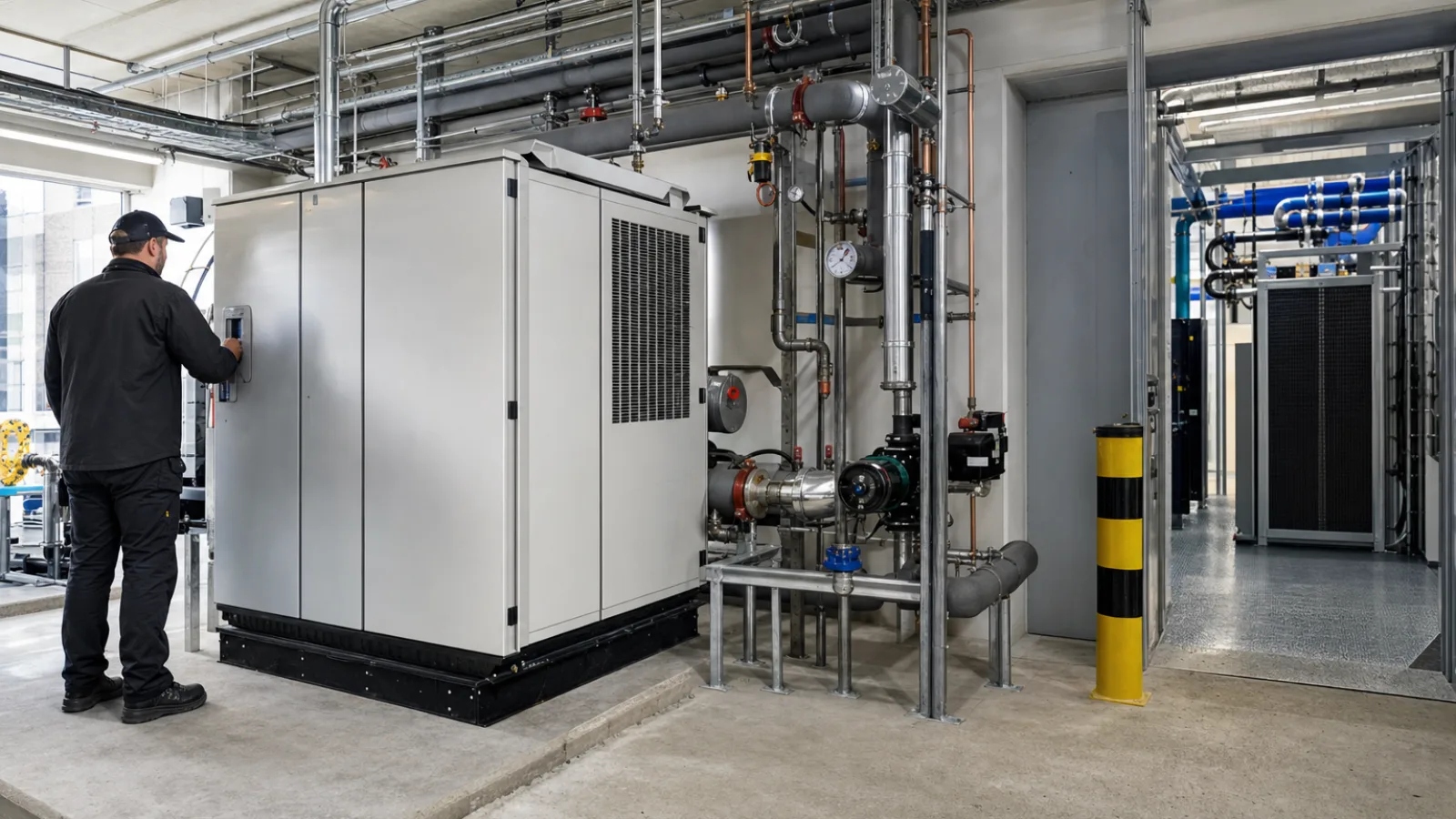
The key message from Chillventa 2026 was not simply that natural refrigerants are gaining attention. It was that manufacturers are designing equipment around them at useful commercial and industrial temperatures. An R290 heat pump capable of delivering 80°C outlet water at 0°C ambient, in a reported 30–400 kW range, illustrates how propane systems are moving beyond low-temperature applications. At the same time, large cooling concepts for AI factories are linking refrigerant selection with data center liquid cooling, electrical capacity and heat-rejection strategy.
These developments do not make propane the automatic choice for every project. R290, carbon dioxide and ammonia each impose different requirements for pressure management, charge control, ventilation, machinery-room layout, controls and compliance. For engineers, the practical question after the show is therefore not “Which refrigerant is most sustainable?” It is “Which refrigerant and system architecture provide the required temperature and capacity with an acceptable risk profile over the asset’s life?”
This article treats reported exhibitor performance and startup claims cautiously. Product selection still requires certified performance data, a refrigerant-charge assessment, local code review and project-specific commissioning.
Key takeaways
- R290 heat pumps are becoming credible options for high-temperature hydronic heating, but propane’s A3 flammability classification changes equipment location, charge and service requirements.
- CO2 can be attractive for hot-water production and heat recovery, while ammonia remains powerful for larger industrial systems; neither is universally more efficient.
- The reported Refra example—80°C leaving water at 0°C ambient and 30–400 kW—should be confirmed against a full rating table, not judged from a headline operating point.
- AI-factory cooling concepts and data center liquid cooling are pushing HVAC designers toward integrated plant, controls and heat-reuse decisions rather than isolated chiller selection.
- EN 378 is an important reference, but designers must also verify building, fire, pressure-equipment, electrical and occupational-safety requirements in the project jurisdiction.
Why Chillventa 2026 matters for HVAC design
Trade shows often reveal a technology trend before it appears in standard specifications. The signal from Chillventa 2026 was a shift from proving that natural refrigerants can work to packaging them into equipment that contractors and owners can actually deploy.
That shift has several consequences. First, the market is increasingly addressing higher leaving-water temperatures, which can support radiator retrofits, domestic hot-water preheating, process heat and lower-temperature industrial duties. Second, manufacturers are treating safety engineering as part of the product architecture: sealed or minimized refrigerant circuits, leak detection, ventilation, factory testing and prescribed service procedures. Third, cooling suppliers are designing around the heat density of AI computing, where liquid-cooled racks can alter the temperature levels, flow rates and redundancy requirements of the facility water system.
The reported Trane concepts for two 250 MW AI-factory cooling designs should be understood as large-scale design propositions rather than evidence that every data center needs a 250 MW cooling plant. At that scale, cooling equipment is inseparable from grid connection, heat rejection, water availability, standby generation and phased construction. The engineering lesson is the integration, not the headline capacity.
R290 heat pump performance: what the Refra example shows
Refra’s reported propane unit was presented as holding 80°C outlet water at 0°C ambient, with a capacity range stated as 30–400 kW. If confirmed under a defined rating condition, that is relevant to engineers working on high-temperature heat pumps for commercial buildings, district-energy substations and selected industrial processes.
However, a single outlet-temperature figure is not enough to establish suitability. A design review should request:
- Heating capacity and coefficient of performance at several source and sink temperatures;
- Whether the 80°C figure is continuous, a maximum, or dependent on supplementary heating;
- Compressor type, refrigerant charge and the physical arrangement of the propane circuit;
- Leaving-water temperature, return-water temperature, flow rate and allowable temperature glide;
- Defrost behavior, part-load performance and minimum operating temperature;
- Sound-power data, service clearances and requirements for leak detection or mechanical ventilation.
A high-temperature heat pump can reduce boiler use while retaining existing emitters, but higher condensing temperatures generally reduce efficiency. A building with oversized radiators and a 45–55°C design water temperature may achieve better annual performance than a building that demands 80°C continuously. The correct comparison is therefore seasonal system performance, including pumps, backup heat, defrost and distribution losses—not the maximum water temperature alone.
R290, CO2 and ammonia compared
| Refrigerant | Typical engineering strengths | Main hazards or constraints | Where it may fit |
|---|---|---|---|
| R290 propane | Good thermodynamic performance in many heat-pump duties; low global-warming impact; suitable for compact packaged equipment when charge is controlled. | A3 highly flammable refrigerant; ignition control, charge limits, ventilation, separation and service procedures are central design issues. | Packaged commercial heat pumps, hydronic systems, hot-water production and selected industrial heating applications. |
| CO2, R744 | Non-flammable classification, strong heat-recovery potential and effective hot-water production, particularly where high gas-cooler outlet temperatures are useful. | Very high operating and standing pressures; transcritical operation can be sensitive to gas-cooler conditions and control quality. | Domestic and commercial hot water, heat recovery, supermarkets and applications with a high temperature lift or simultaneous heating and cooling. |
| Ammonia, R717 | Excellent industrial refrigerant efficiency and heat-transfer characteristics; extensive operational experience in large systems. | Toxicity, mild flammability, machinery-room requirements, material compatibility and strict operating procedures. | Industrial refrigeration, district or process heating, and larger central plants with trained operators and controlled access. |
Safety classifications alone do not determine project risk. A small factory-sealed R290 system can present a different practical risk from a large ammonia plant, even though ammonia is often selected for industrial efficiency. Conversely, a CO2 system avoids flammable refrigerant but introduces pressure hazards that affect components, relief arrangements, commissioning and maintenance.
EN 378 provides a major framework for refrigerating systems and heat pumps, including safety and environmental requirements, system location, refrigerant charge and protection measures. It should be read alongside the adopted national edition and local rules. Depending on the project, the design may also fall under pressure-equipment legislation, fire codes, building regulations, machinery requirements, electrical rules and workplace exposure controls.
Natural refrigerants HVAC design: the safety work moves upstream
With R290, safety cannot be left to the service contractor after the plant room has been drawn. The design team must establish where a leak could travel, whether refrigerant could accumulate in a low point, how ignition sources are controlled and how occupants or technicians will be warned. Equipment selection should include the manufacturer’s charge limits and installation conditions, not just the nominal heating capacity.
Typical design measures may include refrigerant detection, forced ventilation, emergency isolation, suitable electrical equipment, restricted access and carefully located relief discharge. The exact combination depends on the system type, charge, occupancy, equipment location and applicable code. A packaged outdoor unit may simplify some hazards; it does not eliminate the need for a documented risk assessment.
Construction sequencing also matters. Penetrations, ventilation ducts, drainage, access zones and fire stopping should be coordinated before procurement. For retrofit projects, a survey should identify boiler-room constraints, nearby air intakes, occupied spaces and routes through which a leaked refrigerant could enter a building.
What AI-factory cooling means for data center liquid cooling
AI servers concentrate more heat in each rack than conventional enterprise equipment. Direct-to-chip liquid cooling uses cold plates and a liquid distribution system to remove heat close to the processors. It can reduce the dependence on room air as the primary heat-transfer medium, but it does not remove the need for a complete cooling plant. Heat still has to be transferred through a coolant distribution unit, chiller or heat-recovery loop and finally to the environment.
A useful real-world reference is the liquid-cooled Frontier supercomputer at Oak Ridge National Laboratory. Its design demonstrates the principle of circulating liquid close to high-power computing hardware rather than relying solely on room air. It is a supercomputing installation rather than a typical commercial data center, so its architecture should not be copied without qualification. The transferable lesson is that cooling distribution, controls, leak management, maintenance access and computing availability must be designed as one system.
For a new AI facility, engineers should establish the required supply and return temperatures for the server cooling loop before choosing chillers or heat pumps. Higher return temperatures can improve heat-rejection and heat-recovery opportunities, while strict supply-temperature requirements may increase compressor lift. Redundancy must cover not only chillers but also pumps, heat exchangers, controls, valves and the liquid-cooling distribution path.
Claims such as Pascal’s reported 20% efficiency gain should be treated as unproven until the company publishes a defined baseline, boundary conditions, measurement method, climate, load profile and independent validation. “Efficiency” may refer to compressor power, cooling-plant energy, rack-level power usage or total facility energy. Those are not interchangeable metrics.
Engineer’s selection checklist
- Define the load: document capacity, source temperature, leaving-water temperature, return temperature, annual load profile, turndown and simultaneous heating or cooling demand.
- Compare seasonal performance: request certified or test-based data across the actual climate and operating envelope, including auxiliaries, defrost and backup heat.
- Screen the refrigerant: compare R290, CO2 and ammonia for flammability, toxicity, pressure, charge, maintenance capability and likely code pathway.
- Complete a location study: assess plant-room volume, outdoor clearances, air intakes, occupied spaces, drainage, relief discharge and access for replacement.
- Confirm compliance: identify the applicable edition of EN 378 and all national fire, pressure, building, electrical and occupational-safety requirements.
- Design the water side: coordinate flow rates, hydraulic separation, buffer volume, water quality, freeze protection, heat exchangers and control valves.
- Plan service and emergency response: specify detection, isolation, ventilation, alarms, training, personal protective equipment and recovery procedures.
- Test the business case: include electricity tariffs, gas or boiler displacement, peak demand, carbon costs, maintenance, refrigerant policy and expected equipment life.
- Verify vendor claims: require test conditions, rating tables, independent certification where applicable, reference installations and a clear definition of every efficiency metric.
Construction and investment implications
Natural refrigerants can improve long-term regulatory resilience, but they may increase early design effort. Owners should budget for specialist review, authority approvals, operator training, detection systems and commissioning. Contractors need clear responsibility boundaries between the heat-pump supplier, controls integrator, electrical contractor and building-services team.
For investors, the important risk is not only refrigerant regulation. It is whether the building can operate efficiently at realistic temperatures and partial loads. A high-temperature heat pump installed on a poorly balanced distribution system may underperform even when its laboratory rating is strong. In data centers, the equivalent risk is procuring liquid-cooled IT hardware without reserving space, redundancy and maintenance procedures for the associated coolant infrastructure.
Frequently asked questions
Is R290 more efficient than CO2 or ammonia?
Not universally. Efficiency depends on source and sink temperatures, climate, part-load operation, heat recovery, system architecture and controls. R290 can perform strongly in many heat-pump duties; CO2 can be advantageous for hot water and heat recovery; ammonia is often compelling in larger industrial systems.
Can an R290 heat pump really produce 80°C water?
Some equipment is reported to do so under defined conditions. The engineer must confirm capacity, COP, return temperature, ambient range, duration and whether supplementary heat is involved. Maximum outlet temperature is not the same as efficient continuous operation.
Is CO2 automatically the safest natural refrigerant?
CO2 is generally classified as non-flammable, but its very high pressure creates important mechanical and operational hazards. It can also displace oxygen in an enclosed space. A project still requires pressure protection, detection where appropriate, ventilation and trained service personnel.
Does EN 378 approve a particular refrigerant installation?
No. EN 378 provides requirements and guidance for refrigerating systems and heat pumps, but compliance depends on the complete design and the rules adopted in the project jurisdiction. Authorities may apply additional fire, pressure, building or workplace requirements.
Will liquid cooling eliminate chillers in AI data centers?
Usually not. Liquid cooling changes how heat is collected and distributed. The facility still needs heat exchangers, pumps, controls and a method of rejecting or reusing heat. It may enable higher coolant temperatures and different plant configurations, but it does not remove the thermal balance.
Sources
- European Committee for Standardization, EN 378 series: Refrigerating systems and heat pumps—Safety and environmental requirements.
- International Organization for Standardization, ISO 817: Refrigerants—Designation and safety classification.
- Oak Ridge National Laboratory, Frontier supercomputer technical and project information, including its liquid-cooling architecture.
- Chillventa, official exhibition information and 2026 event materials.
- Manufacturer product literature and exhibition material for the Refra R290 heat-pump example and reported Trane AI-factory cooling concepts; performance claims require project-specific verification.
How to verify these figures yourself
Ask each supplier for the complete rating table, test standard, boundary conditions and definition of capacity or efficiency. For the Refra example, verify the 30–400 kW range and 80°C outlet-water point against a signed technical datasheet. For large AI-factory claims, request the design basis, cooling-load definition, redundancy topology and whether the figure describes IT load, cooling capacity or total facility capacity. For startup efficiency claims, require an independent comparison using the same climate, load profile and system boundary.