How to Select PMI Foam Core for Lightweight Structural Applications
A practical engineering guide to selecting PMI foam core for lightweight sandwich structures based on density, structural loads, manufacturing processes and performance requirements.
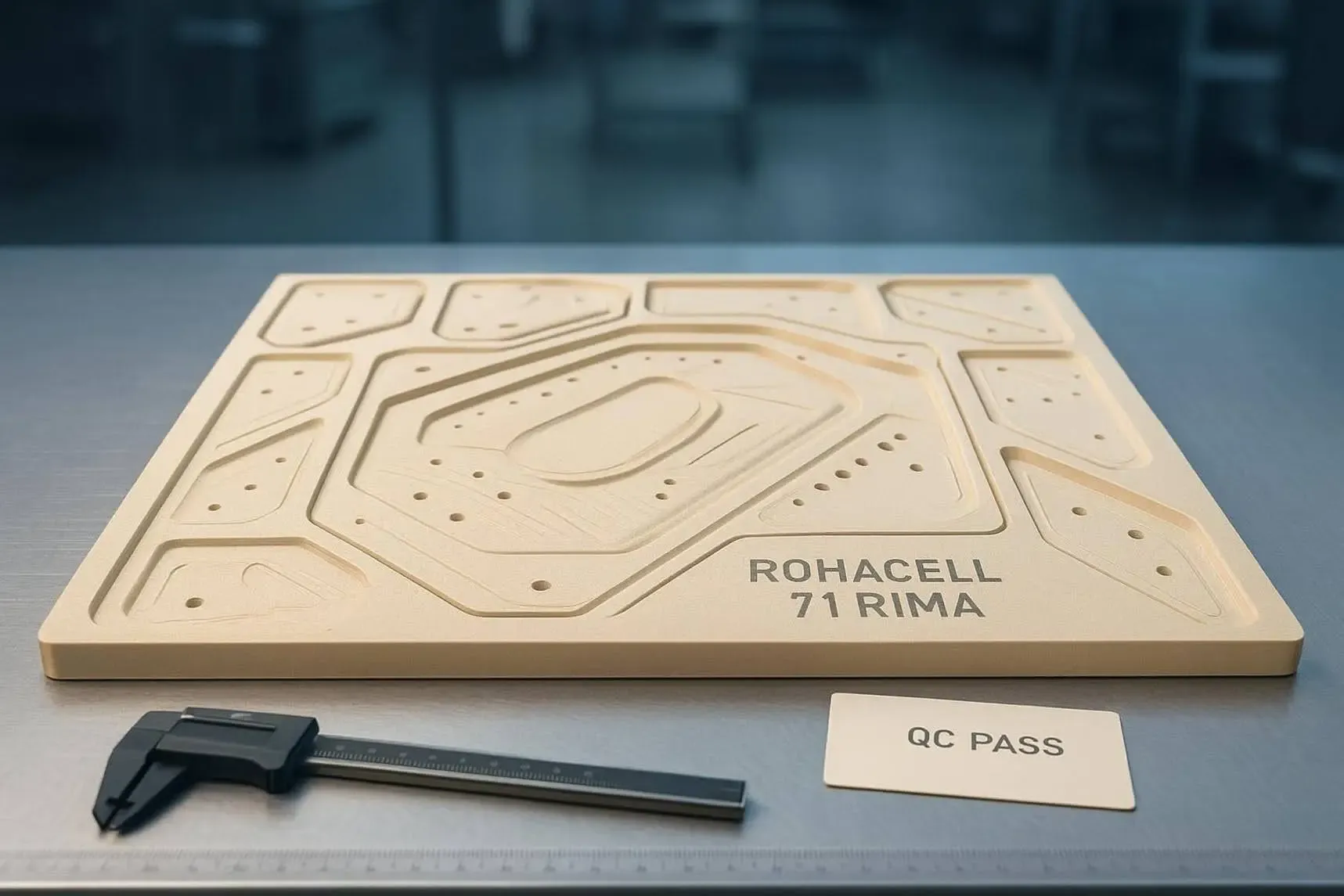
Selecting the right polymethacrylimide (PMI) foam core for a lightweight structure starts with identifying how the sandwich laminate could fail. Engineers may need to check core shear, flatwise compression, local skin wrinkling, fatigue, or several of these conditions at once. The selected core must also suit the thermal, chemical, and manufacturing conditions. Density alone is not enough. A sound choice balances resin uptake, cell structure, design allowables, and dimensional stability at high temperatures during autoclave or infusion processing. By connecting each load path to certified material allowables and maintaining a strong skin-to-core bond, engineers can reduce structural weight while limiting the risk of early laminate failure.
Sandwich construction uses the core to carry transverse shear, support thin skins against out-of-plane buckling, and keep the skins separated across curved or complex shapes. When you Order PMI Foam Core at Chem-Craft, choosing the correct density and formulation provides the base for high strength-to-weight performance in demanding service conditions. This guide explains how to review, compare, test, and specify PMI foam core for structures where low weight and dependable performance are required.
Define the Structural Requirements Before Selecting PMI Foam
Set Weight, Stiffness, Strength, and Safety Targets
Material selection begins by turning the main system requirements into clear panel dimensions and performance targets. Designers need to set limits for overall deflection, natural frequency, and total assembly weight. These targets help establish the needed core thickness and show whether the design is controlled by stiffness, such as panel bending stiffness (EI), or by strength, such as face-sheet or core failure.
Safety factors must follow the rules for the intended industry. Examples include aerospace requirements under FAR/CS 25, marine rules from DNV GL, and automotive crash standards. Practical reduction factors also account for normal material variation, manufacturing defects, environmental exposure, and loads introduced at local points.
Identify Compression, Shear, Tensile, and Fatigue Loads
Sandwich cores do not see one simple type of stress. They experience combined stresses in three directions. Core shear is often the main load in a bending member because it carries transverse forces across the panel. Compression can act across the whole face of the panel or at small areas under fasteners and line contacts. Out-of-plane tension, also called flatwise tension, tests the internal strength of the core and its resistance to separation from the skins.
Dynamic fatigue loads also need review. Vibration, wave impact, and aerodynamic buffet can repeat shear stress millions of times. These cycles may cause small buckling events in the cell walls. Fatigue performance should be checked over the expected number of cycles so that operating stresses stay below the long-term endurance limit of the material.
Account for Operating Temperature, Moisture, Chemicals, and Impact
The service environment determines whether a PMI grade will keep its starting properties over time. Designers should record the highest service temperature, how long that temperature may last, and the expected humidity. Heat combined with moisture can lower the effective glass-transition temperature and speed up viscoelastic creep.
Possible chemical exposure also needs a compatibility review. Examples include hydraulic fluids, de-icing chemicals, aviation fuel, motor oil, and industrial solvents. Impact threats from dropped tools, runway debris, hail, or bird strikes set the minimum damage tolerance. The selected core must limit hidden delamination and crushing after an impact.
Confirm Laminate Design, Skin Materials, and Core Thickness
A core cannot be reviewed by itself because its behavior depends on the skin laminates. High-modulus carbon fiber skins can create higher shear stress at the skin-core interface than lower-modulus glass fiber skins. Core and face-sheet thicknesses must be balanced so the panel resists global buckling without causing local shear failure at the bond line.
Core thickness controls the section modulus of the sandwich panel. A thicker core can greatly increase bending stiffness with little added mass. A core that is too thick, however, may create larger out-of-plane shear deformation or make edge tapering harder. The full composite cross-section should be modeled to confirm that the core meets stiffness needs and fits the available aerodynamic or packaging space.
Match PMI Density and Grade to the Load Case
How Lower-Density PMI Grades Reduce Weight
Lower-density PMI grades are commonly made in the 50 kg/m³ to 75 kg/m³ range, including 51 and 52 kg/m³ formulations. They offer major mass savings in secondary structures, interior bulkheads, and lightly loaded fairings. These very light cores work best where overall bending stiffness and deflection control matter more than concentrated shear, point loads, or severe impact.
Low density also brings mechanical limits. In lighter grades, the ratio of shear yield to tensile yield can be around 0.50. This shows that the cell walls are thin and may buckle early under compression or shear. Low-density cores should not be used under point loads or heavy fastener pull-out forces unless solid inserts or other local support are added.
When Higher-Density PMI Grades Improve Strength and Damage Tolerance
Panels that must handle strong out-of-plane impacts, high-shear edge closeouts, or structural hardpoints may need grades from 110 kg/m³ to 205 kg/m³. As density rises, the cell walls become thicker and the internal structure changes. The main failure mode can shift from elastic cell-wall buckling to stable, gradual plastic crushing.
This change can improve compression-after-impact (CAI) strength and impact energy absorption. Instead of puncturing or breaking suddenly, the higher-density foam crushes gradually under the impact. It spreads energy over a larger area, keeps the face sheet more intact, and limits local skin wrinkling during later in-plane compression.
Compare Density, Compressive Strength, Shear Strength, and Modulus
The table below shows representative properties for common aerospace-grade PMI foam cores:
|
Nominal Density (kg/m³) |
Compressive Strength (MPa) |
Compressive Modulus (MPa) |
Shear Strength (MPa) |
Shear Modulus (MPa) |
|
52 |
0.8 |
75 |
0.8 |
24 |
|
75 |
1.7 |
105 |
1.3 |
38 |
|
110 |
3.6 |
180 |
2.4 |
70 |
|
205 |
9.0 |
350 |
5.0 |
150 |
Moving from a 52 kg/m³ core to a 205 kg/m³ core raises compressive strength by about ten times and shear strength by more than six times. The moduli rise in a similar way. This shows why the core density should match the main stress condition. A core that is too light may fail, while one that is too dense adds weight and cost without a structural need.
Use Design Allowables Instead of Density Alone
A frequent mistake is to choose a core density from the average values on a product data sheet. Average values come from controlled laboratory tests and do not show the full variation between production batches or the loss of properties during long service.
Certified aerospace and other high-consequence structures should use statistical design allowables. These are often B-basis values, which represent a 90% probability with 95% confidence, or A-basis values, which represent a 95% probability with 99% confidence. The values include reductions for environmental conditioning, hot/wet service, production variation, and processing history. This helps prevent the finished part from failing below the advertised stress level.
Select Grades for Thin Skins, Thick Sandwich Panels, and Localized Loads
Very thin composite skins, such as one- or two-ply carbon prepregs, can fail through local wrinkling. If the core has too little out-of-plane shear modulus, the skin may wrinkle into or away from the core at a low compressive stress. A higher-density or fine-cell grade can give the skin more support and delay this instability.
For thick sandwich panels with cores from 50 mm to 100 mm, a lower-density foam may meet bending requirements over most of the span. Local high-load areas, such as hinges and bolted inserts, need a different solution. Engineers may add a higher-density PMI block, a locally densified area, or a potted compound ring to resist pull-out without increasing the mass of the entire panel.
Check PMI Compatibility with Manufacturing Processes
Determine Compatibility With Epoxy, Polyester, Vinyl Ester, and Thermoplastic Resins
PMI cores are generally chemically compatible with structural thermosets such as amine-cured epoxies, bismaleimides (BMI), polyimides, cyanate esters, and vinyl esters. The closed-cell polymer does not normally disrupt resin reaction rates or soften and crack when exposed to reactive styrene or cross-linking catalysts.
High-temperature thermoplastics such as PEEK, PEKK, and PPS can be processed above 340°C. This is higher than the breakdown temperature of standard PMI chemistries. In advanced thermoplastic structures, PMI is usually added through secondary bonding with a modified epoxy film adhesive or through a co-consolidation process that uses a lower-melt polyaryletherketone system.
Select a Grade for Prepreg, Wet Lay-Up, Infusion, RTM, and Autoclave Curing
Each production method places different heat, pressure, and fluid-flow demands on the core:
- Autoclave Prepreg Processing: Uses aerospace-grade PMI, such as ROHACELL WF or an equivalent, with high creep resistance for autoclave pressures of 0.3-0.7 MPa and cure temperatures up to 180°C.
- Vacuum-Assisted Resin Transfer Molding (VARTM) / Liquid Resin Infusion: Uses microporous, very fine-cell grades, such as RIMA variants, to limit resin movement into open surface cells and avoid added resin weight.
- Resin Transfer Molding (RTM): Needs a core that can handle mold clamping pressure and fast resin flow without cell distortion or erosion at the edges.
- Wet Lay-up and Room-Temperature Vacuum Bagging: May use a standard industrial PMI grade because the processing loads are lower, which can reduce material cost.
Check Cure Temperature, Pressure, and Dimensional Stability
During autoclave or heated-press consolidation, heat softens the polymer walls while compaction pressure pushes on the cells. If the core’s compressive creep resistance at the cure temperature is lower than the applied pressure, the foam can crush permanently. This changes the part shape, creates local skin wrinkles, and pushes resin into the collapsed cells.
The core’s time-temperature-pressure limits must match the resin cure schedule. Heat-stabilized grades, including XT or heat-treated versions, may handle pressures up to 0.7 MPa at temperatures near 190°C. Before production, the core should be dried using a validated method. Removing absorbed moisture limits vapor formation during heating, which can otherwise cause blisters or push the skins away from the core.
Plan Machining, Contouring, Perforation, and Bonding Operations
PMI is uniform in all directions and can be machined with high-speed 5-axis CNC routers, carving tools, saws, and sanders. It cuts cleanly with little tearing, fiber pull-out, or edge chipping. This makes it possible to hold close dimensions, including about ±0.1 mm, on aerodynamic contours, chamfered edges, and internal pockets.
For curved parts, PMI can be thermoformed between about 170°C and 220°C. Uniform heating softens the foam so it can be pressed against a tool with compound curves. It then keeps the new shape after cooling. For liquid infusion, suppliers such as Chem-Craft can provide the core with surface grooves and grid perforations that help distribute resin without heavy external flow media.
Prevent Crushing, Resin Starvation, Voids, and Core Print-Through
Resin uptake can reduce the weight advantage of a light foam core. CNC machining cuts through surface cells and leaves small open cavities. If coarse-cell foam is infused with low-viscosity resin under vacuum, the resin can fill these cavities and add a large amount of extra mass, often 500 to 1,000 g/m².
Microporous PMI grades with cell sizes from 0.05 mm to 0.3 mm can lower resin uptake to about 50 to 100 g/m². Fine cells also reduce core print-through. This defect occurs when the shape of coarse cells shows through very thin surface plies under high cure pressure. Fine-cell PMI helps preserve a smooth Class-A surface on exterior aerospace and automotive parts.
Select PMI Foam for Specific Lightweight Structural Applications
Aerospace Panels, Aircraft Interiors, and Unmanned Aerial Vehicles
Commercial and military aircraft use PMI cores in fuselage fairings, wing control surfaces such as ailerons, flaps, and elevators, landing gear doors, and engine nacelles. These parts need high stiffness, resistance to acoustic fatigue from jet engines, and reliable processing during standard 180°C epoxy prepreg cures.
PMI also supports lightweight airframes, radomes, and high-aspect-ratio wings in unmanned aerial vehicles (UAVs) and urban air mobility (UAM) aircraft. Electric and autonomous aircraft have strict weight limits because lower mass helps extend flight time. PMI provides high structural performance while allowing complex aerodynamic shapes.
Space Structures and Satellite Components
Space hardware faces launch vibration, intense acoustic shock, repeated thermal cycles, and strict vacuum outgassing limits. PMI cores are used in launch vehicle fairings, interstage adapters, satellite solar-array substrates, and antenna reflectors.
PMI’s low thermal conductivity, stable dimensions, and low outgassing help satellite panels keep their shape and avoid releasing condensable material that could contaminate optical or electronic sensors. Its largely uniform structure also makes finite element analysis easier for launch load cases.
Automotive, Motorsport, and Electric Vehicle Components
PMI provides stiffness and impact protection in Formula 1 monocoques, aerodynamic diffusers, and electric vehicle battery enclosures. In battery packs, it can support a light, rigid underbody shield against road debris while also reducing heat and noise transfer between the battery cells and cabin.
In motorsport, the foam absorbs a large amount of impact energy for its mass, helping protect the driver area during high-speed crashes. Gradual cell-wall crushing absorbs kinetic energy, limits cabin intrusion, and keeps the vehicle light for better acceleration, braking, and handling.
Wind Turbine Blades and Renewable Energy Structures
Offshore wind turbine blades now exceed 100 meters in length, making blade mass and fatigue major design concerns. Balsa and PET remain common in lower-stress trailing-edge areas, while PMI is increasingly used in shear webs, blade roots, and high-load spar caps.
PMI’s long fatigue life helps it resist shear-related cell buckling through tens of millions of rotations. This supports reliable service in offshore locations where repairs are expensive and difficult. Engineers can also vary PMI density along the blade to match shear demand and limit face-sheet wrinkling during high wind gusts.
Marine Hulls, Decks, and High-Speed Vessels
High-speed ferries, naval patrol boats, and racing yachts experience strong hull slams and repeated wave impact. PMI sandwich construction can reduce the mass of the upper structure, lower the vertical center of gravity, and improve stability, speed, and fuel use.
Marine panels may suffer skin punctures, but PMI’s closed-cell, non-wicking structure limits water movement through the core. Water is less likely to cause saturation, freeze-thaw damage, or internal skin separation. This helps the vessel retain its light weight and buoyancy over its service life.
Specify the Final PMI Foam Core for the Application
Document Density, Thickness, Grade, Tolerances, and Surface Condition
The final specification should list every physical and structural feature needed for consistent production. It should state nominal density, commercial grade, sheet thickness, and allowed dimensional variation. Precision CNC-machined stock may have a thickness tolerance of about ±0.15 mm.
Drawings should also describe the surface condition. They may call for sanded surfaces to improve adhesion, CNC-machined pockets, through-thickness vent holes, or surface grooves that help distribute resin during liquid infusion.
Record Resin System, Cure Cycle, Laminate Schedule, and Processing Limits
Engineering drawings and process documents should identify the approved resin system, prepreg type, and structural adhesive film. They should also list heating rates, dwell temperatures, maximum autoclave pressure, and cooling requirements.
Clear processing limits prevent operators from changing a cure schedule in a way that harms the core. If the core needs a pre-bake, such as drying at 100°C for several hours to remove moisture, that step must appear in the work instructions. This helps prevent blisters during high-temperature consolidation.
Define Performance Requirements, Standards, and Acceptance Tests
Purchase documents should state the quality standards and acceptance tests for incoming material. They may reference ASTM, ISO, or DIN procedures for density, including ASTM D1622, flatwise compression under ASTM C365, and core shear modulus under ASTM C273.
For flight-critical structures, the specification should include lot-acceptance testing (LAT) limits. Each incoming lot must meet these limits before release to production. Clear pass/fail rules help block substandard material and provide protection if a supplier changes the formulation without notice.
Confirm Supplier Capacity, Quality Controls, and Lifecycle Support
Before approving the final material, engineering and purchasing teams should review the supplier’s production capacity, testing resources, and long-term business position. The supplier should have a quality system supported by AS9100 or ISO 9001 certification. It should also have change-control rules that require customer notice before changing chemical formulations or foaming processes.
Long-term supply support matters for programs that run for decades, including commercial aircraft, military equipment, and offshore energy systems. Long-term supply agreements and approved secondary distributors can help maintain access to high-performance core material, limit the effect of market changes, and keep composite production running.