Excavation Dewatering Methods: Sumps, Wellpoints, or Deep Wells
Selecting an excavation dewatering system requires more than comparing excavation depth. Soil permeability, groundwater behavior, settlement sensitivity, discharge constraints, construction sequencing, and contingency planning all influence whether sump pumping, wellpoints, deep wells, eductor wells, cutoff systems, or a hybrid approach is most appropriate.
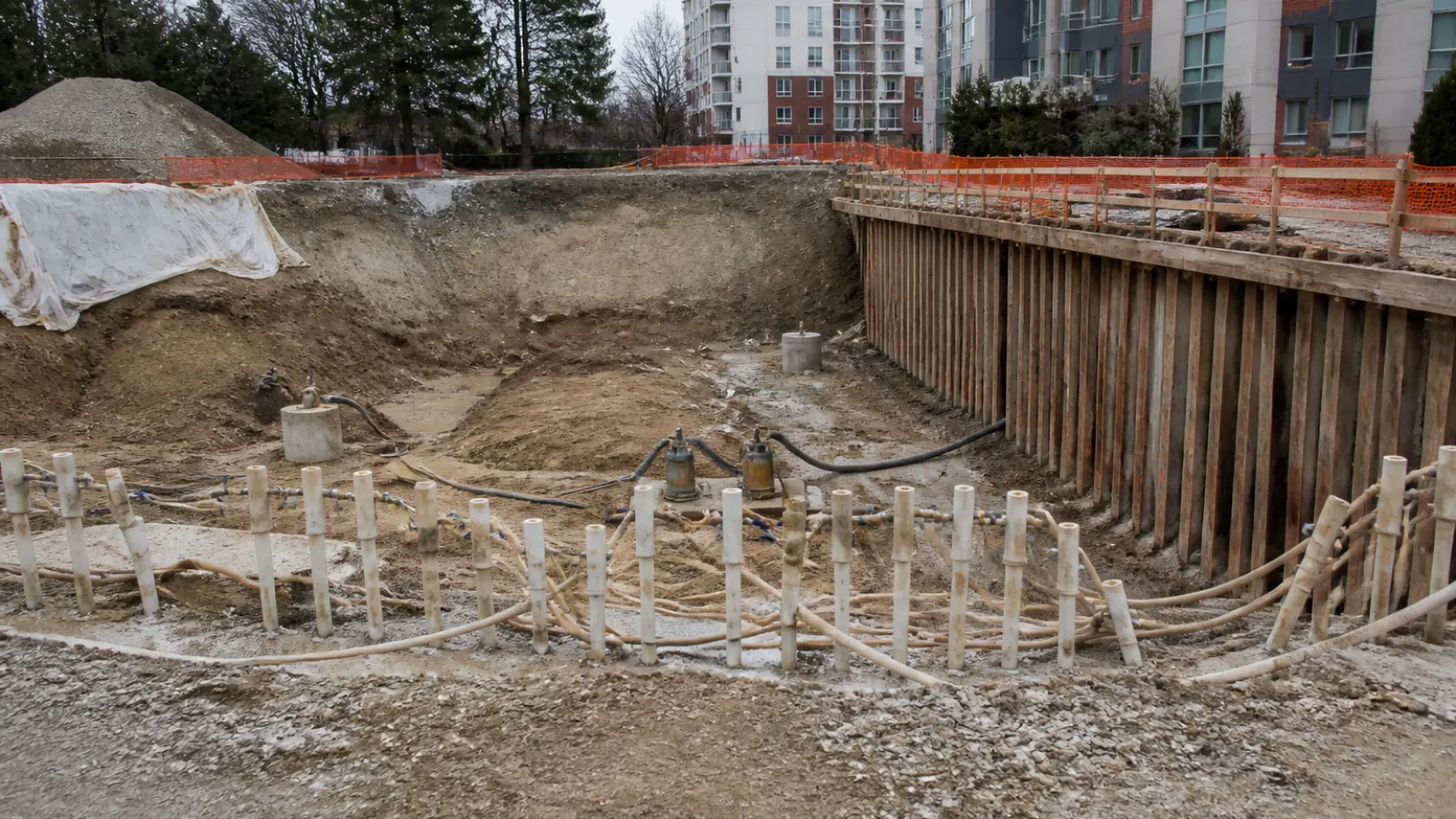
Excavation dewatering is the controlled removal or exclusion of groundwater so below-grade construction can proceed in a stable, workable environment. Groundwater control should be considered before excavation begins because the selected system can affect shoring design, excavation sequencing, foundation performance, discharge approvals, and the condition of adjacent property.
The appropriate arrangement depends on more than excavation depth alone. Soil permeability, aquifer conditions, groundwater levels, pumping rates, drawdown limits, settlement risk, and site access all influence the selection of construction dewatering pump systems, including pump duty points, solids-handling requirements, reliability, standby capacity, and suitability for actual site conditions. This article compares sump pumping, wellpoint dewatering, deep wells, eductor wells, cutoff systems, and hybrid approaches.
What excavation dewatering is designed to achieve
A dewatering system is designed to lower groundwater levels, control seepage, and maintain conditions suitable for excavation and construction. Depending on the project, objectives may include:
- Lowering the groundwater table below the excavation base or working level.
- Reducing inflow through excavation faces, joints, permeable strata, or the base.
- Maintaining a stable excavation base and reducing the risk of piping, boiling, or uplift.
- Protecting workers, excavation equipment, reinforcement, formwork, and stored materials.
- Providing workable conditions for subgrade preparation, blinding concrete, foundations, slabs, and waterproofing.
Groundwater lowering is not the same as surface-water management. Diversion berms, drainage channels, temporary covers, and stormwater pumps address rainfall and runoff, while dewatering addresses groundwater entering from below or through the excavation sides. Waterproofing is also different: membranes, waterstops, joint systems, and drainage composites limit water entry into the completed structure but do not necessarily make an open excavation dry or stable.
Inadequate groundwater control can produce piping, boiling, base instability, erosion, muddy working conditions, construction delays, and loss of bearing capacity. Uncontrolled drawdown can also mobilize fines, lower pore pressures outside the excavation, and contribute to groundwater settlement affecting nearby foundations, utilities, pavements, or other assets.
Site information required before selecting a method
Soil and rock permeability
Permeability controls how readily water moves toward a pumping point. Clean sands and gravels generally transmit water efficiently, making distributed wellpoints or deep wells practical where sufficient drawdown is required. Silts and clays transmit water much more slowly. In those materials, conventional pumping may have limited influence beyond the immediate well or sump, and pore-pressure dissipation may control the construction sequence.
Fractured rock can behave differently from intact rock. Water may move rapidly through joints, faults, bedding planes, or solution features while the surrounding rock matrix remains relatively tight. Investigation should identify the continuity and orientation of these pathways, as well as any perched water or water-bearing seams. Grain-size distribution, hydraulic conductivity, stratification, and aquifer testing may be needed to estimate inflow and drawdown response.
Groundwater levels and flow conditions
Initial groundwater readings should be evaluated alongside seasonal variation, recent rainfall, nearby pumping, tides, surface-water levels, and recharge sources. A short observation period may not represent the conditions that will occur during the full construction period.
The investigation should determine whether groundwater is unconfined, perched, or confined. Confined or artesian conditions can create upward pressure beneath an excavation base even when the visible water level is relatively low. Recharge from rivers, lakes, leaking utilities, irrigation, or adjacent excavations may sustain inflow after pumping begins. The required drawdown should be defined at specific elevations and locations rather than expressed only as a general desire for a dry excavation.
Excavation geometry and construction sequence
Depth, footprint, bottom elevations, side slopes, shoring, internal obstructions, and available working space affect where wells, headers, pumps, and discharge lines can be installed. A broad excavation may need a distributed system, while a shaft or narrow trench may be controlled with localized pumping or a cutoff arrangement.
Staging is equally important. Wells or wellpoints may need to be installed before excavation and operated in stages as the excavation advances. The system must remain accessible while bracing, anchors, underpinning, foundations, and slabs are installed. The expected duration of pumping matters because equipment reliability, maintenance access, energy use, and discharge management become more significant during long construction periods.
Settlement and environmental constraints
Drawdown outside the excavation can reduce pore-water pressures in compressible or loose soils. If surrounding soil consolidates or densifies, nearby foundations, utilities, pavements, historic structures, and buried services may experience settlement or movement. The risk is influenced by the drawdown radius, soil compressibility, groundwater duration, and sensitivity of neighboring assets.
Investigations should also identify contaminated soil or groundwater, wetlands, streams, lakes, protected habitats, and other environmental constraints. A method that removes large volumes of groundwater may be unsuitable if it spreads contamination, affects a wetland, or creates unacceptable off-site drawdown. Cutoff systems, recharge measures, staged pumping, or treatment may be required to control these effects.
Discharge, permits, and water quality
Discharge planning should begin before pumps are selected. The receiving system must have sufficient hydraulic capacity, and the discharge route must remain practical throughout excavation. Water quality may require testing for turbidity, suspended solids, hydrocarbons, metals, salts, nutrients, or other site-specific constituents.
Depending on location and receiving environment, approvals may be required for discharge to a storm system, sanitary system, surface water, ground, or off-site treatment facility. Requirements can address flow, pH, turbidity, contamination, sampling, reporting, and treatment. The design should account for energy supply, noise, freezing, hose or pipe routing, settling tanks, filtration, and the consequences of a blocked or unavailable discharge route.
Main excavation dewatering methods
Sump pumping
Sump pumping collects water in excavated pits, trenches, drainage channels, or temporary collection points and removes it with pumps. It is often effective for shallow or moderate seepage, surface runoff, localized inflow, coarse granular soils, and work where some water can be allowed to enter the excavation before collection.
The main advantages are simplicity, flexibility, and relatively low installation effort. Sumps can be moved as excavation progresses and can supplement another system during rain or isolated leakage. However, they do not necessarily lower groundwater levels throughout the surrounding soil. Pumping may be ineffective where inflow is high, the base is sensitive, or groundwater enters through fine soils and carries sediment.
Improperly placed sumps can cause fines migration, erosion, piping, loss of subgrade material, and local instability. Where the structural subgrade must remain undisturbed, sumps should be separated from the final foundation footprint by drainage trenches, sacrificial excavation, filter materials, well-graded aggregate, or other engineered details. Pump intakes should be protected against sediment and should not be allowed to scour the base. Sump pumping is a construction control measure, not a substitute for analysis where uplift, piping, or base heave is possible.
Wellpoint systems
A wellpoint system uses closely spaced small-diameter screened points connected by a header pipe to a pump. Vacuum-assisted systems can improve collection where groundwater must be drawn toward the points and where air entry or fine soils affects performance. Points are commonly installed around the excavation perimeter or in internal rows, with the system staged as excavation advances.
Wellpoint dewatering is generally suited to permeable soils where water can move readily to multiple closely spaced points. It can provide relatively uniform drawdown along trenches, foundations, and larger open excavations, while allowing the pumping arrangement to follow the excavation sequence. Installation can be comparatively efficient when access permits driving or jetting the points before excavation.
Limitations include reduced effectiveness in very low-permeability soils, difficulty achieving drawdown beneath low-permeability layers, air leakage, clogged screens, and the need for continuous header and pump operation. The appropriate spacing, filter design, suction arrangement, and staging depend on soil gradation, target drawdown, excavation geometry, and the expected inflow. General depth or flow rules should not replace project-specific analysis.
Deep wells
Deep well dewatering uses larger-diameter wells equipped with submersible pumps. Wells are positioned outside or around the excavation, and each well can remove a substantial volume of groundwater from the aquifer. This method is often considered for deeper excavations, high-flow conditions, thick permeable deposits, or sites where drawdown must occur before excavation reaches the groundwater-bearing layer.
Deep wells can reduce the number of pumping points and keep pumps outside the main work area. They may also provide effective regional drawdown when well spacing, screen length, pumping capacity, and aquifer connectivity are appropriate. Their effectiveness depends on the aquifer test results and on whether low-permeability layers, recharge boundaries, or isolated water-bearing zones restrict flow to the wells.
Installation requires drilling, well development, filter-pack or screen design, pump sizing, electrical distribution, discharge routing, and access for maintenance. Deep wells can be less effective in silts, clays, or fractured formations with limited connectivity. Because their influence may extend beyond the excavation, monitoring for settlement, neighboring water-level changes, and environmental effects is particularly important.
Eductor or ejector wells
Eductor wells use high-pressure water circulated through an eductor assembly. Venturi action creates suction that draws groundwater into the well and carries it back through the return system. This arrangement can be useful in lower-permeability soils where conventional gravity-flow wells or wellpoints do not provide sufficient drawdown.
Eductor systems can be installed as multiple small wells and may provide control where pore pressures must be reduced over a broad area. They are operationally more complex than basic sump pumping and require high-pressure pumps, return lines, appropriate nozzles, and continuous attention to hydraulic balance. Energy consumption, heat generation, maintenance, noise, and sensitivity to clogged components should be included in the design and contingency plan.
Cutoff and exclusion methods
Cutoff systems reduce groundwater inflow rather than simply pumping water away. Slurry walls, secant pile walls, diaphragm walls, sheet piles, grout curtains, cutoff trenches, and embedded barriers can limit horizontal seepage into an excavation. They are frequently combined with internal sumps, wellpoints, relief wells, or localized pumping.
A cutoff may reduce the required pumping rate, limit drawdown outside the excavation, and integrate with excavation support. Its performance depends on continuity, embedment, joint treatment, keying into a low-permeability layer, and control of defects or leakage paths. Constructability, underground obstructions, vibration, spoil handling, wall tolerances, and sequencing can affect the final hydraulic performance.
Cutoff walls do not automatically eliminate groundwater problems. Water can pass beneath the cutoff, through seams, around terminations, or through construction joints. Internal water pressure and base uplift must still be checked, and pumping may be required to manage residual seepage. The preferred solution may therefore be a cutoff with targeted internal dewatering rather than a fully exclusion-based system.
Excavation dewatering methods comparison
| Method | Best-fit ground conditions | Typical strengths | Key limitations | Important controls |
|---|---|---|---|---|
| Sump pumping | Localized seepage, runoff, and relatively permeable ground | Simple, flexible, and easy to relocate | May not lower regional groundwater; can mobilize fines | Filtered sumps, erosion control, sediment management, base protection |
| Wellpoints | Permeable sands and granular strata needing distributed drawdown | Uniform control along excavation edges and staged installation | Less effective in very low-permeability soils; depends on vacuum and header integrity | Point spacing, screen selection, vacuum monitoring, standby pumping |
| Deep wells | Thick aquifers, deeper excavations, or higher groundwater inflow | High-capacity regional drawdown with pumps outside the work area | Requires drilling, testing, power, and settlement monitoring | Aquifer response, well development, flow measurement, redundancy |
| Eductor wells | Lower-permeability soils requiring pressure reduction | Can draw pore water through small-diameter wells | Energy-intensive and operationally complex | High-pressure circulation, nozzle condition, return flow, alarms |
| Cutoff systems | Sites where inflow or off-site drawdown must be limited | Reduces seepage and can form part of excavation support | Leakage, underseepage, constructability, and residual pumping remain possible | Continuity, embedment, joints, leakage inspection, internal relief |
How to choose the right dewatering system
A practical selection sequence should connect the groundwater objective to the construction method:
- Establish the target water level and allowable inflow. Define the required level at the excavation base, working surface, foundation formation, or shaft, and identify acceptable seepage during each stage.
- Characterize soil, rock, aquifer, and recharge conditions. Use borings, piezometers, permeability information, groundwater observations, and, where warranted, pumping or aquifer testing.
- Estimate pumping demand and drawdown influence. Assess inflow from the sides and base, rainfall and runoff, leakage through shoring, recharge, well interference, and the likely area affected by drawdown.
- Check settlement and neighboring-asset risks. Evaluate groundwater settlement, vibration, underpinning requirements, utility sensitivity, contaminated areas, and acceptable movement criteria.
- Confirm discharge quality, permits, treatment, and receiving capacity. Include turbidity control, settling, filtration, contamination treatment, sampling, and an alternate route if the primary discharge becomes unavailable.
- Coordinate with shoring and construction sequence. The system must work with sheet piles, diaphragm or secant walls, anchors, bracing, underpinning, excavation stages, foundation placement, and waterproofing.
- Select equipment and redundancy. Size pumps, headers, wells, filters, power supplies, controls, discharge lines, standby pumps, generators, fuel, alarms, and spare parts around the required duty point and credible failure conditions.
- Review installation, commissioning, and removal. Confirm access for drilling or point installation, well development, testing, startup, maintenance, decommissioning, and sealing of temporary wells.
Hybrid systems are often appropriate. Examples include cutoff walls with internal sumps, wellpoints supplemented by localized sump pumps, deep wells combined with a low-permeability barrier, or eductor wells used in a less permeable layer while sumps handle surface water. The best arrangement is the one that meets the hydraulic and construction objectives without creating unacceptable effects outside the site.
Monitoring and operational controls
Monitoring should begin before pumping so baseline groundwater levels and nearby conditions are documented. Piezometers or observation wells can track water levels inside and outside the excavation. Flow meters help confirm actual pumping rates, while turbidity and other water-quality checks verify discharge performance.
Settlement markers, survey points, crack gauges, inclinometers, and utility or structure observations may be needed where neighboring assets are sensitive. Operators should record pump runtime, discharge pressure, water levels, flow, alarms, maintenance, fuel, and inspection results. Discharge lines, tanks, filters, sumps, wellheads, electrical connections, and backup equipment require routine inspection rather than reliance on visual observations from the excavation alone.
A trigger-action-response plan should define normal ranges, warning thresholds, and required actions. For example, a rising piezometric level, falling pump flow, increasing turbidity, or unexpected settlement may trigger inspection, reduced excavation advance, additional pumping, discharge treatment, engineering review, or emergency stabilization. Trends are more informative than isolated readings, particularly when rainfall, excavation depth, or pumping stages change.
Common failure modes and contingency planning
Common problems include clogged wellpoints, poorly developed wells, pump failure, loss of electrical power, unexpected recharge, artesian pressure, heavy rainfall, sediment carryover, blocked discharge lines, freezing, overheating, and inadequate standby capacity. A system that works during initial excavation may not remain adequate as the excavation deepens or as seasonal groundwater conditions change.
Contingency planning should be specific to the site. Depending on risk, provisions may include redundant pumps, emergency generators, automatic level alarms, temporary storage tanks, alternate discharge routes, spare motors and wear parts, additional wellpoints, predrilled contingency wells, backup hoses, and fuel reserves. Operators should know how to isolate a failed component without shutting down the entire system.
Escalation procedures should identify who can authorize additional pumping, a temporary change in excavation sequence, discharge treatment, or emergency protection of the base. If artesian pressure, boiling, piping, or rapid inflow occurs, excavation may need to stop while the system and stability assessment are revised. Contingency planning is most effective when tested through commissioning checks and documented response drills.
Focused FAQ
What are the main excavation dewatering methods?
The main methods are sump pumping, wellpoint systems, deep wells, eductor or ejector wells, and cutoff or exclusion systems. Projects often combine two or more methods.
When is sump pumping appropriate?
Sump pumping is appropriate for manageable seepage, surface water, localized inflow, and relatively stable granular ground. It is less suitable where pumping could erode the base, mobilize fines, or fail to control regional groundwater.
Are wellpoints or deep wells better for a deep excavation?
Neither is universally better. Wellpoints may suit distributed drawdown in permeable soils, while deep wells may suit deeper or higher-flow excavations with a connected aquifer. Soil layering, aquifer testing, access, settlement risk, and required drawdown determine the choice.
Can dewatering cause settlement outside an excavation?
Yes. Lowering pore-water pressures can consolidate compressible soils or densify loose deposits outside the excavation. Piezometers and movement monitoring should be used where nearby structures, utilities, or pavements could be affected.
What is the difference between dewatering and a cutoff system?
Dewatering pumps remove groundwater that enters or approaches the excavation. A cutoff system reduces the pathways for groundwater to enter. Cutoffs often require internal pumping to manage leakage, underseepage, or residual water pressure.
Does every excavation require a dewatering permit?
Not necessarily. Requirements depend on jurisdiction, discharge location, flow, water quality, contamination, and environmental protections. The project team should confirm applicable approvals before pumping begins.
How should a dewatering system be monitored?
Monitor groundwater levels with piezometers or observation wells, pumping rates with flow meters, discharge quality, settlement or movement, pump operation, power, alarms, and inspection records. Use predefined trigger-action-response thresholds and review trends regularly.
Conclusion
No single method is universally best among the available excavation dewatering methods. Sumps, wellpoints, deep wells, eductor wells, cutoff walls, and hybrid systems each respond differently to soil permeability, groundwater behavior, excavation depth, recharge, settlement sensitivity, discharge requirements, and construction sequence.
Final selection should be based on site investigation, engineering analysis, applicable regulations, discharge approvals, monitoring requirements, and a credible contingency plan. Where groundwater, excavation support, adjacent assets, or environmental consequences create significant risk, qualified geotechnical, structural, environmental, and dewatering specialists should coordinate the design and field controls.