PLC, PAC, or Industrial PC? How to Choose the Right Control Platform for a Modern Factory
Selecting a control platform affects machine response, motion performance, data integration, cybersecurity, maintenance, and future expansion. This guide compares PLCs, PACs, and industrial PCs to help factory teams choose an architecture that matches their technical and operational requirements.
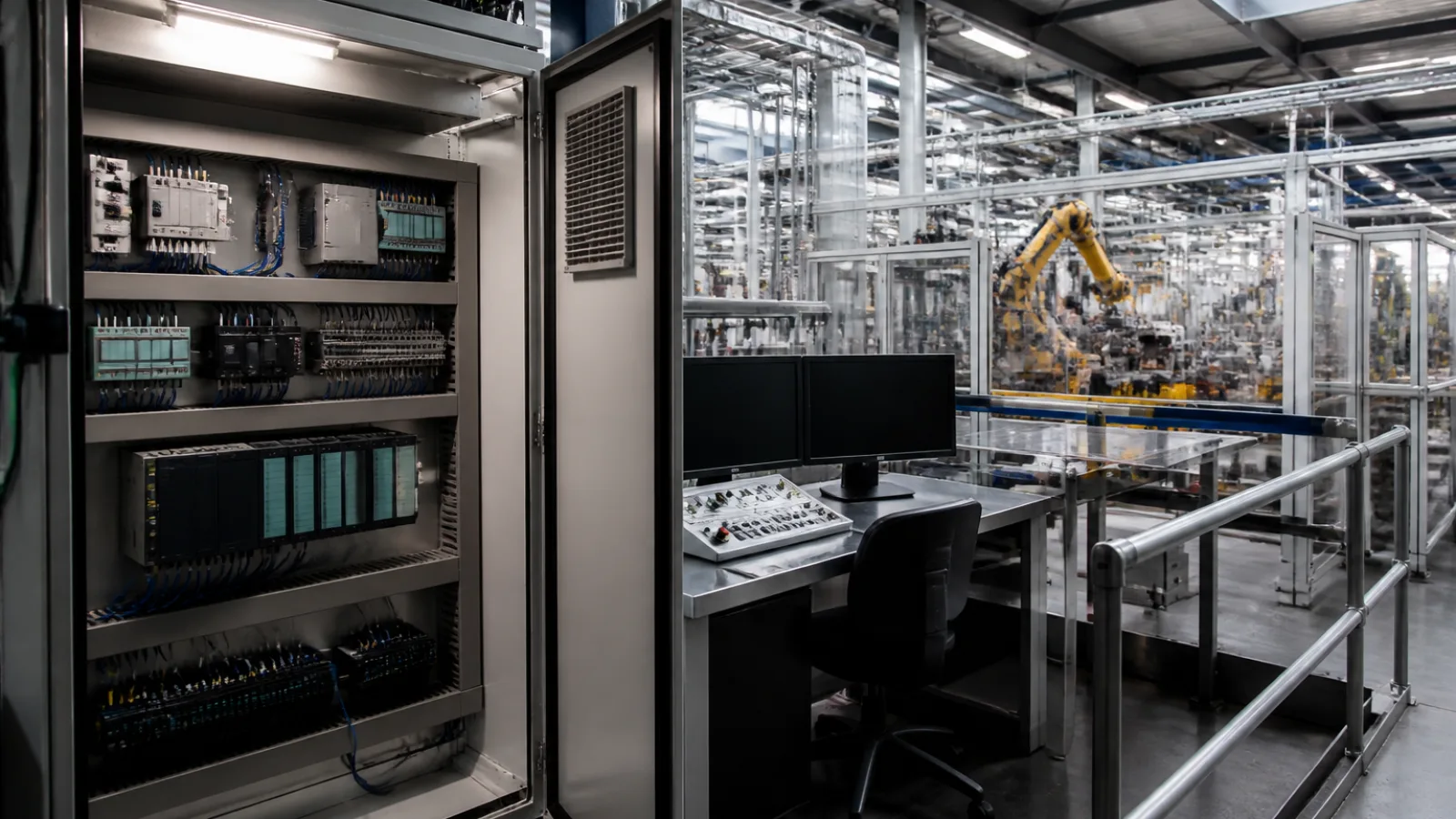
Choosing a control platform is an architectural decision, not simply a matter of selecting a familiar brand. The controller influences machine response, motion performance, data availability, cybersecurity, maintenance procedures, and the ability to expand a production system later. When reviewing Rockwell Automation industrial control systems or other technology options, project teams should evaluate the complete operating environment rather than compare processor specifications alone.
The most common choices are a programmable logic controller (PLC), a programmable automation controller (PAC), and an industrial PC (IPC). These platforms increasingly overlap, but they are not interchangeable in every application. The right choice depends on the required control cycle, motion complexity, software architecture, data workload, environmental conditions, and skills available to operate the factory.
What is a PLC?
A PLC is a purpose-built industrial controller designed to monitor inputs, execute a control program, and update outputs reliably. It is the established choice for discrete automation, sequencing, interlocking, and many process-control tasks.
PLCs typically use a scan-based operating model. The controller reads field inputs, evaluates the program, updates outputs, and repeats the cycle. Modern PLCs can execute multiple tasks with different priorities, but predictable cyclic operation remains a central strength.
Typical PLC advantages include:
- Predictable response for machine and process control.
- Strong tolerance for vibration, electrical noise, temperature variation, and industrial contamination when properly specified.
- Well-established programming, troubleshooting, and maintenance practices.
- Modular input, output, safety, communication, and specialty hardware.
- Long service life and broad availability of industrial support resources.
A PLC is often the best fit for a conveyor system, pump station, material-handling machine, packaging cell, or other application where deterministic control and maintainability matter more than intensive computing.
What is a PAC?
A PAC combines PLC-style deterministic control with capabilities traditionally associated with higher-level computer systems. Depending on the manufacturer, a PAC may support larger programs, more advanced motion, object-oriented or structured programming, high-level data handling, and broad communication options.
The term PAC is used differently across the automation industry, so the label should not be treated as a universal technical standard. One vendor’s PAC may resemble an advanced PLC, while another may emphasize distributed control, motion, analytics, or software integration. The product’s actual task model and supported modules matter more than the name.
PACs are useful when a machine or line requires several coordinated functions, such as:
- Multiple axes of motion and synchronized drives.
- Integrated safety, process, motion, and sequence control.
- Large numbers of networked devices and remote I/O stations.
- Recipe management, production tracking, and more complex data structures.
- Communication with supervisory, manufacturing, and enterprise systems.
A PAC can reduce the need to divide a sophisticated line among several specialized controllers. However, it may require more advanced engineering skills and a clearer software architecture than a basic PLC project.
What is an industrial PC?
An industrial PC is a computer engineered for industrial use. It may use a fanless enclosure, extended-temperature components, shock-resistant storage, panel or rack mounting, and interfaces suited to factory networks and equipment. An IPC can run conventional operating systems, real-time extensions, visualization software, machine-vision applications, databases, analytics, and custom software.
Compared with a PLC or PAC, an industrial PC generally offers greater computing flexibility. It can process large data sets, host multiple applications, connect to modern software platforms, and support advanced algorithms. Those benefits come with additional responsibilities. The project team must manage operating-system updates, user accounts, endpoint protection, backups, storage health, application dependencies, and recovery procedures.
An IPC is often appropriate for machine vision, advanced inspection, production optimization, edge analytics, digital-twin applications, historian functions, and systems that need software libraries unavailable on a conventional controller.
PLC vs PAC vs industrial PC: key differences
The following comparison provides a starting point. Product capabilities vary, so the final decision should be based on the specific platform, firmware, I/O architecture, and engineering tools under consideration.
| Factor | PLC | PAC | Industrial PC |
|---|---|---|---|
| Primary role | Reliable machine or process control | Integrated, complex automation control | Flexible computing and software execution |
| Real-time behavior | Strong and predictable | Strong, often with more task options | Depends on operating system and real-time configuration |
| Motion control | Basic to advanced, depending on hardware | Typically strong for coordinated motion | Powerful when paired with suitable real-time hardware and software |
| Data processing | Suitable for control data and basic recipes | More capable for structured and networked data | Best for large data sets, databases, vision, and analytics |
| Networking | Industrial protocols and field networks | Broad multi-network integration | Industrial Ethernet, standard IT networks, and software APIs |
| Environmental durability | Usually high | Usually high, subject to specification | High only when industrially rated and correctly installed |
| Programming | PLC languages and vendor tools | PLC languages plus advanced development options | General-purpose languages, software tools, and automation frameworks |
| Maintenance model | Familiar industrial troubleshooting | Requires broader controls expertise | Requires controls, IT, and cybersecurity skills |
| Typical applications | Machines, conveyors, utilities, packaging | Complex lines, robotics, motion, integrated cells | Vision, analytics, optimization, data-intensive edge systems |
How to choose the right platform
Evaluate response time and determinism
Start by defining the fastest control event, not the average workload. Identify required scan times, interrupt response, synchronization accuracy, safety reaction, and allowable variation between cycles. A PLC or PAC is usually easier to configure for predictable control timing. An industrial PC can also deliver deterministic performance, but this may require a real-time operating system, specialized hardware, and careful management of background processes.
Do not select a computer-based platform solely because it has a faster processor. Raw processing speed does not guarantee consistent response. For safety functions and time-critical motion, the controller, network, drives, and safety architecture must be evaluated as one system.
Match motion and process-control requirements
List the number of axes, servo synchronization requirements, camming or gearing functions, robot interfaces, temperature loops, pressure loops, and sequencing interactions. A basic PLC may be sufficient for straightforward positioning and interlocking. A PAC is often more suitable when multiple motion groups, robotics, safety, and process control must share information.
An industrial PC becomes attractive when motion is combined with machine vision, advanced optimization, or custom software. In that design, the time-critical control layer should remain clearly separated from noncritical applications so that a database query or software update cannot disrupt the machine.
Plan networking and data integration
Modern factories need more than controller-to-I/O communication. The architecture may include drives, robots, vision systems, energy meters, manufacturing execution systems, historians, cloud services, and maintenance tools. Assess the required industrial protocols, data rates, network segmentation, redundancy, remote diagnostics, and interface standards.
PLCs can communicate effectively with supervisory systems, but a PAC may simplify integration across a larger and more varied network. An IPC is well suited to protocol conversion, local databases, analytics, and application programming interfaces. Regardless of platform, avoid sending unnecessary raw data across every network. Define what must be controlled in real time, what should be stored locally, and what belongs in a higher-level system.
Consider cybersecurity and access control
Every connected controller becomes part of the factory’s attack surface. A platform decision should therefore include user authentication, role-based permissions, secure remote access, patching procedures, backup and restore testing, logging, removable-media controls, and network segmentation.
PLCs and PACs are not automatically secure because they are specialized devices, and industrial PCs are not automatically unsuitable because they use a general-purpose operating system. Security depends on architecture, configuration, vendor support, and operating discipline. IPC projects usually require more explicit endpoint-management responsibilities, while PLC and PAC projects still need firmware governance and controlled engineering access.
Assess environmental and lifecycle requirements
Review temperature, humidity, dust, washdown exposure, vibration, electromagnetic interference, hazardous-area requirements, power quality, and available cabinet space. An industrial PC should be selected for the actual environment, not installed as an ordinary office computer inside a cabinet.
Lifecycle planning is equally important. Confirm product availability, firmware compatibility, engineering-tool licensing, spare-part strategy, migration paths, documentation, and local technical support. A low purchase price can be outweighed by difficult troubleshooting, obsolete software, or scarce replacement hardware over the system’s operating life.
Compare total cost of ownership
Compare more than controller and I/O prices. Include engineering hours, panel modifications, software licenses, network equipment, cybersecurity tools, commissioning, training, spare parts, scheduled maintenance, downtime exposure, and future expansion.
A PLC may have the lowest overall cost for a repeatable machine with a familiar control sequence. A PAC may reduce integration effort on a complex line by consolidating control functions. An IPC may create the most value where vision, analytics, or custom computation directly improves quality or throughput. The most economical platform is the one that meets the requirements without creating unnecessary complexity.
Which platform fits common factory scenarios?
Standalone machine or packaging cell
Choose a PLC when the application consists primarily of sensors, actuators, interlocks, drives, safety devices, and a human-machine interface. A PLC is typically easy for maintenance personnel to diagnose and can provide a stable foundation for future I/O or communication expansion.
High-speed coordinated production line
A PAC is often a strong choice for a line with multiple servo axes, robots, distributed I/O, recipe control, and synchronized sequences. It can provide a common control model while preserving the deterministic behavior expected in industrial automation.
Data-intensive inspection or optimization system
An IPC is appropriate when the central workload includes high-resolution images, machine-learning inference, database operations, complex calculations, or integration with specialized software. Keep safety and essential machine control on a suitable deterministic layer, with the IPC exchanging clearly defined commands and results.
Hybrid architecture
Many modern factories benefit from a hybrid design. A PLC or PAC can manage real-time control, safety coordination, and machine sequencing, while an industrial PC handles vision, analytics, dashboards, local data storage, or advanced optimization. This separates critical control from applications that may need frequent software changes.
Questions to answer before specifying a platform
- What are the fastest control and safety response requirements?
- How many I/O points, axes, devices, and network segments are required?
- Will the system need coordinated motion, robotics, vision, or advanced recipes?
- Which data must be processed in real time, and which data can move to supervisory systems?
- Who will program, troubleshoot, patch, and restore the system?
- What environmental ratings and cabinet conditions apply?
- How long must the platform remain supported, and what is the migration plan?
- Can the architecture expand without replacing the core controller?
- What cybersecurity controls are required before remote connectivity is enabled?
Frequently asked questions
Is a PAC better than a PLC?
Neither is universally better. A PAC is generally more capable for complex motion, large programs, and integrated data handling. A PLC may be the better choice for a straightforward machine where predictable control, simple maintenance, and long-term familiarity are priorities.
Can an industrial PC replace a PLC?
It can replace some PLC functions when the IPC has suitable real-time capabilities, industrial hardware, I/O interfaces, and a properly engineered control software stack. However, replacing a PLC is not automatically an improvement. The project must address deterministic timing, safety, startup behavior, backup procedures, and maintenance skills.
Which platform is best for machine vision?
An industrial PC is often the most flexible option for high-resolution imaging, advanced vision libraries, and machine-learning workloads. A PLC or PAC may still coordinate triggers, reject mechanisms, safety conditions, and production sequences.
Should cybersecurity influence the controller decision?
Yes. Cybersecurity should be considered during architecture and procurement, not added after commissioning. Compare authentication, permissions, patching, logging, backup, remote-access, and vendor-support capabilities for the complete system.
Conclusion
In the PLC vs PAC vs industrial PC decision, the best platform is the one that fits the control timing, motion, data, environment, lifecycle, and workforce requirements of the factory. Select a PLC for dependable machine and process control, a PAC for integrated and complex automation, and an industrial PC for flexible, data-intensive computing. In many modern projects, a carefully separated hybrid architecture delivers the strongest balance of determinism, intelligence, maintainability, and future expansion.