Curb Management for Dense Cities: Designing Loading Zones, Parking, and Freight Access
Effective curb management treats the street edge as a coordinated public asset, using design, time-based rules, permits, enforcement, and performance data to balance freight, parking, transit, accessibility, and passenger activity.
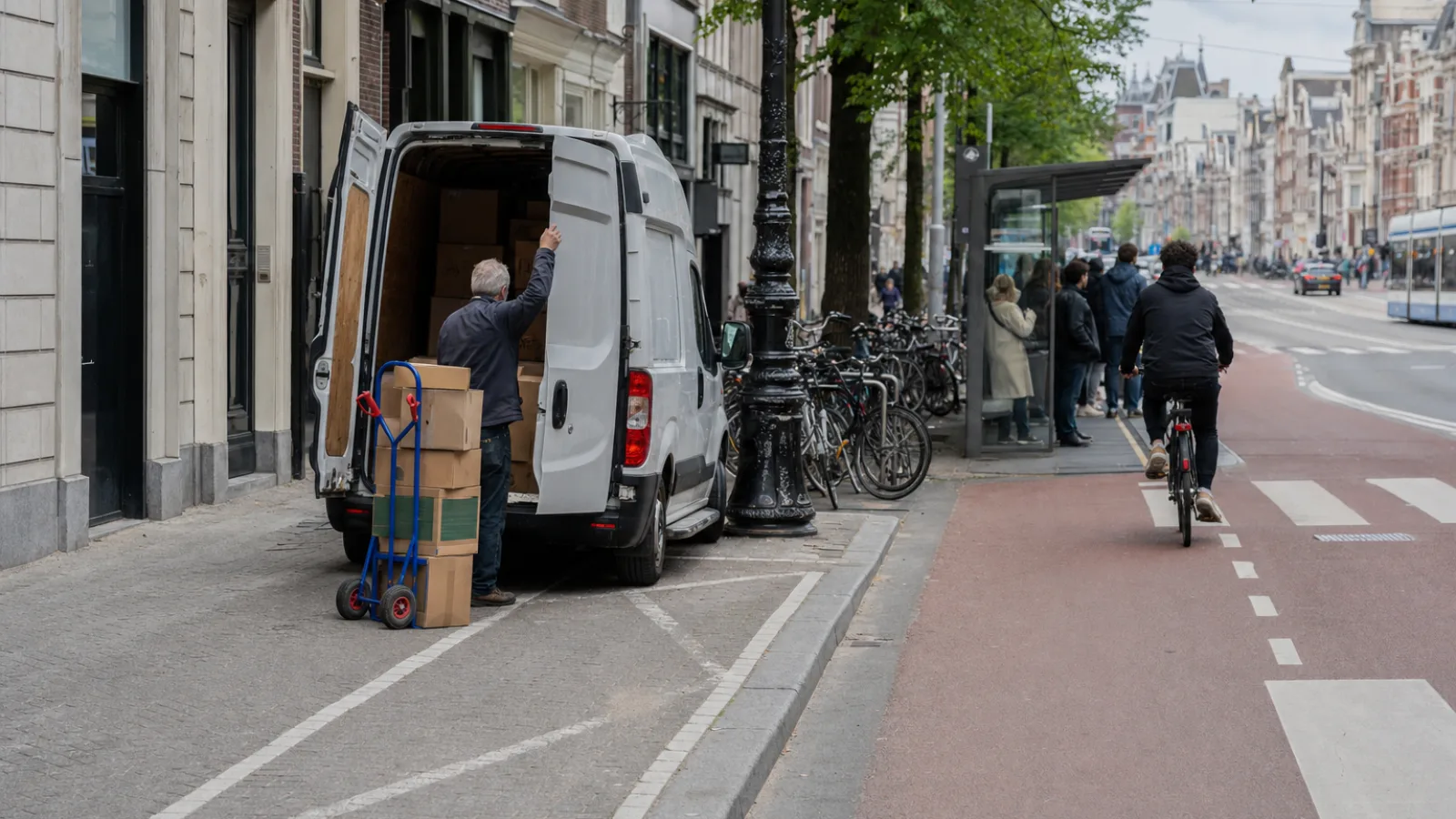
Curb management is the coordinated allocation and operation of space at the edge of the roadway. In dense cities, that narrow strip must serve deliveries, freight vehicles, buses, taxis, passenger pickup, parking, cycling, accessibility needs, construction activity, waste collection, and emergency response. Because demand changes throughout the day, effective programs combine physical design, operating rules, permits, enforcement, and ongoing measurement. Digital tools, including parking and curb management technology from Passport, may support permits, payments, reservations, and operational data when they are aligned with a clear local policy.
The central planning question is not simply where vehicles can stop. It is how a city can assign limited curb space to the uses that provide the greatest safety, accessibility, reliability, and public value in a particular place and time.
Key Takeaways
- Begin with a block-by-block inventory of physical curb supply, signed rules, and actual behavior.
- Allocate space according to safety, accessibility, transit performance, freight necessity, and local activity—not parking revenue alone.
- Use time windows, permits, reservations, and pricing carefully, with signs that users can understand quickly.
- Measure outcomes such as dwell time, illegal stopping, transit obstruction, delivery reliability, and pedestrian conflicts.
- Treat curb management as an operating program that is tested, enforced, reviewed, and adjusted over time.
What Is Curb Management?
The curb is a limited, time-sensitive public asset rather than simply a parking edge. A single block face may function as a bus stop in one section, a commercial loading zone in the morning, paid parking during the day, passenger pickup in the evening, and residential parking overnight. Its value depends on the surrounding land use, street geometry, pedestrian conditions, vehicle mix, and the consequences of stopping in the wrong location.
Conventional parking management generally focuses on storing private vehicles, setting rates, controlling duration, and enforcing parking rules. Curb management includes parking but also addresses loading, transit, accessible passenger service, taxis, ride-hailing, construction, waste collection, bicycle facilities, outdoor commerce, and emergency access. It is therefore a more comprehensive form of curb space management.
Transportation demand management seeks to influence how, when, and by which mode people travel. Curb management operates at the point where those trips interact with the street. The two approaches can support one another, but they answer different operational questions.
Why Dense Cities Need a More Deliberate Curb Strategy
Dense streets have little spare right-of-way. Buildings may have limited loading docks, sidewalks may carry heavy pedestrian flows, and intersections, bus stops, bike lanes, hydrants, driveways, and accessible entrances constrain where vehicles can stand. At the same time, retailers need predictable deliveries, residents expect convenient access, and passenger pickup often concentrates near transit stations, offices, hotels, schools, and entertainment venues.
Unmanaged demand produces familiar problems: double parking, blocked bike lanes, bus delays, unsafe cart movement, vehicles stopping across accessible paths, and drivers circling while searching for a legal space. A delivery vehicle may obstruct traffic because the nearest commercial loading zone is too far from the receiving entrance. A passenger may stop in a bus lane because signs do not explain where pickup is permitted. Construction activity can create similar conflicts when staging areas are approved without considering daily freight and transit operations.
A curb management strategy should therefore be based on the function of each street and block face. A retail corridor, residential side street, hospital frontage, transit interchange, and construction zone will not require the same rules or priorities.
Step 1: Build a Reliable Curb Inventory
Map the physical curb supply
Start by documenting the physical conditions that determine whether a curb segment can support a particular use. The inventory should include:
- Curb length, lane configuration, traffic direction, and available road width.
- Sidewalk width, paving condition, crossings, ramps, street furniture, and pedestrian desire lines.
- Bus stops, bike facilities, intersections, driveways, hydrants, accessible entrances, and loading docks.
- Freight elevators, building service entrances, waste areas, and emergency access routes.
- Existing signs, painted markings, meters, payment equipment, and physical barriers.
Plans should distinguish legal curb capacity from theoretical curb length. A segment interrupted by a driveway or a bus stop may not provide continuous loading space. A space that appears usable on a map may be unsuitable if trucks would block a crosswalk or if carts must cross a busy cycle track.
Record current rules and actual behavior
Compare signed curbside regulations with what actually happens. Observations should be organized by block face and time period, recording occupancy, dwell time, turnover, vehicle type, illegal stopping, delivery activity, passenger pickup, and blocked facilities. Camera-based observation, manual surveys, permit records, and operator interviews can be combined where legally and operationally appropriate.
The difference between posted rules and real-world behavior is important. A loading zone that is rarely used may be poorly located, difficult to understand, or regularly occupied by vehicles that do not qualify. Conversely, frequent illegal stopping may indicate unmet demand rather than merely weak compliance.
Include stakeholders and unusual demand
Consult retailers, residents, freight operators, transit agencies, disability advocates, emergency services, property owners, schools, event organizers, parking operators, and construction managers. Their needs often vary by day and season. Events, deliveries to schools, building moves, street cleaning, waste collection, and construction mobilization can create short-duration demand that a normal weekday survey will miss.
For additional context, see our article on Predictive Search Intent Modeling: Enhancing SEO Strategy for Real Estate Professionals.
Step 2: Match Curb Space to Priority and Demand
Allocation should reflect safety, accessibility, transit performance, freight necessity, public value, and local economic activity rather than simply maximizing parking revenue. The appropriate priority may differ by corridor. A bus route may require protection from general stopping, while a service street behind a retail frontage may be better suited to freight and waste operations.
Possible curb functions include transit stops, accessible passenger loading, commercial loading, short-term pickup, paid parking, taxi or ride-hailing zones, bicycle facilities, micromobility parking, outdoor commerce, construction staging, waste collection, and emergency access. These functions should be assigned only where the street can support them safely.
| Curb use | Strongest demand period | Typical operational need | Design or policy consideration |
|---|---|---|---|
| Commercial loading | Morning and business hours | Short-term vehicle standing and cart access | Place near receiving entrances; set realistic vehicle and time limits. |
| Passenger pickup | School, commute, and evening peaks | Brief dwell time with clear pull-in or stopping space | Keep crossings, bus stops, and accessible paths unobstructed. |
| Paid parking | Midday, evening, or residential periods | Turnover and payment compliance | Use rates and time limits that support the local policy objective. |
| Transit stop | Service operating hours | Reliable boarding, alighting, and vehicle clearance | Protect the stop from general loading and coordinate with sidewalk design. |
| Construction staging | Scheduled work periods | Permit-based access for materials and equipment | Require a traffic and pedestrian management plan with defined end dates. |
Step 3: Design Loading Zones That Work for Freight
Locate loading where deliveries actually occur
Loading zones should be close to building entrances, freight elevators, loading docks, and retail frontages, with a safe path for carts and hand trucks. Relocating every loading activity to a distant side street may look efficient on a plan but can encourage illegal stopping, long cart movements, and conflicts with pedestrians.
Loading zone design should account for vehicle length, turning movements, door swing, curb height, sidewalk width, and the likely transfer method. A space that accommodates a small van may not work for a rigid truck. Where larger vehicles are prohibited, signs and permits should make the restriction clear, and an alternative location should be identified.
Use time windows carefully
Commercial loading windows can protect freight access during the hours when deliveries are most concentrated. Overnight restrictions may address noise or residential impacts, while peak-hour protections may preserve transit and general traffic movement. Rules may need to distinguish among small vans, rigid trucks, and larger vehicles.
Time windows should reflect neighborhood activity, noise concerns, transit operations, local delivery patterns, and enforcement capacity. Complicated schedules create failure when signs are difficult to read or drivers cannot determine whether a rule applies to their vehicle. If a schedule is necessary, it should be expressed in plain language and supported by consistent markings and digital information where appropriate.
Coordinate public and private loading capacity
Public commercial loading zones are only one part of freight access in dense cities. Shared loading bays, building docks, consolidation points, and delivery booking systems can reduce pressure on the public curb. Development approvals can require adequate service access, while curb regulations can protect the public spaces needed by buildings that cannot receive all deliveries internally.
Property managers should coordinate delivery hours, dock availability, tenant instructions, and waste collection. Municipal approval processes should identify who is responsible for maintaining private loading areas and preventing building operations from shifting avoidable demand onto the street.
Step 4: Use Time-Based Rules, Pricing, and Permits
Time-based allocation
One illustrative curb segment might support deliveries in the morning, paid parking at midday, passenger pickup in the evening, and residential needs overnight. This can increase the public value of a block face, but only if transitions are visible and enforceable. Signs should state who may use the space, during which hours, for how long, and under what conditions.
Pricing and demand management
Paid loading, reservation fees, parking prices, or escalating penalties can discourage overstaying and improve turnover in high-demand locations. Dynamic curb pricing may be useful where demand changes substantially by time or location, but it is not automatically the best solution. Pricing should support a stated policy goal, such as improving loading availability or reducing passenger dwell time.
Programs should consider accessibility, small-business impacts, essential services, and the difference between a brief delivery stop and long-term vehicle storage. Revenue should not become the only performance measure.
Permits and reservations
Commercial vehicle permits, construction permits, accessible loading permits, event permits, and digital reservations can clarify eligibility and help coordinate scarce space. Good systems use simple rules, transparent fees, expiration dates, and audit procedures. Outdated permits, informal exceptions, and unclear transfer rules can undermine trust and make enforcement inconsistent.
Step 5: Make Signs, Markings, and Enforcement Consistent
Clear curbside regulations should answer four questions quickly: who may use the space, when may they use it, how long may they stay, and what conditions apply? Consistent colors, curb markings, sign placement, readable time ranges, and repeated information at decision points can reduce confusion.
Where appropriate, curb rules can also be coordinated with navigation, delivery, reservation, and payment information. Technology should reinforce the physical signs rather than replace them. Drivers, pedestrians, enforcement officers, and emergency responders must be able to understand the space without relying on an application.
Enforcement options include patrols, camera-based observation where legally permitted, license-plate tools, officer discretion, launch-period warnings, and graduated penalties. Enforcement should prioritize accessible spaces, bus operations, emergency routes, pedestrian safety, and repeated misuse. It should also include a process for correcting errors and reviewing inequitable or arbitrary outcomes.
Step 6: Measure Performance and Adjust the Program
Collect a baseline before implementation and establish a regular review afterward. Useful measures include curb occupancy, dwell time, turnover, delivery search time, double-parking incidents, bus obstruction, loading-zone utilization, citation patterns, complaint trends, freight reliability, pedestrian conflicts, and revenue compared with operating cost.
For a related technical perspective, read Rethinking Urban Mobility: A Case Study on Smart Parking and Curbside Management in the European Union.
Activity measures describe what happened; outcome measures show whether the program achieved its purpose. For example, a loading zone may have high occupancy, but that does not prove that deliveries are efficient if vehicles regularly overstay or block a bike lane. A reduction in citations may indicate better compliance—or weaker enforcement. Measures should therefore be interpreted together.
Test changes in phases where possible. Publish understandable results, gather feedback from affected users, and revise rules when land use, construction, events, transit service, or travel patterns change. A curb management program should be capable of learning rather than treating its first set of rules as permanent.
Common Curb Management Mistakes to Avoid
- Treating every curb segment the same, regardless of street type or surrounding land use.
- Creating rules without observing actual demand and vehicle behavior.
- Providing loading space that is too short, inaccessible, or poorly located.
- Adding complicated time windows without clear signs and markings.
- Relying on enforcement without sufficient legal, staffing, or technology support.
- Measuring only parking revenue rather than safety, reliability, access, and turnover.
- Ignoring accessibility, emergency access, transit reliability, and small-business impacts.
- Installing technology before defining the policy objective and operating process.
A Practical Implementation Framework
- Establish goals: Define the problems to be addressed, such as bus obstruction, unreliable freight access, unsafe pickup, or limited accessible loading.
- Inventory the curb: Map physical supply, existing rules, building access, and actual behavior.
- Consult users: Include people who depend on the curb as well as those affected by conflicts.
- Classify street contexts: Distinguish transit corridors, retail streets, residential blocks, service lanes, event areas, and construction zones.
- Pilot rules: Test allocation, time windows, pricing, permits, signs, and enforcement in a focused corridor or district.
- Communicate changes: Provide advance notice, plain-language instructions, maps, and contact channels.
- Enforce consistently: Protect priority uses while allowing a reasonable launch and correction period.
- Measure results: Compare outcomes with the baseline and publish findings in an accessible format.
- Refine the program: Adjust space, schedules, prices, permits, and enforcement as conditions change.
Municipalities and developers should coordinate curb plans with roadway design, building access, freight operations, parking supply, transit service, construction management, and public-realm improvements. A durable plan should identify responsible agencies, decision rights, funding, data ownership, maintenance responsibilities, and review intervals. Without those assignments, even well-designed curbside regulations can deteriorate as signs, markings, buildings, and travel patterns change.
Frequently Asked Questions About Curb Management
What is the main purpose of curb management?
Its purpose is to coordinate scarce curb space so essential and high-value uses can operate safely and reliably. It balances access, movement, loading, parking, transit, accessibility, and public-space objectives.
How is curb management different from parking management?
Parking is one curb use among many. Curb management addresses the full range of users, time periods, vehicle activities, pedestrian needs, and operational priorities at the roadway edge.
What should a city measure first?
Begin with curb occupancy, dwell time, turnover, illegal stopping, delivery activity, transit obstruction, accessibility conflicts, and user feedback. These measures establish both demand and the consequences of current rules.
Are dynamic curb prices necessary?
No. They can help in high-demand locations, but clear allocation rules, time limits, permits, reservations, and consistent enforcement may be more appropriate in other contexts.
How can curb management support freight access?
Provide well-located loading zones, realistic delivery windows, suitable vehicle restrictions, reservations where useful, coordination with building docks, and enforcement against misuse. Freight access improves when public and private loading capacity are planned together.
How often should curb rules be reviewed?
Review frequency should reflect local change. Every program should have a defined monitoring schedule and a process for responding to new development, construction, events, transit changes, or shifting travel patterns.
Conclusion
Curb management is an ongoing operating program, not a one-time sign installation. Dense cities can reduce conflicts by inventorying demand, assigning space by purpose and time, designing practical loading areas, coordinating public and private access, communicating rules clearly, enforcing them fairly, and using performance data to refine decisions.
The practical starting point for cities, developers, and logistics teams is a focused corridor or district pilot. Define measurable objectives, document existing behavior, test a manageable set of rules, and adjust the system before scaling it to other streets. That disciplined process makes limited curb space more predictable, safer, and more useful for the people and businesses that depend on it.