Transit Signal Priority: How Cities Give Buses Faster, More Reliable Journeys Without Worsening Traffic
Transit signal priority helps buses avoid unnecessary intersection delay through carefully controlled changes to traffic signal timing. This guide explains how TSP works, how agencies protect other road users, and which performance measures determine whether a deployment is successful.
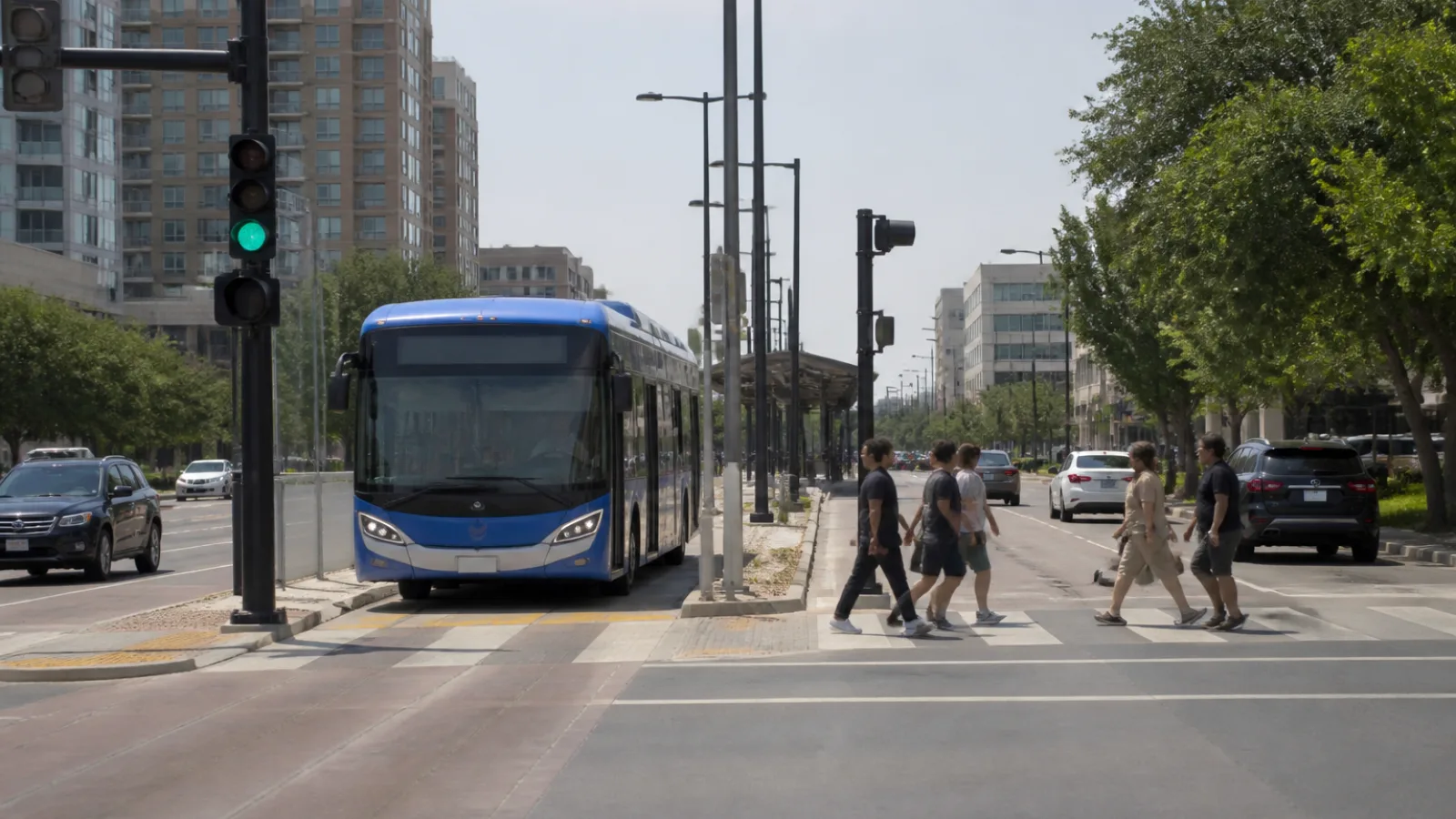
Buses lose time at traffic signals, particularly on busy corridors where a red phase can interrupt an otherwise efficient trip. Transit signal priority, commonly shortened to TSP, allows a traffic signal controller to make limited, conditional adjustments when an eligible bus is approaching. The objective is not to give buses unlimited priority. It is to reduce avoidable delay while preserving safe, predictable operation for pedestrians, cross traffic, cyclists, emergency vehicles, and other transit services.
Successful TSP depends on more than installing roadside equipment. Agencies must connect transit operations with signal control, define priority rules, verify communications, and monitor results over time. The same planning process often sits alongside broader traffic signal control solutions, but TSP should be designed around a corridor’s actual service patterns and traffic constraints.
What Is Transit Signal Priority?
Transit signal priority is an intelligent transportation strategy that gives buses a conditional advantage at signalized intersections. When a bus meets defined criteria, the signal system may extend the current green, shorten a conflicting red, or make another small timing adjustment. The action is normally limited by safety constraints, maximum extensions, minimum pedestrian service requirements, and rules that prevent repeated disruption.
Eligibility can be based on several factors. A system may prioritize every scheduled bus, or only vehicles that are behind schedule, carrying a high passenger load, serving an important route, or approaching a critical transfer point. Some agencies also use direction, time of day, traffic conditions, and the number of recent priority requests to determine whether an intervention is justified.
The central distinction is that TSP is usually coordination rather than interruption. It works within the normal signal sequence whenever possible. That makes it different from emergency-vehicle preemption, which can interrupt normal phases to clear a path for a responding vehicle.
How Transit Signal Priority Works
Detecting an Approaching Bus
The process begins when the system identifies a bus and estimates where it is in relation to the intersection. Detection can use dedicated roadside transponders, GPS-based location data, cellular communications, computer-aided dispatch and automatic vehicle location systems, or a combination of these technologies. The choice affects installation cost, location accuracy, cybersecurity requirements, and the ability to support multiple transit operators.
A bus may send a message when it enters a detection zone, reaches a specified distance from the stop line, or is predicted to arrive during a particular signal phase. The system then associates the request with a route, direction, vehicle class, and other operational information. Detection zones should be long enough to provide useful decision time but not so long that inaccurate arrival predictions create unnecessary requests.
Estimating Arrival and Eligibility
Detection alone does not justify priority. The controller or central system must determine whether the bus will actually benefit from a change and whether the request satisfies the agency’s policy. A bus that is already passing through on green may need no intervention. A bus that is only a few seconds late may receive less priority than one that has accumulated substantial delay.
Eligibility rules should also account for repeated requests. If several closely spaced buses approach the same intersection, granting priority to each one could disrupt the progression of general traffic and create a new queue for pedestrians or cross streets. Request logic can therefore include cooldown periods, maximum priority frequency, route-level limits, or coordination with neighboring intersections.
Applying a Priority Action
Once a request is approved, the traffic signal controller applies a permitted action. The action must respect minimum green times, yellow and all-red intervals, pedestrian clearance, railroad or transit crossing requirements, and any other programmed safety logic. Priority should never bypass the controller’s basic conflict protections.
After the bus clears the intersection, the signal may return to its normal pattern, compensate affected phases, or continue a coordinated progression. The recovery behavior matters. A system that provides a small benefit to one bus but causes a long recovery cycle at every downstream intersection may perform poorly at the corridor level.
Common Transit Signal Priority Strategies
| Strategy | How it works | Typical use | Main consideration |
|---|---|---|---|
| Green extension | Holds the current green for a limited period so the bus can reach the intersection. | The bus is approaching during an active green. | Can delay the next phase and should have a firm maximum. |
| Early green | Shortens a conflicting red phase to start the bus’s movement sooner. | The bus arrives during a red phase. | Minimum opposing-phase and pedestrian times must be protected. |
| Phase insertion | Adds a permitted transit movement or special phase to the sequence. | Special bus lanes or complex junction movements. | Requires careful conflict analysis and controller programming. |
| Phase skipping | Omits or reduces a low-demand phase when conditions allow. | Intersections with flexible side-street demand. | May affect waiting motorists, cyclists, or pedestrians if used too often. |
Green extension and early green are often easier to integrate into established signal plans because they modify existing phases. Phase insertion and skipping can produce larger operational effects and therefore require stronger rules, testing, and public communication. In practice, agencies may use different strategies at different intersections on the same route.
How Cities Protect Cross Traffic and Other Road Users
The concern that TSP will worsen traffic is valid if priority is applied without limits. A responsible design treats the intersection as a shared system rather than giving one mode permanent control. Common safeguards include maximum green extensions, minimum red times, pedestrian clearance protection, maximum cycle disruption, and restrictions during oversaturated conditions.
Coordination is especially important on signalized corridors. If one intersection grants priority while the next intersection creates a long stop, the bus may gain little overall. Engineers should review progression, queue storage, turn bays, bus stop locations, and downstream spillback. A priority action may be rejected if the receiving link is already blocked and the bus cannot move through the intersection safely.
Emergency vehicles need explicit treatment. TSP may coexist with emergency preemption, but the hierarchy and handoff rules must be unambiguous. An emergency request normally receives higher priority, while a bus request may be delayed, canceled, or resumed after the emergency event. Pedestrian calls, accessible crossing intervals, school-zone operation, rail interfaces, and maintenance modes also need defined behavior.
Infrastructure and Data Requirements
A TSP deployment usually includes equipment and software on the bus, at the roadside, in the signal controller environment, and in a central management platform. The exact architecture varies, but the following capabilities are commonly required:
- Vehicle identification: A reliable way to distinguish eligible buses from other vehicles.
- Location and arrival data: Timely information about direction, distance, speed, and expected arrival.
- Signal controller compatibility: Controller firmware and cabinets capable of receiving and applying priority requests.
- Communications: A secure, monitored connection between vehicles, roadside devices, and management systems.
- Time synchronization: Consistent timestamps for diagnosing requests, signal states, and bus movements.
- Monitoring and logging: Records of requests, approvals, actions, faults, and recovery behavior.
Data quality is as important as hardware. Agencies should verify that route identifiers, vehicle clocks, signal phase records, and automatic vehicle location feeds agree. Communications failures should result in a safe fallback, not uncontrolled signal behavior. Cybersecurity planning should cover authentication, access control, software updates, network segmentation, and vendor support responsibilities.
A Practical Implementation Framework
1. Establish the operating problem
Begin with a clear problem statement. Is the route affected by recurring red-light delay, unreliable travel times, poor schedule adherence, or missed transfers? Identify the intersections and time periods that matter. TSP is most useful when it addresses a measurable operational constraint rather than being installed as a technology demonstration.
2. Build a baseline
Collect pre-deployment information on bus travel time, intersection delay, schedule deviation, dwell time, traffic queues, pedestrian service, and signal performance. Separate recurring delay from incidents, weather, construction, and unusual events. A baseline makes it possible to distinguish a genuine TSP effect from normal variation.
3. Select priority policies
Define which buses qualify and what they may request. Policies might prioritize late buses, buses in a dedicated lane, vehicles carrying transfers, or routes with high service frequency. Set limits for maximum extension, early return, request frequency, and corridor-wide disruption. Document how TSP interacts with emergency preemption and other signal priorities.
4. Test the corridor before launch
Use controller simulation, field observation, and staged testing to verify every permitted phase transition. Test normal requests, duplicate requests, lost communications, inaccurate locations, emergency events, pedestrian calls, and cabinet or detector failures. Operators should know how to disable or modify priority when construction, special events, or incidents change conditions.
5. Deploy in phases
A pilot on a limited number of intersections can expose data and operational issues before a full corridor rollout. Start with conservative timing limits, review logs frequently, and involve transit and traffic-control staff in the same performance meetings. Expand only after the system demonstrates reliable detection and predictable recovery.
How to Measure Whether TSP Is Working
Evaluation should consider both transit benefits and network impacts. Useful measures include:
- Bus intersection delay and corridor travel time.
- Travel-time variability and schedule adherence.
- Number of successful, rejected, expired, and canceled requests.
- Average and maximum priority duration.
- Passenger-facing reliability, including missed transfers or bunching.
- Side-street delay, queue length, and progression quality.
- Pedestrian wait and clearance performance.
- Signal-system faults, communication failures, and manual overrides.
Agencies should compare similar time periods and account for changes in schedules, ridership, construction, fleet mix, and traffic demand. A reduction in bus delay is valuable, but it should be weighed against the frequency and severity of impacts elsewhere. The best systems are tuned using operational evidence rather than a single headline metric.
Benefits, Limitations, and Design Trade-Offs
TSP can improve schedule adherence, reduce stop-and-go delay, support transfers, and make bus service more dependable without building a new lane at every intersection. It can also help agencies get more value from existing signal infrastructure. Reliability improvements may be particularly important on routes where small delays compound across many stops and intersections.
However, TSP cannot solve every cause of slow bus service. It does not remove congestion between intersections, reduce excessive dwell time, fix inadequate stops, or replace dedicated transit lanes where demand requires them. If buses are frequently blocked by double parking or turning vehicles, signal priority alone may produce limited results.
| Feature | Transit signal priority | Emergency-vehicle preemption |
|---|---|---|
| Primary purpose | Improve transit reliability through conditional timing adjustments. | Create a rapid path for an emergency response. |
| Typical control approach | Works within or makes limited changes to the normal sequence. | May interrupt normal phases and coordination. |
| Frequency | May occur regularly during scheduled service. | Occurs only during qualifying emergency responses. |
| Priority level | Usually subordinate to emergency preemption and safety requirements. | Typically receives the highest operational priority. |
Trade-offs are unavoidable. More aggressive priority may improve bus travel time but increase cross-street delay. More restrictive rules protect traffic progression but may provide too little benefit to justify the investment. Agencies should make these choices transparently and revisit them as service patterns and traffic conditions change.
Frequently Asked Questions
What is transit signal priority?
Transit signal priority is a system that detects an approaching eligible bus and makes a limited adjustment to a traffic signal, such as extending green or shortening a conflicting red. The goal is to reduce bus delay while maintaining safety and reasonable service for other road users.
Does transit signal priority stop traffic lights for every bus?
No. A TSP system can reject requests when the bus is not eligible, the predicted benefit is too small, the intersection is constrained, or a recent request has already affected the signal. Most programs use limits to prevent continuous disruption.
How is transit signal priority different from signal preemption?
Priority generally makes a conditional adjustment within the signal plan. Preemption interrupts normal operation to serve a higher-priority movement, commonly an emergency vehicle. Their rules, equipment interfaces, and operational authority should be configured separately.
Can TSP work with bus rapid transit?
Yes. TSP can support bus rapid transit, especially at intersections where buses operate in dedicated lanes or have high passenger volumes. It works best alongside complementary measures such as level boarding, off-board fare collection, stop spacing, and lane enforcement.
What data should an agency collect before deployment?
At minimum, collect bus location and travel-time data, schedule adherence, intersection delay, signal timing, traffic queues, pedestrian operation, and incident information. The baseline should cover representative operating periods so results are not distorted by unusual conditions.
Conclusion
Transit signal priority gives cities a practical way to improve bus reliability by coordinating transit operations with existing traffic signals. Its effectiveness depends on disciplined rules, accurate detection, compatible controllers, resilient communications, and continuous evaluation. When agencies protect pedestrian service, coordinate with emergency operations, and measure impacts across the corridor, TSP can help buses move more predictably without treating general traffic as an afterthought.