Beyond Concrete: 3D-Printed Construction Materials, Applications, and Selection Criteria
Construction-scale additive manufacturing extends well beyond conventional concrete. This guide compares polymers, geopolymers, ceramics, composites, bio-based systems, and emerging materials by their practical applications, limitations, equipment needs, and qualification requirements.
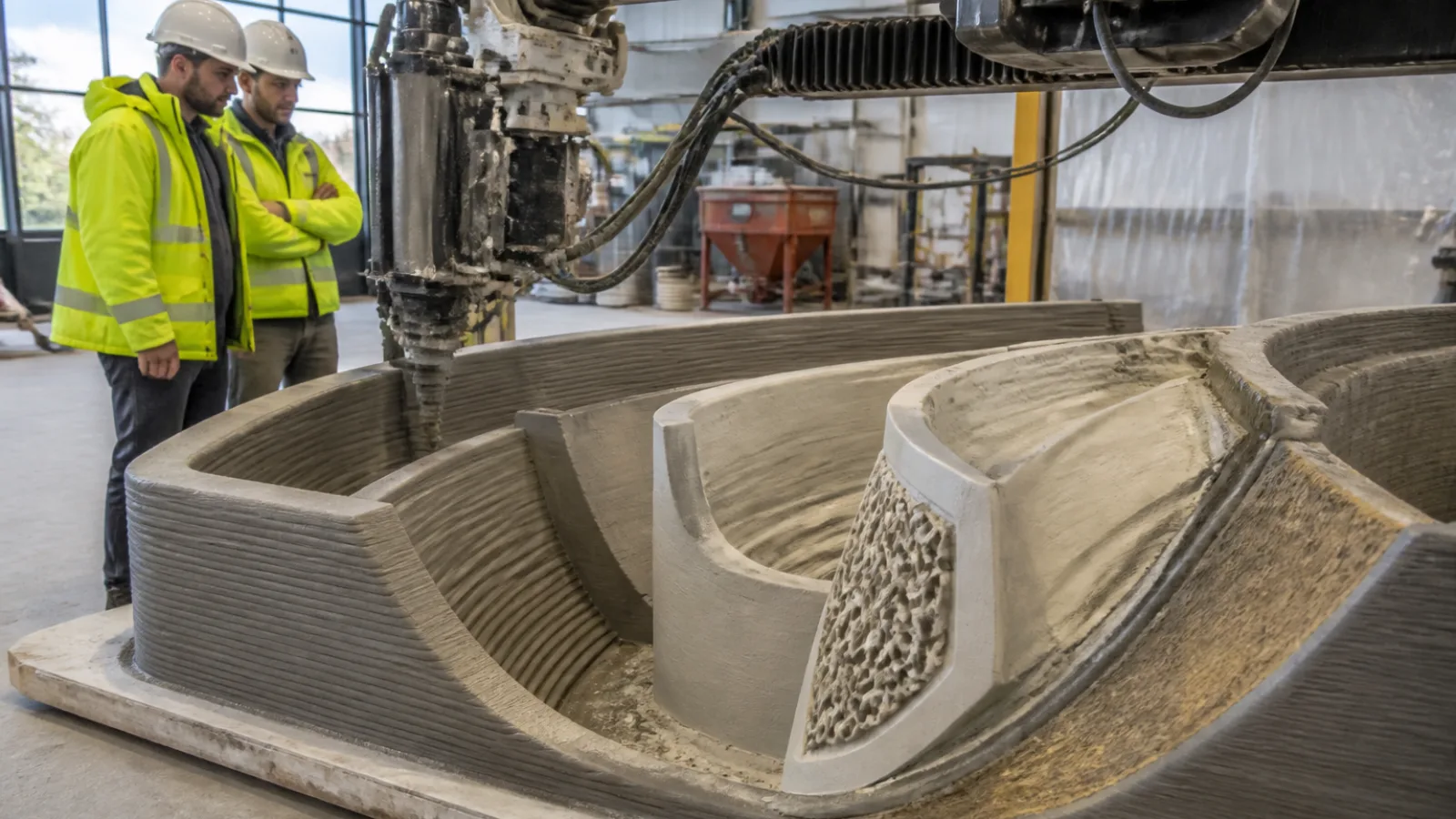
3D printed construction materials are feedstocks formulated for extrusion, deposition, jetting, or another additive process at a scale relevant to buildings, infrastructure, components, and temporary works. They include polymers, mineral binders, ceramics, fiber-reinforced composites, recycled and bio-based systems, and specialized materials that do not behave like conventional cast concrete.
Material selection matters because a printed element must do more than leave a nozzle consistently. Printability, end-use performance, production scale, and regulatory acceptance must be considered together. Useful background on the range of engineering-grade printable materials is available in this reference to 3D printing materials for engineering applications. The appropriate choice depends on what the element does, where it will be used, how it will be produced, and how it will be tested and approved.
What Makes a Material Suitable for Construction 3D Printing?
A construction material has to move through a deposition system, form a stable layer, bond to adjacent material, and develop the required properties afterward. These demands can conflict. A mix that flows easily may slump after deposition, while a highly stable mix may fail to bond or require excessive pumping pressure.
Important variables include flow behavior, open time, layer adhesion, shape retention, curing or cooling, dimensional stability, handling, and final performance. For large-format additive manufacturing, the material must also remain consistent over long print runs and across changing ambient conditions. Small variations in moisture, temperature, particle size, or mixing energy can affect the finished geometry.
Printability is not the same as structural performance
A material can extrude reliably and still fail requirements for load, moisture, fire, UV exposure, impact, or long-term durability. Printed parts may also be weaker across layer interfaces than within a layer. A laboratory coupon made under carefully controlled conditions does not automatically represent a wall, panel, connection, or curved shell produced on a job site.
Performance must therefore be assessed at the system level. That includes geometry, deposition direction, layer time, curing conditions, reinforcement, joints, supports, coatings, and connections. A material may be appropriate for a mold or interior feature but unsuitable for a primary structural element.
The role of the printer and process
The printer is part of the material specification. Nozzle diameter, extrusion pressure, deposition method, build volume, travel speed, temperature control, and layer height all influence the result. Thermoplastics may require heated chambers or controlled build plates; mineral systems may require continuous mixing and curing; ceramics may need drying and firing equipment.
Post-processing can include machining, sanding, coating, heat treatment, firing, impregnation, or the addition of reinforcement. Equipment compatibility also affects storage, maintenance, cleaning, waste handling, and production reliability. A material that appears inexpensive can become impractical if it requires specialized heating, activators, curing chambers, or extensive finishing.
Main Families of 3D Printed Construction Materials
The following families cover the most relevant options for construction applications beyond conventional printed concrete. Their maturity varies widely: some are common in tooling and component production, while others remain pilot-stage or primarily research systems.
Polymers and thermoplastics
ABS, ASA, PETG, nylon, recycled plastics, and other engineering polymers are widely used in extrusion-based printing. They offer low weight, relatively rapid production, moisture resistance, and a broad range of surface finishes. Some can be machined, bonded, or recycled more readily than mineral materials, although actual recyclability depends on additives, contamination, and whether different materials are combined.
Thermoplastics also have important limitations. Thermal movement can create warping and dimensional drift, particularly in large parts. UV exposure may degrade some formulations, while fire behavior, smoke generation, and indoor emissions require careful review. Nylon can absorb moisture, and recycled feedstocks may vary in viscosity, contamination, color, and mechanical performance.
Realistic uses include molds, formwork, ducts, fixtures, jigs, façade prototypes, interior elements, furniture, and low-load components. Printable polymers are generally not direct substitutes for structural concrete or masonry in buildings. Large polymer parts may need ribs, frames, coatings, or hybrid reinforcement to achieve useful stiffness and stability.
Geopolymers and low-cement mineral binders
Geopolymer and alkali-activated systems use reactive mineral feedstocks and chemical activators to develop a hardened binder. They differ from ordinary Portland-cement-based mixes in chemistry, curing behavior, formulation, and often in the source materials used. Some systems can be adapted for extrusion and may support mineral-based architectural or structural concepts.
Practical challenges include consistent feedstock quality, safe handling of activators, setting control, curing conditions, shrinkage, and long-term durability validation. Reinforcement compatibility must be established rather than assumed, particularly when steel, fibers, or embedded inserts are used. Moisture movement and bond behavior can vary substantially between formulations.
Geopolymer 3D printing should therefore be treated as application-dependent. Some systems are being evaluated for structural and semi-structural work, but code acceptance, reliable supply, standardized testing, and project-specific engineering remain essential. Potential environmental advantages should be assessed through verified life-cycle analysis rather than inferred from the binder label alone.
Ceramics and clay-based materials
Clay and ceramic pastes can produce distinctive architectural surfaces, fine textures, screens, tiles, and specialized components. They offer heat resistance and, after suitable firing, can provide durable finished surfaces. Unfired earth or clay systems may also be useful where the design and exposure conditions are compatible with their moisture sensitivity.
Drying and firing are the central technical concerns. Water loss can cause shrinkage, cracking, warping, or dimensional inaccuracy. Firing requires controlled thermal cycles, appropriate kiln capacity, and attention to the compatibility of glazes, supports, and adjacent materials. Fired ceramics can be strong in compression but fragile under impact or tension, and large elements may be difficult to transport without damage.
Suitable applications include façade tiles, screens, interior features, architectural components, finishes, and specialized nonstructural elements. Ceramic 3D printing construction is less suitable where large monolithic parts, rapid field production, or high tolerance to impact are required without substantial post-processing.
Fiber-reinforced and mineral-filled composites
Glass, carbon, natural, and other fibers can modify stiffness, toughness, shrinkage, and weight. Mineral fillers may improve dimensional stability, surface quality, thermal behavior, or cost. These systems can be formulated as polymer composites, mineral composites, or hybrid materials.
Fibers introduce their own process constraints. They can increase nozzle wear, obstruct small passages, complicate mixing, and align with the deposition direction. This orientation creates anisotropy: stiffness and strength may differ significantly along, across, and through the printed layers. Recyclability can also become more difficult when fibers and binders cannot be separated.
Composite 3D printing materials may suit panels, shells, façade modules, molds, tooling, and engineered components. Designers must verify properties in the actual printed directions and around openings, corners, supports, and connections. A high fiber content is not automatically beneficial if it reduces flow consistency or creates voids.
Bio-based and recycled materials
Recycled plastics, bio-based polymers, cellulose- or wood-filled systems, and other lower-impact concepts are attracting interest for components, interiors, and temporary work. They can make productive use of secondary feedstocks and may offer distinctive textures or lower material weight.
However, feedstock variability is a major issue. Moisture, biological degradation, mold, fire performance, emissions, and supply consistency must be controlled. Wood or cellulose fillers can alter water absorption and dimensional stability, while recycled polymers may have inconsistent thermal history or contamination. Bio-based content does not by itself establish low environmental impact or code compliance.
These materials may be appropriate for temporary structures, interior features, demonstrators, non-load-bearing components, or controlled environments. More demanding applications require evidence of service life, fire behavior, emissions, repairability, and reliable batch-to-batch performance.
Emerging and specialized materials
Metal deposition, high-performance resins, foams, and hybrid material systems extend the range of additive manufacturing. Metal processes may produce brackets, reinforcement elements, or specialized components, but they often require controlled atmospheres, thermal management, machining, and inspection. High-performance resins can provide precision or chemical resistance while demanding specialized curing and ventilation.
Foams and hybrids may provide lightweight insulation or integrated assemblies, but their behavior under fire, moisture, compression, and aging must be established. These systems demonstrate why laboratory printability is only an initial screen. Construction suitability depends on equipment, geometry, exposure, connections, compliance, and repeatable production.
Material Comparison at a Glance
| Material family | Key advantages | Principal risks or limitations | Equipment or process needs | Realistic construction applications |
|---|---|---|---|---|
| Polymers and thermoplastics | Low weight, rapid production, moisture resistance, finish flexibility | Thermal movement, UV and fire concerns, limited structural substitution | Heated extrusion, controlled temperature, possible machining or coating | Molds, formwork, ducts, fixtures, interiors, prototypes |
| Geopolymers and low-cement binders | Mineral-based performance potential, adaptable formulations | Activator handling, curing, durability validation, code acceptance | Continuous mixing, controlled dosing, curing and reinforcement systems | Architectural elements, panels, shells, pilot structural systems |
| Ceramics and clay | Heat resistance, distinctive finish, architectural versatility | Shrinkage, drying cracks, firing, fragility, dimensional control | Paste extrusion, controlled drying, kiln firing or suitable unfired design | Tiles, screens, façade components, interiors, nonstructural features |
| Fiber and mineral composites | Potentially higher stiffness, toughness, or dimensional stability | Anisotropy, nozzle wear, mixing difficulty, complex recycling | Reinforced feed system, wear-resistant nozzle, directional testing | Panels, shells, façade modules, molds, engineered components |
| Bio-based and recycled systems | Secondary feedstock use, low weight, distinctive material character | Variability, moisture, fire, emissions, degradation, supply consistency | Drying, feedstock control, formulation and environmental testing | Temporary work, interiors, demonstrations, non-load-bearing parts |
How to Select 3D Printed Construction Materials for a Project
Start with the function of the printed element
Define whether the element is primary structure, secondary structure, enclosure, façade, interior finish, mold or formwork, temporary work, or a research prototype. A formwork insert may prioritize release, dimensional accuracy, and reuse, while a structural shell requires verified strength, stiffness, connections, durability, and code review. The required performance profile changes with the function.
Evaluate strength, anisotropy, and reinforcement compatibility
Assess layer interfaces, directional properties, joints, embedded reinforcement, hybrid assembly, and connection details. Material strength is not the same as system strength. A strong coupon may not predict the behavior of a large printed element with voids, imperfect interfaces, corners, penetrations, or field-installed reinforcement.
Check durability and environmental exposure
Identify exposure to water, humidity, freeze-thaw cycles where relevant, UV radiation, chemicals, abrasion, thermal cycling, and expected service life. Testing should reflect the final geometry, deposition process, curing or firing condition, and exposure—not only raw-material data supplied for a different manufacturing method.
Address fire, health, and code requirements early
Review combustibility, smoke development, fire resistance, indoor emissions, worker exposure to powders or chemical activators, and disposal requirements. Confirm the applicable building-code pathway, product certifications, testing standards, and authority approvals before design decisions are fixed. Regulated applications may require an engineer-of-record, special inspection, or alternative-material approval.
Compare equipment, post-processing, and logistics
Consider printer availability, material storage, mixing or heating, curing or firing, finishing, transport, tolerances, maintenance, and waste handling. The project may need a dedicated pump, kiln, heated enclosure, dust controls, or machining capability. A cheaper feedstock does not necessarily produce a lower total project cost if it increases labor, rejects, downtime, or finishing.
Consider life-cycle and end-of-life performance
Review recycled content, embodied impacts, repairability, separation of mixed materials, reuse of molds or formwork, recyclability, and expected replacement cycles. Environmental claims should be supported by independent life-cycle assessment that reflects production, transport, energy, coatings, waste, and end-of-life treatment. No material is automatically sustainable because it is printable, recycled, bio-based, or lightweight.
Which Applications Suit Which Materials?
- 3D printed formwork and molds: Polymers, fiber-reinforced composites, and some mineral systems are often suitable where dimensional accuracy, release behavior, reuse, and cleanability are more important than direct structural capacity. Check thermal expansion, pressure resistance, surface finish, and compatibility with the cast material. The approach may be inappropriate for very high casting pressures, prolonged outdoor exposure, or one-off molds whose finishing cost exceeds conventional methods.
- Façade screens, panels, and architectural components: Ceramics, polymers, mineral binders, and composites can support complex patterns and customized geometry. Critical checks include UV, water absorption, freeze-thaw exposure, wind loads, attachment hardware, fire behavior, and color or finish stability. Fragile fired ceramics or unprotected polymers may be unsuitable in high-impact or severe exposure zones.
- Interior partitions, furniture, and design elements: Polymers, clay, ceramics, wood-filled systems, and composites can be appropriate for non-load-bearing interiors. Review fire rating, smoke, emissions, cleaning, impact resistance, acoustics, and dimensional stability. Materials with uncertain emissions or combustible behavior should not be selected solely for appearance.
- Temporary structures and site-specific installations: Recycled polymers, bio-based systems, clay, lightweight composites, and mineral materials may be useful when service life, disassembly, and controlled exposure are clearly defined. Check weathering, anchorage, public safety, reuse, and disposal. Temporary status does not remove obligations for fire, stability, or occupant safety.
- Insulation or lightweight components: Foams, cellular polymers, mineral composites, and hybrid systems may reduce weight or integrate cavities. Thermal conductivity, moisture uptake, fire performance, compression, airtightness, and continuity at joints are critical. A printable material is inappropriate if it creates hidden voids, uncontrolled moisture paths, or unverified fire behavior.
- Structural or semi-structural systems: Mineral binders, geopolymers, fiber composites, and hybrid assemblies may be candidates, but only after project-specific engineering and testing. Evaluate anisotropy, reinforcement, connections, buckling, creep, shrinkage, durability, inspection, and code acceptance. Do not treat prototype success as evidence that a material is ready for a permitted building.
Common Selection Mistakes to Avoid
- Choosing a material because it prints well in a small prototype.
- Confusing material strength with the strength of the printed system, including layers and connections.
- Ignoring scale-up behavior, long print times, temperature changes, and feedstock variability.
- Overlooking fire, moisture, UV, chemical, and abrasion performance.
- Failing to test interfaces, penetrations, joints, reinforcement, and attachment details.
- Assuming a sustainability label replaces a complete life-cycle assessment.
- Leaving code, inspection, and authority requirements until after the material is selected.
A Practical Qualification Workflow
- Define the element's function, loads, exposure, service life, tolerances, finish, and approval pathway.
- Shortlist material families based on those requirements rather than on printability alone.
- Confirm printer, nozzle, temperature, mixing, curing, firing, and post-processing compatibility.
- Print representative coupons, layer interfaces, connections, corners, penetrations, and full-scale details.
- Test relevant mechanical, dimensional, moisture, thermal, fire, emissions, and durability properties.
- Review code requirements, certifications, fire documentation, and authority acceptance.
- Assess life-cycle, procurement, labor, maintenance, waste, and total project cost.
- Document feedstock controls, process parameters, inspection points, storage, and repair procedures.
- Approve a monitored production trial before full deployment.
Structural or regulated applications should include review by the engineer of record and the relevant authority. The qualification record should identify the approved material, equipment, process window, inspection method, and limits of use.
Frequently Asked Questions
What are the main types of 3D printed construction materials?
The main families are polymers and thermoplastics, geopolymers and other mineral binders, ceramics and clay, fiber-reinforced or mineral-filled composites, bio-based and recycled systems, and specialized materials such as metals, foams, and high-performance resins.
Can polymers replace concrete in 3D-printed buildings?
Usually not as a direct replacement for structural walls or foundations. Polymers are more established for molds, formwork, ducts, fixtures, interiors, prototypes, and selected lightweight components. Structural use requires verified fire, stiffness, durability, connection, and code performance.
Are geopolymer materials suitable for structural printing?
Some geopolymer and alkali-activated systems are being evaluated for structural or semi-structural printing. Suitability depends on formulation, curing, reinforcement, durability evidence, consistent production, and code acceptance. It cannot be assumed from successful extrusion alone.
Which materials work best for 3D-printed formwork?
Polymers and fiber-reinforced composites are common candidates because they can provide low weight, accurate geometry, and useful surface finishes. Mineral systems may also work where stiffness, heat resistance, or compatibility with the cast material is more important. Release, pressure resistance, reuse, and finishing must be tested.
How do printed layers affect material performance?
Layers can create directional strength, weaker interfaces, voids, shrinkage differences, and surface discontinuities. The result depends on layer time, temperature or moisture, deposition direction, bonding, and post-processing. Testing must represent the actual print orientation and process.
What should be tested before using a new printable material on a construction project?
Test printability and dimensional control first, followed by strength in relevant directions, layer adhesion, connections, reinforcement compatibility, moisture, thermal cycling, fire, emissions, durability, and finish. Full-scale interfaces and production controls should be reviewed before approval.
Conclusion
The best 3D printed construction material is determined by the element's function, exposure, required certification, printer process, reinforcement strategy, and end-of-life plan—not by printability alone. Polymers, geopolymers, ceramics, composites, recycled systems, and emerging materials each have useful roles, but their benefits are balanced by different limitations and approval requirements.
Early collaboration among designers, material specialists, printer operators, contractors, testing laboratories, and code professionals gives projects a better basis for selection. When the material, process, geometry, and qualification plan are developed together, construction 3D printing can be evaluated as a practical production method rather than as a material demonstration.