District Cooling Systems: Why Entire Cities Are Sharing One Cooling Network
As cities grow denser and hotter, traditional air conditioning is becoming unsustainable. This guide explores district cooling systems, a centralized utility model that provides highly efficient, reliable, and cost-effective cooling for entire urban areas, transforming how we design and build our cities.
Introduction
As urban centers expand and global temperatures rise, the demand for reliable and efficient air conditioning has never been greater. For decades, the default solution has been to equip each building with its own self-contained cooling system. This approach, however, is leading to strained power grids, soaring energy costs, and a significant environmental footprint. A paradigm shift is underway, moving away from isolated units towards a smarter, utility-scale solution: district cooling systems. This technology treats cooling not as a building-specific appliance but as a city-wide service, delivered with the same reliability as water or electricity. As a key component of modern urban planning, innovative district energy solutions are being developed to create more sustainable and resilient cities. By centralizing production and distributing chilled water through a vast underground network, district cooling offers a powerful response to the challenges of modern urbanization.
What Are District Cooling Systems? A Centralized Approach to Urban Comfort
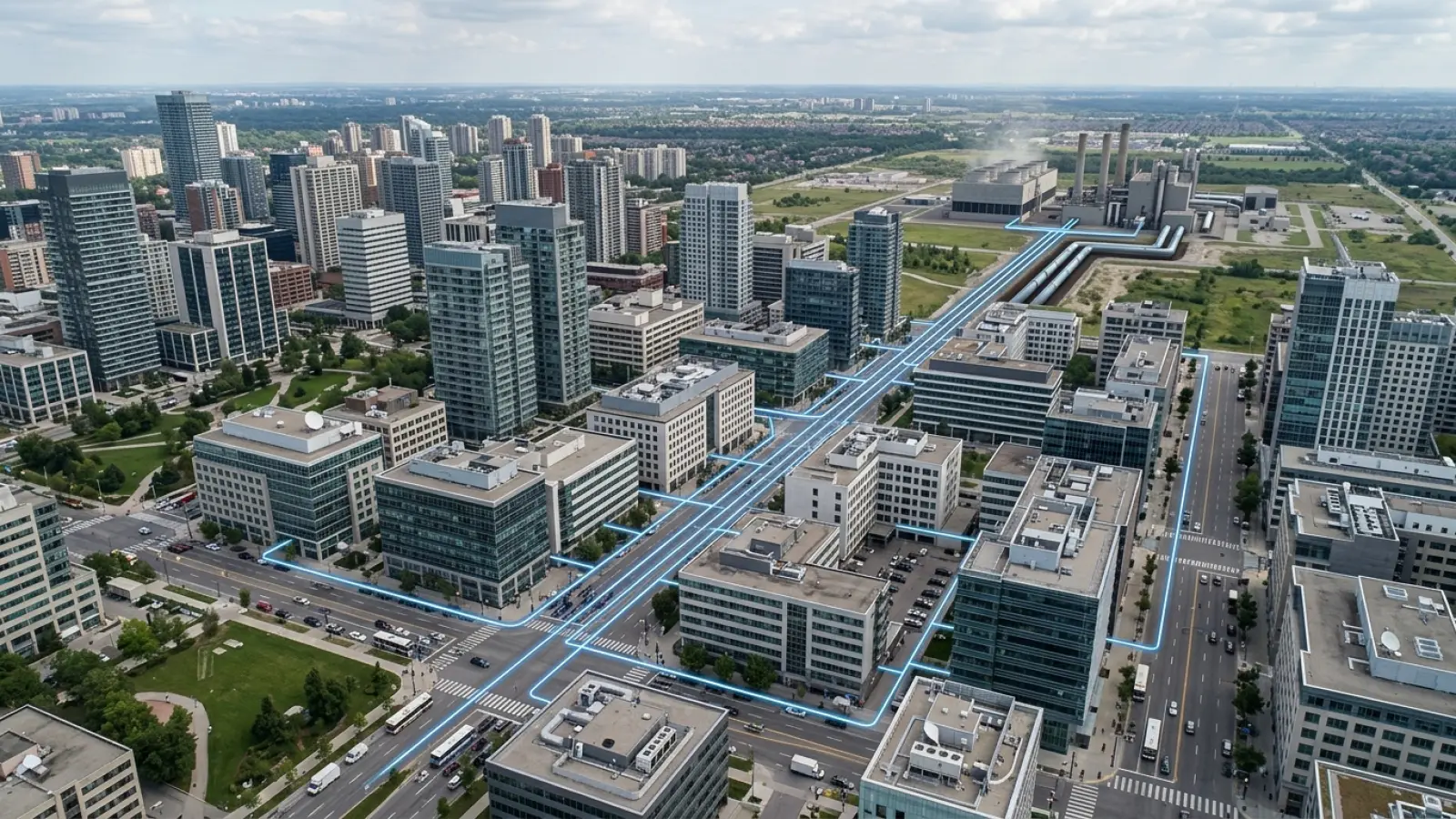
At its core, a district cooling system (DCS) is a large-scale refrigeration and distribution network. Instead of producing cold air locally within each building, a DCS generates chilled water at a central, highly efficient plant and distributes it to a network of residential, commercial, and industrial buildings through insulated underground pipes. This centralized cooling network effectively serves an entire district, campus, or even a whole city, operating on a principle of shared infrastructure and economies of scale.
The Core Concept: From Individual Units to a Shared Network
The conventional approach to cooling involves placing individual chillers, cooling towers, or countless air conditioning units in or on top of every building. This decentralized model results in widespread duplication of equipment, inconsistent maintenance, and suboptimal energy performance. District cooling systems fundamentally change this dynamic. By consolidating cooling production into one large-scale chilled water plant, the system can leverage industrial-grade, ultra-efficient equipment that would be impractical for a single building. This centralization not only dramatically improves energy efficiency but also standardizes maintenance and operational reliability, transforming cooling from a capital expense and management burden into a simple utility service for building owners.
Key Components of a District Cooling System
A district cooling system is comprised of four primary components working in harmony to deliver seamless cooling across an urban landscape:
- Central Chiller Plant: This is the heart of the system. Located strategically, often on the periphery of a dense urban area, the plant houses large, industrial-grade chillers, powerful pumps, and cooling towers. It operates 24/7 under the supervision of skilled technicians to produce a continuous supply of chilled water. These plants are designed with significant redundancy to ensure uninterrupted service.
- Distribution Network: A vast, insulated network of underground pipes acts as the system's circulatory system. It consists of two main lines: a supply pipe that carries chilled water from the plant to the buildings, and a return pipe that brings the warmer water back to be re-chilled. The high-grade insulation minimizes thermal loss, ensuring the water arrives at its destination at the optimal temperature.
- Energy Transfer Stations (ETS): Located within each connected building, typically in a small mechanical room, the Energy Transfer Station is the interface between the district network and the building's internal cooling system. It contains a heat exchanger, control valves, and a BTU meter. The heat exchanger transfers thermal energy from the building's water loop to the district cooling loop without the two streams of water ever mixing, ensuring the integrity of both systems.
- End-User Systems: Once the building's internal water loop is chilled via the ETS, it circulates to the existing in-building equipment. This includes standard HVAC components like Air Handling Units (AHUs) and fan coil units (FCUs), which use the chilled water to cool the air that is then distributed throughout the building's spaces.
How District Cooling Works: The Chilled Water Cycle
The operational process of a district cooling system is a continuous, closed-loop cycle that efficiently moves thermal energy out of buildings and releases it at a central location. Understanding this cycle demystifies how a single plant can cool an entire city.
Step 1: Centralized Water Chilling
The process begins at the central chiller plant. Here, water is cooled to a precise, low temperature, typically around 4-6°C (39-43°F). This is achieved using high-efficiency industrial chillers, which can be powered by electricity, natural gas, or even renewable energy sources. The sheer scale of these chillers allows for far greater efficiency than smaller, building-sized units.
Step 2: Distribution to Buildings
Once chilled, the water is pushed into the supply network by powerful pumps. It travels through the heavily insulated underground pipes, maintaining its low temperature as it flows towards the various residential, commercial, and public buildings connected to the grid. The high pressure ensures a steady and reliable flow to every customer, regardless of their distance from the plant.
Step 3: Heat Exchange and Cooling Delivery
When the chilled water reaches a building, it enters the Energy Transfer Station (ETS). Inside the ETS, the district water flows through one side of a plate heat exchanger. On the other side, the building's own closed-loop water circulates. Heat from the building's warmer water is transferred to the district's colder water, effectively chilling the building's internal loop. This newly chilled building water is then pumped to air handling units to cool the indoor air.
Step 4: The Return Loop
After absorbing the building's heat, the water in the district network is now warmer, typically around 12-14°C (54-57°F). It exits the ETS and flows into the separate return pipe. This warmer water travels back to the central chiller plant, where the entire cycle begins again. The process is continuous, ensuring a constant supply of cooling capacity to all connected buildings.
The Driving Force: Key Benefits of City-Wide Adoption
The rapid adoption of district cooling systems in cities worldwide is driven by a powerful combination of economic, environmental, and operational advantages that are simply unattainable with conventional cooling methods.
Unmatched Energy Efficiency and Cost Savings
Centralized plants achieve significant economies of scale. They can use larger, more sophisticated, and more efficient chillers, including variable speed drives and optimized control systems, leading to energy savings of 30-50% compared to the collective consumption of individual building systems. For building owners and developers, this translates into lower operational costs, as they pay a predictable utility fee instead of bearing the high capital and maintenance expenses of owning and operating a complex chiller plant.
Significant Environmental Advantages and Carbon Reduction
The dramatic improvement in energy efficiency directly correlates to a lower carbon footprint. By consuming less electricity, district cooling systems reduce the load on power grids and decrease greenhouse gas emissions from power generation. Furthermore, central plants can utilize environmentally friendly refrigerants in a controlled, industrial environment, minimizing the risk of leaks. They also open the door to using non-potable water sources like seawater, river water, or treated sewage effluent for condenser cooling, conserving precious freshwater resources.
Enhanced Reliability and Reduced Maintenance for Building Owners
District cooling is a utility-grade service with exceptional reliability. Central plants are designed with built-in redundancy (e.g., N+1 or N+2 chiller configurations), meaning a backup unit is always available if one fails. They are staffed 24/7 by professional operators who manage performance and conduct proactive maintenance. This frees building owners from the burden of managing their own HVAC infrastructure, dealing with emergency repairs, and planning for costly equipment replacement.
Architectural Freedom and Space Optimization
By eliminating the need for bulky chillers, pumps, and cooling towers on-site, district cooling liberates valuable real estate. Rooftops can be transformed into green spaces, occupant amenities like pools or gardens, or even additional revenue-generating floors. Basement and mechanical room space is also drastically reduced, allowing for more efficient building design. This approach also contributes to quieter and more aesthetically pleasing urban environments by removing noisy and unsightly rooftop equipment.
Comparing District Cooling with Conventional HVAC Systems
The advantages of a centralized cooling network become even clearer when directly compared to traditional, building-by-building HVAC systems.
| Feature | District Cooling Systems (DCS) | Conventional Systems (Individual Building Chillers) |
|---|---|---|
| Energy Efficiency | Very High (leverages economies of scale) | Moderate to Low (dependent on individual unit efficiency) |
| Upfront Cost (Developer) | Lower (connects to utility, no chiller plant purchase) | High (requires purchase and installation of entire plant) |
| Operational & Maint. Costs | Lower (paid as a utility fee, no on-site staff/repairs) | High (requires dedicated staff, maintenance, and repairs) |
| Space Requirements | Minimal (only a small ETS room) | Significant (requires large mechanical rooms and rooftop space) |
| Environmental Impact | Low (reduced emissions, controlled refrigerant use) | Higher (cumulative emissions and refrigerant leak risk) |
| Reliability | Very High (centralized plant with redundancy) | Variable (dependent on single building's equipment and upkeep) |
Challenges and Considerations for Implementation
Despite its compelling benefits, deploying a district cooling system is a major infrastructure project with significant hurdles that require careful planning and long-term vision.
High Initial Capital Investment
The primary barrier is the substantial upfront capital required to construct the central chiller plant and lay the extensive underground distribution network. These costs are borne by the utility provider, which requires long-term financial models, often supported by public-private partnerships, to ensure a return on investment over the system's multi-decade lifespan.
Logistical Complexity of Urban Installation
Retrofitting a district cooling network into a dense, established city presents immense logistical challenges. The installation requires extensive excavation to lay the insulated pipes, which can disrupt traffic, businesses, and daily life. This process demands meticulous coordination with municipal authorities, other utilities, and transportation departments to minimize public inconvenience.
Regulatory Frameworks and Stakeholder Coordination
Successful implementation hinges on a supportive policy environment and strong stakeholder alignment. This includes establishing clear regulatory frameworks for tariffs and service standards, securing long-term commitments from anchor tenants (like hospitals, universities, or large commercial developments), and fostering collaboration between the utility operator, city planners, and real estate developers to integrate the network into urban development plans.
The Future of Urban Cooling: Innovations and Trends
District cooling is not a static technology. It is continuously evolving, integrating new innovations to become even more efficient, sustainable, and intelligent.
Integration with Renewable Energy Sources
Centralized plants are uniquely positioned to integrate a variety of renewable energy sources. Solar thermal arrays can pre-heat water for absorption chillers, geothermal energy can provide a stable source for heat rejection or absorption, and biomass can be used in combined heat and power plants that also produce chilled water, further decarbonizing the cooling process.
Thermal Energy Storage (TES)
A game-changing innovation is Thermal Energy Storage. Large TES tanks allow the central plant to produce and store chilled water during off-peak hours, typically overnight when electricity is cheaper and demand is low. This stored cooling capacity is then dispatched during peak afternoon hours, reducing strain on the electrical grid, lowering operational costs, and increasing the system's overall efficiency and resilience.
Smart Grids and AI-Powered Optimization
The next frontier is the digitalization of district cooling networks. By deploying IoT sensors throughout the network, creating digital twins for simulation, and using AI-powered algorithms, operators can predict cooling demand with remarkable accuracy. This allows for proactive optimization of chiller plant operations, dynamic pressure adjustments in the distribution network, and early detection of leaks or inefficiencies, pushing performance to its theoretical maximum.
Conclusion
District cooling systems represent a fundamental shift in how we approach urban comfort and sustainability. By moving from an individual, product-based model to a collective, utility-based service, cities can achieve unparalleled levels of energy efficiency, operational reliability, and environmental performance. While the implementation challenges are significant, the long-term benefits—reduced carbon emissions, lower costs for building owners, and more resilient urban infrastructure—are undeniable. As urban centers continue to grow and face the escalating impacts of climate change, centralized cooling networks will become a critical and indispensable component for creating the smart, livable, and sustainable cities of the future. It is incumbent upon developers, engineers, and planners to champion these systems and integrate them into the blueprint of our future projects.
Frequently Asked Questions (FAQ)
Is district cooling only suitable for new cities?
No, while it's easiest to implement in new developments, many existing cities like Paris and Toronto have successfully retrofitted district cooling networks into their urban cores to replace aging, inefficient systems. Retrofitting allows cities to upgrade their infrastructure, improve air quality, and meet modern sustainability goals.
How much more efficient is a district cooling system?
District cooling systems can be 30-50% more energy-efficient than traditional individual air-conditioning systems. This massive efficiency gain comes from the economies of scale of large industrial-grade equipment, the ability to incorporate thermal energy storage, and continuous professional optimization of the central plant's operations.
Can district cooling be combined with district heating?
Yes. This integrated approach is known as district energy or cogeneration (Combined Cooling, Heat, and Power - CCHP). A single plant can generate electricity, use the waste heat for district heating in the winter, and use that same waste heat to power absorption chillers for district cooling in the summer. This maximizes the energy efficiency of the entire system.
Who pays for the district cooling service?
Building owners pay a utility company for the cooling service, much like they pay for electricity or water. The fee is typically based on metered consumption of thermal energy (measured in BTU or ton-hours). This model eliminates the large capital expenditure and ongoing maintenance costs associated with owning and operating a private chiller plant.
What are some examples of cities with successful district cooling systems?
Dubai has one of the world's largest and most advanced district cooling infrastructures. Other notable examples include Toronto, Canada, which cools its financial district; Paris, France, which has one of the oldest and largest networks in Europe; the city-state of Singapore; and the Cornell University campus in the United States, which operates as a city-scale system.