Thermal Energy Storage Systems: How Chilled Water, Ice, and Molten Salt Reduce Building Peak Loads
Thermal energy storage systems act as thermal batteries by producing or storing cooling and heat when conditions are favorable and releasing it later. This article compares chilled water, ice, and molten salt storage, explaining their HVAC integration, benefits, limitations, and suitability for buildings, campuses, and district energy networks.
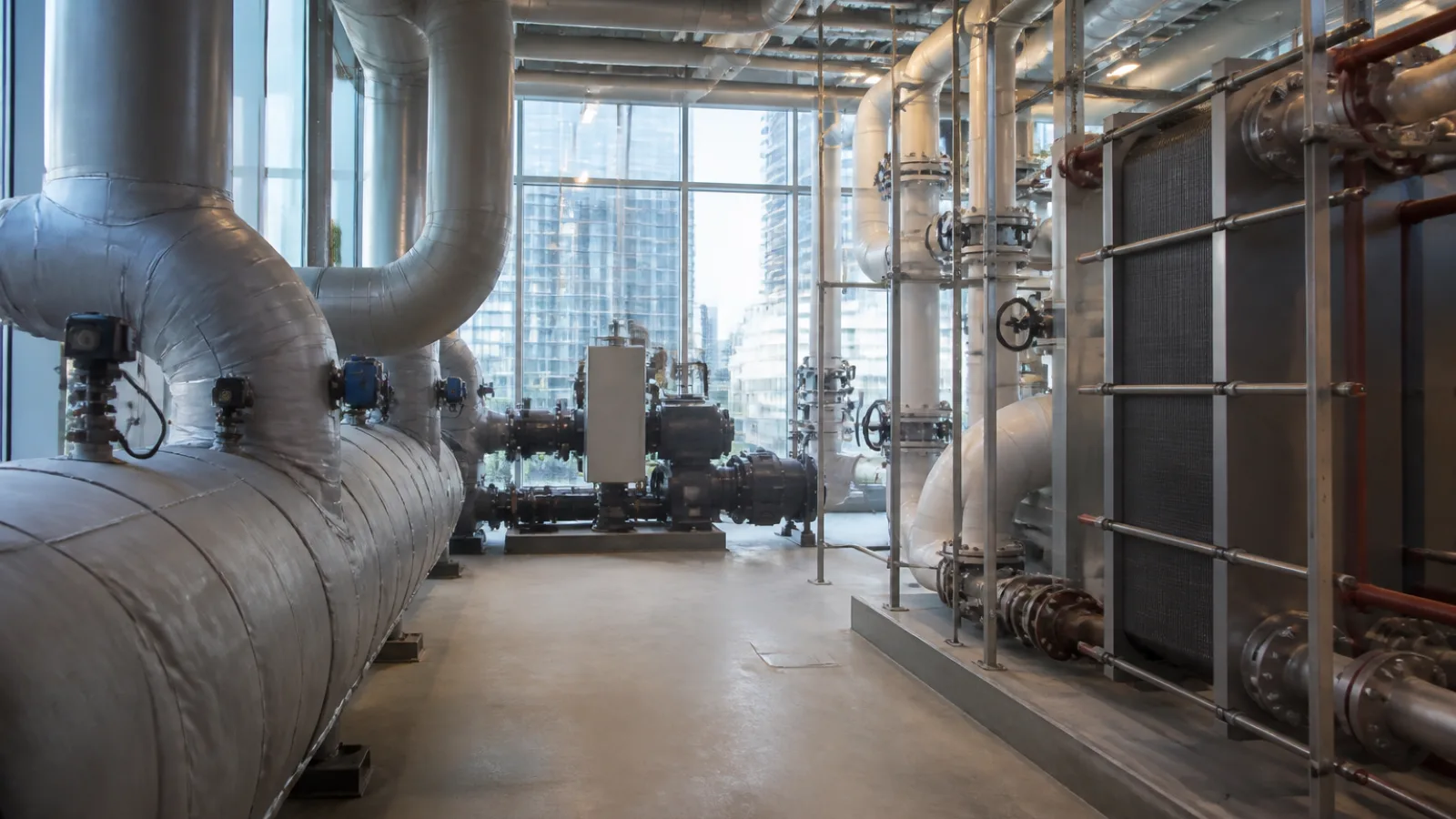
Cooling demand often rises at the same time across a building, campus, or city. Hot outdoor conditions, occupied offices, lighting, equipment, and solar gains can create a coincident electrical peak, forcing chillers and the wider grid to operate at their highest output when electricity may be most expensive or carbon intensive.
Thermal energy storage solutions provide a way to separate the timing of cooling production from the timing of cooling demand. Instead of treating storage as another type of chiller, it is more useful to view it as a system that produces or stores cooling or heat at one time and uses that capacity later.
These thermal batteries do not store electricity in the same way as an electrochemical battery. They store temperature differences or a material’s ability to absorb and release heat. When correctly designed and controlled, thermal energy storage systems can reduce peak electrical demand, improve plant dispatch, and support more flexible building energy systems. They do not, however, guarantee lower total energy use or lower costs in every project.
What Are Thermal Energy Storage Systems?
Thermal energy storage, or TES, is the controlled storage of heating or cooling capacity for later use. In a cooling application, a chiller may operate during the night to cool water or freeze water into ice. During the following day, the stored cooling capacity can supplement or replace part of the chiller output. In a heating application, a tank or other medium may store heat from a boiler, heat pump, solar system, or waste-heat source.
Sensible thermal storage uses a temperature change in a material without changing its physical state. Chilled water storage is a common example: energy is stored by lowering the water temperature and is released when warmer return water is cooled again. The amount of stored energy depends mainly on the mass of the water, its specific heat, and the usable temperature difference.
Latent thermal storage uses a phase change, such as water freezing into ice or melting back into liquid. The phase change absorbs or releases substantial heat at a relatively stable temperature. This allows ice storage HVAC systems to hold more cooling capacity in a smaller volume than a comparable sensible-storage tank, although the associated equipment may operate under less favorable temperature conditions.
A typical TES cycle has three stages:
- Charge: A chiller, heat pump, boiler, or another heat source creates a stored temperature condition, such as chilled water or ice.
- Store: Insulated tanks, vessels, or thermal media retain that cooling or heat while limiting losses and unwanted mixing.
- Discharge: Pumps, valves, and heat exchangers deliver the stored capacity to the building or district network when demand or electricity prices are higher.
This sequence shifts part of the cooling production from high-demand afternoon hours to lower-demand periods. The value of that shift depends on the building load profile, utility tariff, equipment efficiency, climate, storage temperature, and quality of the controls.
How TES Reduces Building Peak Loads
A coincident peak occurs when many loads reach high output at the same time. For a commercial building, this may include air-conditioning compressors, pumps, fans, elevators, lighting, and plug loads. Utilities may apply demand charges based on the highest measured power level during a billing period, so a short interval of high demand can affect the monthly bill.
TES reduces this exposure by discharging stored cooling during defined peak periods. The chiller plant can then operate at a lower output, or a smaller plant can meet the combined load when storage is included in the design. In some systems, chillers charge storage overnight and operate steadily during the day rather than cycling sharply to follow every cooling fluctuation.
Plant sizing must be based on hourly or sub-hourly load data, not only on a building’s design-day peak. Storage may be sized to cover a complete peak period, a portion of the afternoon load, or a limited demand-response event. A smaller chiller plant with storage can have different capital, maintenance, and redundancy requirements from a conventional chiller-only plant.
Peak load reduction can produce demand-cost savings where tariffs reward lower maximum demand or where time-of-use electricity prices are significant. Storage may also allow equipment to operate for longer periods under stable conditions, improve the use of renewable electricity, and provide limited operational resilience during grid constraints. The carbon benefit depends on whether charging occurs during cleaner grid periods and whether the additional pumping, heat-transfer, or refrigeration work offsets that benefit.
TES does not automatically reduce total energy consumption. Chilling water or making ice can require additional electricity because of temperature lift, heat loss, pumping, and charging inefficiencies. Total savings may instead come from better operating hours, reduced oversizing, lower-cost electricity, improved controls, or charging when the grid has lower carbon intensity. These effects must be evaluated through whole-system modelling.
Main Types of Thermal Energy Storage
Chilled Water Storage
Chilled water storage normally uses a large, insulated tank designed to maintain thermal stratification. In a stratified tank, warmer return water remains above colder stored water, creating a usable temperature boundary known as the thermocline. During charging, the chiller sends cold water into the appropriate part of the tank. During discharge, pumps draw chilled water from the cold region and send warmer return water back into the tank.
The storage capacity depends on tank volume and the temperature difference between supply and return water. Larger temperature differences can reduce the required water volume, but the building’s air-handling units, coils, control valves, and terminal units must be able to operate at the selected temperatures and flow rates.
Chilled water storage uses a familiar heat-transfer medium and can integrate well with central chilled-water plants. It is often suitable for large campuses, hospitals, mixed-use developments, and district cooling networks where a central plant already serves multiple load types. The main physical requirement is space for a properly constructed, insulated tank, which may be difficult in dense urban retrofits.
Designers must address tank foundations, insulation, vapor control, water treatment, corrosion protection, nozzle arrangement, mixing, and standby capacity. Poor inlet design or excessive turbulence can destroy stratification and reduce usable capacity. Commissioning should verify actual temperature profiles, flow balance, sensor accuracy, and charge-and-discharge performance.
Ice Storage HVAC
Ice storage HVAC systems use a chiller to freeze water during the charging cycle. During discharge, warmer building return water or a secondary fluid flows through the storage equipment and melts the ice, absorbing heat before the cooled fluid returns to the building system. Depending on the design, the chiller may operate alone, the ice system may provide most of the cooling, or both may operate together.
Because melting ice absorbs latent heat at a relatively stable temperature, ice storage can provide high energy density. This is useful where a building has limited tank volume but needs to shift a meaningful portion of its cooling load. Modular ice tanks can also be installed in phases, subject to structural, access, and maintenance constraints.
The trade-off is that making ice requires lower evaporator temperatures than conventional chilled-water production. Lower evaporator temperatures can reduce chiller efficiency and may increase compressor lift. The complete design must therefore compare the demand-charge benefit and operating schedule against the extra refrigeration energy, pumping, heat loss, and equipment complexity.
Ice storage also requires careful coordination with air-handling-unit coils and terminal units. Supply-water temperatures, coil selection, humidity control, condensation risk, valve authority, and freeze protection must be considered together. Controls must prevent unwanted simultaneous charging and discharging, manage partial melt conditions, and preserve sufficient stored capacity for the intended peak period.
Molten Salt and Other High-Temperature Storage Systems
Molten salt storage is a sensible heat-storage method that uses a salt mixture maintained at high temperature. The salt absorbs heat when charged and releases it through heat exchangers when heat or steam is required. Unlike chilled-water and ice systems, it is primarily designed for high-temperature energy rather than ordinary commercial-building cooling.
Molten salt is more commonly associated with concentrated solar power, industrial heat, thermal generation, and some district-scale energy applications. It can help capture renewable heat or electricity conversion opportunities where high-temperature output is valuable. Other high-temperature storage media, including solid materials and hot water systems, may serve heat networks or process loads depending on the required temperature.
For a typical office building, molten salt is generally not a standard substitute for chilled-water or ice storage. The temperature range, safety provisions, heat exchangers, containment, footprint, and operating expertise may not match the building’s needs. Its relevance increases where a development is connected to a heat network, has industrial process demand, or participates in a larger renewable-energy system.
HVAC Integration and Controls
TES is not an isolated tank or vessel. It must be integrated with chillers, boilers or heat pumps where relevant, pumps, heat exchangers, cooling towers, air-handling units, terminal equipment, the building automation system, and utility or demand-response signals. The hydraulic arrangement determines whether storage is connected in series, parallel, or through a separate heat exchanger loop.
Effective smart HVAC operation depends on accurate sensors and clear control sequences. Typical measurements include supply and return temperatures, flow rates, tank temperature layers, chiller power, pump status, outdoor conditions, and building demand. The control system uses these values to estimate state of charge, meaning the amount of usable cooling or heat remaining in storage.
Dispatch logic may charge storage when tariffs are lower, renewable generation is available, outdoor conditions are favorable, or the plant has spare capacity. It can discharge during a defined peak window, when a demand-response signal is received, or when operating the chiller would create an undesirable electrical peak. Comfort, humidity, indoor-air quality, and equipment limits must remain higher priorities than an aggressive storage schedule.
Commissioning should test normal, partial-load, failure, and emergency sequences. Important issues include redundancy, freeze protection, water quality, insulation condition, sensor calibration, metering, alarm handling, and recovery after a power interruption. A storage system that is physically adequate but poorly controlled may fail to deliver its intended peak-load or cost benefits.
TES Compared With Conventional HVAC Operation
| Approach | Operating pattern | Peak-demand behavior | Space or equipment implications | Best-fit applications |
|---|---|---|---|---|
| Conventional chiller-only operation | Chillers follow building cooling demand as it occurs. | Highest electrical demand may coincide with the hottest and most expensive periods. | Fewer storage components, but chillers and electrical infrastructure may need to serve the full peak. | Buildings with moderate peaks, favorable tariffs, limited space, or simple operating requirements. |
| Chilled-water storage | Chillers charge an insulated tank, which discharges through the chilled-water system later. | Can shift part of the cooling load and reduce plant output during selected peak hours. | Requires significant tank volume, insulation, hydraulic design, and space. | Large buildings, campuses, hospitals, and district cooling networks with central plants. |
| Ice storage HVAC | Chillers freeze water during charging; stored ice melts during discharge. | Can provide high peak-load reduction from a comparatively compact storage volume. | Requires low-temperature refrigeration, specialized storage equipment, and careful coil and controls coordination. | Buildings with high cooling peaks and constrained tank space where tariff benefits justify complexity. |
| High-temperature or molten-salt storage | High-temperature media store heat for later process, network, or power applications. | Can shift heat production or renewable-energy use at district or industrial scale. | Requires high-temperature containment, heat exchangers, safety systems, and specialist operation. | Concentrated solar power, industrial heat, heat networks, and large renewable-energy systems. |
The table illustrates operating differences rather than a universal ranking. TES can reduce demand charges without reducing annual kilowatt-hours, while a conventional system may use less energy in some conditions because it avoids storage losses. The correct comparison should include capital cost, maintenance, demand charges, energy prices, emissions, resilience, and the cost of associated electrical and mechanical infrastructure.
Energy, Sustainability, and Practical Benefits
Potential benefits of TES include peak demand reduction, tariff savings, improved chiller utilization, better alignment with renewable generation, and reduced reliance on peak-generation capacity. Storage may also give a facility more flexibility during grid constraints or short interruptions, although it should not be described as a complete backup-power system unless supported by the necessary pumps, controls, and electrical infrastructure.
TES contributes most effectively to energy-efficient buildings when it is combined with an efficient envelope, properly selected chillers, variable-speed drives, heat recovery, optimized air distribution, and strong building automation. Storage should not be used to compensate for excessive solar gain, poor insulation, uncontrolled ventilation, or an inefficient plant.
A whole-life assessment should include embodied carbon in tanks, insulation, structural works, refrigeration equipment, heat exchangers, and replacement components. Water use, treatment chemicals, refrigerants, leakage risk, maintenance access, and end-of-life handling also matter. A system that reduces operational emissions but requires substantial material or maintenance inputs should be assessed across its expected service life and local grid conditions.
Global Examples of TES in the Built Environment
Dubai district cooling: Large district-cooling networks can use thermal storage to manage the timing of cooling production and improve central-plant dispatch. Storage may help reduce the need to run every chiller at maximum output during hot periods, but the appropriate tank type, operating schedule, and economics depend on network hydraulics, customer diversity, tariffs, and local climate.
Marina Bay, Singapore: A dense mixed-use urban context such as Marina Bay demonstrates why centralized chilled-water infrastructure and demand management can be important. District cooling and other shared energy strategies may coordinate diverse commercial and public loads, but the storage configuration and performance of any particular building or network should not be assumed without verified project information.
University campuses in the USA: Campuses are strong candidates for TES because they commonly have central plants, varied building schedules, seasonal loads, and multiple building types. Chilled-water or ice storage can help coordinate classrooms, laboratories, residences, sports facilities, and administrative buildings. Each campus still requires an analysis of expansion plans, load diversity, utility rates, and plant redundancy.
Commercial office towers in Europe: Office towers may face limited plant space, variable occupancy, carbon-reduction targets, and growing interest in demand response. TES can work with smart-building controls where the building has a predictable enough load, suitable central equipment, and a tariff or grid signal that rewards flexibility. These contexts illustrate different applications, not identical system designs or guaranteed savings.
When Should a Building Owner Consider TES?
A practical feasibility review should consider:
- Hourly or sub-hourly heating and cooling load data, including seasonal variation and future expansion.
- Utility tariff structure, demand charges, time-of-use pricing, export rules, and available demand-response programs.
- Peak-demand exposure and the duration, frequency, and predictability of peak periods.
- Available space, structural capacity, access routes, fire strategy, and retrofit constraints.
- Compatibility with existing chillers, heat pumps, boilers, cooling towers, pumps, coils, and electrical systems.
- Climate, humidity conditions, operating schedules, comfort requirements, and required supply temperatures.
- On-site renewable generation, expected grid carbon intensity, and opportunities to absorb otherwise curtailed energy.
- Water availability, water-treatment needs, maintenance access, leakage protection, and operator capability.
- Building automation capability, metering quality, cybersecurity, and the availability of skilled commissioning support.
- Lifecycle cost, embodied carbon, replacement planning, resilience value, and uncertainty in future tariffs.
TES is often most attractive for buildings or campuses with large cooling loads, predictable peaks, central plants, high demand charges, or a need to absorb renewable generation. It should be evaluated alongside envelope improvements, efficient chillers, variable-speed drives, heat recovery, and controls. These measures are not necessarily competitors; reducing the load first can change the most appropriate storage size and improve the entire system’s economics.
The Future of TES in Smart Cities
Thermal storage can become a flexible resource within district energy and smart-city systems. Digital twins and predictive controls can combine weather forecasts, occupancy information, tariff data, grid conditions, and carbon signals to determine when storage should charge or discharge. District networks can aggregate many buildings so that a small change in each load produces a useful response at city scale.
Interoperable controls are important to this model. Building automation systems, district-energy platforms, utility signals, heat pumps, renewable generation, and storage equipment need reliable data exchange and clear operating responsibilities. Building-to-grid programs may use thermal capacity to reduce demand without changing indoor comfort, provided the controls understand the building’s thermal response.
Barriers remain. Capital cost, planning space, complex controls, ownership models, tariff uncertainty, water requirements, and the shortage of skilled commissioning professionals can delay adoption. Smart-city deployment is therefore not simply a technology decision; it requires compatible market rules, long-term planning, operational accountability, and verified performance.
Frequently Asked Questions About Thermal Energy Storage Systems
What is the main purpose of thermal energy storage?
The main purpose is to shift heating or cooling capacity through time. A system produces or stores thermal capacity when electricity, equipment availability, or renewable generation is favorable, then releases it during a later demand period. This can reduce electrical peaks and demand charges, although it does not automatically reduce total annual energy consumption.
Is chilled-water storage better than ice storage?
Neither is universally better. Chilled-water storage uses a familiar medium and can integrate efficiently with large central plants, but it generally needs more volume. Ice storage offers higher energy density and may suit sites with limited space, while its lower refrigeration temperatures can affect chiller efficiency. Load profile, tariffs, space, equipment, and controls should determine the selection.
Does TES reduce energy consumption or only peak demand?
TES is primarily a peak-demand and load-shifting measure. It may reduce total energy use when it improves plant loading, avoids oversizing, enables efficient operating hours, or uses cleaner and more favorable grid periods. However, charging, pumping, heat loss, and temperature lift can add energy use. A calibrated hourly model is needed to quantify the net result.
Can thermal storage be added to an existing HVAC system?
It can be added to some existing systems, but feasibility depends on hydraulic arrangement, chiller and heat-pump controls, available space, structural capacity, electrical infrastructure, coil temperatures, and metering. Retrofit work may require heat exchangers, pumps, valves, automation upgrades, or plant modifications. A staged study should confirm constructability, outage requirements, and lifecycle economics before installation.
Are molten salt systems suitable for ordinary office buildings?
Usually, molten salt is not the first choice for ordinary office cooling. It is more commonly used for high-temperature heat, industrial processes, concentrated solar power, and some district-scale applications. Office buildings typically have better-matched options in chilled water, ice, hot water, or phase-change materials. Molten salt may be relevant when a building connects to a larger high-temperature energy network.
How does TES support smart-city energy management?
TES gives buildings a controllable thermal load that can respond to electricity prices, renewable output, grid constraints, or carbon-intensity signals. Connected buildings can coordinate charge and discharge schedules through district-energy platforms or building-to-grid programs. The benefits depend on interoperable controls, accurate metering, reliable communications, suitable tariffs, and operating strategies that preserve comfort and equipment reliability.
Conclusion
Thermal energy storage systems provide a strategic way to shift heating or cooling capacity through time. Chilled water, ice, and molten salt each use different storage principles and serve different temperature ranges, scales, and applications. Their value may include peak load reduction, demand-cost management, renewable-energy alignment, improved plant operation, and greater flexibility during grid constraints.
The right technology depends on the building’s load shape, climate, utility tariffs, available space, equipment, water and maintenance requirements, controls capability, and lifecycle economics. Storage should be assessed alongside envelope upgrades, efficient HVAC equipment, heat recovery, and commissioning rather than treated as a universal replacement for efficiency measures.
Before selecting chilled water, ice, molten salt, or another storage approach, analyze hourly loads and model the complete HVAC and energy system. That process provides a more reliable basis for comparing energy use, peak demand, emissions, capital cost, operational risk, and long-term building performance.