The Engineering Behind Floating Cities: How Coastal Civil Engineering is Preparing for Sea-Level Rise
As sea levels rise, floating cities are emerging as a viable climate adaptation strategy. This article delves into the core civil and marine engineering principles, from Very Large Floating Structures (VLFS) and semi-submersible platforms to the advanced mooring and infrastructure systems required to build resilient offshore communities.
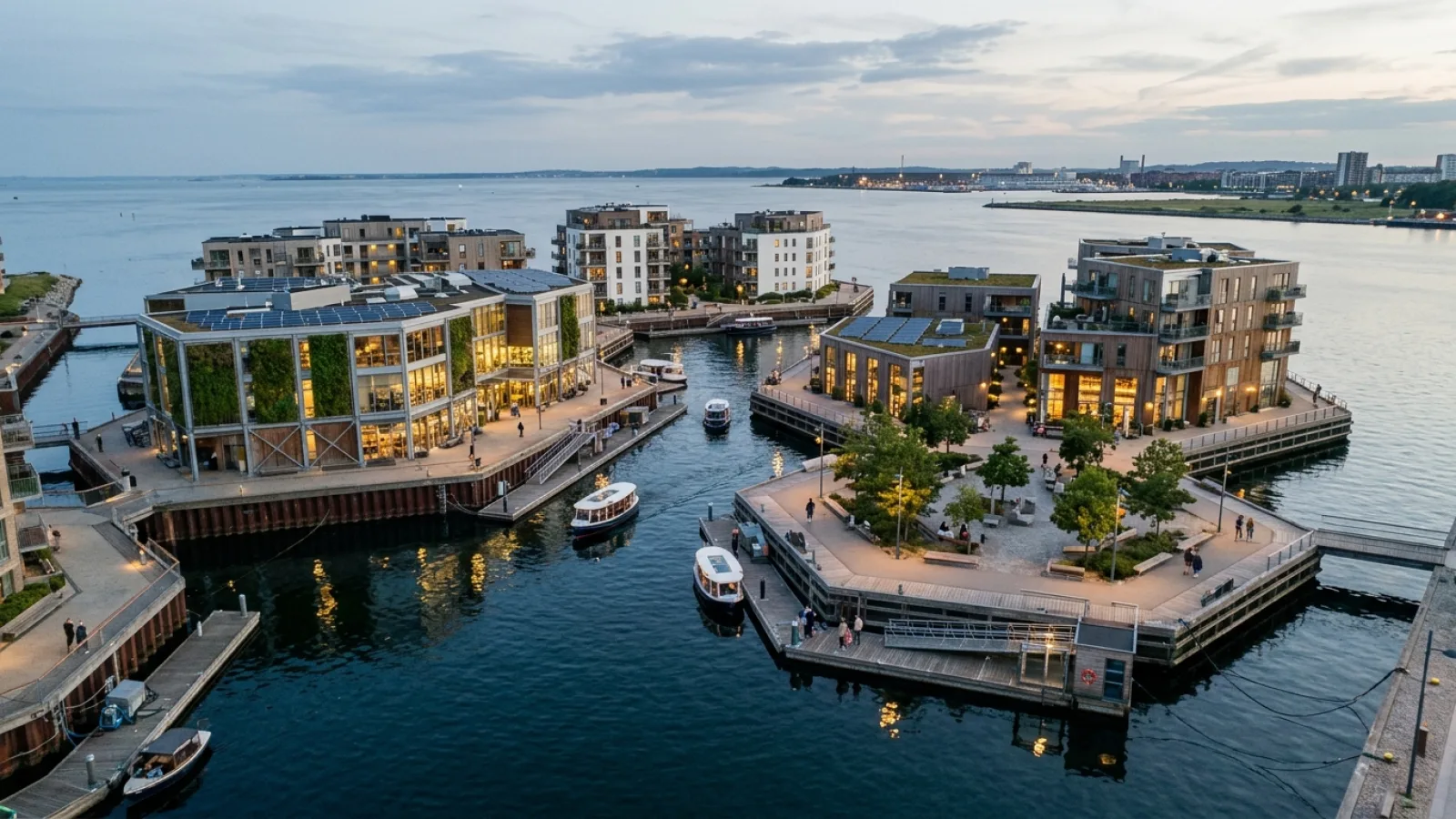
Rising sea levels present an existential threat to coastal cities worldwide, jeopardizing trillions of dollars in infrastructure and displacing hundreds of millions of people. Traditional coastal civil engineering defenses like seawalls and levees are increasingly proving to be costly, temporary, and ecologically disruptive. This reality is demanding innovative engineering solutions that move beyond resistance to embrace resilience. Floating architecture represents a proactive, resilient adaptation strategy that works with water rather than against it. This concept is rapidly moving from theory to practice, driven by advancements in marine and civil engineering, with specialized firms in floating development leading the charge. This article deconstructs the core engineering disciplines required to design, build, and operate a viable floating city, providing a technical overview of this emerging frontier in sustainable urbanism.
Foundational Principles: Creating Buoyancy and Stability
The foundation of a floating city is its most critical component, defining its stability, scale, and suitability for different marine environments. The choice of foundational technology dictates everything from inhabitant comfort to structural integrity and long-term viability. Civil and marine engineers primarily consider two advanced platform types, each with specific applications and challenges.
Pontoon-Based Platforms (Very Large Floating Structures - VLFS)
Pontoon-based platforms, often categorized as Very Large Floating Structures (VLFS), are massive, box-like structures typically constructed from reinforced concrete or steel. These platforms provide a continuous, stable surface that functions much like land, allowing for conventional building construction on top. Their design prioritizes creating a large, contiguous area with high initial stability, making them ideal for deployment in relatively sheltered waters such as bays, harbors, and lagoons where wave action is minimal.
The primary advantage of a VLFS is its ability to create expansive, usable real estate directly on the water. However, the civil engineering challenges are significant. Managing structural stresses over vast spans requires meticulous design to prevent cracking and fatigue. A key concern is the hydroelastic response, where the structure deforms under wave loads. Engineers must use sophisticated finite element analysis (FEA) to model these interactions and design internal structural systems that can absorb and distribute these forces without compromising the integrity of the platform or the buildings it supports.
Semi-Submersible Platforms
Adapted from decades of use in the offshore oil and gas industry, semi-submersible platforms represent a more robust solution for open-sea conditions. This technology uses a series of large, submerged columns and pontoons connected by a truss structure. The main platform, where the city is built, is elevated high above the water's surface. By keeping the bulk of the buoyant volume deep beneath the waves, the platform is largely decoupled from surface wave action, providing superior stability in rough seas.
This enhanced stability makes semi-submersible platforms suitable for more exposed offshore locations. The trade-off is a significant increase in design complexity, construction cost, and maintenance requirements. The submerged components are subject to immense hydrostatic pressure and require materials and designs capable of withstanding the harsh deep-water environment. Inspection and repair of these underwater elements necessitate specialized equipment and procedures, adding to the operational lifecycle costs.
Material Science and Durability in Marine Environments
The success of any floating building technology hinges on material science. Structures are exposed to a relentless combination of saltwater corrosion, marine biofouling, and constant dynamic loads from waves and wind. Marine-grade, corrosion-resistant concrete is essential, often formulated with admixtures like fly ash or silica fume to reduce permeability and enhance durability. Specialized steel alloys with higher resistance to chloride-induced corrosion are used for critical structural components.
Furthermore, advanced fiber-reinforced polymer (FRP) composites are gaining traction for their high strength-to-weight ratio, corrosion immunity, and design flexibility. To protect these materials, engineers employ multi-layered defense systems. Cathodic protection systems, which use an electrochemical process to prevent steel corrosion, are standard. Advanced anti-fouling coatings are applied to hulls and submerged elements to inhibit the growth of marine organisms that can add weight, increase drag, and accelerate material degradation.
Mooring and Anchoring: Securing a City to the Seafloor
A floating city must be securely anchored to prevent drifting while simultaneously accommodating vertical movement from tides and storm surges. Mooring systems for floating structures are a specialized field of coastal engineering, balancing immense forces with the need for controlled flexibility.
Catenary vs. Taut Leg Mooring Systems
The two primary mooring methods are catenary and taut leg systems. A catenary mooring system uses heavy chains or cables that lie partially on the seabed. The weight and sag (the catenary curve) of the line provide the restoring force that pulls the structure back into position when moved by wind or currents. This system is robust and cost-effective for shallower waters but requires a large seabed footprint due to the long scope of the mooring lines.
In contrast, a taut leg mooring system uses lightweight, high-strength tethers (often made of polyester or steel) that are tensioned vertically between the platform and its anchors. This provides stability with a minimal seabed footprint, making it the preferred choice for deep-water applications and for minimizing ecological disturbance. The engineering challenge lies in maintaining constant tension and designing tethers that can withstand cyclic loading for decades.
Advanced Anchoring Technologies
The mooring lines are only as strong as their anchors. The choice of anchor technology is dictated by seabed geology. Gravity-based anchors are simply massive concrete blocks that rely on their sheer weight to provide holding power, suitable for hard or rocky seabeds. For soft seabeds composed of sand or clay, driven pile anchors are hammered deep into the seafloor, providing immense holding capacity through skin friction. A more advanced solution is the suction caisson, a large, inverted steel bucket that is lowered to the seabed. By pumping water out of the caisson, the external hydrostatic pressure drives it firmly into the soil, creating powerful suction and holding force.
Dynamic Positioning as a Niche Solution
For temporary positioning during construction or for highly specialized mobile platforms, some modules could employ Dynamic Positioning (DP). This is a computer-controlled system that uses a network of thrusters to automatically maintain a structure's position and heading without traditional mooring lines. While energy-intensive and not practical for permanently stationing an entire city, DP technology is a critical tool in the offshore engineering toolkit for assembly and maintenance operations.
Integrating Critical Infrastructure on a Floating Platform
A true floating city must be more than a collection of buildings; it must be a self-sustaining ecosystem. This requires a complete reimagining of urban infrastructure, engineered for efficiency, resilience, and circularity in an isolated marine environment.
Energy Generation and Distribution
Energy independence is a primary goal. Power generation solutions must be diverse and integrated directly into the city's structure. This includes covering all available surfaces with high-efficiency photovoltaics, building oscillating water column or point absorber wave energy converters into the breakwaters and foundational structures, and potentially deploying small-scale tidal or current turbines beneath the platform. A robust battery storage system is critical to ensure a stable power supply. For connectivity, flexible, articulated subsea cables engineered to withstand constant movement are required to link to mainland grids or connect different floating modules.
Closed-Loop Water and Waste Management
Creating a circular economy for resources is not an option but a necessity. Freshwater is generated primarily through high-efficiency reverse osmosis desalination plants, supplemented by advanced rainwater harvesting and purification systems integrated into building designs. Wastewater is managed through compact, onboard treatment plants. These systems separate and treat greywater (from sinks and showers) for reuse in irrigation or toilet flushing, while blackwater is treated to a standard safe for marine discharge or processed in bioreactors. Solid waste is managed via pneumatic collection tubes, onboard compaction and sorting facilities, and potentially waste-to-energy gasification systems to close the loop.
Connectivity and Transportation Networks
Connecting disparate floating modules requires specialized civil engineering. Flexible bridges with expansion joints and gimbal-like bearings are designed to accommodate the multi-axis relative motion between platforms. For larger separations or all-weather connections, submerged floating tunnels (SFTs) anchored to the seabed offer a stable and protected transit corridor. Internal transportation is planned around pedestrian-centric walkways, dedicated channels for electric water taxis, and docking stations for autonomous ferries, eliminating the need for personal cars and maximizing usable space.
Key Civil Engineering Challenges and Future Innovations
The engineering of floating cities is an evolving discipline. While the foundational principles are established, scaling these concepts to the size of a city presents formidable challenges that are driving innovation across the field.
Scalability and Modular Construction
Building a city at sea monolithically is impractical. The future lies in a modular design approach. Large, prefabricated concrete or steel modules are constructed in controlled onshore facilities, such as dry docks, ensuring high quality and efficiency. These modules are then towed to the site and connected. This method allows for phased development, enabling cities to grow organically over time as needs and populations change. The engineering of the connections between these modules is critical, requiring systems that are strong enough to form a cohesive city but flexible enough to absorb differential movements.
Hydrodynamic and Aerodynamic Analysis
The dynamic marine environment necessitates an unprecedented level of analysis. Advanced computational fluid dynamics (CFD) is essential for simulating how the city will interact with waves, currents, and tides. This hydrodynamic analysis informs the shape of the foundation, the design of the mooring system, and the layout of breakwaters to ensure stability and minimize motion. Simultaneously, extensive wind tunnel testing and aerodynamic modeling are used to design the city's superstructure. The arrangement and shape of buildings are optimized to minimize wind loads on the platform and to prevent uncomfortable wind tunneling effects at the pedestrian level.
Environmental Impact and Ecological Integration
Responsible offshore engineering must prioritize the health of the marine ecosystem. A key challenge is to design floating cities that not only minimize harm but actively enhance their environment. Innovations include designing the undersides of platforms to function as artificial reefs, creating complex habitats that can boost local biodiversity. Permeable breakwaters and strategically spaced foundation columns are designed to avoid disrupting natural currents and sediment transport patterns. Furthermore, engineers must carefully manage light and noise pollution to protect sensitive marine life, integrating these considerations into the earliest stages of the design process.
Conclusion
The engineering of floating cities is a serious and complex discipline, representing a fundamental paradigm shift in how humanity approaches coastal living. It is a convergence of coastal civil engineering, marine engineering, material science, and sustainable urbanism. The core pillars—robust buoyant foundations, resilient mooring systems, and fully integrated, closed-loop infrastructure—form the blueprint for this next generation of urban development. Far from being a futuristic fantasy, floating development is a tangible response to the urgent pressures of climate change. Civil engineers stand at the forefront of this movement, tasked with pioneering the resilient, sustainable, and innovative habitats that will define the 21st century and beyond.
Frequently Asked Questions
How do floating cities withstand tsunamis and hurricanes?
Floating cities are surprisingly resilient to certain natural disasters. During a tsunami, which is a long-wavelength wave, the entire structure would rise and fall with the water level, experiencing minimal structural stress, unlike coastal structures that are hit by the breaking wave's full force. For hurricanes, resilience is achieved through advanced engineering. Semi-submersible platforms are designed to be stable in extreme wave conditions. Mooring systems are engineered with high safety factors to withstand storm surges and extreme winds. Additionally, aerodynamic building design and potential breakwaters help mitigate the impact of high winds and storm-generated waves.
What are the primary materials used to build floating structures?
The primary materials are selected for strength, durability, and resistance to the marine environment. These include: Marine-grade reinforced concrete, often with special admixtures to prevent corrosion and water ingress; high-strength steel alloys with protective coatings for structural frames and critical components; and increasingly, fiber-reinforced polymer (FRP) composites for their light weight, high strength, and immunity to corrosion.
How is sewage and waste managed in a floating city?
Waste management is based on a closed-loop, circular economy model. Sewage is treated in compact, highly efficient onboard wastewater treatment plants. These systems separate greywater (from sinks, showers) for recycling and reuse, while blackwater (from toilets) is treated to a high standard before being safely discharged or used in waste-to-energy processes. Solid waste is managed through pneumatic tubes, centralized sorting, high-efficiency recycling, and composting, with residual waste potentially converted to energy via gasification.
Are floating cities designed to be fully self-sufficient?
The goal is a high degree of self-sufficiency, though full autonomy may not always be practical or desirable. They are designed for self-sufficiency in critical areas like energy, water, and waste management. Energy is generated from integrated renewable sources like solar, wave, and wind. Water is produced through desalination and rainwater harvesting. Waste is recycled and treated on-site. While they aim for independence, they may still maintain a connection to the mainland for specialized goods, services, and as a redundant power link, balancing resilience with economic and social integration.