What Is Fiber-Reinforced Polymer (FRP)? A Guide to Strengthening Structures Without Demolition
Discover Fiber-Reinforced Polymer (FRP), an advanced composite material used for structural strengthening. This guide covers the types of FRP, its applications in rehabilitating bridges and buildings, and its advantages over traditional repair methods.
The Challenge of Aging Infrastructure: Why Traditional Methods Fall Short
Across the globe, critical infrastructure like bridges, buildings, and industrial facilities are aging. Increased load demands, environmental degradation, and changes in design codes mean many structures no longer meet modern safety and performance standards. For decades, the primary solutions for structural strengthening involved invasive, disruptive, and often costly methods. Techniques like steel plate bonding, section enlargement (concrete jacketing), and external post-tensioning add significant weight, are susceptible to corrosion, and require extensive demolition and lengthy operational shutdowns.
These challenges have driven the engineering community to seek more efficient, durable, and less intrusive solutions. Enter Fiber-Reinforced Polymer (FRP) strengthening, a transformative technology that allows for significant structural enhancement without the need for demolition. By leveraging advanced materials, these innovative FRP composite systems provide a powerful alternative for rehabilitating and upgrading concrete, steel, and masonry structures, extending their service life for decades to come.
What Is Fiber-Reinforced Polymer (FRP)?
Fiber-Reinforced Polymer is a composite material made from two primary constituents: high-strength structural fibers and a polymer matrix. It is not a single material but a system where the combination of its parts creates properties superior to those of the individual components. Think of it like reinforced concrete, where steel rebar provides tensile strength and concrete provides compressive strength and form. In FRP, the fibers are the primary load-bearing element, while the polymer matrix protects the fibers and transfers loads between them.
Defining the Composite: Fibers and Polymer Matrix
- Fibers: These are the backbone of the FRP system, providing its exceptional strength and stiffness. The fibers are typically made from carbon, glass, aramid, or basalt. They are manufactured into various forms, such as flexible fabrics (tows), rigid plates, or reinforcing bars (rebar), depending on the application.
- Polymer Matrix: Usually an epoxy, vinyl ester, or polyester resin, the matrix serves several critical functions. It binds the fibers together, protects them from environmental damage (like moisture and chemicals), and efficiently transfers stress from the existing structure to the high-strength fibers. The performance of the entire system depends on the strong bond between the matrix, the fibers, and the substrate (the original structure).
The Science Behind the Strength: High Tensile Strength and Low Weight
The remarkable effectiveness of FRP lies in its material science. The fibers have incredibly high tensile strength—many times that of traditional steel—but are exceptionally lightweight. For example, carbon fiber is roughly five times stronger than steel by weight. When these fibers are bonded to a concrete beam or column, they act as external reinforcement, engaging when the structure is under load. This external bonding significantly increases the element's flexural (bending), shear, and axial (compressive) capacity without adding the significant dead load associated with steel plates or new concrete.
Key Types of FRP Used in Structural Strengthening
The choice of fiber depends on the specific project requirements, including the desired strength, stiffness, and budget. Each type offers a unique set of properties.
Carbon Fiber-Reinforced Polymer (CFRP): The High-Performance Choice
CFRP is the most common type used for structural strengthening due to its superior properties. It boasts extremely high tensile strength, high stiffness (resistance to stretching), and excellent fatigue resistance. This makes it ideal for demanding applications like reinforcing bridge girders, increasing the load capacity of floor slabs, and seismic retrofitting of columns.
Glass Fiber-Reinforced Polymer (GFRP): Versatility and Cost-Effectiveness
GFRP is a more economical option than CFRP. While it has lower tensile strength and stiffness than carbon fiber, it is still significantly stronger than steel. GFRP is often used in applications where high strength is needed but stiffness is less critical. It is also an electrical insulator, making it suitable for use in environments with electromagnetic fields. Common uses include reinforcing masonry walls and repairing corroded concrete elements.
Aramid Fiber-Reinforced Polymer (AFRP): Impact Resistance Specialist
Aramid fibers (like Kevlar®) are known for their exceptional toughness and impact resistance. AFRP systems excel in applications requiring high energy absorption, such as blast retrofitting or strengthening structures prone to seismic shock or impact loads. They are less stiff than CFRP but offer superior durability in harsh environments.
Basalt Fiber-Reinforced Polymer (BFRP): A Sustainable Alternative
BFRP is a newer addition to the FRP family, made from melted basalt rock. Its properties fall between glass and carbon fiber. It offers high-temperature resistance, good chemical resistance, and is considered more sustainable to produce than carbon fiber. It is gaining traction for applications where a balance of performance, cost, and environmental consideration is important.
| Property | CFRP (Carbon) | GFRP (Glass) | AFRP (Aramid) | BFRP (Basalt) |
|---|---|---|---|---|
| Tensile Strength | Very High | High | High | High |
| Stiffness (Modulus) | Very High | Low to Moderate | Moderate | Moderate to High |
| Corrosion Resistance | Excellent | Excellent | Excellent | Excellent |
| Relative Cost | High | Low | Very High | Moderate |
| Key Application | Flexural/shear strengthening, seismic upgrades | Confinement, corrosion repair, masonry | Impact/blast resistance, seismic dampers | High-temperature environments, sustainable projects |
How is FRP Applied? The Strengthening Process Explained
Applying FRP is a precise, multi-step process that requires skilled technicians and careful quality control. Unlike pouring concrete, it is more akin to a technical craft.
Step 1: Structural Assessment and Surface Preparation
Before any FRP is applied, a thorough structural analysis is performed by a qualified engineer to determine the strengthening requirements. The substrate (concrete, steel, etc.) must be sound. The surface is then prepared meticulously. This involves removing any deteriorated concrete, cleaning the surface to remove dust and contaminants, and often grinding it to achieve a smooth, flat profile. Proper surface preparation is critical for achieving a strong bond.
Step 2: Primer and Resin Application
A primer is applied to the prepared concrete surface to penetrate the pores and create a high-bond interface. After the primer cures, a saturation resin (typically epoxy) is applied. This resin serves as both the adhesive for the FRP and the matrix that will encapsulate the fibers.
Step 3: FRP Fabric or Plate Installation (Wet Layup vs. Pre-Cured)
There are two primary methods for installation:
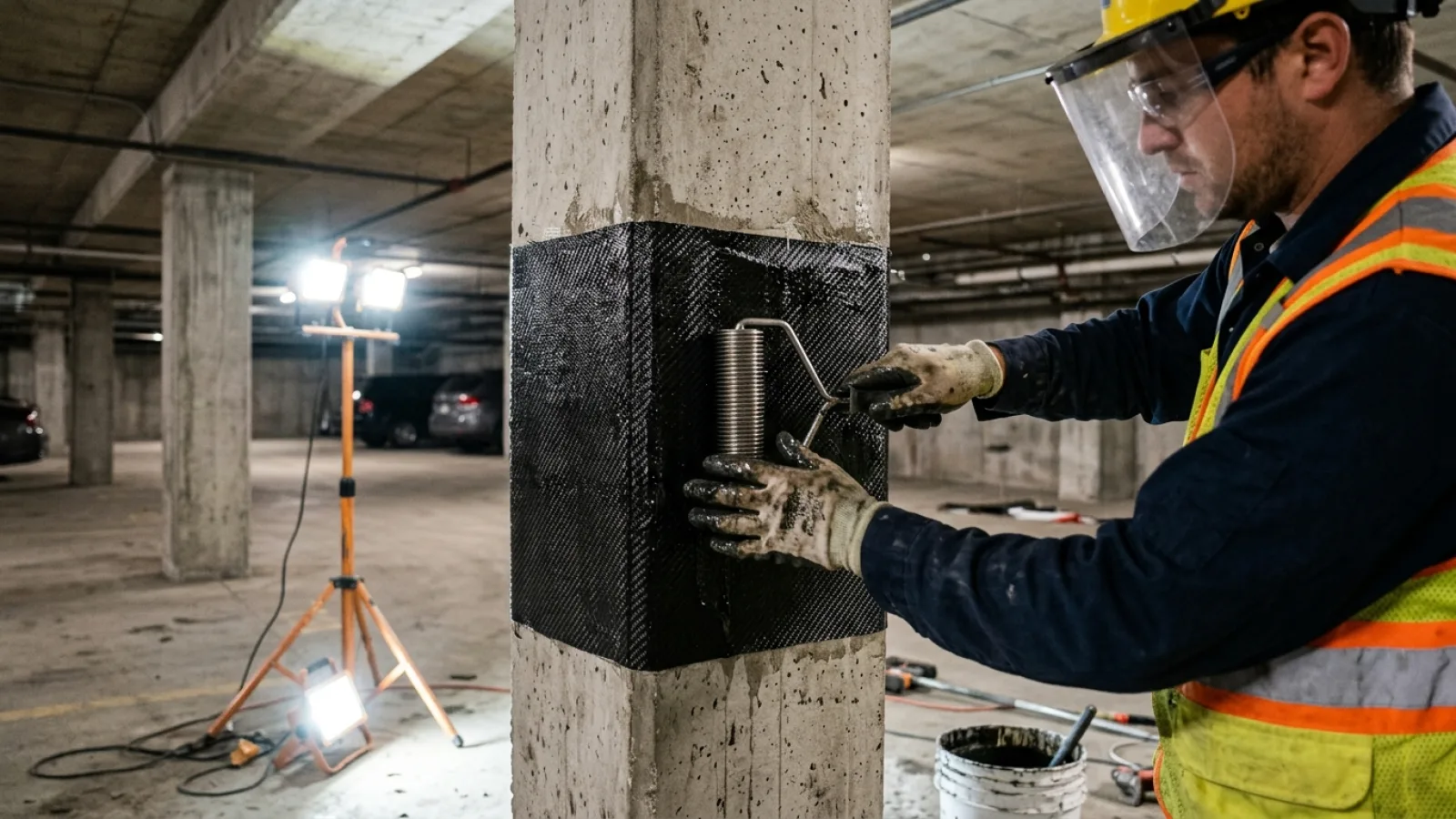
- Wet Layup: Dry fiber fabrics are saturated with the resin on-site and then applied to the prepared surface. Rollers are used to press the fabric firmly onto the substrate, removing air voids and ensuring full impregnation of the fibers. This method is highly versatile and can conform to complex shapes like round columns or beam corners.
- Pre-Cured Systems: The FRP is manufactured in a factory as rigid strips or plates (pre-cured). On-site, an epoxy adhesive is applied to the substrate, and the pre-cured plate is pressed into place. This method offers higher quality control but is best suited for flat or gently curved surfaces.
Step 4: Curing and Protective Coating
The epoxy resin cures over a period specified by the manufacturer, typically 24 to 72 hours, depending on ambient temperature. Once cured, the FRP system is fully bonded and capable of carrying load. A final topcoat is often applied to protect the FRP system from UV radiation, fire, or mechanical damage.
Common Applications for Fiber-Reinforced Polymer Strengthening
FRP technology is versatile and can be applied to a wide range of structural challenges.
Bridge Rehabilitation: Beams, Girders, and Columns
FRP is widely used to increase the load-carrying capacity of aging bridges. It can be wrapped around columns to improve their shear strength and ductility for seismic events or bonded to the underside of girders to enhance their flexural strength.
Building Retrofitting: Seismic Upgrades and Load Capacity Increases
In buildings, FRP is used to strengthen columns and beams to handle increased loads from a change in use (e.g., converting office space to storage). It is also a primary tool for seismic retrofitting, where wrapping columns in FRP (confinement) prevents them from failing during an earthquake.
Repairing Corroded or Damaged Concrete Structures
For structures like parking garages or marine piers where steel rebar has corroded, FRP can restore the lost strength. After the damaged concrete is repaired, FRP is applied to provide external reinforcement that is immune to future corrosion.
Strengthening Industrial Facilities and Pipelines
The chemical resistance of FRP makes it ideal for strengthening corroded pipes, storage tanks, and structural elements in harsh industrial environments like chemical plants or wastewater treatment facilities.
The Advantages of FRP Over Conventional Strengthening Techniques
FRP offers a compelling list of benefits that make it the preferred choice for many rehabilitation projects.
Superior Strength-to-Weight Ratio
FRP adds immense strength with negligible weight, avoiding the need to strengthen foundations or other structural elements to support the repair itself.
Exceptional Corrosion and Chemical Resistance
Unlike steel, FRP does not rust or corrode, making it a permanent solution in harsh or corrosive environments and dramatically reducing future maintenance costs.
Minimal Disruption to Operations and Occupants
Installation is fast, quiet, and does not require heavy machinery. A bridge lane can remain open, or a building can stay occupied during the retrofitting process, minimizing economic and social disruption.
Design Flexibility and Conformance to Complex Shapes
FRP fabrics can be wrapped around columns, beams, and joints of virtually any shape, providing reinforcement precisely where it is needed without altering the structure's geometry.
Rapid Installation and Curing Times
FRP systems can be installed and cured much faster than concrete jacketing, which requires weeks to reach its design strength. This allows for a much quicker return to service.
Limitations and Design Considerations for FRP Systems
While highly effective, FRP is not a universal solution. Its performance is dependent on proper engineering and has some inherent limitations. The resins used in most FRP systems can soften at high temperatures, reducing their effectiveness. Therefore, fire protection coatings are often required. The polymer matrix can also degrade with long-term exposure to UV radiation, necessitating a protective topcoat. Most importantly, FRP strengthening is a specialized field that requires an experienced structural engineer to design the system and certified installers to apply it correctly. The performance of the system is only as good as its bond to the existing structure.
The Future of Structural Rehabilitation with FRP
The field of FRP technology continues to evolve. Researchers are developing more advanced resins with higher temperature resistance and integrating fiber-optic sensors into FRP systems to create “smart structures” that can monitor their own stress and health in real-time. As material costs decrease and expertise becomes more widespread, Fiber-Reinforced Polymer strengthening is set to play an even more critical role in preserving and enhancing our vital infrastructure for generations to come.
Frequently Asked Questions (FAQ)
What is the lifespan of an FRP strengthening system?
When properly designed and installed with protective coatings, an FRP system is expected to last for decades. The materials themselves do not corrode or degrade, so their lifespan is typically governed by the lifespan of the structure they are reinforcing. Durability studies have shown excellent performance over 20+ years of field application.
Can FRP be used to strengthen steel structures?
Yes, FRP can be used to strengthen steel structures, typically to increase the tensile capacity of members or to repair sections with corrosion loss. Special attention must be paid to surface preparation and the bonding adhesive to ensure a durable bond between the FRP and the steel substrate.
Is FRP strengthening more expensive than traditional methods?
The initial material cost for FRP can be higher than for traditional materials like steel or concrete. However, when total project costs are considered—including labor, equipment, reduced downtime, and long-term maintenance—FRP is often more cost-effective, especially in situations where operational disruption is a major expense.
How does FRP perform in a fire?
The organic polymer matrix in standard FRP systems will lose strength at elevated temperatures (typically above 150-200°F or 65-95°C). For structures that require a fire rating, specialized insulating coatings or fire protection systems must be applied over the cured FRP to protect it and ensure it meets building code requirements.