Caterpillar Earnings, Telematics and the Diesel Question: What Equipment News Tells Contractors
Caterpillar’s pending earnings report is only one signal for contractors. Equipment orders, telematics upgrades and electric-machine development reveal how fleets are being managed and where jobsite technology is heading.
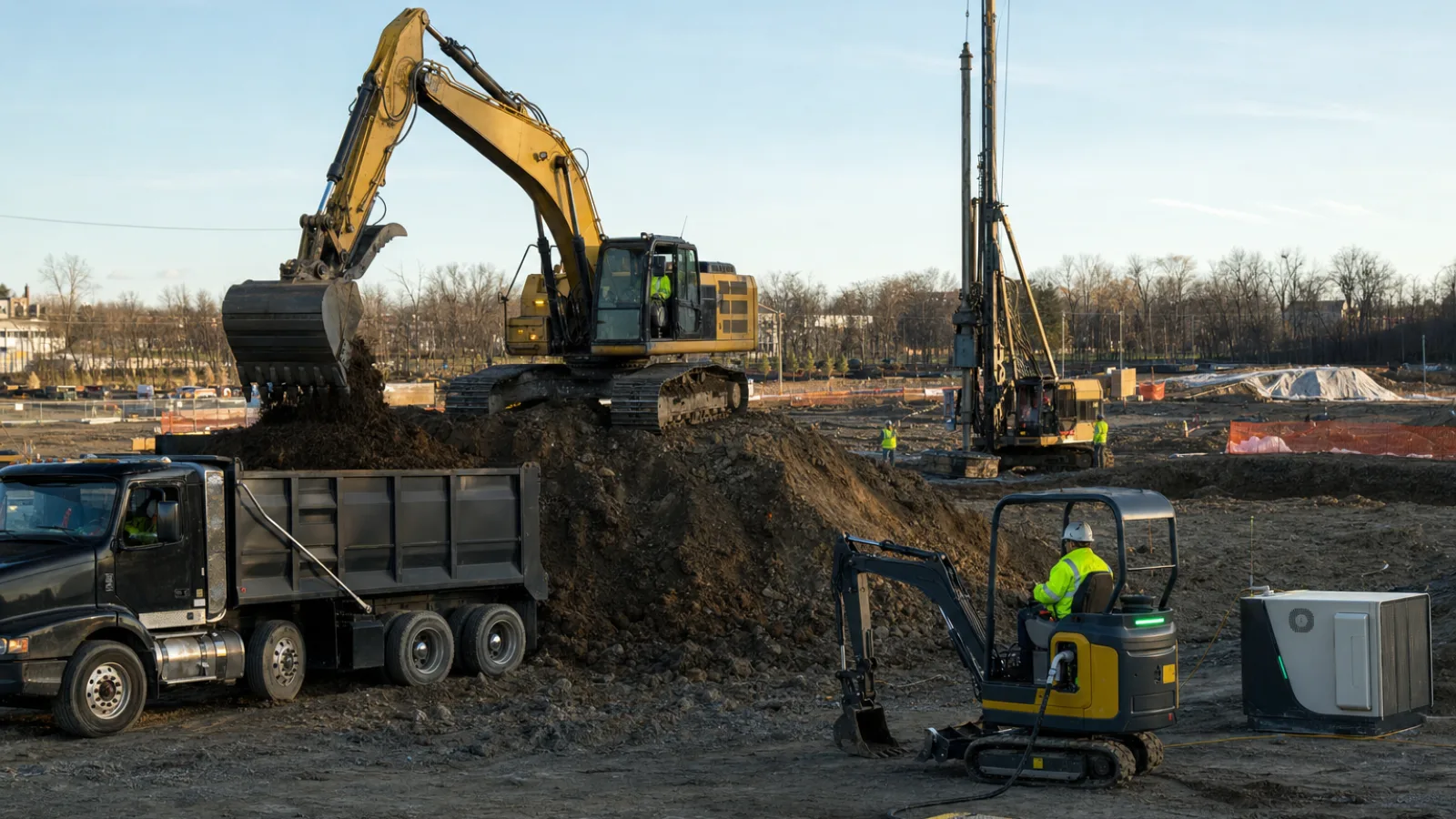
Contractors should not read the next Caterpillar earnings report as a simple verdict on construction. The more useful question is what the company’s order activity, customer commentary and technology spending reveal about fleet replacement, utilization and the cost of operating equipment.
Analysts cited in the supplied earnings calendar and analysis for the week expect Caterpillar to report $7.03 in earnings per share on $20.7 billion in revenue. Those are expectations, not reported results or company guidance. The figures should be replaced with the actual numbers when Caterpillar publishes its results. Until then, the report is best treated as a demand signal to interpret alongside equipment utilization, rental activity, dealer inventories and financing conditions.
Key takeaways
- Caterpillar orders can indicate customer confidence, but backlog and deliveries do not translate directly into new construction starts.
- Telematics is becoming an operating system for fleet decisions: utilization, idle time, maintenance, location and machine health matter more than a dashboard alone.
- Diesel remains central to heavy construction, while electric machines are gaining ground first where duty cycles, charging and noise requirements make them practical.
- Yanmar’s SmartAssist upgrade and Sandvik’s autonomous electric concept drill illustrate two different technology paths: connected fleet management and redesigned machine operation.
- Fleet managers should evaluate total operating conditions before choosing diesel, battery-electric, hybrid or alternative-fuel equipment.
Why Caterpillar Q3 earnings matter to contractors
Large equipment manufacturers sit upstream of construction activity. Their results combine signals from infrastructure, mining, energy, building construction, rental companies and replacement demand. A strong quarter may therefore reflect several end markets rather than a broad-based rise in contractor workloads.
For contractors, the most informative parts of the release and earnings call are likely to be order intake, backlog, dealer inventory, machine deliveries, rental demand and regional differences. Order intake shows what customers committed to. Deliveries show what manufacturers and dealers were able to supply. Backlog indicates future production, but it does not establish when equipment will reach a jobsite or whether the end user is a contractor, rental fleet or industrial customer.
The distinction is important. A rental company may add excavators because customers prefer short-term access to equipment, even when contractors are postponing ownership. Conversely, a contractor may replace an aging dozer to protect productivity without taking on more work. Equipment demand is a leading indicator in some situations, a replacement cycle in others and a financing decision in many.
What to listen for after the results
- Construction end-market commentary: Is demand broad across regions or concentrated in selected infrastructure and industrial projects?
- Order quality: Are customers placing firm orders, or are they requesting delivery slots and delaying final commitments?
- Dealer and rental channels: Are inventories balanced, building or being reduced?
- Production constraints: Are lead times driven by demand, components, labor or logistics?
- Technology mix: Is spending directed toward conventional diesel machines, connected services, automation or lower-emission powertrains?
Construction equipment trends behind the headline numbers
Equipment orders signal demand most reliably when several indicators move together. Rising orders, healthy utilization and stable rental rates provide a stronger case for improving construction activity than rising orders alone. Contractors should also compare equipment news with bid pipelines, awarded work, backlog conversion and local labor availability.
There is a timing issue. Equipment purchases often precede revenue production. A contractor may order a machine months before a project begins, especially when delivery slots are limited. That creates a gap between manufacturer optimism and field production. The reverse can also occur: a contractor may operate intensively with an existing fleet while postponing capital expenditure because borrowing costs or project visibility are uncertain.
Used-equipment prices and machine hours can add context. High used prices may indicate constrained supply, strong demand or expensive replacement equipment. Low hours on rented machines may indicate weak utilization, but could also reflect seasonal work patterns. No single metric should be treated as a complete construction forecast.
Telematics turns equipment into operating data
Telematics combines onboard sensors, positioning, wireless communications and software. In practical terms, it can show where a machine is, how long it works, when it idles, whether a fault is developing and how maintenance intervals are progressing. An upgraded platform such as Yanmar’s SmartAssist is part of this broader movement toward connected fleet management.
The engineering value is not the interface itself. It is the data path from the machine to a decision. A fuel-burn trend is useful only if the fleet manager can connect it to operator behavior, soil conditions, attachment choice, haul distance or hydraulic load. A fault code is useful only if the maintenance team can diagnose the issue, obtain parts and schedule the repair before a critical shift is lost.
Where telematics can produce measurable value
- Utilization: Separate productive hours from travel, warm-up, waiting and idle time.
- Maintenance: Use engine hours, fluid condition and fault history to plan service rather than relying only on calendar intervals.
- Security: Track unauthorized movement and establish geofences around yards or projects.
- Production: Compare cycle times, payload information and machine location with the planned work sequence.
- Energy management: Monitor fuel, battery state of charge and charging behavior using consistent operating boundaries.
Telematics data also needs governance. Fleet managers should establish who owns the data, which employees can access it, how long records are retained and whether information from subcontractors or rented machines is handled consistently. A system that produces more alerts than a team can act on becomes an administrative burden rather than a productivity tool.
The diesel question is a duty-cycle question
Diesel remains difficult to displace in heavy construction because energy must be carried to remote jobsites, machines often work long shifts and refueling can be faster than recharging. High-load excavation, quarrying, roadbuilding and continuous production place demanding requirements on power density, thermal management and uptime.
Battery-electric equipment changes the engineering problem. The machine must manage battery mass, high-voltage safety, charging power, thermal control and reduced operating noise. Battery mass can be helpful as ballast in some machines, but it also affects transport, ground pressure and structural loads. Electric motors can deliver precise torque and eliminate local exhaust emissions, yet the project still needs a reliable electricity source and a plan for charging hardware, cables, weather exposure and peak demand.
An electric excavator is therefore not simply a diesel excavator with a battery installed in the engine bay. The hydraulic system, cooling circuits, controls, duty cycle and service procedures may all change. Contractors should assess the complete site system, including temporary power, rather than comparing only rated power or purchase price.
Where alternative fuels may fit
Renewable diesel, biodiesel blends, hydrogen-derived fuels and hybrid systems each involve different questions about availability, storage, emissions accounting, warranty requirements and equipment compatibility. A fuel that works well in a centralized fleet may be impractical for scattered civil projects. Carbon benefits also depend on how the fuel is produced, transported and used.
The practical near-term strategy for many fleets is likely to be mixed: improve diesel utilization, electrify selected compact or regularly scheduled machines, and test alternative fuels where supply is dependable. The right choice depends on operating hours, load profile, ambient conditions, charging access and the financial cost of downtime.
What an autonomous electric drill signals
Sandvik’s autonomous electric concept drill points to a different development path from a connected telematics platform. Telematics improves visibility around an existing machine. Automation and electrification can change how the machine is operated, controlled and powered.
For drilling, autonomy depends on more than remote controls. The machine needs positioning, obstacle detection, drilling-pattern data, machine-health monitoring and control logic that can respond to changing ground conditions. Electric power adds requirements for battery protection, thermal management and charging coordination. The engineering challenge is to make the whole drilling cycle repeatable while preserving safe human oversight.
Concept equipment should not be treated as immediately available production equipment. It is evidence of the direction of research and product development, not proof that every contractor can purchase and deploy the technology today. Fleet managers should ask when a product will be commercially supported, what service network exists and how autonomous functions interact with site rules and insurance requirements.
Structure, thermal mass and carbon in equipment decisions
Equipment strategy is connected to the physical design of the projects being built. Different construction systems change the loads, sequencing, access requirements and energy used on site. They also change which machines are needed and for how long.
| Construction system | Structural and thermal characteristics | Equipment implications | Carbon considerations |
|---|---|---|---|
| Timber-hybrid | Timber carries much of the gravity load, while concrete or steel provides selected cores, foundations, transfer elements or lateral resistance. Thermal mass is usually concentrated in exposed concrete or other interior surfaces. | Requires lifting, accurate delivery sequencing, temporary stability measures and careful moisture protection. Electric lifting and compact equipment may be useful in urban sites where noise and emissions are constrained. | Can reduce reliance on high-volume structural concrete, but carbon accounting must include forestry, adhesives, transport, fire protection, foundations and end-of-life pathways. |
| Rammed earth | Compacted soil forms thick, heavy walls with substantial thermal mass. Structural capacity and weather resistance depend on material composition, moisture control, wall geometry and detailing. | Needs material processing, controlled placement, formwork and compaction. Site logistics can be demanding because wall thickness and material handling affect access and sequencing. | May use local mineral material and require less fired or highly processed material, but excavation, stabilization, transport and cement content can alter the result. |
| Concrete | Provides high compressive capacity, stiffness and thermal mass. Reinforcement, geometry, curing and connection details determine structural performance. | Often requires batching, pumps, mixers, cranes, formwork systems and finishing equipment. Delivery timing and pour continuity can drive equipment utilization. | Cement production is a major source of embodied carbon, while mix optimization, supplementary cementitious materials, efficient formwork and long service life can reduce impacts. |
This comparison is not a ranking. It shows why equipment demand cannot be separated completely from design choices. A project with thick rammed-earth walls may have fewer repetitive concrete pours but greater material-handling demands. A timber-hybrid project may shift equipment use toward precision lifting and temporary works. A concrete structure may require concentrated pumping and formwork operations. Telematics can help measure those differences at the work-package level.
Fleet-manager checklist for telematics and electrification
- Define the duty cycle: Record operating hours, peak loads, idle time, travel distance, attachment use and shift length before selecting a powertrain.
- Measure the baseline: Capture fuel use, maintenance events, downtime, production output and operator-reported constraints for comparable machines.
- Check site energy: Confirm available electrical capacity, connection arrangements, charging location, backup plans and protection from weather or construction damage.
- Model the whole cost: Include acquisition, financing, fuel or electricity, charging equipment, maintenance, tires or tracks, transport and residual value.
- Plan service capability: Identify trained technicians, high-voltage procedures, spare parts, software support and emergency recovery arrangements.
- Set data rules: Decide who receives alerts, how data is shared with rental providers and subcontractors, and which metrics will trigger action.
- Start with a controlled trial: Select a repeatable application where the machine can be compared with a conventional equivalent without putting a critical project milestone at risk.
- Review carbon boundaries: Distinguish tailpipe emissions from total energy-related emissions and document assumptions for fuels, electricity and manufacturing.
How contractors should interpret the next update
When Caterpillar reports, contractors should separate reported performance from market expectations and then compare the commentary with their own field evidence. A strong result does not guarantee more work. A weaker result does not prove that construction is contracting. The useful signal is the combination of order quality, customer behavior, delivery timing and technology investment.
The same discipline applies to telematics and electric equipment. A new platform or concept machine matters when it solves a defined operating problem: reducing unproductive hours, preventing failures, lowering energy cost, improving safety or making a low-emission site technically workable. Technology should be judged by the quality of the decision it enables, not by the number of features listed in a product announcement.
Frequently asked questions
What do Caterpillar Q3 earnings tell contractors?
They can provide a broad signal about equipment demand, replacement activity, dealer conditions and selected construction end markets. They do not measure construction starts directly, and the result should be read with rental, backlog and local project data.
Do rising equipment orders mean construction demand is rising?
Not necessarily. Orders may reflect fleet replacement, rental-fleet expansion, financing timing or purchases by mining and industrial customers. The signal is stronger when orders align with utilization, awarded work and healthy delivery activity.
Is an electric excavator suitable for every project?
No. It is most practical where the duty cycle is compatible with available battery capacity and charging, and where reduced noise or local emissions has operational value. Remote, high-load or continuous applications may require different solutions.
What is the main benefit of construction telematics?
Its main benefit is linking machine behavior to operational decisions. Useful systems help teams improve utilization, maintenance planning, security, production control or energy management rather than simply displaying location data.
Are autonomous electric machines ready for general contractor fleets?
Some automated functions are commercially available, but concept machines should be evaluated separately from production models. Availability, site integration, operator oversight, service support and regulatory requirements remain decisive.
Sources
- Kiplinger, “Next Week Earnings Calendar & Analysis for This Week,” supplied editorial reference for the analyst expectations cited in this preview.
- Caterpillar, quarterly earnings releases, earnings presentations and regulatory filings, including the company’s investor-relations materials.
- Yanmar, SmartAssist product and platform announcements and technical documentation.
- Sandvik Mining and Rock Solutions, announcements and technical materials concerning autonomous and electric drilling development.
How to verify these figures yourself
Check Caterpillar’s official earnings release and regulatory filing for reported revenue, earnings per share, order information and management commentary. Then compare those figures with the analyst expectations in the linked earnings-calendar reference. For fleet decisions, verify machine specifications, charging requirements, fuel compatibility and warranty terms in the current manufacturer documentation rather than relying on a concept announcement or secondary summary.