UK Housebuilding Slump: Why Starts Are Falling and What Developers Can Do
Glenigan forecasts a sharp fall in private housing starts during 2026. Landsec’s project decisions and Persimmon’s outlook show why developers are re-phasing, re-testing and redesigning schemes.
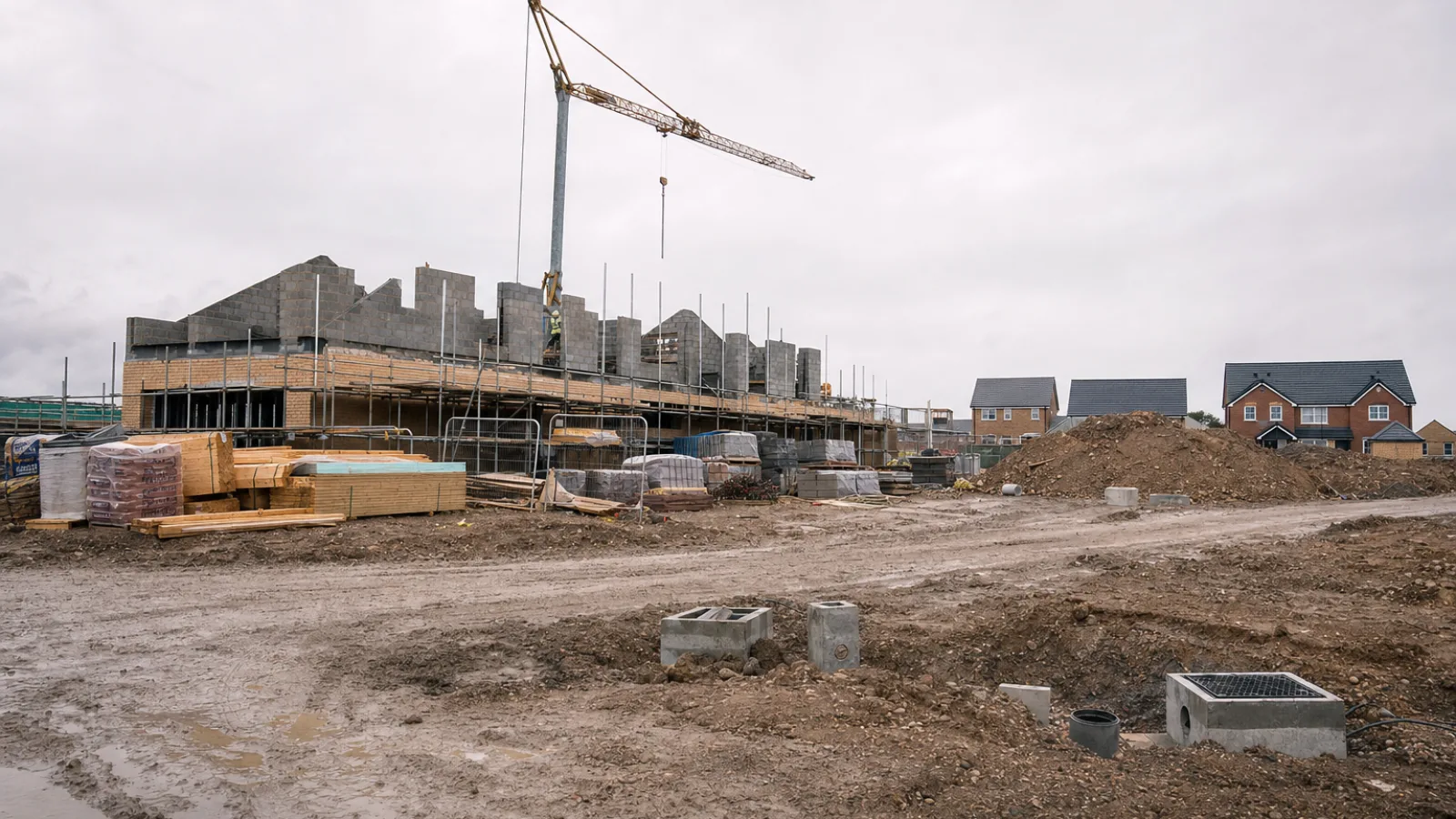
The UK housebuilding slump is no longer just a question of weak sales. Developers are delaying starts because land values, planning obligations, finance, labour, materials and build costs are no longer aligning with achievable selling prices.
Glenigan expects private housing starts on schemes valued below £100 million to fall by 24% by the end of 2026, while total construction starts are forecast to decline by 13%. Those figures point to a market in which smaller and mid-sized residential schemes may be particularly exposed: they have less purchasing power, fewer opportunities to spread overheads and less flexibility when a viability appraisal moves against them.
The immediate answer for developers is not simply to build faster. It is to make schemes smaller, more flexible and easier to restart. That means phased delivery, frequent viability testing, disciplined procurement and a realistic assessment of whether conventional construction is still the best solution for every part of a project.
Why UK housing starts are falling
Housing starts sit at the end of a long chain of decisions. A project can have planning permission and still fail to reach site if its appraisal depends on assumptions that have moved materially since the consent was granted.
Build costs are one part of the problem. Labour availability, utilities, preliminaries, compliance requirements and the cost of servicing a site all influence the amount required before a home can be sold. Higher borrowing costs add another layer of pressure. A delayed start does not only postpone revenue; it can increase interest, professional fees, security, insurance and site overheads.
Sales values are also difficult to forecast. If buyers become more price-sensitive, a developer may be unable to pass increased construction costs through to the market. Reducing specification can help in some cases, but it must be balanced against planning conditions, building regulations, warranty requirements, energy performance and the expectations of lenders and purchasers.
Planning obligations can make the appraisal more sensitive still. Affordable housing, highways works, public realm, drainage, biodiversity measures and community infrastructure may be fixed or difficult to renegotiate. These obligations remain important to the quality and acceptability of development, but their timing and cost need to be tested against the deliverable scheme rather than treated as static entries in an old appraisal.
The ONS housing data provides the wider context for tracking housing activity, construction and market conditions. For developers, however, national totals are only the starting point. A project’s location, tenure mix, sales rate and infrastructure requirements determine whether it can proceed.
What Glenigan’s construction starts forecast means
Glenigan’s forecast of a 24% fall in private housing starts on schemes below £100 million is significant because it focuses attention on the part of the market where many regional housebuilders, smaller developers and specialist contractors operate.
Large schemes can sometimes absorb disruption by adjusting the order of plots, changing tenure or securing additional funding. Smaller schemes have fewer levers. A modest increase in groundworks, a delayed utility connection or a slower sales rate can remove the contingency that made the scheme viable.
The forecast does not mean every consented scheme will be abandoned. It suggests that developers are likely to be more selective about when they commit to construction. Starts may be delayed until a critical proportion of units is reserved, until abnormal costs are better understood or until a revised funding package is agreed.
That distinction matters for suppliers and consultants. A planning consent is not the same as a firm construction workload. Builders’ merchants, subcontractors, offsite manufacturers, cost consultants and development finance providers should expect more projects to move through repeated appraisal and procurement stages before reaching a full start on site.
Landsec shows how major schemes can be re-timed
Landsec’s decision to drop its Lewisham redevelopment illustrates the pressure facing complex urban projects. Large regeneration schemes combine land assembly, planning obligations, infrastructure, commercial space, residential delivery and long construction programmes. Their scale creates opportunities, but it also increases exposure to changes in finance costs, market demand and construction risk.
Landsec has also indicated that housing at Mayfield cannot start before 2028. The lesson is not that urban housing is unviable in every location. It is that a consented scheme may need to be re-timed when its delivery sequence no longer supports an acceptable risk-adjusted return.
For smaller developers, the same principle can be applied at a more practical level. Instead of treating the planning permission as a fixed instruction to build the entire site, the team should identify which elements must happen first, which can be postponed and which can be redesigned without reopening the whole project.
Persimmon’s position: delivery remains possible, but costs are moving
Persimmon presents a different part of the market picture. The housebuilder says it is on track while warning that costs are expected to rise in 2027. That combination is important: construction can continue where land, sales rates, funding and operating scale support delivery, but forward cost pressure still requires careful planning.
For developers, the message is to separate current performance from future exposure. A project that works at today’s rates may not work if labour, materials, utilities or subcontract packages increase before later phases are built. Conversely, cancelling every project in response to a forecast can destroy value if demand and procurement conditions improve.
A robust appraisal should therefore show the effect of cost escalation by trade and by phase. It should also distinguish between costs that are already fixed, costs covered by supplier quotations and costs that remain provisional. A single blanket inflation allowance is less useful than a package-by-package review of groundworks, structure, envelope, building services, fit-out, external works and professional fees.
How developers can protect a viable scheme
1. Phase construction around real demand
Phasing is more than dividing a site into convenient parcels. Each phase should have a credible access arrangement, drainage strategy, utility solution, fire and emergency access plan and construction logistics route. It should also be capable of standing financially on its own, or the developer should understand exactly which later phase funds the shared infrastructure.
A smaller first phase can reduce exposure and generate evidence about sales values, build costs and buyer preferences. The tradeoff is that early phases may carry a disproportionate share of roads, substations, attenuation, demolition or enabling works. Cost consultants should allocate those items transparently rather than making the first phase appear artificially attractive.
2. Re-test viability before committing to a start
Viability testing should be repeated when there is a material change in price, programme, specification, finance or planning obligation. It should not be limited to a single base case. At minimum, developers should model slower sales, higher borrowing costs, construction inflation, abnormal ground conditions and a delayed utility connection.
The purpose is not to predict the future precisely. It is to identify the assumptions that can break the scheme and establish decision points before cash is committed. A short monthly dashboard can track reservations, achieved sales values, tender returns, cost movements, finance drawdown and planning conditions.
3. Use modular and offsite methods selectively
Modular and offsite construction can reduce site labour, improve repetition and shorten some installation periods. It can be especially useful where the design has a high degree of standardisation, site access is constrained or the programme is exposed to poor weather and labour shortages.
It is not a universal cost-saving solution. Transport, cranage, foundation tolerances, fire performance, acoustics, moisture control, warranty approval and connection details must be resolved early. A factory-produced component that arrives before the site is ready can create storage and programme problems rather than solving them.
Small developers should compare a modular option against a conventional baseline at concept stage. The comparison should include design fees, factory deposits, transport, lifting, temporary works, foundations, cranage, site finishing and the consequences of changing the design after manufacture. Early engagement with an offsite manufacturer can be valuable, but only if the project team retains a clear record of what is fixed and what remains adaptable.
4. Procure information before procuring materials
Incomplete drawings and unresolved specifications are expensive in a volatile market. Builders’ merchants and subcontractors can help identify availability and lead-time risks, but they cannot remove design uncertainty from a package that has not been properly coordinated.
Before tendering, the developer should close key design interfaces: windows to cladding, waterproofing to ground levels, services to structural zones and drainage to finished floor levels. Substitutions should be assessed for performance, approvals, warranty and maintenance rather than selected on headline price alone.
5. Match finance to the revised programme
Development finance should reflect the actual delivery plan, including the possibility of a pause between phases. A facility sized only for the original programme may become expensive if sales slow or if the developer must fund infrastructure for longer than expected.
Finance discussions should address drawdown conditions, interest during construction, valuation assumptions, presales, cost overruns and extension terms. An updated cost plan from a qualified cost consultant can make those discussions more practical and expose funding gaps before construction contracts are signed.
A practical checklist for small developers
- Rebuild the appraisal: update land, finance, build, professional, infrastructure and sales assumptions rather than applying a single inflation percentage.
- Test the first phase: confirm that access, drainage, utilities, planning obligations and sales arrangements work independently.
- Protect optionality: avoid committing early to details that may need to change as costs and demand become clearer.
- Compare construction methods: assess conventional, panelised and modular options on whole-project cost, programme and risk.
- Check procurement exposure: identify long-lead products, scarce trades and packages with limited tender competition.
- Set trigger points: define when to proceed, re-price, reduce scope, pause or seek revised finance.
- Document assumptions: keep a dated record of quotations, exclusions, planning conditions and cost allowances so changes can be traced.
What the 1.5 million homes target means in practice
The 1.5 million homes target creates a strong policy need for more delivery, but a target does not remove the commercial barriers that prevent starts. If schemes cannot secure finance, meet infrastructure requirements and produce homes at prices the market can support, permissions will not translate into completed units.
Closing that gap requires more than speeding up planning decisions. Developers need workable land values, reliable infrastructure delivery, realistic cost plans and construction methods suited to the scale and constraints of each site. Public authorities and industry participants also need to distinguish between a stalled scheme that requires redesign and a scheme that is temporarily delayed by market conditions.
The UK housebuilding slump will not affect every project equally. Developers with clear phasing, current cost intelligence and flexible design decisions will have more choices than those relying on a single appraisal prepared before costs and finance moved. In a weaker starts market, the strongest advantage is not simply owning permission; it is knowing precisely what must be true for construction to begin, and what can be changed when those assumptions no longer hold.