Data Centers and the Grid: Who Pays for Power?
Data center expansion is turning electricity access into a construction and regulatory problem. The answer may depend on who can reduce demand, who funds upgrades and how quickly new power can be delivered.
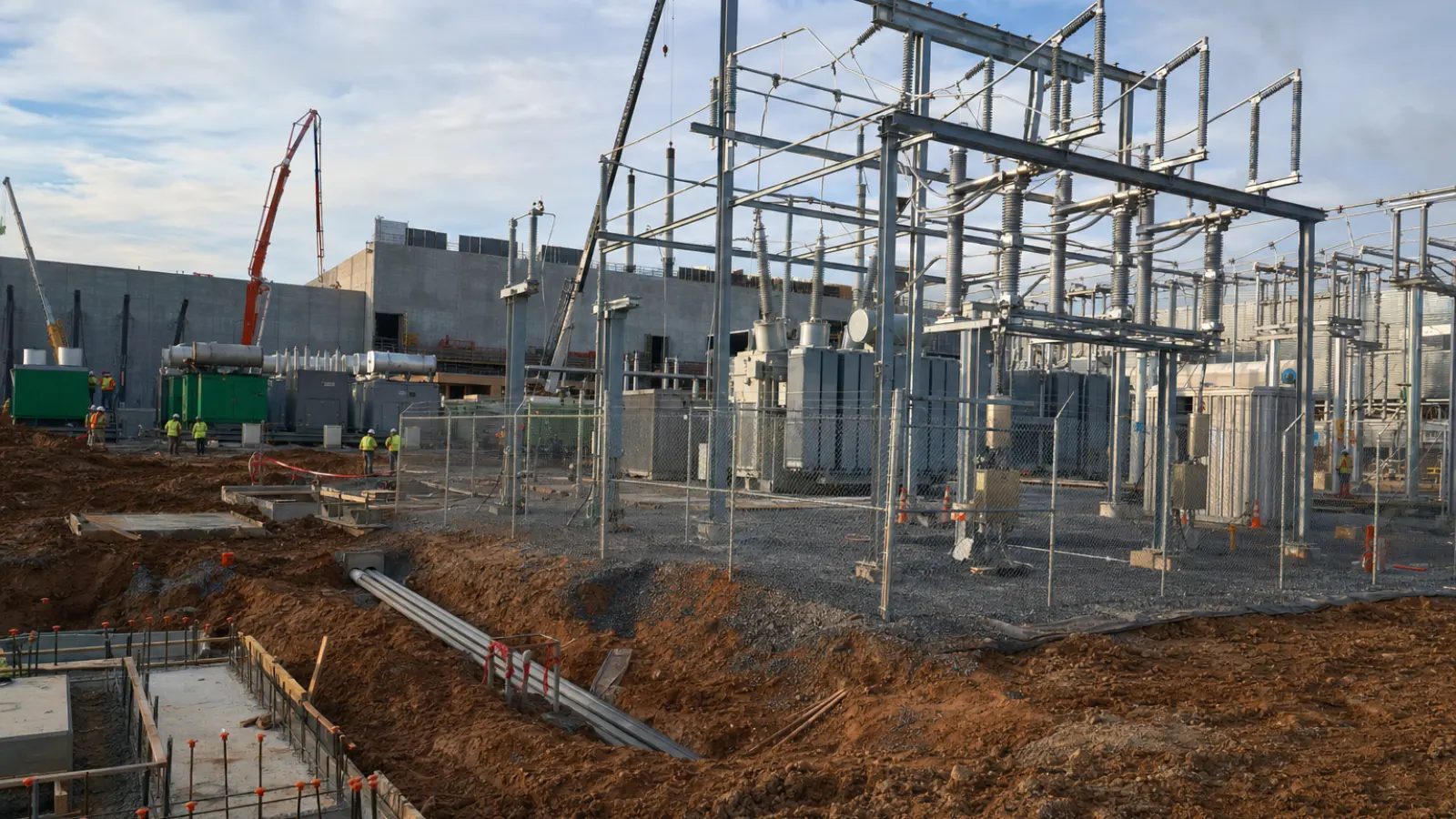
A large data center can be designed, permitted and built faster than the transmission and generation projects needed to serve it. That mismatch is making the data center grid connection a central commercial risk—not just an electrical-design task.
The immediate question for developers is not simply whether enough electricity exists in a region. It is whether the local grid can deliver the required megawatts at the required voltage, on the required date, without transferring excessive upgrade costs or reliability risks to other customers. The emerging answer is a combination of grid-first planning, temporary or permanent on-site generation, and contracts that allow operators to reduce consumption during stressed conditions.
Each approach can improve speed to power. None eliminates the underlying tradeoff. Someone must finance substations, transmission, reserve capacity, fuel infrastructure, controls and the risk that a forecast data center load does not arrive as expected.
Why the data center grid connection is becoming harder
Data centers are unusually concentrated electrical loads. A single campus may add hundreds of megawatts in one location, with high power-quality requirements and demanding schedules for commissioning. Artificial-intelligence facilities can also have a different load profile from conventional cloud campuses because accelerator systems may create large, rapidly changing demand and require substantial cooling capacity.
Utilities must assess more than the customer’s peak load. They need to study the point of interconnection, short-circuit current, voltage stability, protection coordination, transformer availability, transmission constraints and the effect of the new load on neighboring customers. A project can be physically close to a high-voltage line and still require extensive network reinforcement.
That work is handled through an interconnection process. The developer submits a request, the transmission or distribution owner studies the proposed connection, and the utility identifies equipment and network upgrades. Depending on the market and project type, the process can involve feasibility studies, system-impact studies, facilities studies, design approvals, financial security and construction agreements.
What an interconnection queue actually means
An interconnection queue is not a line in which every project has a guaranteed place in a fixed construction schedule. It is a planning and study pipeline containing proposed generators, storage projects and, increasingly, large loads. Projects may withdraw, change size, move their requested service date or fail to secure financing.
Queues become especially difficult when many data center proposals cluster around the same substations or fiber-rich regions. The utility may need to study the projects together because the network solution for one customer depends on whether other customers proceed. This creates a circular problem: developers want a firm energization date before committing capital, while utilities are reluctant to build major upgrades for projects that remain speculative.
Equipment lead times add another constraint. Large power transformers, medium-voltage switchgear, breakers, protection systems and substation control equipment may need to be ordered well before construction. An approved interconnection agreement therefore does not necessarily mean that power will be available when the building shell is complete.
PJM capacity auction costs and the allocation dispute
The cost debate is particularly visible in PJM, the large regional transmission organization serving parts of the Mid-Atlantic and Midwest. PJM’s capacity market is intended to secure resources that can meet future reliability needs, separate from the day-to-day energy market. When the forecast peak load rises, the system may need more generation, demand response, transmission and reserve capability.
PJM’s independent market monitor has warned that data-center capacity forecasts could add between $5 billion and $10 billion in costs for the delivery year beginning in June 2029, on top of $29.4 billion in earlier auctions, according to the figures cited in the supplied industry reporting. Those figures describe market-wide capacity costs, not a simple invoice assigned to one data center. The practical dispute is how much of the cost should be paid by large new loads, existing customers, generators or a broader group of ratepayers.
Consumer advocates generally focus on the risk of socializing infrastructure built for uncertain or highly concentrated loads. If a planned campus is delayed, downsized or canceled, other customers may still be left paying for transmission, generation and reserve capacity. They also question whether households and smaller businesses should absorb higher capacity charges when the principal driver is a new industrial customer.
Data center developers and power suppliers counter that large customers bring investment and can be required to sign long-term service agreements, provide financial security or pay direct connection costs. They argue that overly slow or uncertain interconnection rules can push investment to regions with weaker planning processes rather than solve the reliability problem. Both sides can be correct: a customer may pay for its direct facilities while still imposing wider system costs that appear in market prices or regulated rates.
ERCOT data centers and emergency curtailment
Texas presents a different market structure. ERCOT does not operate a conventional capacity market like PJM; it relies primarily on energy-market signals, ancillary services, scarcity pricing and forward planning to support reliability. That makes the treatment of large flexible loads particularly important.
As reported by Bloomberg, Texas’s grid chief wants authority to require data centers to reduce power before an emergency is formally declared. The policy question is significant because curtailment is most valuable before the system reaches its most dangerous operating conditions. Waiting until an emergency is declared may leave too little time to reduce demand safely.
For a data center, however, “cut power” cannot be treated as a simple switch. Operators must identify which workloads can move, pause or slow down; which cooling systems can be reset; how much ride-through capability batteries provide; and how quickly the site can return to normal operation. A curtailment program also needs clear rules for notice, duration, frequency, measurement, compensation and penalties for nonperformance.
Some workloads are more flexible than others. Batch training, data processing and certain backup computations may be shifted to another site or scheduled at a different time. Latency-sensitive services, storage operations and critical control systems generally have less tolerance for interruption. The useful measure is not the nameplate load but the verified load that can be reduced at a particular time without compromising equipment or service obligations.
Flexible-load pledges could change the economics
Demand flexibility means agreeing in advance that electricity consumption will respond to grid conditions or price signals. The response may involve reducing load, shifting it to another hour, switching to batteries or transferring workloads to another facility.
Axios has reported that OpenAI offered to cut demand by up to one gigawatt at a planned Georgia campus. A pledge of that scale illustrates why flexible-load commitments are attracting attention: they can give a utility more planning options than a rigid block of demand. They may also improve the project’s negotiating position if the developer can demonstrate that its maximum connected load is not its guaranteed coincident load.
Such offers must be converted into enforceable engineering and commercial terms. The agreement should define the baseline against which reductions are measured, the site’s response time, minimum operating load, permitted number of events, restoration ramp, telemetry and testing procedures. It should also state whether the utility can call an event during an ordinary constraint, a forecast reserve shortage or only a formal emergency.
A flexible-load contract does not make new generation unnecessary. A campus still needs firm service for periods when workloads cannot be moved or when multiple reliability events occur. It does, however, reduce the amount of capacity that the system must hold for the customer’s absolute maximum demand.
Three routes to power
Developers are increasingly comparing three broad strategies. The right choice depends on the utility territory, connection voltage, schedule, emissions requirements, fuel availability, financing and the value of uninterrupted service.
| Strategy | How it works | Advantages | Main constraints and cost questions |
|---|---|---|---|
| Grid-first | Wait for the planned transmission, substation and utility-service upgrades, with the campus supplied primarily from the grid. | Uses established utility operations; avoids continuous on-site fuel consumption; can provide a clear long-term service arrangement. | Interconnection queues and equipment lead times may delay occupancy. Costs for network upgrades, capacity and reserves must be allocated among the customer and other ratepayers. |
| On-site generation | Install gas engines, turbines or other generation behind the meter while the permanent grid connection is developed or expanded. | Can improve schedule certainty and provide power during grid constraints. It may support phased commissioning before the full utility connection is ready. | Fuel supply, air permits, noise, emissions, water or cooling needs, maintenance and interconnection rules remain material issues. Temporary generation can become a long-lived asset. |
| Flexible load | Commit to reduce, shift or relocate a defined portion of consumption when the grid operator or utility calls an event. | May lower coincident peak demand, reduce reserve requirements and improve the case for earlier service if performance is credible. | Requires controls, telemetry, workload planning and compensation. Reliability obligations may limit how often or how deeply the site can curtail. |
On-site gas is a bridge, not a free pass
On-site gas generation is attractive because it can be deployed independently of a delayed transmission upgrade and can support a phased energization plan. Reciprocating engines and gas turbines can be arranged in modular blocks, allowing capacity to track the build-out of the campus. In some designs, the units can also provide standby power, peak shaving or microgrid operation.
The electrical design is more complicated than placing generators beside the building. Engineers must coordinate generator controls with utility protection, establish islanding and reconnection sequences, manage fault current, provide synchronization equipment and determine how critical loads are divided among utility, generator and battery sources. Fuel pressure, pipeline capacity and dual-fuel requirements may also affect firm output.
Permitting can be the decisive constraint. Air-quality approvals, emissions limits, local noise rules and operating-hour restrictions may prevent a supposedly temporary installation from serving as unrestricted baseload generation. Gas supply interruptions and common-mode failures also need to be included in the reliability model. A gas plant may provide schedule flexibility, but it does not remove the need for a durable grid strategy.
What the project team should negotiate
Large-load developers, utilities and regulators can reduce conflict by treating flexibility and cost allocation as part of the initial electrical program. The key questions include:
- What is the firm contracted load, and what portion is interruptible or shiftable?
- Which network upgrades are required for the customer alone, and which support broader regional reliability?
- Who pays if the project misses its energization date or never reaches its forecast demand?
- Can the utility use staged service, temporary generation or a lower initial load while permanent works are built?
- What equipment, telemetry and controls are required to verify curtailment performance?
- How will batteries, generators and flexible computing loads interact during a grid event?
These questions affect more than the utility agreement. They shape the substation footprint, medium-voltage distribution, switchgear ratings, generator yard, battery rooms, controls architecture and commissioning sequence. Electrical contractors and equipment suppliers need the operating philosophy early, because late changes to protection, transformer capacity or generator integration can disrupt an otherwise complete facility.
The emerging deal: pay for certainty, provide flexibility
The most workable arrangement may not be purely grid-first or purely behind the meter. A developer could fund dedicated connection facilities, provide financial security for a defined share of network upgrades, install temporary generation for a limited commissioning phase and offer verified demand flexibility once the campus is operating.
That arrangement still requires regulatory oversight. Flexible-load promises should not be counted as firm reliability resources unless they are measurable, dispatchable and backed by penalties or other credible performance incentives. Conversely, utilities should not require a customer to maintain expensive idle generation indefinitely when the customer is already paying for a reliable permanent connection.
The central issue is therefore not whether data centers should connect to the grid. They must. The issue is how quickly they connect, how much firm capacity they reserve, what they do during system stress and who carries the cost when forecasts prove wrong.
For developers, the strongest power strategy will be the one that combines a realistic load forecast with a documented operating response. For utilities and regulators, the challenge is to distinguish genuine flexibility from an informal promise and to prevent infrastructure built for speculative demand from becoming an unexamined charge on consumers. The next phase of data center construction will be judged as much by those agreements as by the buildings, servers and substations themselves.