Commercial Property Due Diligence Checklist for Deferred Capital Repairs
A building can be occupied, cash-flowing, and visibly functional while carrying substantial roof, façade, mechanical, structural, and life-safety costs. This checklist helps buyers turn inspection findings into defensible budgets, reserves, and acquisition decisions.
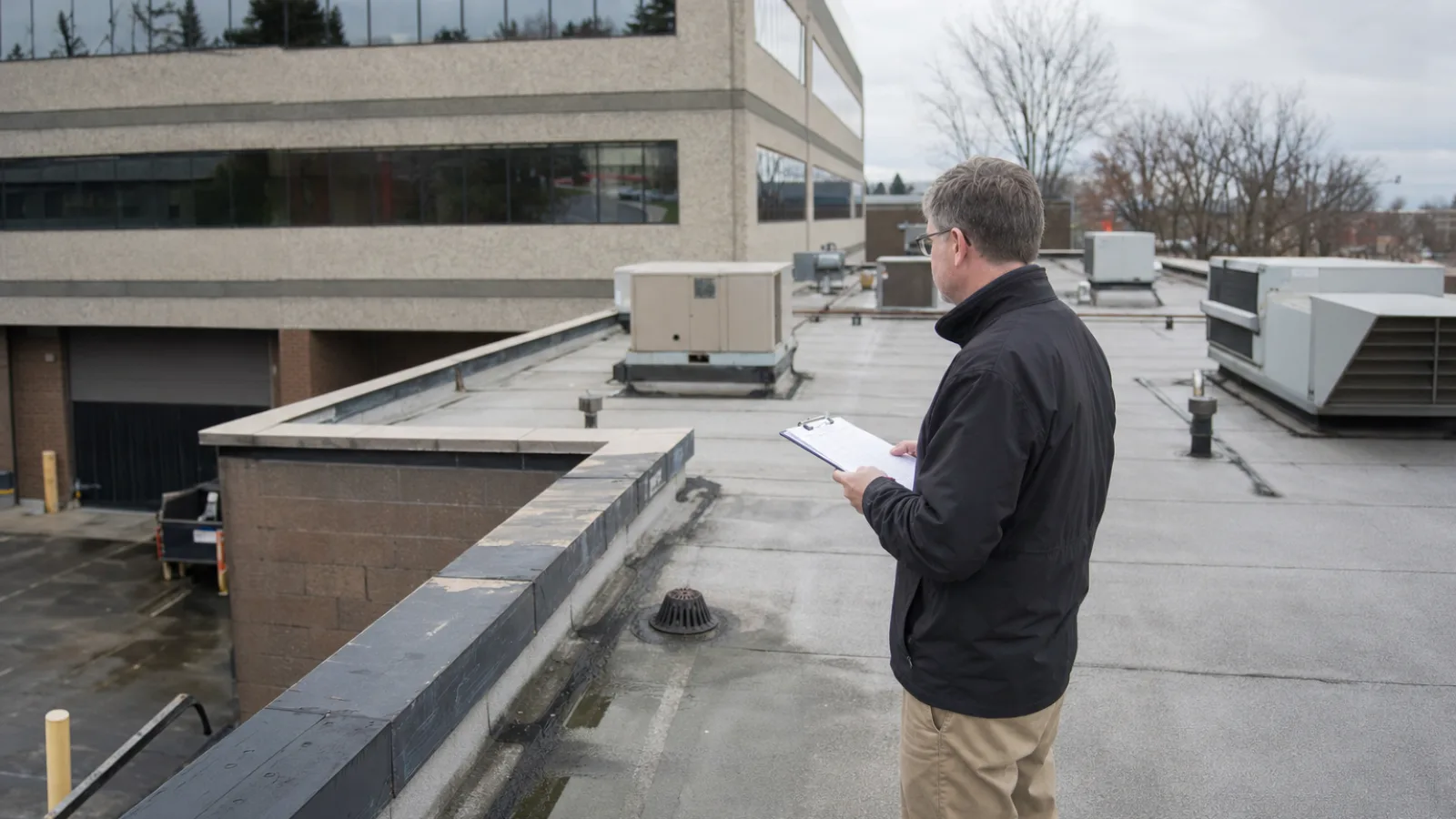
A commercial building can be occupied, producing rent, and apparently functional while carrying substantial future costs. An aging roof may not leak during a dry inspection. A façade may look acceptable from the ground while anchors, sealants, or concealed edges require further review. Mechanical equipment can operate today but be near the end of its useful life, with replacement requiring major tenant coordination.
Those conditions can materially change the economics of a commercial real estate acquisition. A qualified provider of commercial property due diligence services can help organize the investigation, but buyers should understand what is being reviewed, what remains uncertain, and how findings translate into purchase-price protection, reserves, and post-closing work.
This commercial property due diligence checklist is a framework, not a substitute for a full property condition assessment or specialist testing. Structural engineers, building-envelope consultants, mechanical and electrical professionals, fire-protection specialists, environmental consultants, elevator professionals, and accessibility experts may be needed depending on the property and the findings.
Why Deferred Capital Repairs Matter Before a Commercial Property Purchase
Deferred capital repairs are significant repairs or replacements that have been postponed beyond the point at which they should reasonably have been addressed. They may include roof replacement, façade repairs, parking-lot reconstruction, electrical distribution upgrades, boiler or chiller replacement, plumbing riser work, or repairs to structural and life-safety components.
Deferred work is different from a building being generally untidy or having a list of minor maintenance items. The concern is exposure: a known or likely project that could affect safety, compliance, operating continuity, insurability, financing, tenant retention, or future cash flow. A small roof leak, for example, may become a larger envelope and interior repair if moisture remains concealed.
Buyers should convert observations into four decisions: what needs attention, when it may be needed, what it may cost, and how certain that conclusion is. A report that only lists defects without timing, scope, and uncertainty is less useful for acquisition planning.
What Counts as a Deferred Capital Repair?
Classification matters because it determines whether an item belongs in operating expenses, a maintenance budget, a near-term capital plan, or a transaction negotiation. Routine maintenance includes recurring activities such as filter changes, lubrication, cleaning, landscape care, drain clearing, and scheduled inspections. Minor repairs may restore a component without materially extending or changing its service capability.
A capital repair generally involves substantial replacement, rehabilitation, or improvement of a building component with a longer service life. Tenant improvements are usually work customized for a particular occupant and may be governed by lease obligations rather than the owner’s base-building capital plan. Emergency work is defined by urgency, not necessarily by accounting treatment; a failed fire pump or unsafe structural condition may require immediate action even if the ultimate cost classification is determined later.
Code corrections should be separated from ordinary deterioration. Some are triggered by a current violation, alteration, change of use, or authority requirement; others may become applicable only when work is performed. Buyers should not assume that every older condition must be upgraded to current standards without jurisdiction-specific review.
Commercial Property Due Diligence Checklist for Capital Repairs
Review the Property’s Records Before the Site Visit
Request the records that reveal how the building has actually been operated and repaired. Useful documents include construction drawings, specifications, prior property condition assessments, roof reports, façade studies, warranties, permits, certificates of occupancy, inspection certificates, service contracts, repair invoices, maintenance logs, capital plans, utility records, insurance claims, code notices, tenant complaints, and records of prior replacement dates.
Compare documents with one another. A capital plan may identify a roof replacement that does not appear in the operating budget. An invoice may show repeated repairs to the same air-handling unit. Utility records may indicate a change in consumption that warrants investigation, but they do not by themselves prove equipment failure. Ask who performed past work, whether permits were closed, what warranties remain, and whether service contracts transfer to the buyer.
Inspect the Roof, Drainage, and Building Envelope
Review the roof assembly, age, repair history, drainage pattern, ponding, membrane condition, flashings, curbs, penetrations, edge metal, rooftop equipment, and access conditions. Determine whether the remaining useful life is supported by records and observed condition rather than by age alone. Check interior ceilings and upper-floor areas for staining, dampness, damaged finishes, and repeated leak complaints.
For façades, look for cracking, spalling, displaced masonry, corrosion staining, failed sealants, open joints, damaged cladding, loose elements, and deterioration around balconies or loading areas. Inspect windows and doors for failed seals, water intrusion, difficult operation, air leakage, and obsolete hardware. Insulation and concealed air or water barriers may require targeted investigation.
Roof and façade reviews are often limited from grade or by safe-access constraints. A building-envelope consultant, drone review where permitted, lift access, moisture testing, or selective openings may be appropriate. Invasive testing should be planned, authorized, and repaired properly; it should not be assumed that a visual inspection has verified concealed conditions.
Evaluate Structure and Site Improvements
Document visible cracking, deflection, settlement indicators, corrosion, water damage, damaged slabs, deteriorated concrete, and movement at structural joints. Review retaining walls, foundations where observable, loading areas, ramps, and basement spaces for signs that warrant engineering investigation. Cracks are not automatically structural failures, but their location, pattern, width, movement, and associated moisture or displacement matter.
Review parking lots, sidewalks, curbs, loading docks, site walls, fencing, drainage structures, and paving transitions. Standing water, settlement, blocked inlets, inadequate slopes, and failing pavement can create both repair costs and operational disruption. A paving allowance should distinguish isolated patching from milling, resurfacing, full-depth reconstruction, drainage correction, or concrete replacement.
Structural concerns require review by a qualified engineer familiar with the building type and jurisdiction. A general inspection can identify indicators; it cannot reliably establish structural adequacy from limited visual access.
Assess Electrical and Mechanical Systems
For electrical systems, review service capacity, main switchgear, distribution equipment, panels, transformers, grounding and bonding, emergency power, generators, transfer equipment, lighting controls, and evidence of overheating or unauthorized alterations. Confirm whether equipment is accessible, labeled, maintained, and suitable for current loads and planned occupancy. Testing may be needed for protection settings, insulation, power quality, or generator performance.
For HVAC, identify equipment types, capacities, installation dates, controls, refrigerant considerations, condition, redundancy, and maintenance history. Review boilers, chillers, cooling towers, pumps, air-handling units, rooftop units, exhaust systems, and terminal equipment. Ask whether seasonal equipment was operating during the inspection. A system that cannot be tested because of weather, tenant schedules, or shutdown status should be recorded as unverified.
Plumbing review should include domestic water, sanitary and storm systems, pumps, water heaters, backflow devices, risers, visible corrosion, leaks, pressure concerns, and recurring blockages. Underground services and concealed piping may require camera inspection, pressure testing, water-quality testing, or targeted openings. Remaining useful life is an estimate informed by condition, material, repair history, service environment, and replacement access.
Check Fire, Life-Safety, Accessibility, and Vertical Transportation Systems
Review fire-alarm panels, initiating devices, notification appliances, sprinkler and standpipe systems, fire pumps, extinguishers, emergency lighting, exit signage, fire doors, smoke-control features, and inspection tags. Collect corrective-action notices and service records. Verify whether deficiencies remain open and whether the responsible party is the owner, tenant, service contractor, or authority having jurisdiction.
Where applicable, inspect elevators, escalators, lifts, machine rooms, controls, doors, cab finishes, inspection certificates, maintenance contracts, and outstanding violations. Vertical transportation replacement can involve long lead times, extensive shutdowns, and coordination with occupants, so an apparently operational elevator may still represent a significant planned capital need.
Accessibility review should consider routes, entrances, door clearances, toilets, parking, signage, ramps, lifts, and common-area features. Requirements vary by jurisdiction, building use, alterations, and applicable law. Accessibility and life-safety conclusions should be made by appropriate specialists and authorities rather than inferred from a general walk-through.
How to Prioritize Deferred Repairs
Rank findings using urgency, consequence, probability of failure, remaining useful life, and confidence in the cost estimate. Active water intrusion, unsafe structural conditions, impaired fire protection, electrical hazards, and blocked egress generally require faster action than cosmetic deterioration. Also consider cascading damage, business interruption, regulatory exposure, tenant impact, insurability, and the time needed to design and procure the work.
| Priority | Typical condition | Recommended action | Budgeting treatment |
|---|---|---|---|
| Immediate | Safety hazard, active major leak, failed critical system, or open authority notice | Stabilize, investigate, and define corrective work promptly | Include in transaction protection and near-term funding |
| Near term | Material deterioration or unreliable equipment likely to affect operations | Develop scope, obtain pricing, and schedule after closing or before closing | Model as a known capital requirement |
| Planned replacement | Serviceable component approaching the end of useful life | Confirm condition, lead time, and replacement strategy | Fund through a capital reserve and multi-year plan |
| Monitor/investigate | Limited evidence, inaccessible condition, or uncertain progression | Arrange testing, monitoring, or specialist review | Carry an allowance with stated uncertainty |
How to Price Deferred Capital Repairs Before Closing
Build a Scope Before Requesting a Number
A vague allowance is weaker than a defined scope. Describe the location, quantity, materials, access, demolition, replacement standard, performance requirements, phasing, and required protection of occupied areas. For a roof, distinguish localized repair, coating, partial replacement, and full replacement. For HVAC, identify equipment, capacity, controls, rigging, temporary conditioning, and commissioning requirements.
Use contractor budget opinions or competitive proposals when the scope is sufficiently defined. Early pricing should state assumptions, exclusions, geographic basis, procurement conditions, and whether taxes or overhead are included. A single contractor number should not be treated as certainty when design, destructive testing, or authority review remains outstanding.
Include the Full Project Cost
Budget for construction, design, engineering, testing, permits, inspections, mobilization, temporary protection, access equipment, traffic control, hazardous-material handling where applicable, tenant coordination, temporary relocation, security, commissioning, and closeout. Include contingency for unknown conditions and escalation where the work will occur later. The appropriate amount depends on scope definition and uncertainty; it should be explained rather than presented as an arbitrary percentage.
Separate Immediate Work From Capital Reserves
Separate known projects from long-term reserve requirements. Immediate costs may include stabilization and life-safety corrections. Near-term capital needs may include a roof, paving, controls, or equipment project expected during the early ownership period. Long-term reserves cover foreseeable replacements whose timing is less certain.
For each item, document evidence, expected timing, useful-life assumption, cost basis, confidence level, dependencies, and responsible decision-maker. Do not use a long-term reserve to obscure an urgent defect or treat a highly uncertain allowance as a firm project budget.
| Repair item | Evidence | Timing | Cost confidence | Acquisition response |
|---|---|---|---|---|
| Roof replacement | Age, leak history, membrane and flashing condition | Near term or planned replacement | Medium until assembly and quantities are confirmed | Obtain envelope scope, negotiate protection, fund reserve |
| Electrical equipment | Inspection findings, maintenance history, load review | Immediate or conditional on testing | Low to medium if inaccessible or undocumented | Require testing, credit, escrow, or financing review |
| Parking reconstruction | Settlement, drainage problems, pavement survey | Planned or phased | Medium if areas and quantities are measurable | Price phases and tenant or customer disruption |
| Elevator modernization | Inspection records, obsolete controls, recurring repairs | Planned replacement | Medium until specialist scope is prepared | Confirm contract, lead time, reserve, and shutdown plan |
Turning Findings Into an Acquisition Decision
Repair findings may support a purchase-price adjustment, seller-performed work, a closing credit, an escrow, a specific seller warranty, or a closing condition tied to testing or agency approval. The best mechanism depends on the defect, the parties’ control of the work, lender requirements, tax treatment, insurance implications, and the buyer’s ability to manage construction after closing.
Seller repairs are not automatically preferable. Work completed quickly before closing may be difficult to inspect or may not match the buyer’s preferred scope. A credit or escrow can provide control, but it must be documented with clear release conditions, responsibility for overruns, access rights, and treatment of undiscovered conditions. Confirm who owns warranties, permits, design documents, and repair decisions after closing.
Coordinate the response with legal, tax, insurance, engineering, and financing advisors. Lenders and insurers may require specific corrections, certificates, reports, or reserves. A buyer should also test whether projected repairs affect debt-service assumptions, tenant obligations, operating budgets, and planned capital reserve funding.
Inspection Limitations Buyers Should Not Overlook
Standard commercial inspections are often visual and non-destructive. They may not reveal concealed corrosion, buried utilities, hidden moisture, undocumented alterations, deteriorated foundations, defective firestopping, or conditions behind finishes. Roofs, equipment, and tenant spaces may be inaccessible. Seasonal systems may not be operating, and a short site visit cannot establish every failure mode.
Code interpretation is another limitation. Requirements can depend on occupancy, construction type, alterations, enforcement history, and the authority having jurisdiction. Environmental hazards, including asbestos-containing materials, lead-based paint, mold, contaminated soil, or refrigerants, require appropriate environmental investigation and handling procedures.
Pricing also changes between inspection and construction because of design development, access discoveries, labor availability, material lead times, market conditions, and concealed conditions. Reports should distinguish observed facts, professional opinions, assumptions, and items requiring further investigation. Buyers should preserve the report, photographs, correspondence, estimates, and decision log for post-closing capital planning.
A Pre-Closing Action Plan
- Collect drawings, permits, reports, warranties, invoices, service records, claims, notices, complaints, utility records, and prior replacement dates.
- Define the inspection scope by building type, occupancy, transaction risk, and known concerns.
- Engage qualified specialists for structural, envelope, electrical, mechanical, fire-protection, environmental, accessibility, elevator, or code issues that exceed a general inspection.
- Verify major systems through records review, observation, operational testing, and targeted destructive or diagnostic testing where justified.
- Rank findings by safety, water intrusion, failure consequence, regulatory exposure, business interruption, useful life, and probability of failure.
- Obtain budget opinions based on defined scopes and record assumptions, exclusions, contingencies, escalation, and confidence levels.
- Compare immediate and near-term work with reserves, financing conditions, insurance requirements, tenant obligations, and the ownership business plan.
- Negotiate credits, escrows, warranties, seller work, price changes, or closing conditions with clear responsibility for scope and overruns.
- Preserve the due-diligence record and convert accepted risks into a post-closing capital plan.
Frequently Asked Questions
What is the purpose of a commercial property due diligence checklist?
It organizes the records review, site investigation, specialist testing, cost planning, and transaction decisions needed to identify deferred capital repairs before closing. It helps buyers compare findings by urgency, cost, uncertainty, and consequence, but it does not replace professional assessments.
Who should evaluate deferred capital repairs?
The team may include a property condition assessor, structural engineer, building-envelope consultant, mechanical and electrical professionals, fire-protection specialist, environmental consultant, elevator professional, accessibility expert, contractor, and legal or financing advisors. The required mix depends on the property and findings.
How are deferred repairs different from deferred maintenance?
Deferred maintenance usually refers to postponed routine upkeep or minor repairs. Deferred capital repairs generally involve larger replacement or rehabilitation projects with significant cost, longer service life, or greater effects on safety, operations, and value. The terms can overlap, so the buyer should define the classification used in the budget.
Can a standard commercial inspection reveal all capital repair costs?
No. A standard inspection may identify visible conditions and recommend further review, but concealed, inaccessible, seasonal, environmental, structural, code, and operational issues may require specialist testing. Cost estimates also become more reliable as scope and access improve.
How should buyers handle uncertain repair estimates?
State the uncertainty explicitly. Define what is known, what is assumed, what testing is pending, and what range or allowance is appropriate. Use contingencies and transaction protections that reflect the evidence rather than presenting an uncertain estimate as a precise bid.
Should deferred repairs reduce the purchase price?
Not automatically. The appropriate response may be a price adjustment, credit, escrow, seller repair, warranty, reserve contribution, or no adjustment if the risk is already reflected in value. The decision should consider verified scope, timing, financing, insurance, control of the work, and the buyer’s ability to fund and manage the repairs after closing.