Comparative Analysis of Wireless Energy Transfer Solutions for Industrial Robots
This article explores various wireless energy transfer technologies suitable for powering industrial robots, helping engineers and builders make informed decisions.
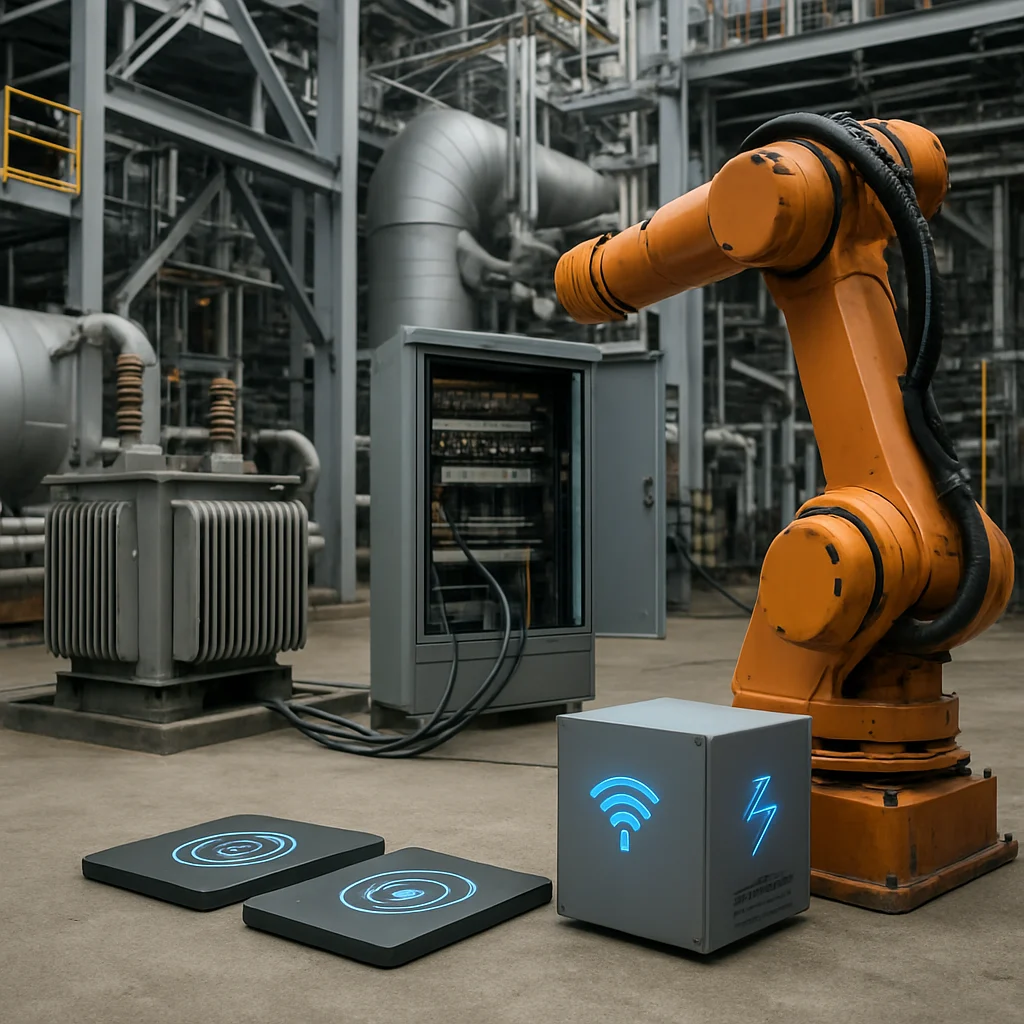
As the manufacturing and automation industries continue to evolve, the need for efficient and reliable energy solutions for industrial robots has never been more pressing. Wireless energy transfer (WET) technologies are emerging as a viable alternative to traditional wired systems, offering flexibility, ease of installation, and the potential for reduced downtime. This article will compare various WET tools and workflows tailored to optimize energy supply for industrial robots.
The Rise of Wireless Energy Transfer
Wireless energy transfer is revolutionizing how power is delivered to machines, enabling a seamless integration of robots into automated systems. This technology primarily relies on three methods: inductive coupling, resonant inductive coupling, and capacitive coupling. Understanding the differences among these solutions can significantly impact the performance and efficiency of industrial robots.
Comparison of Wireless Energy Transfer Technologies
| Technology | Principle of Operation | Efficiency | Use Cases | Advantages | Disadvantages |
|---|---|---|---|---|---|
| Inductive Coupling | Uses electromagnetic fields between coils | 75-90% | Low-power applications | Simple installation, robust | Limited range, alignment sensitive |
| Resonant Inductive Coupling | Enhances efficiency by tuning coils to resonant frequency | Up to 95% | Medium to high-power applications | Greater range, higher efficiency | More complex design |
| Capacitive Coupling | Transfers energy through electric fields | 60-80% | Low-power sensors and devices | Non-invasive, compact | Lower efficiency, environmental sensitivity |
| Laser Power Transmission | Uses focused laser beams to transfer energy | Depends on conversion efficiency | Long-distance applications | High energy density | Safety concerns, expensive |
Detailed Examination of Leading Technologies
Inductive Coupling
Inductive coupling is among the most established forms of wireless energy transfer. It involves the transfer of energy through electromagnetic fields generated by two coils. While its efficiency ranges between 75% to 90%, it is particularly suited for low-power applications such as autonomous mobile robots that require charging stations strategically placed within a workspace. The simplicity of installation makes it a popular choice in manufacturing settings.
Resonant Inductive Coupling
For medium to high-power usage, resonant inductive coupling offers a substantial improvement over traditional inductive methods. With efficiency ratings up to 95%, this technology allows for greater power transmission over a larger distance, thus reducing the need for frequent realignment or exact placement of robots. This is particularly beneficial in dynamic environments where robots need mobility without compromising power access.
Capacitive Coupling
Capacitive coupling, though less efficient, can be extremely useful for powering low-energy devices like sensors. This method uses electric fields to transfer energy wirelessly and is generally more compact. Applications include smart grids and other small-scale robotic systems where space is limited and environmental conditions are controlled.
Laser Power Transmission
Lastly, laser power transmission represents a cutting-edge approach, enabling energy delivery over significantly longer distances. However, despite its high energy density, costs can be prohibitive, and safety concerns regarding laser exposure are paramount. Still, it opens the door to potentially powering aerial drones or remote robotic systems operating in hazardous environments.
Factors Influencing Technology Choice
When considering various wireless energy transfer solutions for industrial robots, several factors come into play:
- Power Requirements: Determine the power needs of the specific robotic application to select an appropriate technology.
- Operating Environment: Assess whether the environment is suitable for inductive, capacitive, or laser transmission methods.
- Installation and Maintenance: Evaluate ease of installation and ongoing maintenance requirements, which can impact operational efficiency.
- Cost-Effectiveness: Balance initial investment with long-term efficiency gains.
Conclusion
The wireless energy transfer landscape is evolving, providing diverse solutions to meet the demands of modern industrial robotics. By comparing technologies such as inductive coupling, resonant inductive coupling, capacitive coupling, and laser power transmission, engineers and builders can make informed decisions tailored to specific project requirements. As reliance on automation continues to grow, the integration of efficient wireless energy systems will undoubtedly enhance productivity and innovation within the manufacturing sector.