If a Subcontractor Is 3 Weeks Behind Schedule, How Should a Project Manager Respond?
If a subcontractor is three weeks behind schedule, what should a project manager do? Read more on Vision Constructors for practical industry insights.
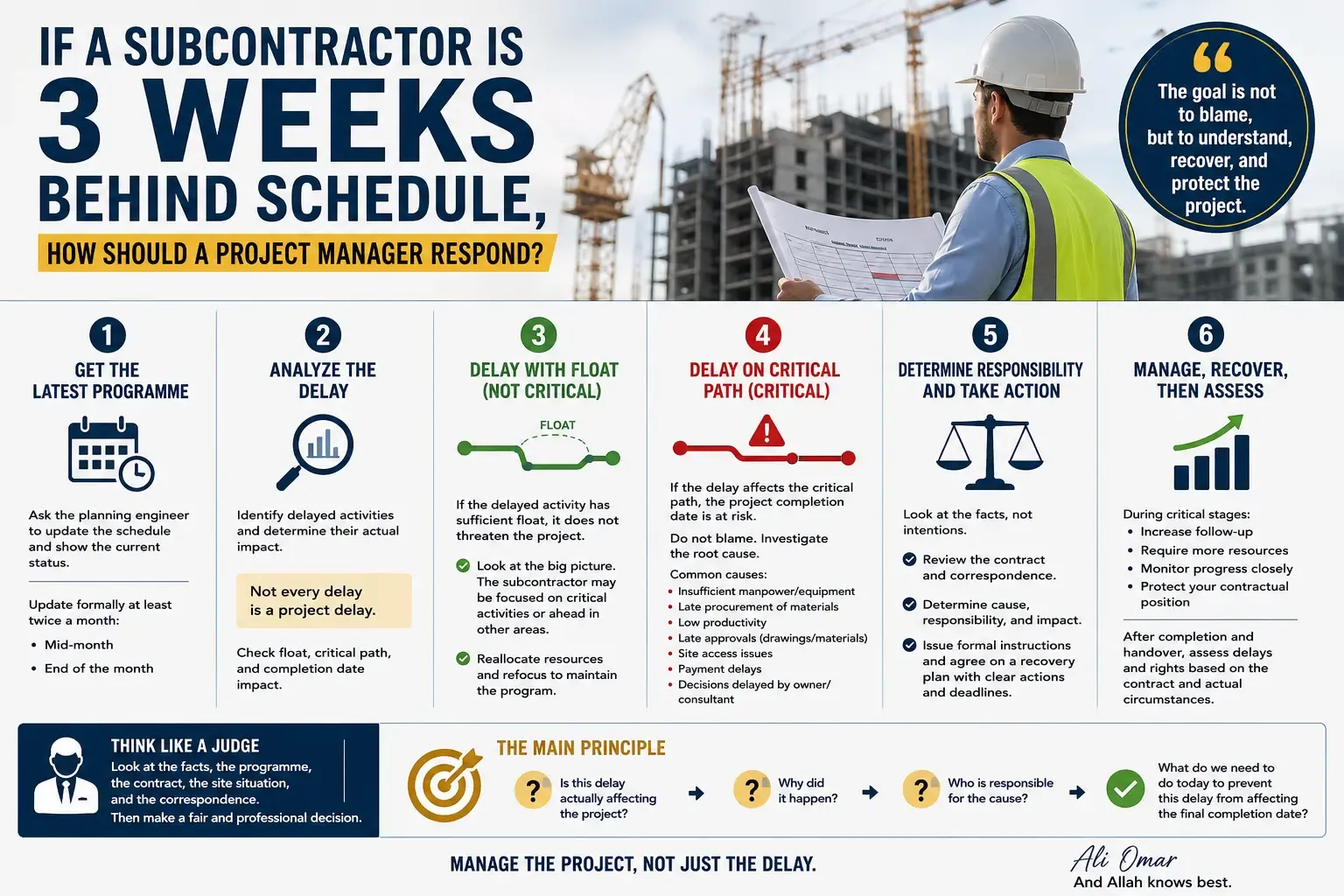
If a subcontractor is three weeks behind schedule, what should a project manager do?
The role of a project manager is not simply to identify delays and blame the subcontractor. The real responsibility is to understand the actual status of the project, analyze the cause and impact of the delay, and take the right action at the right time.
Start With the Updated Planing
The first step is to ask the planning engineer to update the project schedule and clearly show the current status.
In my view, a formal schedule update should be carried out at least twice a month: once around the middle of the month and once at the end.
Based on the updated planing, the project manager should identify the delayed activities and, more importantly, determine their actual impact on the project.
Because not every delay is a project delay.
An activity may be three weeks late but still have sufficient float. In that case, the delay may have no immediate impact on the Critical Path or the contractual completion date.
This distinction is extremely important.
Before Blaming the Subcontractor, Look at the Whole Programme
Suppose the subcontractor is behind on one activity, but that activity still has available float.
At the same time, the subcontractor may have allocated resources to more critical activities or may even be ahead of schedule in other areas.
Immediately issuing a warning simply because one activity is late does not necessarily represent good project management.
The project manager should first understand the complete situation.
If the delayed activity is consuming its float and could eventually become critical, the subcontractor should be formally instructed to refocus its resources, increase manpower or equipment where necessary, and recover the delay before it affects the Critical Path.
This protects the project without unfairly judging the subcontractor based on one isolated activity.
What If the Delay Is on the Critical Path?
This is where the situation becomes more serious.
If the three-week delay is affecting a critical activity and therefore threatening the project completion date, simply blaming the subcontractor will not solve the problem.
In fact, excessive blame without understanding the cause can make the situation worse.
The project manager must perform a root-cause analysis.
Ask the right questions:
- Is there insufficient manpower?
- Is there a shortage of equipment?
- Is productivity below the required level?
- Has the subcontractor failed to procure materials or equipment on time?
- Are there technical problems affecting execution?
- Are drawings or material approvals delayed?
- Is access to the work area unavailable?
- Has the client or consultant delayed decisions?
- Are payment delays affecting the subcontractor's cash flow and ability to maintain resources?
The answer determines both who is responsible and what corrective action is required.
Responsibility and Impact Are Not Always the Same Thing
Consider a contractor whose payments have been significantly delayed.
If those payment delays affect the contractor's ability to pay workers, purchase materials, maintain equipment, or achieve the required production rates, then the resulting delay cannot be properly analyzed without considering the payment issue.
However, a professional contractor must also protect its contractual position.
It is not enough to repeatedly request payment.
The contractor should formally notify the relevant party that continued payment delays may affect procurement, manpower, productivity, progress, and ultimately the project programme.
This creates an important distinction between simply complaining about a problem and properly documenting its potential contractual and schedule consequences.
A Project Manager Should Think Like a Judge
Do not manage contractual relationships based on intentions or assumptions.
Whether you represent the contractor, consultant, or client, you should approach delay situations almost like a judge.
Look at the facts.
Look at the approved baseline programme and its updates.
Look at the Critical Path.
Look at the available float.
Look at the correspondence.
Look at the contract.
Look at what actually happened on site.
Then determine:
What caused the delay?
Who was responsible?
What was the actual impact?
And what needs to happen now to protect the completion date?
Only after answering these questions should responsibility be assigned.
Be Firm, but Remain Diplomatic
A project manager must be firm.
You have to protect yourself, the client, the contractual position, and most importantly, the project.
But firmness should not eliminate diplomacy.
At the end of the day, you still need the subcontractor to complete the work.
There is little value in winning every argument and sending aggressive letters if the project continues to fall further behind.
During a critical stage, stronger pressure may absolutely be necessary. You may need to demand additional manpower, more equipment, extended working hours where appropriate, revised resource allocation, or a formal recovery programme showing exactly how the lost time will be recovered.
The objective of that pressure should be recovery, not punishment.
Solve the Problem First, Assess the Consequences Properly
When the project is in danger, the immediate priority should be preventing a three-week activity delay from becoming a three-week project delay.
Push for recovery.
Monitor progress closely.
Increase reporting frequency if necessary.
Require measurable corrective actions.
Protect the contractual position through proper correspondence.
Once the critical situation has been controlled, the works completed, and the project properly delivered, the parties can fully assess the delays, their consequences, and each party's contractual rights and liabilities based on the contract and the actual circumstances.
The Main Principle
When a subcontractor is three weeks behind schedule, the first question should not be:
“How do I blame the subcontractor?”
The better questions are:
“Is this delay actually affecting the project?”
“Why did it happen?”
“Who is responsible for the cause?”
And most importantly:
“What do we need to do today to prevent this delay from affecting the final completion date?”
That is the difference between simply reporting a delay and actually managing a project.
And Allah knows best.

Eng Ali Omar
Ali Omar is a civil and structural engineer and construction project manager with experience delivering large-scale building projects across Africa and the Middle East. H...
View Profile & Articles