How Artificial Surfing Waves Work: Engineering Behind Modern Wave Pools
Modern wave pools replace wind and ocean swell with precisely controlled water displacement, engineered bathymetry, automation and heavy civil infrastructure.
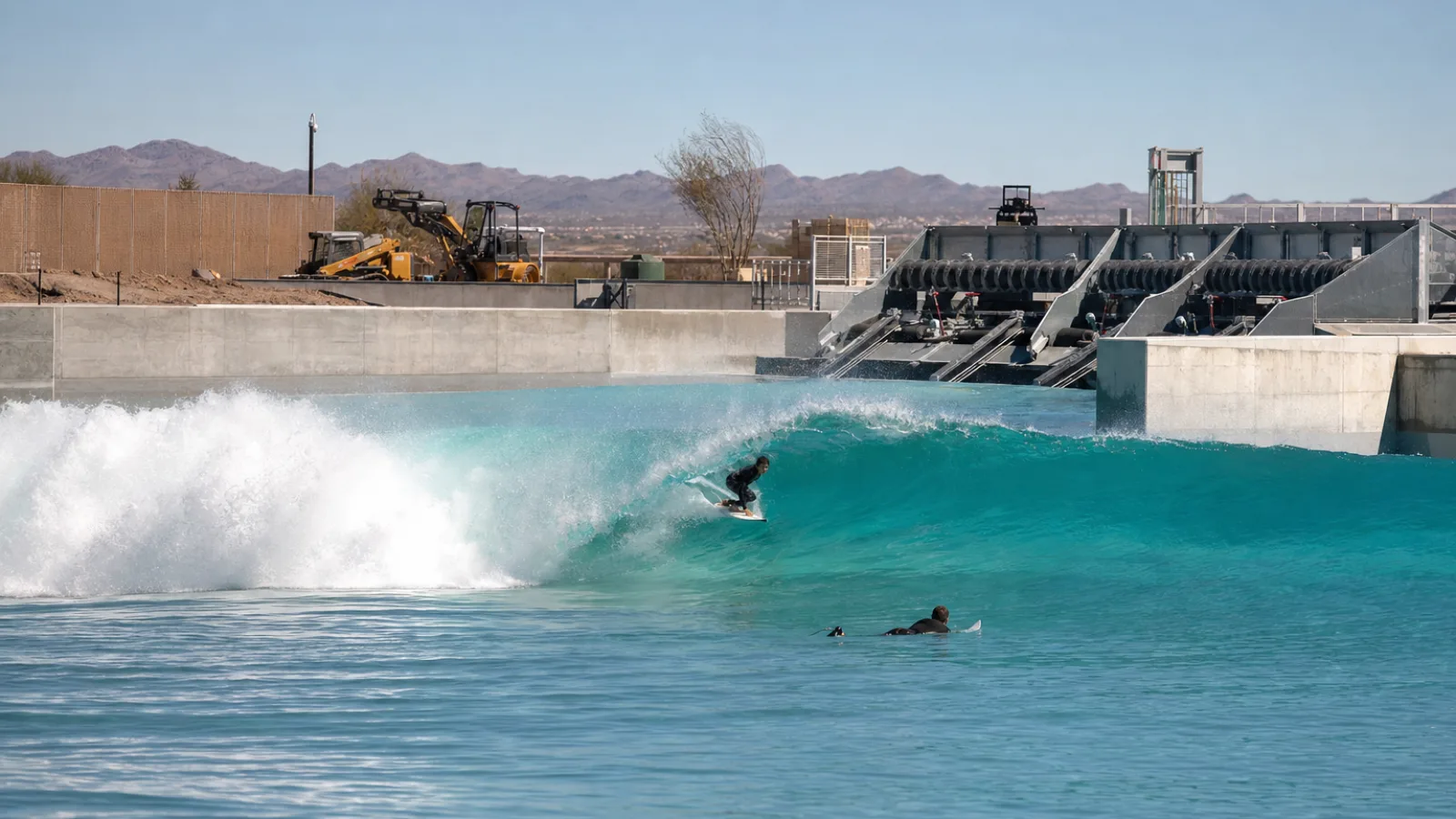
Surfing no longer depends entirely on an ocean coastline. In modern artificial surf pools, a carefully timed machine moves a large volume of water through an engineered basin, creating a traveling wave that can be shaped, repeated and adjusted for different riders.
That apparent simplicity conceals a demanding civil and mechanical engineering problem. A surfable wave must carry enough energy to support a rider, break in a predictable location and retain a useful face or barrel. The basin must withstand substantial water pressure and cyclic loading, while pumps, actuators, controls and filtration equipment operate reliably in an often harsh environment. This is the practical story behind artificial surfing wave technology—and why a wave pool in an inland desert requires much more than a large swimming pool.
The physics behind artificial waves
An ocean wave transports energy through water. In a wave pool, that energy begins with a machine rather than distant wind. The machine displaces water, producing a disturbance that travels across the basin. As the disturbance moves, individual water particles mainly orbit or oscillate rather than traveling with the wave from one end of the pool to the other.
Several properties determine whether the result is a gentle ripple or a surfable breaker. Wave height is the vertical distance from the trough to the crest. Wavelength is the horizontal distance between successive crests. Wave period describes the time between them. Together with water depth, these characteristics influence wave speed, energy and the point at which the wave begins to break.
Depth is especially important. In deep water, the wave can move with relatively little interaction with the floor. As it enters shallower water, friction and pressure effects involving the basin floor slow the lower part of the wave. The crest continues forward, becomes steeper and eventually collapses when the geometry and local depth no longer support it. This is the same broad physical process that produces breaking waves at a beach, but a wave pool compresses it into a precisely designed path.
Displacement is the starting point. If a paddle, plunger or air chamber pushes water forward, the displaced volume creates a pressure pulse. The basin then converts that pulse into a moving wave. The force, stroke, timing and shape of the generating device determine how much energy enters the water. Pool length and floor profile determine how that energy develops before the wave reaches the surfing zone.
How artificial surfing waves are generated
There is no single machine architecture for a wave pool. Systems differ in the way they displace water and in how they distribute the resulting wave across the basin. Four broad approaches are common in engineering discussions: pneumatic chambers, hydraulic paddles, mechanical displacement systems and central plungers.
Pneumatic air-chamber systems
A pneumatic system uses compressed air to move water. Air is introduced into, or withdrawn from, a chamber connected to the pool. Changes in air pressure alter the water level inside the chamber and force water into the basin, creating a pulse. Valves and compressors control the pressure cycle, while the chamber geometry influences the volume and timing of displacement.
Because the water-moving element may have few submerged mechanical parts, pneumatic equipment can offer useful flexibility in wave timing and maintenance access. Its performance still depends on compressor capacity, valve response, chamber sealing and careful control of pressure transients. A representative example of this approach is described through PerfectSwell wave generation technology. The existence of a similar operating principle does not establish any connection between that technology and equipment shown in a particular video or facility.
Hydraulic paddles
Hydraulic systems use pressurized fluid to drive an actuator, usually a cylinder or rotary motor, which moves a paddle or barrier through the water. The paddle transfers mechanical energy directly to the pool. Hydraulic power packs include pumps, reservoirs, filters, pressure-control components and directional valves. A programmable controller can vary the actuator stroke, speed and timing.
The advantage is direct, high-force movement with precise control over the paddle profile. The tradeoff is that hydraulic equipment requires careful management of leaks, seals, fluid cleanliness, heat and mechanical fatigue. The actuators and their supports must also be designed for repeated reversing loads.
Mechanical displacement systems
Mechanical systems use a moving wall, flap, foil, carriage or other submerged or partially submerged element to displace water. An electric motor may drive the mechanism through a gearbox, crank, rack or linear actuator. The machine can be arranged along one side of the pool or divided into sections so that the wave is generated progressively across the width.
Mechanical displacement is attractive when engineers need a clearly defined stroke and repeatable movement. However, gears, bearings, guides and submerged components require access for inspection and replacement. The structural frame must transfer drive forces into the concrete basin without excessive vibration.
Central plungers and pistons
A central plunger moves vertically or horizontally in a dedicated section of the pool, displacing water outward. The resulting wave can travel toward one or more surfing areas, depending on the basin layout. This arrangement can create a symmetrical wave field, although the pool must be shaped to manage reflections and prevent unwanted interference between wave fronts.
These categories are useful comparisons rather than rigid classifications. A commercial installation may combine electrical drives, hydraulic actuators, air systems, local chambers and software control. The engineering objective remains the same: introduce a known amount of energy into the water at a known time.
Hydraulic and pneumatic engineering
Hydraulic and pneumatic equipment are often confused because both use pressurized fluids, but their operating characteristics differ. Hydraulic systems use a liquid, typically an oil-based or water-based fluid, which is nearly incompressible. That allows high force and accurate transmission of motion. Pneumatic systems use compressed air, which is compressible and stores energy like a spring. They can provide rapid response and simpler force modulation, but pressure and volume changes must be managed carefully.
In a hydraulic wave generator, an electric motor drives a pump. The pump sends fluid through control valves to an actuator. Sensors may measure position, pressure and velocity, allowing a PLC to coordinate the movement with other equipment. Relief valves protect the circuit from excessive pressure, and cooling systems may be needed because operating losses become heat.
In a pneumatic arrangement, compressors fill receivers or feed air directly to controlled chambers. Solenoid or proportional valves regulate flow, while pressure transducers confirm that the commanded cycle is occurring. Air dryers, filters and condensate management can be important because moisture and contamination affect valves and seals.
Neither system creates a wave by pressure alone. The pressure system is only the power source. The final wave depends on the displacement volume, the generating surface, the rate of movement and the hydraulic behavior of the basin.
How engineers create barrel waves
A barrel wave is not simply a high wave. It is a breaking wave with a sufficiently hollow, continuous face for a surfer to travel inside or close to the curling lip. Creating that form requires coordination between the generator and the pool floor.
Engineers use bathymetry—the three-dimensional contour of the basin floor—to control shoaling. A relatively deeper section can allow the wave to travel without breaking immediately. A carefully graded shallower section then slows the lower portion of the wave and forces the crest forward. Changes in slope, ridges, channels and side contours can influence where the lip pitches and how long the breaking pocket remains open.
Timing matters just as much. A wave that arrives too early, too late or with an uneven cross-basin profile may close out rather than form a rideable shoulder. Computer modeling, physical testing and operational commissioning are used to refine the relationship between displacement, water depth and breaking position. Water level also matters: a small change in operating level can alter the effective bathymetry and shift the break point.
Pool walls and boundaries must be considered as well. Reflected energy can produce secondary waves that interfere with the next sequence. Designers use basin length, side geometry and timing to reduce those effects, while some systems divide the wave field into zones to create multiple ride paths.
Civil and structural engineering of wave pools
A wave pool is a water-retaining structure, a machine foundation and a public facility at the same time. The basin is commonly formed from reinforced concrete, although the exact construction system depends on soil conditions, geometry and the project delivery method.
Design begins with geotechnical investigation. Bearing capacity, groundwater, settlement potential and seismic conditions affect foundation selection and slab thickness. A large basin may experience different load cases when full, partially drained or empty. Hydrostatic pressure acts laterally on retaining walls, while uplift from groundwater can act beneath the floor when the pool is drained.
Reinforcement must control both structural stresses and crack widths. Water-retaining concrete cannot be treated like an ordinary dry building element; small cracks can become leakage paths or allow aggressive water and chemicals to reach reinforcement. Construction joints, movement joints, penetrations and embedded equipment therefore require detailed waterstops and sealing systems.
Waterproofing may be integrated into the concrete design or supplemented with membranes and protective coatings. The chosen system must tolerate ultraviolet exposure, cleaning chemicals, thermal movement and repeated wetting and drying. Around generators, access pits and mechanical supports, engineers must also allow for vibration, inspection clearances and replacement of major components.
Drainage is equally practical. Deck drains, overflow systems, equipment-room sumps and emergency discharge routes protect the structure and surrounding site. Poorly coordinated drainage can cause water to collect behind walls, damage machinery or create unsafe deck conditions.
Automation and smart control systems
Repeatability is one of the defining benefits of a modern wave pool. A programmable logic controller can coordinate the generator, water-level equipment, filtration plant, lighting and safety interlocks. Operators may select wave height, direction, interval and sequence, within the limits of the equipment and the approved operating envelope.
Sensors provide the feedback needed to keep those settings stable. Depending on the system, instrumentation may monitor actuator position, hydraulic pressure, air pressure, motor current, water level, flow, vibration and equipment temperature. Control software compares the measured condition with the commanded condition and can reduce output or stop the sequence if values move outside safe limits.
Emergency shutdown is designed into the control architecture rather than added as an afterthought. Physical stop buttons, access-gate interlocks, fault detection and manual override functions can isolate energy sources and prevent a new wave from being generated during an unsafe condition. A sophisticated system still needs trained operators, documented procedures and clear communication with lifeguards and maintenance personnel.
Designing wave pools in Arizona and other desert environments
Inland desert locations introduce constraints that coastal facilities may avoid. High temperatures and low humidity increase evaporation from the exposed water surface. Wind can accelerate that loss and carry dust into the basin. Water management therefore involves makeup water, filtration, chemical balancing, backwash planning and control of splash-out.
Conservation measures may include covers for selected operating periods, efficient filtration, recovery of suitable backwash water and careful control of overflow. The appropriate solution depends on local regulations, water availability, public-health requirements and the operating schedule. Evaporation cannot simply be eliminated without affecting access, ventilation or the user experience.
Heat also affects pumps, compressors, electrical equipment, hydraulic fluid and control enclosures. Mechanical rooms need ventilation or cooling, while exposed materials must tolerate intense solar radiation and thermal cycling. Dust filtration and sealed electrical cabinets can reduce maintenance problems, but they add to capital and operating requirements.
Energy demand is another design consideration. Wave generation, pumping, filtration, water heating or cooling, lighting and building services may operate simultaneously. Energy-efficient drives, variable-speed pumps, heat management and software that avoids unnecessary operating cycles can reduce consumption without compromising wave quality.
Engineering comparison of wave-generation systems
| System | How it moves water | Typical strengths | Key engineering considerations |
|---|---|---|---|
| Pneumatic chamber | Compressed air changes the water level in a chamber and displaces water into the pool. | Flexible timing; potentially fewer submerged moving parts. | Compressor capacity, valve response, pressure control, sealing and air treatment. |
| Hydraulic paddle | Pressurized fluid drives an actuator connected to a paddle or barrier. | High force and precise control of stroke and speed. | Leaks, seals, fluid cleanliness, heat, fatigue and actuator support loads. |
| Mechanical displacement | A motor-driven wall, flap, carriage or similar element pushes water. | Direct, repeatable displacement and adaptable layouts. | Gears, bearings, vibration, submerged maintenance and structural reactions. |
| Central plunger | A piston or plunger displaces water from a central section. | Can produce organized wave fronts toward multiple zones. | Reflection control, symmetry, drive forces and access to the central mechanism. |
Safety, maintenance and long-term reliability
Wave energy that is useful to a surfer can be hazardous to a swimmer. Facilities need physical or operational separation between surfing zones, learner areas, access routes and machinery. Lifeguard sightlines, rescue access, depth transitions, edge protection and clear operating rules are part of the engineering design, not merely facility management.
Maintenance begins with inspection access. Operators need safe routes to pumps, compressors, valves, actuators, electrical panels and submerged mechanisms. Planned work may include checking seals and bearings, testing pressure relief devices, cleaning filters, inspecting concrete joints and monitoring corrosion or coating deterioration.
Water quality systems must manage biological contamination, suspended solids and chemical balance while coping with high bather loads and mechanical turbulence. Monitoring, circulation and treatment systems must be sized for actual use, and their failure modes should be understood before the facility opens.
Structural inspections should look beyond visible leaks. Cracking, joint movement, settlement, vibration and changes in water level can indicate developing problems. A reliable facility combines condition monitoring with scheduled shutdowns, rather than waiting for a machine failure or structural defect to interrupt operations.
The future of artificial surfing technology
Future improvements are likely to focus on doing more with less water and energy. More efficient motors, variable-speed drives, improved air systems and better control algorithms can reduce the energy required for each wave sequence. Digital models may also help operators tune wave output to demand, avoiding full-power operation when a lower setting is sufficient.
Water management will become increasingly important as wave pools expand into dry regions. Better filtration, recovery systems, automated leak detection and more accurate evaporation monitoring can reduce losses. Materials and coatings that withstand chemicals, ultraviolet exposure and repeated thermal cycling may extend maintenance intervals.
Programmable wave fields could also become more responsive. Sensors and control software may adjust a sequence for changing water levels, equipment condition or user requirements while retaining predictable safety limits. The objective is not simply to make a larger wave, but to create a consistent hydraulic environment with lower operating risk and resource demand.
Artificial surfing wave technology works because several disciplines are coordinated in one system. Mechanical equipment supplies the displacement, hydraulic or pneumatic components control force, bathymetry shapes the break, reinforced concrete contains the water, and automation makes the result repeatable. In a desert setting, filtration, heat management and conservation become equally important. The best wave pools are therefore not oversized swimming pools with a machine attached; they are integrated civil, hydraulic and control systems designed to make moving water behave with remarkable precision.