Solid-State Transformers Explained: How Power Electronics Are Redesigning Electrical Distribution
Solid-state transformers combine transformer isolation with semiconductor power conversion to create more controllable electrical interfaces. This guide explains their architecture, benefits, applications, limitations, and planning implications for modern distribution systems.
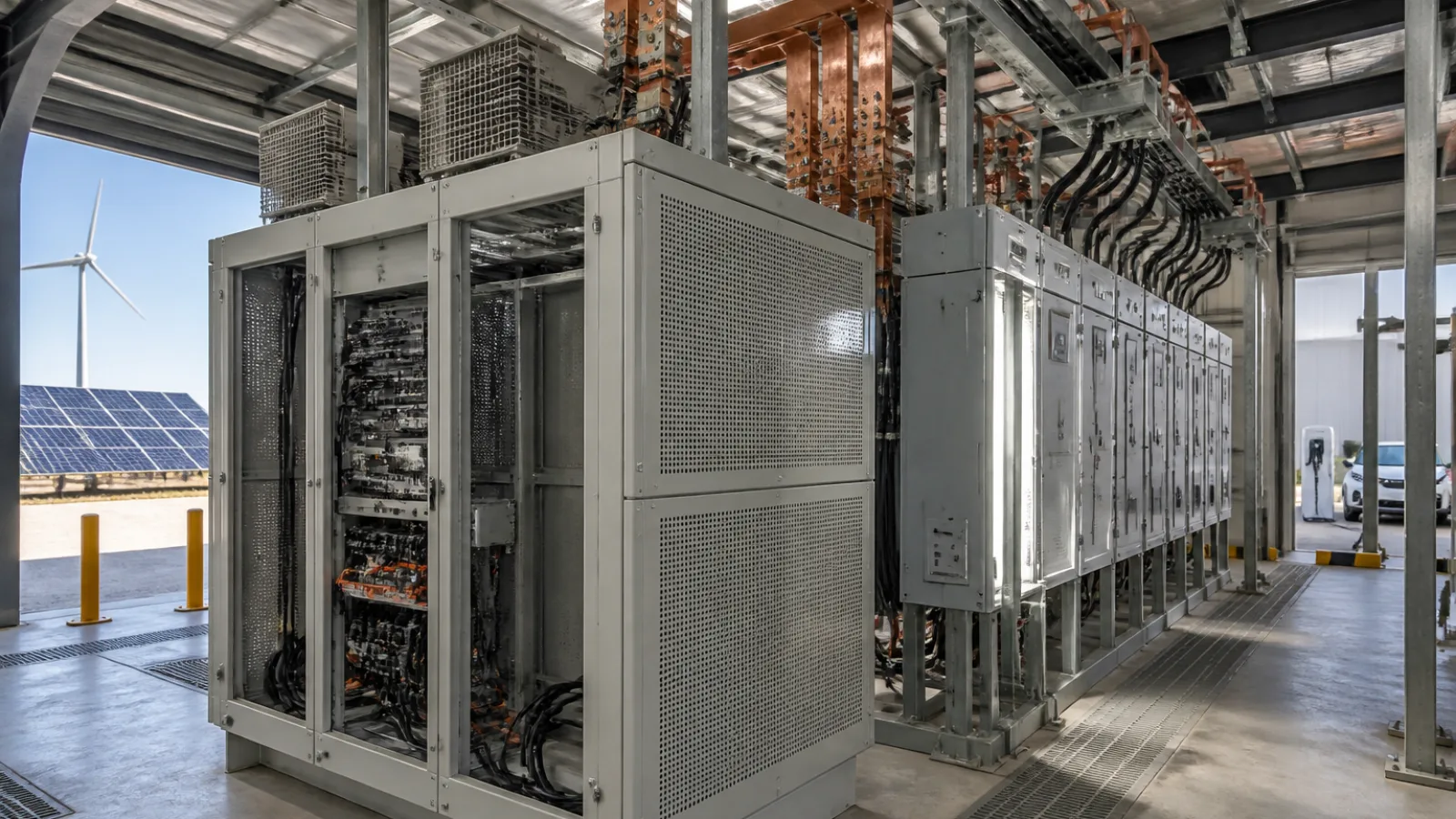
Solid-State Transformers, commonly called SSTs, combine transformer-based electrical isolation with semiconductor power conversion. Instead of relying primarily on electromagnetic induction to change voltage, an SST converts, controls, isolates, and reconstructs electrical power through several coordinated power-electronic stages.
SSTs are attracting attention because electrical infrastructure is becoming more interactive. Solar generation, battery storage, electric vehicles, data centers, and microgrids all require distribution equipment that can manage changing power flows and, in some cases, both AC and DC connections. Technical references such as Hitachi Energy’s solid-state transformer solutions illustrate the broader industry interest in this area. This article explains how SSTs work, how they differ from conventional transformers, where they may be useful, and what engineers and project planners should consider before adopting them.
What Is a Solid-State Transformer?
A solid-state transformer is a power-conversion system that uses semiconductor switches, control electronics, and a high-frequency transformer to perform voltage transformation and electrical isolation. Depending on its design, an SST may accept medium-voltage AC, convert it to DC, transfer energy through a high-frequency isolated stage, and then produce regulated low-voltage AC, DC, or both.
A conventional transformer changes voltage and maintains frequency through electromagnetic induction between windings. It is passive in normal operation: once connected, its voltage ratio and electrical behavior are largely determined by its design and the connected system. An SST adds active conversion stages, allowing the equipment to regulate voltage, control power factor, manage bidirectional energy flow, and communicate operating information to other systems.
The term does not describe one universal circuit. SST architectures vary according to voltage level, power rating, isolation requirements, switching devices, cooling method, output type, and application. Some designs are intended for utility distribution, while others are optimized for traction systems, industrial equipment, EV charging, or DC-based facilities.
How Solid-State Transformers Work
1. Input conversion and power control
In a typical SST, incoming AC power first passes through an input conversion stage. This stage may use a rectifier or an active front end to convert AC into a controlled DC link. A rectifier changes alternating current into direct current; an active front end uses controllable semiconductor switches to shape the input current and regulate how power is drawn from the grid.
Modern switching devices, including insulated-gate bipolar transistors and newer wide-bandgap devices such as silicon carbide switches, turn on and off at high speed. Digital controls coordinate these switches to regulate voltage, current, power factor, and energy flow. The exact topology depends on the required voltage, power rating, isolation arrangement, efficiency target, fault strategy, and application environment.
2. High-frequency isolation and voltage transformation
The DC link feeds a power-electronic inverter, which creates high-frequency AC for an isolated transformer stage. This medium- or high-frequency transformer provides galvanic isolation and performs voltage transformation while operating at a much higher frequency than the utility supply.
Higher-frequency operation can reduce the size and mass of magnetic components because less core material and winding area may be needed for a given power-transfer function. That characteristic is valuable where space, weight, or integrated AC/DC conversion matters. However, it also introduces design challenges involving switching losses, insulation coordination, electromagnetic interference, dielectric stress, thermal management, and control stability.
After the high-frequency transformer, another converter stage commonly rectifies the isolated high-frequency output into DC. In some architectures, multiple modular power-conversion cells are connected in series on the medium-voltage side and in parallel or another coordinated arrangement on the low-voltage side. This modular approach can help manage voltage stresses and support service strategies, but it adds control and component complexity.
3. Output conversion and interface management
The output stage determines how the SST connects to the downstream electrical system. It may provide a regulated DC bus, synthesize low-voltage AC, or supply both AC and DC outputs. An inverter can reconstruct AC with a selected voltage and frequency, while a DC converter can regulate the voltage delivered to batteries, solar equipment, industrial loads, or charging systems.
Controls continuously compare measured voltage and current with operating targets. They can adjust switching commands to respond to changing loads, distributed generation, and grid conditions. Depending on the design, the SST may provide voltage support, limit current, manage reactive power, coordinate with storage, or transition between operating modes. These functions must be coordinated with upstream utility equipment and downstream protection rather than treated as isolated features.
4. Sensors, controls, and communications
SSTs rely on sensors to monitor voltage, current, temperature, insulation condition, switching behavior, and other operating variables. Digital controllers use this information for regulation, fault detection, diagnostics, and protection. Condition monitoring can identify abnormal thermal behavior, degraded components, or control problems before they become major failures, although the quality of those benefits depends on sensor coverage, software, maintenance, and operating procedures.
Communications allow an SST to exchange information with supervisory control systems, energy-management platforms, building-management systems, microgrid controllers, or utility automation networks. This connectivity makes SSTs relevant to smart-grid architecture. It also creates cybersecurity responsibilities, including access control, secure communications, software management, event logging, and recovery planning.
Solid-State Transformers vs. Conventional Transformers
The comparison below is general. Actual performance depends on topology, loading, environmental conditions, controls, protection design, and the wider distribution system.
| Characteristic | Conventional transformer | Solid-state transformer |
|---|---|---|
| Voltage conversion | Electromagnetic induction and fixed design ratio | Semiconductor conversion with actively controlled stages |
| Size and weight | Often larger at low operating frequency | Potentially more compact, but includes additional electronics and cooling |
| Controllability | Limited during normal operation | Dynamic regulation of voltage, current, and power flow |
| AC/DC interfaces | Usually requires separate converters | Can integrate AC, DC, or hybrid interfaces |
| Bidirectional operation | Physically possible but not actively managed by the transformer itself | Can be designed for controlled two-way power flow |
| Fault response | Relies mainly on external protection and transformer impedance | Can respond rapidly through controls, but requires specialized protection |
| Efficiency behavior | Typically strong and predictable across established operating ranges | Depends on switching, conversion, cooling, and loading losses |
| Maintenance | Mature procedures and widely available expertise | Requires power-electronics, controls, thermal, and cybersecurity capability |
| Cost maturity | Highly mature supply chain and cost structure | Economics vary by design, scale, application, and field experience |
| Grid integration | Usually needs separate equipment for advanced functions | Can integrate regulation, monitoring, and energy-management functions |
Potential Benefits of SST Technology
More precise voltage regulation
An SST can adjust output voltage dynamically rather than relying only on fixed taps or the natural voltage behavior of a passive transformer. This may help manage voltage changes caused by variable loads, distributed generation, or long feeders. Voltage support can be particularly useful where network constraints change throughout the day. The value depends on the control range, response time, available capacity, and coordination with other voltage-regulation assets.
Bidirectional power flow
Many emerging power systems are no longer organized around one-way movement from a substation to passive consumers. Rooftop solar exports energy, batteries charge and discharge, electric vehicles may participate in vehicle-to-grid programs, and microgrids can change between grid-connected and islanded operation. An SST designed for bidirectional operation can manage these flows at the electrical interface and provide a more active role for distribution equipment.
AC and DC distribution options
An SST may provide a controlled DC link or DC output for data centers, industrial equipment, EV charging systems, solar arrays, and battery storage. In a carefully designed system, direct DC distribution can reduce unnecessary conversion stages between a source and a DC load. It does not automatically reduce losses, however. Cable selection, protection, isolation, grounding, conversion efficiency, and the operating profile of every connected device still determine the system result.
Power-quality management
Power electronics can support controllable power factor, harmonic-management functions, voltage regulation, and certain ride-through behaviors. An SST may help coordinate power quality with active filters, storage, UPS systems, or utility controls. These are potential capabilities rather than guaranteed outcomes. Harmonic performance, fault behavior, and ride-through must be demonstrated for the selected equipment and verified across the complete installation.
Monitoring and maintainability opportunities
Embedded sensors and digital diagnostics can provide better visibility into temperatures, loading, switching conditions, and abnormal events. That information may support condition-based maintenance and more informed operational decisions. At the same time, an SST is not maintenance-free. Qualified personnel are needed for high-voltage isolation, power-electronics servicing, firmware management, thermal systems, and cybersecurity controls.
How SSTs Support Smart Grids and Renewable Integration
Smart grids use sensing, communications, automation, and controllable equipment to operate electrical networks more dynamically. An SST can act as an intelligent interface between a utility feeder and local loads or energy resources. It can measure conditions, regulate the connection, and exchange commands with an energy-management or distribution-management system.
Distributed solar and wind generation can fluctuate with weather and may create local voltage constraints or reverse power flow. Battery storage can absorb excess generation and discharge during periods of high demand. An SST may coordinate these resources by controlling voltage, current, power factor, and the direction of energy transfer. It can also support islandable microgrids by managing the interface between utility service, local generation, storage, and critical loads.
These capabilities do not eliminate the need for network studies. Protection coordination, fault-current availability, anti-islanding functions, grounding, communications reliability, and operating authority must all be addressed. An SST does not create renewable energy; it provides a more controllable electrical interface for connecting and managing it.
Applications in Future Electrical Infrastructure
Electric-vehicle charging
High-power charging sites and fleet depots can require substantial capacity, fast load changes, and multiple charging outputs. An SST may provide a direct DC interface to charging equipment, coordinate battery charging, and help manage site power limits. Practical design still requires utility coordination, adequate upstream capacity, short-circuit and protection studies, thermal management, metering, communications, and a clear approach to maintenance.
Data centers and high-density commercial facilities
Data centers and other high-density facilities often have large, variable, and increasingly DC-based loads. Project teams may evaluate SST architectures alongside conventional switchgear, UPS systems, rectifiers, busways, and distribution equipment. Potential advantages include integrated conversion, power-quality control, and digital monitoring. The decision must also consider redundancy, bypass arrangements, cooling, fault containment, service access, replacement strategy, and the consequences of a control or communications failure.
Industrial facilities and transportation systems
Industrial drives, factories, ports, rail systems, and transportation infrastructure may benefit from controllable voltage conversion or integrated AC/DC power paths. Applications with changing loads, regenerative braking, specialized voltage requirements, or limited space can make active conversion attractive. Engineering teams must assess harmonics, electromagnetic compatibility, motor-drive interactions, grounding, protection, and the operating profile before selecting an SST.
Microgrids and resilient facilities
An SST may help coordinate utility service, generators, solar generation, storage, and critical loads within a microgrid. It can support controlled transitions, energy dispatch, and selected voltage or frequency functions. Resilience, however, depends on more than one device. System design, protection, controls, fuel availability, equipment redundancy, communications, black-start capability, cybersecurity, and operator procedures all influence whether a facility can maintain critical service.
Global Technology Examples
Companies such as Siemens, ABB, Hitachi Energy, and General Electric are associated with major power-grid equipment portfolios, power electronics, transformer innovation, and related research and development. Their work spans established conventional transformers, grid automation, converters, digital substations, and emerging power-electronics architectures.
The market should be interpreted carefully. A company may have extensive conventional transformer manufacturing and research activity without offering one universally standardized SST product for every distribution application. Product maturity, pilot activity, commercial availability, ratings, service arrangements, and regional approvals can differ. Engineers should evaluate the specific equipment and evidence available for the proposed project rather than infer performance from a corporate technology portfolio.
Technical and Project-Planning Challenges
SST adoption introduces challenges that are less prominent in passive transformer installations. Semiconductor devices and control assemblies can be costly, and their switching losses produce heat that must be removed reliably. Cooling fans, liquid systems, heat exchangers, and thermal interfaces may become important maintenance items. Electromagnetic interference from high-frequency switching also requires careful enclosure, filtering, grounding, cable routing, and compliance design.
Insulation coordination is more complex when medium-voltage switching, high-frequency waveforms, and galvanic isolation are combined. Fault-current behavior may differ from the behavior engineers expect from a conventional transformer, particularly when converter controls limit current. Short-circuit protection must therefore be designed around the equipment's actual response, not only its nameplate rating.
Controls interoperability and cybersecurity are also central issues. The SST must communicate reliably with protection relays, microgrid controllers, utility systems, and facility networks. Access management, software updates, secure protocols, event recording, and recovery procedures should be defined early. Additional components and control layers can provide useful functionality but also introduce additional failure modes compared with a passive transformer.
Standards, utility approval, spare-parts availability, qualified service personnel, and lifecycle economics may vary by location and application. A project should compare total cost of ownership, including installation, cooling, commissioning, software support, planned maintenance, unplanned outages, replacement modules, and end-of-life management. Emerging technology can be technically suitable while still requiring a stronger service and procurement strategy than a conventional alternative.
What SST Adoption Means for Electrical Design and Construction
SST decisions should begin during early electrical design rather than after voltage levels and equipment rooms have already been fixed. Load studies should identify normal, peak, transient, standby, regenerative, and reverse-power conditions. Engineers may also need voltage-drop studies, harmonic assessments, fault studies, grounding reviews, protection coordination, and operating-mode analysis for grid-connected and islanded conditions.
Physical planning matters as much as the electrical schematic. Equipment rooms may need space for cooling systems, filters, communications hardware, isolation barriers, maintainable clearances, lifting access, and replacement modules. Designers should assess acoustic effects, heat rejection, fire protection, environmental conditions, and the separation of high-voltage and low-voltage control areas.
Construction and commissioning teams need clear responsibilities for factory testing, site testing, firmware configuration, network integration, protection settings, functional tests, and energization procedures. Spare parts and service arrangements should be agreed before procurement. Utilities, electrical engineers, contractors, facility owners, operators, and equipment vendors must align on interfaces and responsibilities.
For these reasons, an SST should be evaluated at the system level rather than by comparing transformer nameplates alone. The relevant question is whether its combined conversion, control, monitoring, protection, and integration functions create enough value for the project's operating requirements.
Are Solid-State Transformers the Future of Power Distribution?
Solid-State Transformers are promising for applications that need flexible AC/DC conversion, bidirectional control, renewable integration, EV charging, or digitally managed distribution. They can give electrical engineers more control over voltage, power flow, and system information than a conventional transformer provides by itself.
They are not a universal replacement. Conventional transformers remain highly effective, mature, robust, and economical for many utility, commercial, industrial, and building applications. SST adoption will depend on reliability evidence, total cost of ownership, standards, supply chains, qualified service capability, thermal performance, and project-specific requirements. The most practical future power systems may use both technologies, selecting each where its technical and economic characteristics are best suited.
Frequently Asked Questions
What is a solid-state transformer?
A solid-state transformer combines transformer isolation and voltage transformation with semiconductor power conversion. It can convert AC to DC and DC to AC, regulate electrical conditions, and support controlled power flow.
How is an SST different from a traditional transformer?
A traditional transformer mainly changes voltage through electromagnetic induction. An SST adds active conversion stages, digital controls, sensors, communications, and often AC/DC interfaces, making it more controllable but typically more complex.
Can solid-state transformers work with renewable energy?
Yes. SSTs can interface with solar, wind, batteries, and microgrids while managing voltage and bidirectional power flow. Compatible controls, protection, grounding, and utility requirements are still necessary.
Are solid-state transformers more efficient than conventional transformers?
They can reduce system-level conversion losses in some architectures and may avoid separate conversion equipment. However, semiconductor switching and cooling create losses, so efficiency must be assessed across the complete operating profile rather than assumed from the technology name.
Where are SSTs most likely to be used first?
Early applications are likely to involve strong needs for controllability or integrated AC/DC conversion, including EV charging, microgrids, industrial systems, transportation infrastructure, renewable-energy interfaces, and selected high-density facilities.
Do SSTs eliminate the need for conventional transformers?
No. Conventional transformers remain appropriate for many power-distribution applications because of their maturity, robustness, cost profile, simpler operation, and established maintenance infrastructure.