Deconstructing Failure: Inside the High-Stakes World of Battery Cell Safety Testing
As Energy Storage Systems (ESS) become central to the green energy transition, the risk of thermal runaway poses a critical safety challenge. This technical deep dive explores how TÜV SÜD's rigorous UL 9540A cell-level abuse testing—from nail penetration to overcharging—generates the crucial data needed to engineer safer battery venting, fire barriers, and system designs, setting new benchmarks for the entire industry.
The Unseen Engine of the Green Transition: The Critical Role of Energy Storage Systems
The global transition to renewable energy is not just a story of solar panels and wind turbines; it is fundamentally a story of storage. Energy Storage Systems (ESS) are the silent, indispensable heart of this revolution, providing the grid stability necessary to balance the intermittent nature of renewables. They are the reservoirs that store solar energy during the day for use at night and capture wind power on blustery afternoons to deploy during calm spells. At the core of the vast majority of these systems lies the lithium-ion battery cell—a marvel of electrochemical engineering celebrated for its high energy density and efficiency. However, with this immense power comes a profound responsibility. The very chemistry that makes these cells so effective also harbors the potential for catastrophic failure, namely thermal runaway and subsequent fire propagation. These are not abstract risks; they are serious safety challenges that the Architecture, Engineering, and Construction (AEC) and Real Estate sectors must confront as ESS installations become ubiquitous in commercial buildings, industrial facilities, and utility-scale projects. At TÜV SÜD, we believe that understanding failure is the first step toward preventing it. We don’t just ask what happens when a battery cell fails; we methodically force it to fail, measure the consequences with scientific precision, and use that data to design solutions that set industry benchmarks for safety.
The Electrochemical Domino Effect: A Technical Breakdown of Thermal Runaway
Thermal runaway is not merely a fire; it is a rapid, self-sustaining, and violent chain reaction originating within a single battery cell. Understanding this phenomenon at a granular level is crucial for any engineer or designer working with ESS. The process typically begins with an abuse factor, which can be thermal, mechanical, or electrical.
- Thermal Abuse: Exposure to external heat sources or internal hotspots from manufacturing defects can accelerate the cell's internal chemical reactions beyond its stable operating threshold.
- Mechanical Abuse: Physical damage, such as a crush event or a puncture (as simulated by nail penetration tests), can cause an immediate internal short circuit between the anode and cathode.
- Electrical Abuse: Overcharging the cell can lead to the formation of lithium dendrites—microscopic, metallic structures that can grow through the separator, creating an internal short circuit. Over-discharging can also degrade components, increasing failure risk.
Once a trigger event initiates the failure, a cascade of exothermic reactions begins. The Solid Electrolyte Interphase (SEI), a critical passivating layer on the anode, starts to decompose at temperatures around 80-120°C. This decomposition is itself exothermic, releasing heat and flammable hydrocarbon gases, which further increases the cell's internal temperature. As the temperature continues to climb, the polymer separator—the thin membrane preventing direct contact between the anode and cathode—begins to melt, typically between 130-190°C. This leads to widespread internal short-circuiting, causing a massive and instantaneous release of energy. The cathode material becomes unstable and breaks down, releasing oxygen—a critical component for combustion. The organic solvent-based electrolyte vaporizes and is often violently ejected from the cell in a process known as venting. This vented gas is a highly flammable mixture of hydrocarbons and hydrogen. If this mixture ignites, it can lead to a jet-like fire or, in a contained space, an explosion. The intense heat from this single failing cell—often exceeding 700°C—can then heat adjacent cells to their own trigger points, initiating a propagating failure that can consume an entire battery module, rack, and system.
Beyond Compliance: Shaping Safety Standards with UL 9540A Cell-Level Testing
In the face of such a complex failure mechanism, the industry requires a standardized methodology to evaluate risk and validate safety solutions. This is the role of UL 9540A, the Test Method for Evaluating Thermal Runaway Fire Propagation in Battery Energy Storage Systems. It is essential to understand that UL 9540A is not a pass/fail certification for a product; it is a structured test method designed to provide critical data that informs safety decisions. The standard outlines a four-tiered approach:
- Cell-Level Testing: Determines if a cell can exhibit thermal runaway and characterizes the nature of its failure.
- Module-Level Testing: Assesses if thermal runaway can propagate from one cell to others within a module.
- Unit-Level Testing: Evaluates fire propagation between entire battery units and characterizes the heat release and gas composition.
- Installation-Level Testing: A final, large-scale test to validate the effectiveness of fire protection systems at the system level.
Our work at TÜV SÜD focuses heavily on the foundational cell-level testing. It is at this microscopic level that the seeds of catastrophic failure are sown. By comprehensively understanding the failure characteristics of the individual cell, we can engineer mitigation strategies that are far more effective and efficient than those applied at the system level. This is the essence of designing for safety from the ground up.
The Laboratory as a Proving Ground: Controlled Abuse Testing in Practice
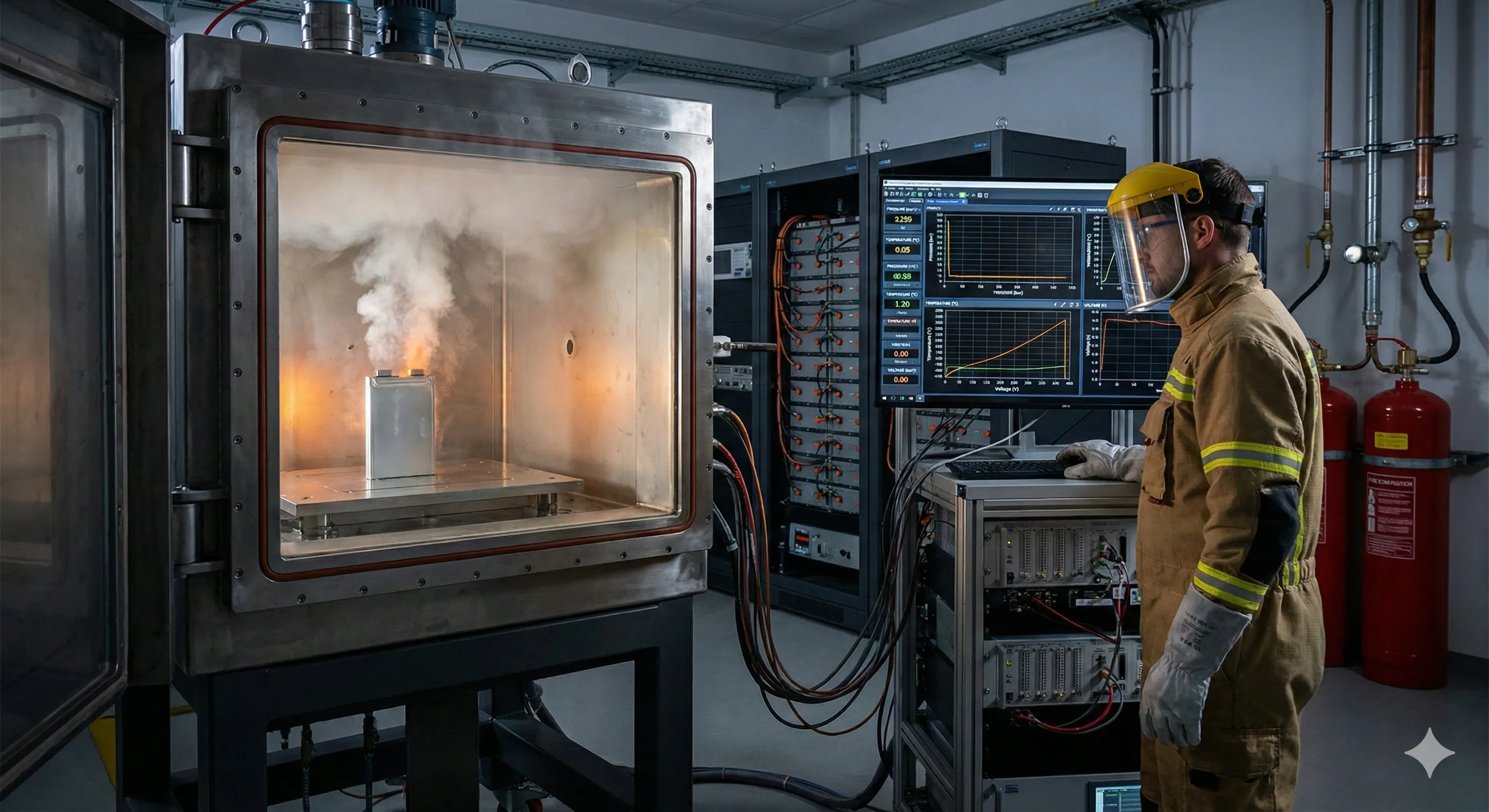
To safely and accurately characterize cell failure, our engineers utilize specialized equipment, primarily high-strength pressure vessels of 20L and 500L capacities. These sealed chambers are critical for two reasons: they safely contain the violent energy release during a test, and they create a closed system where we can precisely measure the byproducts of failure. A key variable in our testing protocol is the atmosphere within the vessel. We conduct tests under both an inert argon atmosphere and a standard air atmosphere. This dual-environment approach is vital for replicating diverse real-world conditions. An inert atmosphere shows us the intrinsic venting behavior of the cell without the presence of external oxygen for combustion, isolating the gases produced by the electrochemical reactions alone. Conversely, testing in an air atmosphere reveals the cell's behavior when the vented flammable gases can immediately mix with oxygen, providing crucial data on fire and explosion potential. Within this controlled environment, we subject cells to the precise failure modes that simulate the most common real-world risks.
- Overcharge Testing: We deliberately push current into a fully charged cell, exceeding its specified voltage limit. This forces lithium plating on the anode, leading to dendrite growth that eventually punctures the separator, creating the internal short circuit that triggers thermal runaway. This test is critical for evaluating a cell’s tolerance to charger malfunction or a failure in the Battery Management System (BMS).
- Nail Penetration Testing: This test simulates severe mechanical damage. A calibrated nail is driven through the cell, creating a direct, low-resistance path between the anode and cathode. This results in a rapid and localized discharge, generating intense heat that reliably initiates thermal runaway. It provides a worst-case scenario for physical impact events.
- Spot Heating Testing: We use a small, high-power heater applied to a specific point on the cell's surface to simulate an external heat source or a localized internal defect. By controlling the rate of heating, we can carefully study the temperature thresholds at which different stages of thermal decomposition occur, providing invaluable data for developing thermal management systems.
From Raw Data to Robust Design: The Power of Real-Time Acquisition
Inducing failure is only the first step. The true value of this rigorous testing lies in the massive amount of high-fidelity data we acquire in real-time during each event. Without precise quantification, a test is merely a destructive observation. With data, it becomes a blueprint for safer design. This is where the principles of robust engineering truly come to life, informing everything from component selection to system architecture. The goal is to move beyond simple reactive measures and build proactive, intelligent safety into the very DNA of the ESS. Such an approach is fundamental in creating systems that are not just functional but also resilient, aligning with the core tenets of Fail-Safe vs. Fail-Operational Design Choices in Critical Systems: A Comprehensive Analysis.
The Triumvirate of Data: Pressure, Temperature, and Voltage
Throughout each abuse test, which may last only a few seconds from initiation to catastrophic failure, our systems are logging thousands of data points per second across three critical parameters.
Pressure Monitoring: Using high-speed pressure transducers, we capture the precise force of the cell venting event. This data tells us the peak pressure generated, the rate of pressure rise (dP/dt), and the total volume of gas released. This is not just academic information. This data directly dictates the mechanical design requirements for a battery enclosure. It allows engineers to calculate the necessary strength of the housing and, more importantly, to design and size pressure relief vents that can safely manage the gas release without allowing the enclosure to rupture. It also informs risk assessments for potential explosions in confined spaces.
Temperature Monitoring: A network of thermocouples placed on and around the cell maps the thermal event with extreme precision. We measure the peak temperature, the speed at which the temperature escalates, and the amount of heat energy transferred to the cell's immediate surroundings. This thermal data is the cornerstone of designing effective passive safety systems. It enables us to specify the required thermal resistance of fire barriers placed between cells and modules. It informs the selection of phase-change materials or other heat-absorbing elements. Critically, it allows us to validate thermal models and determine the minimum safe spacing between components to ensure that a single cell failure cannot propagate to its neighbors.
Voltage Monitoring: The cell's voltage is its primary state-of-health indicator. During an abuse test, we monitor the voltage for the sharp, sudden drop that signifies the onset of a critical internal short circuit. This data is invaluable for the development and refinement of the BMS algorithms. By understanding the voltage signature that precedes thermal runaway, BMS developers can create more sophisticated detection protocols, enabling the system to electrically isolate a failing cell or trigger an emergency response before the event can escalate.
Engineering Safer Systems by Applying Test Data to Design
The ultimate purpose of this exhaustive data collection is to bridge the gap between theoretical safety and real-world application. Every data point generated in our labs has a direct impact on the design and engineering of safer ESS products, which are integral components of modern infrastructure. The integration of these advanced systems into the wider grid requires a holistic understanding of all components, as detailed in A Comprehensive Checklist for Electrical Power Distribution Systems in MEP Engineering. The insights from cell-level testing directly translate into tangible design improvements:
- Optimized Venting Strategies: Based on measured gas volume and pressure, vents are no longer generically sized but are engineered to the specific failure characteristics of the cell.
- Intelligent Fire Barriers: Material selection for thermal barriers is driven by peak temperature and heat flux data, ensuring they can withstand a worst-case event without failure.
- Data-Driven Module Spacing: Architectural decisions about cell and module layouts are informed by thermal propagation data, creating physical gaps that act as firebreaks.
- Smarter Battery Management Systems (BMS): Fault detection algorithms are refined using the real-world voltage and temperature signatures of cells under duress, improving response time and preventing escalation.
- Safer Enclosure Designs: The mechanical integrity of battery casings and racks is specified based on the measured forces of venting events, preventing catastrophic structural failure.
Redefining Responsibility in the Energy Transition
As we engineer the energy infrastructure of the next century, we must recognize that innovation and responsibility are inextricably linked. The rapid deployment of Energy Storage Systems is a non-negotiable requirement for achieving our global climate goals, but this progress cannot come at the expense of safety. The work being done in testing laboratories like those at TÜV SÜD represents a fundamental shift from a reactive to a proactive safety culture. It is a culture built on the principle that to build a truly safe system, one must first be willing to deconstruct failure in a controlled and measurable way.
The complex interplay of pressure, temperature, and voltage during a thermal runaway event is no longer an unpredictable mystery. It is a quantifiable phenomenon that can be characterized, modeled, and engineered against. This granular, cell-level data empowers designers, engineers, and manufacturers to move beyond simply meeting standards and toward actively advancing the science of battery safety. The fire barriers, venting strategies, and module spacings of tomorrow's safest ESS are being defined today, forged in the crucible of controlled abuse testing. Each test, each data point, and each insight contributes to a collective body of knowledge that makes the entire industry safer, ensuring that the heart of the renewable energy transition beats not only powerfully but also with unwavering reliability and security for decades to come.