Urban vs. Mountain Tunneling: How TBMs Conquer Vastly Different Ground Challenges
Discover the profound differences between tunneling beneath a city and through a mountain. This analysis covers the distinct TBM tunneling challenges, from managing ground settlement in urban areas to battling rockbursts and water ingress in mountains.
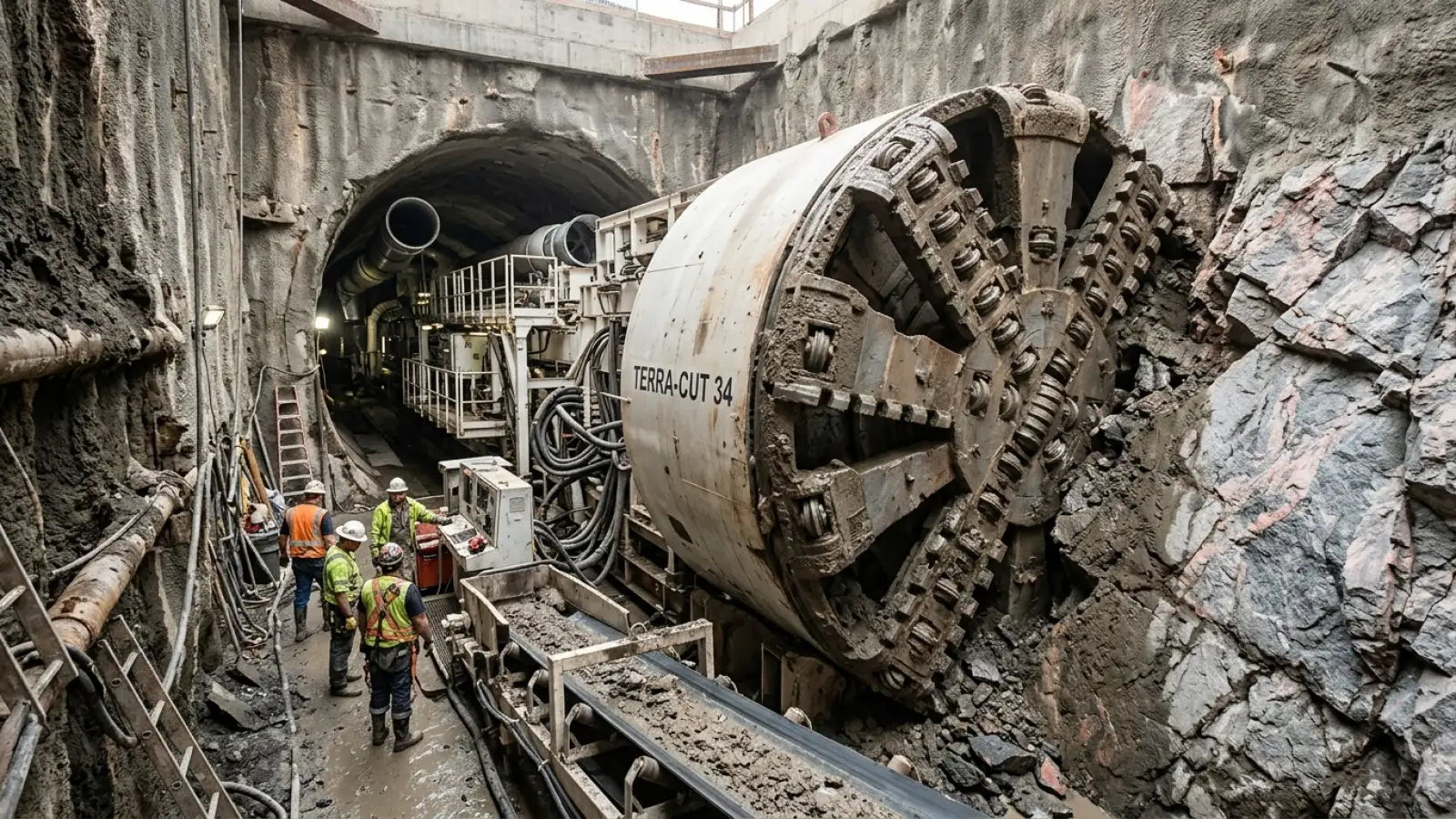
Tunnel Boring Machines (TBMs) are cylindrical marvels of modern engineering, capable of excavating massive tunnels for subways, water mains, and transportation arteries deep beneath our feet. These powerful machines make projects possible that would otherwise be unthinkable. However, the success of a TBM is not guaranteed by its sheer power; it depends entirely on its design and operational strategy being perfectly matched to the environment it must conquer. The TBM tunneling challenges faced beneath a bustling metropolis are profoundly different from those encountered when boring through a colossal mountain range.
Understanding this critical distinction is fundamental to modern mega-project execution. While both scenarios involve moving earth and rock, the engineering philosophies, risks, and required technologies diverge completely. Urban tunneling is a delicate, surgical procedure demanding precision and control, whereas mountain tunneling is a brute-force expedition against immense geological pressures and unpredictability. Leading innovators continue to develop advanced tunnel boring systems capable of tackling these specialized environments, but the core strategy is always dictated by the ground itself. This analysis will explore the unique challenges of each domain and how specialized TBM technology rises to meet them.
The Urban Tunneling Gauntlet: Precision in a Congested Environment
Tunneling beneath a city is akin to performing surgery in a crowded room. The primary objective is not just to excavate the tunnel but to do so with minimal to zero impact on the surface world. Every meter of progress is scrutinized for its effect on existing buildings, sensitive infrastructure, and the daily lives of millions of people. The challenges are defined by what lies above and around the tunnel path.
Ground Settlement and Subsidence Control
The foremost concern in urban tunneling is ground settlement. Excavating soil, especially soft and saturated clays or sands, can cause the ground above to shift and settle, potentially damaging building foundations, cracking roads, and breaking utility lines. To counteract this, urban projects predominantly use Earth Pressure Balance (EPB) or Slurry Shield TBMs. These machines feature a pressurized front chamber that actively supports the excavation face. By precisely matching the pressure in this chamber to the surrounding soil and groundwater pressure, the TBM prevents ground loss and subsequent settlement. Engineers inject soil conditioning agents, such as foams and polymers, into the excavation chamber to improve the soil's plasticity and flow, allowing for smooth, controlled extraction without causing voids.
Navigating the Subterranean Maze: Existing Utilities and Foundations
Modern cities have a complex, often poorly documented web of infrastructure buried just below the surface. A TBM's path may intersect with water mains, high-pressure gas lines, sewer systems, fiber optic networks, and even the deep pile foundations of skyscrapers. An accidental encounter with any of these can be catastrophic. Consequently, the pre-construction phase of an urban tunneling project is dominated by exhaustive geotechnical investigation and utility mapping. Techniques like ground-penetrating radar (GPR) and 3D modeling are used to create a detailed digital twin of the subsurface, allowing engineers to plot a precise course that meticulously avoids these critical obstacles.
Vibration and Noise Mitigation
The continuous grinding and cutting action of a TBM generates noise and vibration that can travel through the ground to the surface. In a dense urban environment, this can be a major nuisance for residents and a serious risk for sensitive structures like hospitals, data centers, and historic landmarks. TBMs designed for urban use incorporate features to minimize this impact. Cutterheads are engineered for smooth, continuous excavation rather than aggressive hammering. The electric motors and hydraulic systems are acoustically insulated, and the entire boring process is designed to be as continuous as possible to avoid the start-stop jolts that cause the most perceptible vibrations. Real-time monitoring stations are set up along the tunnel route to ensure vibration levels remain within strict, pre-defined limits.
The Mountain Tunneling Expedition: Battling Raw Geological Forces
If urban tunneling is surgery, mountain tunneling is a heavyweight bout with nature. Here, the challenges are not man-made obstacles but the raw, unpredictable, and immense forces of geology. The primary focus shifts from surface protection to ensuring the stability of the tunnel and the safety of the crew against overwhelming natural hazards.
Unpredictable Geology and Fault Zones
A mountain is rarely a homogenous mass of solid rock. A TBM may start in hard granite and, meters later, encounter a soft clay-filled fault zone, a section of highly fractured rock, or a completely different geological formation. These sudden transitions, known as mixed-face conditions, pose a significant TBM tunneling challenge. A cutterhead designed for hard rock can get clogged and bogged down in soft, sticky material. To manage this uncertainty, mountain TBMs are often equipped with systems for probing ahead of the machine. Probe drills are extended forward through the cutterhead to take core samples, while seismic-ahead-of-TBM systems use sound waves to map the geology 50-100 meters in front of the machine, giving the crew advance warning of changing conditions.
High-Pressure Water Ingress
Mountains can hold vast quantities of groundwater within fractures and aquifers, often under extremely high pressure. Breaching one of these features can result in a sudden, high-volume ingress of water that can flood the tunnel, damage electrical systems, and destabilize the surrounding rock mass. Hard Rock TBMs are equipped with extensive sealing systems to prevent water from entering the machine. In areas where high water pressure is anticipated, engineers may undertake pre-excavation grouting, a process where cementitious or chemical grout is injected into the rock ahead of the TBM to seal fractures and block water pathways.
High Rock Stresses and Rockbursts
Deep inside a mountain, the rock is under immense pressure from the weight of the mountain above. When a tunnel is excavated, this pressure is redistributed, and in certain types of brittle rock, the stress can be released suddenly and violently. This phenomenon, known as a rockburst, is an explosive failure of the rock wall that can be extremely dangerous. To counter this, TBMs used in high-stress environments are built with incredibly robust and reinforced shields. Furthermore, they are designed to allow for the immediate installation of rock support systems—such as long rock bolts, steel ring beams, and layers of fiber-reinforced shotcrete—right behind the cutterhead to stabilize the rock mass before it has a chance to fail.
Comparative Analysis: TBM Selection and Operational Strategy
The choice of TBM and the entire operational plan are dictated by these contrasting environments. A machine that excels in one setting would likely fail spectacularly in the other. The table below summarizes the key differences.
| Feature | Urban Tunneling | Mountain Tunneling |
|---|---|---|
| Primary Challenge | Controlling surface impact (settlement, vibration) and avoiding existing infrastructure. | Managing geological uncertainty, high pressure (water/rock), and tunnel stability. |
| Typical Ground Condition | Soft ground: clays, silts, sands, often saturated. | Hard rock: granite, gneiss, limestone, often fractured or in mixed-face conditions. |
| Dominant TBM Type | Earth Pressure Balance (EPB) or Slurry Shield. | Open-mode Hard Rock Main Beam, Single Shield, or Double Shield. |
| Key Risk | Subsidence damage to surface structures; utility strikes. | Tunnel collapse, flooding from water ingress, rockbursts. |
| Primary Mitigation Strategy | Active face pressure management; extensive 3D utility mapping; real-time monitoring. | Geological probing ahead; pre-excavation grouting; robust shield design and immediate rock support. |
TBM Type Selection: EPB/Slurry vs. Hard Rock Shield
As highlighted, the TBM itself is fundamentally different. EPB and Slurry TBMs are closed-face machines, creating a sealed, pressurized environment at the front to manage unstable ground. In contrast, Hard Rock TBMs are often open-mode or shielded machines designed to allow direct access to the rock face for tool maintenance and to facilitate the rapid installation of ground support systems.
Cutterhead Design and Tooling
An urban TBM's cutterhead is a complex arrangement of scraper tools, cutting bits, and sometimes small disc cutters to handle occasional boulders or mixed soils. A mountain TBM's cutterhead is a simpler, more powerful face of steel, armed almost exclusively with large, heavy-duty rolling disc cutters that exert immense pressure to fracture and chip away at solid rock.
Muck Removal and Logistics
The method of removing excavated material (muck) also differs. Urban EPB machines often use screw conveyors to move conditioned soil from the pressurized chamber, while Slurry TBMs mix the spoil with fluid and pump it out as a slurry. In mountain tunnels, which can stretch for many kilometers, high-capacity conveyor belt systems are installed to transport thousands of tons of hard rock spoil efficiently out of the tunnel.
The Role of Advanced Monitoring and Geotechnical Data
In both scenarios, data is the key to managing risk. However, the focus of data collection and analysis is tailored to the specific challenges of the environment.
Real-Time Data for Urban Projects
For urban projects, the data network is externally focused. A vast array of sensors is placed on buildings, streets, and utilities along the tunnel's path. These sensors provide a continuous, real-time feed on any ground movement, tilt, or vibration. This data is fed back to the TBM operators, who can make micro-adjustments to face pressure, advance rate, and soil conditioning to keep surface impacts within acceptable thresholds.
Predictive Analysis for Mountain Projects
In mountain projects, the data is forward-looking. The goal is to see what's coming before the TBM gets there. Data from probe drilling, seismic surveys, and Measurement While Drilling (MWD) systems—which analyze drilling parameters to infer rock properties—are used to build a predictive geological model. This allows the engineering team to prepare for a fault zone or a water-bearing fracture, adjusting the TBM's operational parameters and preparing the necessary materials for ground treatment or support in advance.
Conclusion
While the Tunnel Boring Machine is a singular category of equipment, its application is a tale of two vastly different worlds. Urban tunneling is a science of precision, control, and non-disruption, where success is measured in millimeters of ground settlement. Mountain tunneling is a battle of power, resilience, and adaptation, where success is defined by overcoming the formidable and often unpredictable forces of nature. The TBM tunneling challenges in each environment demand unique machines, distinct strategies, and specialized expertise. At Vision Constructors, our proficiency in large-scale excavation is built on a deep understanding of this crucial dichotomy. By meticulously analyzing the geotechnical context and deploying precisely the right technology and data-driven strategies, we transform the most daunting subterranean challenges—whether beneath a city's foundation or through a mountain's core—into landmark infrastructure achievements.
Frequently Asked Questions (FAQ)
1. What is the main difference between an urban TBM and a mountain TBM?
The main difference lies in their operating principle and design. An urban TBM (like an EPB or Slurry machine) is a closed-face, pressurized system designed to actively support soft ground and prevent surface settlement. A mountain TBM (like a Hard Rock Shield) is typically an open-face or shielded machine designed for high-thrust excavation in solid rock and for installing robust ground support systems.
2. How is ground settlement prevented during urban tunneling?
Ground settlement is prevented primarily by using a TBM that maintains constant pressure on the excavation face. This pressure perfectly balances the surrounding soil and water pressure, ensuring no ground is lost as the soil is excavated. The use of soil conditioning foams and a highly controlled rate of muck removal are also critical.
3. What is a rockburst in mountain tunneling?
A rockburst is a sudden, violent, and explosive failure of rock deep within a tunnel. It occurs when high compressive stresses in brittle rock are released by the excavation, causing fragments to be ejected at high velocity. It is a significant safety hazard in deep mountain tunnels.
4. Why is water ingress a major TBM tunneling challenge in mountains?
Mountains can contain large, interconnected fracture networks filled with groundwater under immense hydrostatic pressure. When a TBM intersects one of these, it can trigger a massive inflow of water that can flood the tunnel, damage equipment, erode weak geological zones, and create unsafe working conditions.
5. Can one TBM be used for both urban and mountain conditions?
Generally, no. The fundamental designs are too different. However, so-called "crossover" or "hybrid" TBMs have been developed for projects with mixed ground conditions. These machines can be converted to operate in different modes (e.g., from a closed EPB mode in soft soil to an open hard rock mode), but they are highly complex and designed for specific transitional geologies rather than for exclusive use in both extreme environments.