How Hydraulic Movable Swimming Pool Floors Work: Engineering, Design and Safety
A movable swimming pool floor is more than an advanced cover: it is a structural platform, hydraulic machine and architectural surface designed to change how a pool is used.
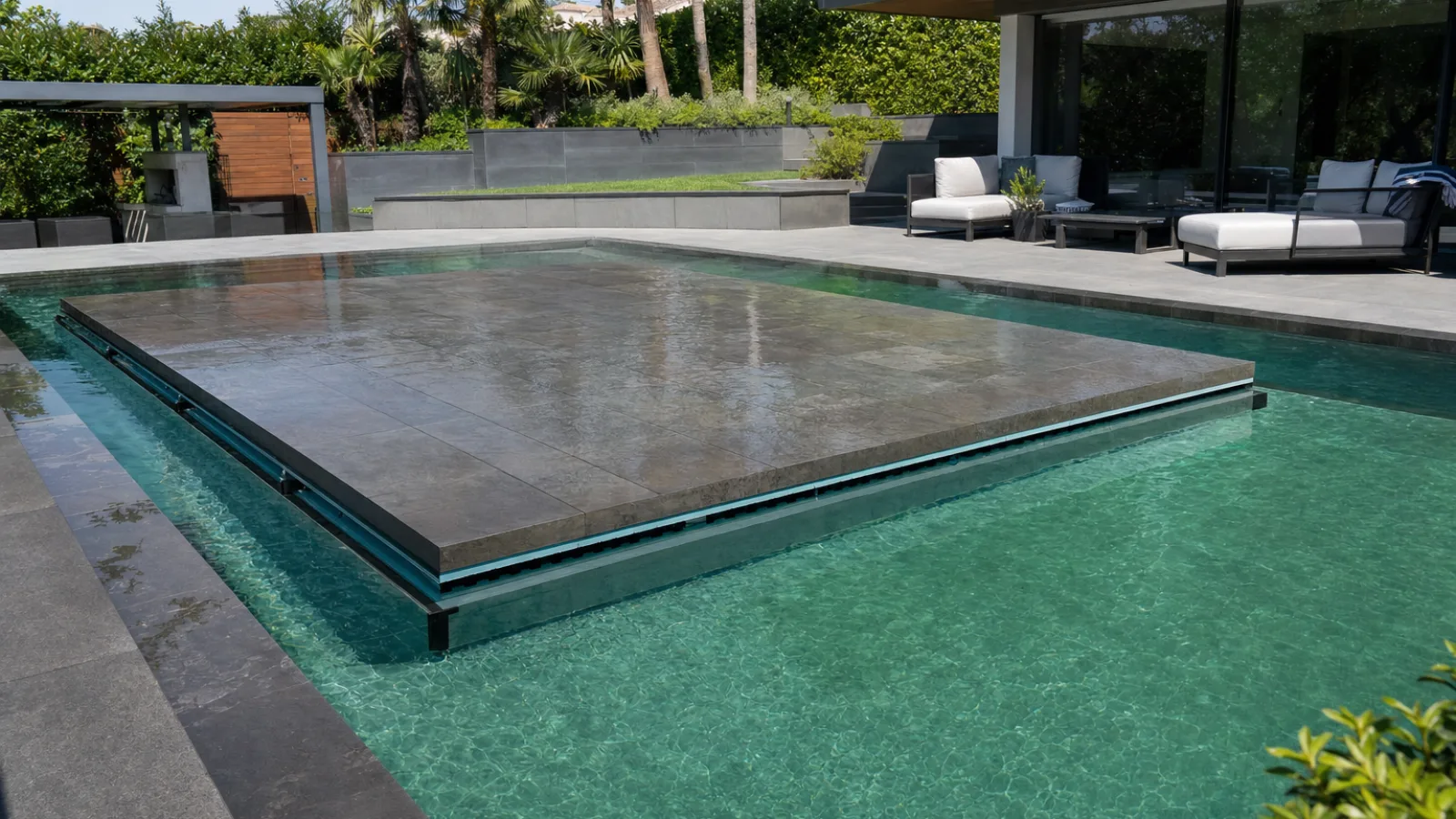
A swimming pool can occupy a large area of a property, yet it may be used only for a few hours each day. A hydraulic movable swimming pool floor addresses that limitation by allowing the basin to become an additional terrace, play area or entertainment surface without draining the water. The transformation looks simple from above, but it depends on coordinated mechanical, structural, hydraulic and control systems beneath the finished surface.
Unlike a conventional retractable cover, a movable floor is a load-bearing platform that travels vertically inside the pool. It can stop at different elevations to create an adjustable depth swimming pool, or rise close to terrace level to make the water space available for another use. Its performance depends not only on the lifting equipment, but also on the pool shell, guidance system, water movement, locking arrangements and the surface placed on top.
How a Swimming Pool Can Disappear Beneath a Terrace
The central idea is to install a rigid platform within the pool envelope. When the platform is lowered, water occupies the space above it and the pool functions normally. When it rises, water passes around or beneath the platform while the finished upper surface approaches the surrounding deck. The result is a hidden swimming pool that can be visually and physically integrated into a larger architectural space.
This is fundamentally different from a conventional retractable swimming pool cover. A cover normally limits access to the water and may provide a degree of protection from debris or accidental entry, but it is not automatically designed to support a terrace, furniture or groups of occupants. A movable floor is engineered as a platform. Its allowable loading, deflection, surface finish and locking system must be considered in the same disciplined way as other occupied structural elements.
How Hydraulic Movable Swimming Pool Floors Work
Several mechanical arrangements are used in the industry, and the exact configuration is manufacturer- and project-specific. In a direct hydraulic arrangement, hydraulic cylinders apply force to the platform or to a linked lifting frame. A hydraulic power unit, consisting of a pump, reservoir, motor and associated control equipment, sends pressurized fluid through valves to extend or retract the cylinders.
Control valves regulate the direction and rate of fluid flow. Multiple cylinders may need synchronized movement, particularly when the platform is wide or carries a substantial distributed load. The machine can therefore use flow-control devices, position feedback or a mechanically linked arrangement to reduce twisting and uneven travel.
Other systems use stainless steel cables and pulleys. Hydraulic cylinders may move a concealed carriage or lifting member, while cables distribute the movement to several points around the platform. Cable systems can help coordinate lifting forces, but they introduce additional components that require inspection for corrosion, abrasion, alignment and tension.
Buoyancy-assisted platforms work differently. A sealed or partially buoyant platform naturally displaces water and therefore experiences an upward force. Hydraulic mechanisms do not necessarily provide all of the lifting force; instead, they control the platform's position, speed and stability. The system may restrain, guide or lower the floating assembly while the water supplies part of the upward support.
Mechanical guides keep the platform aligned with the pool walls and limit lateral movement. Position sensors, limit switches and pressure monitoring help the controller identify whether the floor has reached its intended elevation. At a terrace position, structural locks or mechanical supports should carry the relevant service loads rather than relying solely on hydraulic pressure to hold the platform in place.
Some movable pool floor designs combine buoyant platforms with hydraulic actuators and cable assemblies to control vertical movement. Manufacturers such as Twinscape demonstrate how hydraulic movable pool floor technology integrates hydraulic cylinders, mechanical components, and safety systems into a multifunctional swimming pool.
The Physics Behind Movable Pool Floors
Hydraulic lifting is based on Pascal's principle: pressure applied to a confined fluid is transmitted throughout that fluid. A relatively small force on a pump or piston can produce a much larger output force when it acts over a larger cylinder area. The actual force available depends on fluid pressure, cylinder area, mechanical geometry, friction and losses in the system.
Buoyancy follows Archimedes' principle. An immersed platform receives an upward force equal to the weight of the water it displaces. For an illustrative example, suppose a sealed platform displaces 10 cubic metres of fresh water. The displaced water has a mass of approximately 10,000 kilograms, so the theoretical buoyant force is approximately equivalent to its weight. If the platform and its permanent equipment weigh less than that displacement value, the hydraulic system may need to control only the remaining net force, plus friction, dynamic effects and safety margins.
This is a simplified illustration, not a design calculation. Platform geometry, trapped air, water density, movement speed and changing immersion all affect the real force balance. Buoyancy can reduce actuator demand, but it does not eliminate the need for positive guidance and controlled movement.
Hydrostatic pressure also changes with depth. Water pressure increases approximately in proportion to depth and density, which means the pool walls, platform edges and seals experience different pressures as the floor changes elevation. Movement must be slow and controlled enough to prevent sudden pressure differences, trapped water or hydraulic instability.
Most importantly, the force required to move a platform is not the same as the load it must support when raised. A buoyant floor may be relatively easy to lift but still require a robust frame, locking system and pool structure to support people, furniture or concentrated loads at terrace level.
Structural Engineering and Load-Bearing Capacity
The platform typically includes a corrosion-resistant structural frame, secondary support members and a finished walking surface. Stainless steel is common in exposed or wet components, although the grade, fabrication method and protective detailing must suit the water chemistry and surrounding environment. Connections, welds, fasteners and cable terminations are all potential points for corrosion or fatigue if they are poorly specified or difficult to inspect.
When raised, loads must transfer from the platform through mechanical anchors, bearing points or locking supports into the reinforced concrete pool structure. The design must account for permanent loads such as the frame, decking and equipment, as well as imposed loads from people or movable items. Concentrated loads, such as a table leg or a heavy planter, can be more critical than a uniformly distributed crowd load.
Engineers also assess deflection, vibration, local bending, connection forces and the effects of repeated operating cycles. The pool shell must resist the forces introduced by guides and anchors without compromising waterproofing or creating damaging stress concentrations. There is no universal load-bearing capacity for all movable pool floors; the allowable load depends on the engineered system, dimensions, materials, support arrangement and installation.
How Water Remains Inside the Swimming Pool
The platform does not normally form a watertight piston that seals the pool into two completely isolated chambers. Water moves around the platform through designed perimeter clearances, openings or drainage paths as the floor changes elevation. These gaps must be large enough to permit controlled water movement while limiting excessive wobble, trapping hazards and interference with the pool walls.
As the platform rises, water displaced from the space below flows into the space above or through dedicated routes. As it descends, the reverse movement occurs. The pool's circulation and filtration arrangement must account for areas beneath the platform, where debris, stagnant water or chemical imbalances could otherwise develop. Some designs provide access for cleaning, inspection and drainage below the floor.
Water chemistry is particularly important around metal components, seals and hydraulic equipment. Chlorine concentration, pH, temperature and treatment methods can influence corrosion and material life. The equipment layout should allow technicians to reach hydraulic units, valves, sensors and cable assemblies without dismantling the entire terrace.
From Swimming Pool to Luxury Outdoor Terrace
The architectural advantage is not limited to saving space. In a luxury villa, a raised floor can extend a stone terrace across the pool zone for dining or entertaining. In a small garden, an adjustable floor can provide shallow water for children or exercise and then create a usable deck when the pool is not occupied. Hotels, resorts, wellness facilities and rehabilitation centres may use variable depths to support different activities, although each application requires an appropriate design review.
The upper finish can include stone, porcelain, timber-look materials or other suitable surfaces, provided the added weight and attachment method are included in the engineering design. The surface must offer adequate slip resistance when wet, drain without creating unsafe ponding and tolerate repeated exposure to treated water. Joints around the platform require careful detailing so they remain visually discreet without becoming pinch points or trip hazards.
Rooftop installations require particular caution. The building structure must carry the pool, water, platform and terrace loads, while waterproofing and drainage must remain reliable. A movable floor does not reduce the weight of the water when the pool is full; it changes the arrangement and use of the space. Structural feasibility must therefore be established before architectural finishes are selected.
Automation and Smart Control Systems
A programmable controller can coordinate pump operation, valve sequencing and platform position. Sensors may include rotary encoders, linear position sensors, limit switches and hydraulic pressure transducers. A user interface can offer preset levels for swimming, bathing or terrace use, while restricting operation to trained or authorized users.
Controlled movement is essential. The system can monitor whether the platform is level, whether a cylinder has reached its expected position and whether pressure is consistent with the commanded motion. Fault detection may stop the cycle if a sensor disagrees with another, an obstruction is detected or hydraulic pressure falls outside the permitted range.
Convenience functions should not replace independent safety measures. Emergency-stop circuits, access controls and mechanical locks must be designed according to the applicable regulations and the manufacturer's safety architecture. A floor that can be programmed to stop at a selected depth is not automatically a certified barrier against child access or drowning.
Safety Systems and Accident Prevention
The most serious hazards include unintended movement, crushing at the perimeter, entrapment beneath the platform and access to the pool while the floor is moving. Mechanical locking devices are therefore important when the platform is raised and occupied. They provide a positive load path and prevent the floor from descending if hydraulic pressure is lost.
Obstruction detection may combine pressure monitoring, current monitoring, edge sensors or programmed movement limits. These systems can reduce risk, but they should not be treated as permission for people to stand on, under or near a moving platform. Users must remain clear in accordance with the manufacturer's operating instructions.
Electrical equipment requires appropriate separation from wet areas, grounding, protective devices and installation practices. Hydraulic hoses, seals and fittings should be inspected for leakage, while guides and cables require checks for wear, corrosion and alignment. Professional installation, commissioning and periodic inspection are essential, particularly where the raised floor is used as an occupied terrace.
Construction and Installation Process
- Architectural feasibility: The project team establishes the pool dimensions, finished levels, intended uses, surface materials and access requirements.
- Structural and mechanical design: Engineers coordinate the platform, guides, anchors, hydraulic equipment, operating loads and pool shell.
- Pool construction: Reinforced concrete, waterproofing and embedded components are installed to the coordinated drawings.
- Equipment installation: Hydraulic power units, cylinders, cables, pulleys, guides and control components are fitted and aligned.
- Platform integration: The movable frame and deck finish are installed, with clearances checked throughout the travel range.
- Testing and commissioning: The system is tested under controlled conditions for level operation, emergency stopping, locking, sensor response, drainage and access control.
Early coordination is critical. A late decision to add a movable floor can conflict with pool waterproofing, reinforcement, plant-room space, drainage, electrical routes or finished floor levels. Architects, structural engineers, pool contractors and equipment manufacturers should resolve these interfaces before concrete is placed.
Hydraulic and Other Movable Pool Floor Systems Compared
| System | Operating principle | Structural and space considerations | Typical application |
|---|---|---|---|
| Direct hydraulic lifting | Cylinders apply force directly or through a lifting frame. | Requires cylinder space, guides, synchronized control and robust load paths. | Projects needing precise variable depth and substantial platform control. |
| Buoyancy-assisted hydraulic system | Water supports part of the platform weight while hydraulics control position and speed. | Requires controlled clearances, buoyancy management and reliable restraint. | Installations seeking efficient movement with a carefully designed floating platform. |
| Mechanical lifting system | Screws, racks, winches or other mechanical drives raise and lower the floor. | May need machinery space, drive synchronization and protection from water exposure. | Projects where mechanical drive characteristics suit the available layout. |
| Conventional pool cover | A flexible or sectional cover spans the water surface. | Generally requires less structural integration but is not automatically a terrace floor. | Debris reduction, evaporation control and access restriction where rated and approved. |
Maintenance, Energy Efficiency and Long-Term Costs
Maintenance planning should cover hydraulic fluid condition, hose and seal integrity, cylinder corrosion, cable wear, pulley alignment, guide clearances, sensors, locks and control panels. Pool water chemistry must remain within the equipment manufacturer's specified limits. Access panels and service routes are not minor details; inaccessible machinery can turn a manageable inspection into a major intervention.
When closed, a suitably designed platform can reduce the exposed water surface and may help limit evaporation and heat loss. The actual benefit depends on water temperature, ambient conditions, surface continuity, insulation, operating habits and the performance of the complete pool system. Energy savings should therefore be assessed for the specific project rather than assumed.
Installation complexity and lifecycle cost are influenced by the pool geometry, structural modifications, finish material, plant-room arrangement, controls and maintenance requirements. A lower initial equipment cost may not represent better value if it compromises access, corrosion protection or future replacement. Whole-life planning is more useful than comparing lifting equipment alone.
Conclusion
A hydraulic movable swimming pool floor is a coordinated piece of infrastructure disguised as an architectural surface. Its successful operation depends on the interaction of fluid pressure, buoyancy, structural load transfer, mechanical guidance, automation and water management. When raised, the floor must behave like a properly supported platform; when lowered, it must allow the pool to circulate and function normally.
The technology can make a pool more adaptable, particularly where land is limited or outdoor space has several competing uses. However, the design should begin with engineering feasibility and safety validation, not with the appearance of the finished tile surface. Properly coordinated design, professional installation, commissioning and ongoing inspection are what allow a multifunctional pool to remain useful, predictable and safe.