Canada Budget 2026 and Housing: What Build Canada Homes’ $13B Top-Up Means for Builders
The $13-billion expansion of Build Canada Homes could create a larger pipeline for modular manufacturers, trades contractors and building-product suppliers—but funding alone will not resolve Canada’s permitting, labour and delivery constraints.
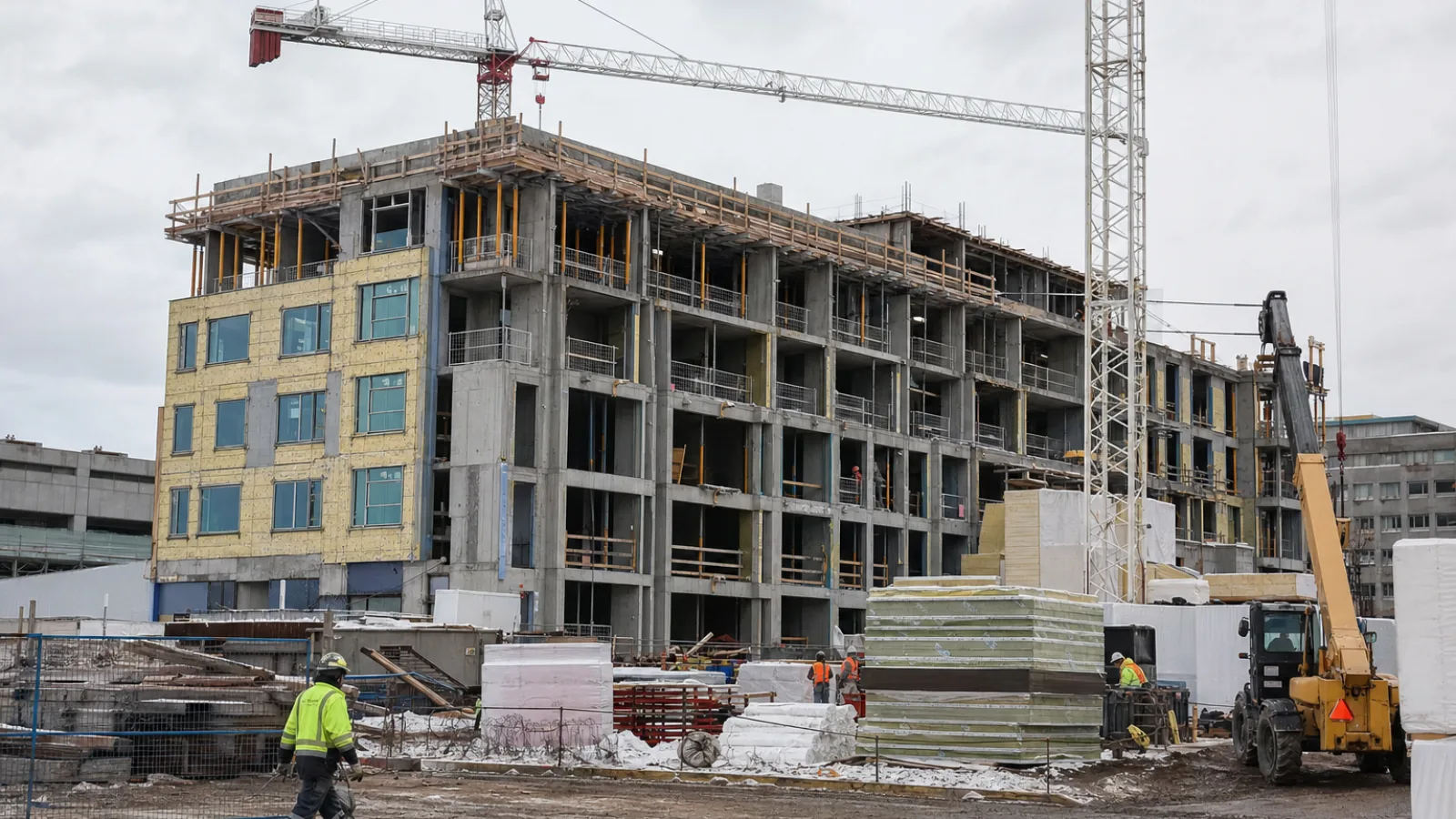
Canada’s housing debate is moving from a question of demand to one of delivery. The federal government’s Budget 2026 proposes an additional $13 billion over 10 years for Build Canada Homes, bringing the program’s total capital to $45 billion. At the same time, it sets a goal of tripling non-market housing production to 24,000 starts a year.
For builders, the important question is not simply how much money has been announced. It is whether the programme can turn public capital into serviced sites, repeatable designs, qualified labour and completed homes. The answer will depend on procurement rules, municipal approvals, project economics and the capacity of the Canadian construction industry to deliver at scale.
Budget 2026 also places the non-market target beside a much larger national requirement. The Canada Mortgage and Housing Corporation (CMHC) estimates that Canada needs between 417,000 and 469,000 housing starts annually to restore affordability. The two figures are not contradictory: 24,000 is a public and non-market housing objective, while the CMHC range covers the total housing system, including private-market homes.
The government’s Budget 2026 housing plan therefore creates a defined opportunity, but not a guaranteed workload. Companies that can offer predictable cost, schedule certainty, low-carbon construction and credible workforce plans will be better positioned than firms relying only on general market growth.
What the $13-billion Build Canada Homes expansion changes
Build Canada Homes is intended to act as a federal housing delivery platform, using public investment to support housing that the market is not producing in sufficient volume or at accessible rents. The new capital allocation expands the potential pipeline for acquisitions, development partnerships, construction finance and projects serving lower-income households.
For contractors and suppliers, the most significant change may be the possibility of a larger multi-project programme rather than isolated development opportunities. A repeatable procurement pipeline can justify investment in panelization, factory capacity, estimating systems, design standardization, equipment and training. It can also make it easier for smaller firms to form delivery partnerships with larger general contractors or nonprofit housing providers.
That opportunity will depend on how Build Canada Homes defines eligible costs and evaluates bids. A programme that rewards the lowest initial price may produce different results from one that scores schedule reliability, operating costs, embodied carbon, accessibility, durability and local workforce development. Builders should watch for requirements covering domestic content, energy performance, construction methods, Indigenous participation, social procurement and reporting.
Public-sector work also brings obligations that can affect pricing. Tender security, bonding, insurance, accessibility standards, environmental reviews, life-cycle documentation and payment schedules all influence working capital. A project that appears attractive at the headline construction value may be difficult to execute if design changes are frequent or approvals are incomplete when a contract is awarded.
Numbers explained: starts, permits and completions
Housing statistics are often used interchangeably even though they describe different points in the development process. That distinction matters when assessing whether public investment is generating actual homes.
| Measure | What it means | Why builders should care |
|---|---|---|
| Housing starts | Construction has begun on a dwelling, generally when foundation work or equivalent work is underway, according to the statistical definition used by CMHC. | Starts indicate that a project has moved from planning into physical construction. They do not show whether the project will finish on schedule. |
| Building permits | A municipality or other authority has issued permission to construct. A permit may cover a project that starts later—or never starts. | Permits are an early indicator of potential workload and future material demand, but they can overstate near-term construction activity. |
| Completions | A dwelling is sufficiently finished to be occupied under the reporting system used for the project. | Completions are the clearest measure of homes actually entering the usable supply. They also reflect delays, financing problems, labour shortages and inspection bottlenecks. |
A programme can therefore produce a rise in permits without an equivalent increase in starts, or a rise in starts without a near-term rise in completions. For suppliers and subcontractors, the distinction affects forecasting. A permit may signal future demand; a start creates immediate site demand; a completion indicates that the project has converted capital and labour into housing.
Government, industry and CMHC: three views of the problem
The federal government: use public capital to increase delivery
The government’s position is that ordinary market conditions have not produced enough affordable and non-market housing. Build Canada Homes is designed to use federal balance-sheet capacity and coordinated delivery to increase supply, particularly where high land costs, low rents or uncertain project revenues make conventional financing difficult.
Its tripling target—24,000 non-market housing starts per year—also signals a preference for measurable production rather than broad policy commitments. For the construction sector, this could favour organizations that can document throughput, manage standardized designs and demonstrate that proposed projects are ready to proceed.
CMHC: the total supply requirement is much larger
CMHC’s estimate of 417,000 to 469,000 annual housing starts frames the scale of the national shortage. Non-market construction is essential for households that cannot be served by private rents or ownership prices, but it represents only part of the total requirement.
That distinction has practical consequences. Public housing projects may create a stable pipeline for some contractors, but they cannot substitute for private rental, condominium, purpose-built rental and ownership construction. If approvals, infrastructure and labour remain constrained, additional public funding may shift competition between projects rather than increase total output.
CCA and CHBA: capacity, cost and regulation determine delivery
The Canadian Construction Association has emphasized the need for a stronger construction workforce, better project conditions and policies that allow companies to build. Its Hill Day on November 17 put industry concerns directly in front of federal policymakers at a time when housing targets are increasing faster than available capacity in many trades and regions.
The Canadian Home Builders’ Association has generally focused on the cost and feasibility of new housing, including development charges, taxes, municipal approval timelines, infrastructure constraints and the availability of skilled workers. From a builder’s perspective, a funding announcement does not remove these costs. A project still requires a viable site, a complete design, approvals, financing, labour and a buyer or long-term operating model.
These positions are not mutually exclusive. Government can provide capital; CMHC can define the scale of the shortage; and industry can identify the conditions required to convert investment into starts and completions. The policy test is whether the three perspectives are reflected in actual project rules.
Where the opportunities may appear first
Prefab and modular construction
Non-market housing is a strong candidate for repeatable construction systems because similar building types can be deployed across multiple sites. Prefabricated wall panels, bathroom pods, volumetric modules and factory-cut structural components may reduce on-site labour and improve quality control when designs, tolerances and logistics are properly coordinated.
Modular construction is not automatically faster or cheaper. Transport dimensions, crane access, foundation tolerances, fire separations, acoustic assemblies, weather protection and municipal inspection procedures must be resolved early. A factory can also become a bottleneck if a programme creates demand faster than production capacity can expand.
Building-product suppliers
A larger public housing pipeline could increase demand for durable, standardized products: insulation systems, windows, doors, mechanical equipment, electrical assemblies, low-carbon concrete solutions and building-envelope components. Suppliers that can provide technical submittals, reliable lead times and documentation for energy or embodied-carbon requirements may have an advantage.
However, suppliers should assess payment terms and specification risk. Public projects can involve approved-product lists, substitution procedures and detailed performance requirements. Capacity planning should be based on realistic starts and procurement schedules, not only on the value of announced funding.
Construction software and project controls
Scaling production across multiple sites increases the value of digital estimating, document control, field reporting, scheduling, procurement tracking and quality-management systems. Standardized projects can benefit from structured data because lessons from one site can be applied to the next.
The practical requirement is interoperability. A platform that cannot exchange information with design, accounting, facility-management and public reporting systems may create another administrative layer. Builders should look for tools that preserve version control, track change orders and connect schedule information to procurement and labour availability.
Trades training and workforce partnerships
The Canadian construction labour shortage is a direct constraint on the housing target. Additional apprentices, experienced supervisors, inspectors, estimators and building-science specialists are needed—not only more entry-level workers. Training plans should reflect the construction method being proposed, including off-site manufacturing, heat-pump installation, airtightness, firestopping and commissioning.
For large public programmes, workforce planning may become part of bid evaluation. Contractors can strengthen delivery by partnering with unions, colleges, Indigenous training organizations and regional employers. The objective should be measurable capacity: apprenticeship hours, qualified crews, supervisor coverage and retention—not simply a general commitment to training.
What builders should examine before pursuing the pipeline
- Project readiness: Determine whether land control, zoning, servicing, environmental review and design approvals are sufficiently advanced to support the proposed schedule.
- Scope certainty: Identify which party carries the risk for geotechnical conditions, utility upgrades, design development, escalation and changes to code or funding requirements.
- Delivery method: Compare design-bid-build, construction management, design-build and integrated procurement against the project’s need for speed and cost certainty.
- Supply-chain resilience: Confirm lead times for major equipment and envelope components, and identify acceptable alternatives before tender.
- Workforce capacity: Map available crews by trade and region. A company should not commit to a national pipeline using labour assumptions based on one local market.
- Operating performance: For affordable and supportive housing, evaluate maintenance access, energy use, durability and replacement cycles—not only construction cost.
The most credible bids will likely be those that connect design choices to delivery evidence. For example, a modular proposal should explain factory throughput, transportation, site sequencing, crane requirements and inspection responsibilities. A conventional proposal should explain how it will protect schedule and quality when multiple projects compete for the same trades.
Capital is necessary, but execution will decide the result
Budget 2026 gives Canada’s housing industry a larger public investment signal and establishes a specific non-market production target. It may support a meaningful pipeline for builders, manufacturers, suppliers, technology firms and training organizations.
Yet the $13-billion top-up will not by itself close the gap between the 24,000 non-market target and CMHC’s estimate of 417,000 to 469,000 total annual starts. The decisive issues will be project readiness, municipal coordination, infrastructure, labour availability, procurement design and the conversion of permits into starts and completions.
For industry participants, the best response is disciplined preparation rather than assuming that every announcement becomes immediate work. Firms that can show repeatable delivery, transparent cost control, qualified labour and reliable building performance will be positioned to turn the new funding into buildable projects.