How Smart Road Infrastructure (V2I) is Preparing Highways for Autonomous Vehicles
The promise of autonomous vehicles (AVs) often conjures images of futuristic cars navigating complex cityscapes on their own. However, the success of this revolution depends as much on the intelligence of our roads as it does on the vehicles themselves. The future of transportation lies in a connected ecosystem where cars and infrastructure are in constant, seamless communication. This dialogue is enabled by Vehicle-to-Infrastructure (V2I) technology, a critical communication link that serves as the cornerstone of modern intelligent transportation systems (ITS). V2I transforms passive roads into active participants, sharing vital data that makes our transportation networks safer and more efficient. This article explores the engineering behind V2I, its core components, and the challenges civil and transportation engineers face in deploying this transformative technology.
What is Vehicle-to-Infrastructure (V2I) Technology?
Vehicle-to-Infrastructure (V2I) technology is the wireless exchange of critical safety and operational data between vehicles and fixed roadside infrastructure. It is a key component of the broader Vehicle-to-Everything (V2X) ecosystem, which also includes Vehicle-to-Vehicle (V2V) and Vehicle-to-Pedestrian (V2P) communication. While V2V allows cars to talk to each other about their speed and position, V2I provides a stream of authoritative data from the surrounding environment. The primary objectives of V2I are to prevent accidents, improve traffic efficiency, reduce emissions, and provide AVs with crucial information that extends far beyond the range of their onboard sensors.
Core Components of V2I-Enabled Infrastructure
Creating a smart highway requires a network of sophisticated physical and digital components working in harmony. These elements form the backbone of V2I communication, turning traditional roadways into intelligent data networks.
Roadside Units (RSUs) and Communication Protocols
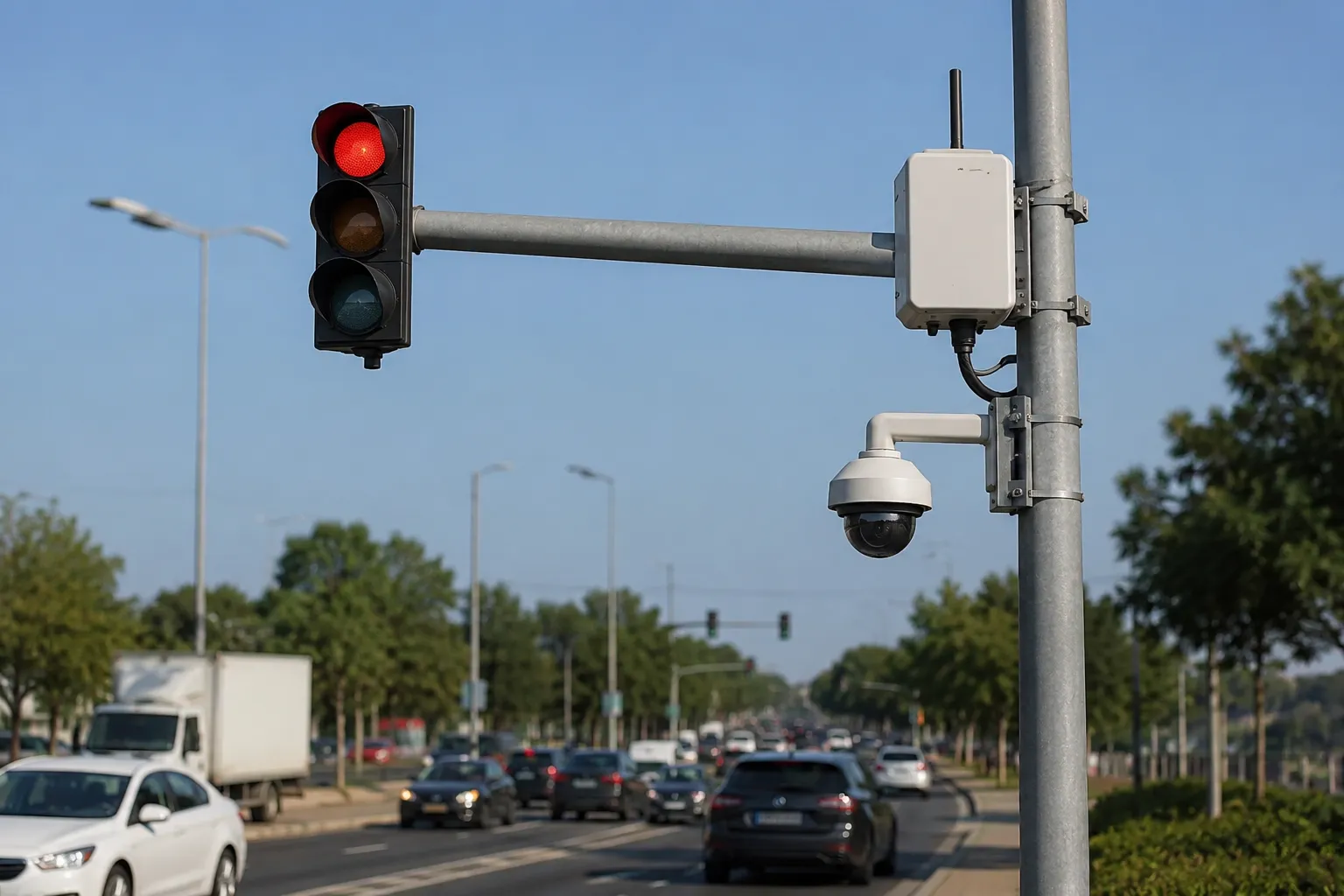
Roadside Units (RSUs) are the communication hubs of the V2I network. These transceivers, typically installed on traffic signal poles or gantries, broadcast and receive data packets to and from vehicles. The effectiveness of this communication depends on the underlying protocol. Two primary standards have emerged:
- DSRC (Dedicated Short-Range Communications): Based on the IEEE 802.11p standard, DSRC is a mature, Wi-Fi-like technology designed for the automotive environment. It offers very low latency and does not require a cellular network.
- C-V2X (Cellular Vehicle-to-Everything): Based on global 3GPP standards, C-V2X leverages cellular technology for communication. It can operate in a direct mode (PC5 interface) without network coverage or use the cellular network (Uu interface) for longer-range communication.
The table below highlights their key differences:
| Feature | DSRC (IEEE 802.11p) | C-V2X (3GPP) |
|---|---|---|
| Technology Base | Wi-Fi | Cellular (4G LTE/5G) |
| Range | ~300 meters | Longer range, network-dependent |
| Latency | Very low | Low, with 5G offering ultra-low latency |
| Network Reliance | Direct communication, no network needed | Can use direct (PC5) or network (Uu) communication |
| Evolution Path | Mature, but limited evolution | Strong evolution path with 5G and beyond |
With its strong performance and clear evolution path alongside 5G networks, C-V2X is increasingly becoming the preferred standard for new V2I deployments worldwide.
Smart Traffic Signals and SPaT Data
In a V2I environment, traffic signals become more than just automated timers; they are dynamic nodes that actively manage traffic flow. They broadcast Signal Phase and Timing (SPaT) data, which informs approaching vehicles about the current signal state (green, yellow, or red) and how long it will remain in that state. This information allows an AV to calculate the optimal speed to arrive at the intersection during a green light, a concept known as creating a "green wave." This capability not only smooths traffic flow but also enhances safety by providing data for red-light violation warnings and reduces fuel consumption by minimizing unnecessary braking and acceleration.
IoT-Enabled Road Sensors
Modern roads are being equipped with a vast array of Internet of Things (IoT) sensors that monitor environmental and traffic conditions in real time. These include pavement sensors that detect ice, moisture, and temperature; environmental sensors that measure visibility in fog or detect high winds; and advanced optical sensors like cameras and LiDAR that can identify pedestrians, debris, or accidents. This raw data is processed locally by RSUs and transmitted as concise, actionable alerts to vehicles, such as 'Icy Bridge Ahead' or 'Accident in Right Lane,' giving AVs critical time to adjust their path or speed.
Digital Signage and Real-Time Information Displays
Dynamic Message Signs (DMS) have evolved from simple text displays to fully integrated V2I endpoints. Connected to the traffic management center and local RSUs, these signs can deliver hyper-relevant, real-time information to drivers and AVs. For example, V2I can trigger a DMS to display instant rerouting instructions following a crash, implement variable speed limits that adapt to changing congestion, or provide precise lane closure warnings for an upcoming work zone long before a vehicle's onboard sensors could detect it.
How V2I Directly Enhances Autonomous Vehicle Performance
The true value of V2I infrastructure is measured by its direct impact on the safety, efficiency, and reliability of autonomous vehicles.
Augmenting Onboard Sensors: The Digital Co-Pilot
V2I technology enables 'cooperative perception,' where the infrastructure provides data that an AV cannot see with its own sensors. For instance, an RSU at a blind intersection can warn an AV about a vehicle approaching on a cross-street, even if a large building blocks the view. This creates a critical layer of redundancy, making the AV system more robust, especially in adverse weather like heavy rain, snow, or fog that can impair the performance of cameras and LiDAR. In essence, the infrastructure acts as a digital co-pilot with a bird's-eye view of the environment.
Optimizing Traffic Flow and Reducing Congestion
With a network of connected vehicles and infrastructure, traffic management centers can move from reactive to proactive control. By analyzing data from the entire network, they can coordinate signal timing across entire corridors to eliminate unnecessary stops. V2I also facilitates vehicle platooning, a practice where digitally tethered trucks can travel in close formation. This reduces aerodynamic drag, significantly improving fuel efficiency and freeing up road space, thereby reducing overall congestion.
Improving Safety in Complex Scenarios
V2I technology is invaluable in high-risk, dynamic environments. In work zones, it can broadcast precise digital maps of lane closures and even the location of individual construction workers directly to a vehicle's control system. At intersections, applications like Red Light Violation Warning (RLVW) and Intersection Movement Assist (IMA) use V2I data to prevent crashes. Furthermore, V2I enables traffic signal preemption for emergency responders, automatically turning lights green for an approaching ambulance or fire truck to clear a safe path and reduce critical response times.
The Engineering and Construction Challenges of V2I Deployment
While the benefits are clear, deploying V2I infrastructure at scale presents significant challenges for engineers, planners, and public agencies.
Infrastructure Retrofitting vs. New Construction
Upgrading existing highways with RSUs, sensors, and the necessary fiber optic cables is a logistically complex and costly undertaking. Trenching miles of roadway and mounting equipment on existing structures requires careful planning and significant capital investment. In contrast, integrating V2I components into new construction projects from the initial design phase is far more efficient and cost-effective. This approach allows for the strategic placement of conduit, power, and mounting hardware, ensuring the infrastructure is smart from day one.
Data Security and Privacy
A connected transportation network is a potential target for cyberattacks. A compromised V2I system could be used to create traffic chaos or cause accidents, making cybersecurity a paramount concern. This requires a multi-layered security approach, including end-to-end encryption, a Public Key Infrastructure (PKI) to authenticate messages and prevent spoofing, and continuous network monitoring to detect and neutralize threats. Additionally, handling sensitive vehicle and location data requires robust privacy protocols to maintain public trust.
Standardization and Interoperability
For V2I to function as a cohesive system, a vehicle from any manufacturer must be able to communicate flawlessly with infrastructure built by any other vendor. This requires strict adherence to universal standards for communication protocols and message sets. Organizations like the Society of Automotive Engineers (SAE) and the IEEE play a crucial role in developing and maintaining these standards, ensuring that all components in the V2X ecosystem can 'speak the same language'.
The Future of V2I: Paving the Way for Smart Cities
V2I is more than just a technology for autonomous cars; it is a foundational layer for the smart city of the future. As these networks expand, they will integrate with public transit systems to provide real-time arrival information, connect with smart parking applications to guide AVs to available spots, and even link with the power grid through Vehicle-to-Grid (V2G) technology, allowing electric vehicles to store and discharge energy. The vast amounts of data generated by V2I systems, when analyzed with AI and processed at the network edge, will enable predictive traffic modeling and instantaneous incident response, creating a truly intelligent and adaptive urban environment.
Conclusion
Vehicle-to-Infrastructure technology is the essential, often invisible, framework that will enable the safe, efficient, and scalable operation of autonomous vehicles. It represents a paradigm shift from building passive roads to engineering active, communicative networks. The journey to full autonomy is not just an automotive challenge but a massive civil and transportation engineering undertaking. By building smarter, more connected infrastructure, we are making the most critical investment possible in a safer, cleaner, and more efficient transportation future.
Frequently Asked Questions
Q1: What is the main difference between V2I and V2V technology?
A1: V2I (Vehicle-to-Infrastructure) is communication between a vehicle and fixed roadside equipment like traffic signals or sensors. V2V (Vehicle-to-Vehicle) is direct communication between two or more vehicles. Both are part of the larger V2X ecosystem, but V2I provides data from a stationary, authoritative source (the infrastructure), while V2V provides data about the immediate, dynamic traffic environment.
Q2: Which communication technology is better for V2I, DSRC or C-V2X?
A2: While DSRC is a mature and reliable technology, the industry is largely moving toward C-V2X. C-V2X leverages existing cellular networks and has a clearer evolution path with 5G, offering potential for higher bandwidth, lower latency, and greater reliability. Most new deployments are focusing on C-V2X for its future-proofing advantages.
Q3: How does vehicle-to-infrastructure technology improve road safety?
A3: V2I improves safety by providing vehicles with information they cannot 'see' with their own sensors. This includes warnings about red-light runners at intersections, icy conditions on a bridge ahead, pedestrians in a blind spot, or upcoming work zones. This advanced warning allows the vehicle's system or the driver to take preventive action much earlier, significantly reducing the risk of collisions.
Q4: What are the biggest barriers to widespread V2I adoption?
A4: The primary barriers are cost, standardization, and security. Retrofitting millions of miles of existing roads with the necessary hardware is a massive financial investment for public agencies. Ensuring all vehicles and infrastructure components from different manufacturers can communicate flawlessly requires strict adherence to universal standards. Finally, securing this critical network against cyberattacks is a complex and ongoing challenge.
Featured Blog
 Building Maintenance
04 08 2026
0 Code Compliance in Renovations: A Contractor's Guide to Permits, Inspections, and Modern Building StandardsNavigating building codes for renovation is crucial for any contractor. This guide covers the entire process, from identifying applicable codes and securing permits to managing inspections and understanding the severe consequences of non-compliance.
 Real Estate
04 08 2026
0 From Supercars to Penthouses: Why Automotive and Fashion Brands Are Entering the Luxury Real Estate MarketA powerful new trend is reshaping the ultra-luxury market: the rise of non-hotel branded residences. This strategic analysis explores why iconic automotive and fashion brands are entering the property market, offering key insights for developers and brand strategists on this evolution in experiential marketing.
 Excavation, Shoring and Dewatering
03 08 2026
0 Urban vs. Mountain Tunneling: How TBMs Conquer Vastly Different Ground ChallengesDiscover the profound differences between tunneling beneath a city and through a mountain. This analysis covers the distinct TBM tunneling challenges, from managing ground settlement in urban areas to battling rockbursts and water ingress in mountains.
 Real Estate
03 08 2026
0 Beyond the Giga-Project: A Developer's Guide to Capturing Ancillary Real Estate OpportunitiesAstute developers know the real value of a giga-project lies in its supporting ecosystem. This guide provides a strategic framework for identifying and executing profitable ancillary real estate development, from logistics hubs to workforce housing, to build a resilient, high-demand portfolio.
 Real Estate
02 08 2026
0 Unlocking the Black Box: How Zillow Gave Real Estate Data to the PeopleBefore Zillow, critical property information was a closely guarded secret of real estate agents. This article explores how Zillow's strategy of data democratization unlocked this 'black box,' empowering consumers and forever changing the roles of buyers, sellers, and agents.
 Construction Building Rehabilitation
02 08 2026
0 Strengthening the Core: A Practical Guide to Seismic Retrofitting for Existing BuildingsOlder buildings often lack modern seismic resilience, posing significant risks. This guide explores the critical process of seismic retrofitting, from initial structural assessment to the implementation of key strengthening techniques like steel moment frames and foundation bolting, ensuring long-term safety and stability.
Submit Comment