Oversized Construction Equipment Transport: Key Planning Steps
Oversized construction equipment transport requires more than choosing a trailer and delivery date. This guide explains how to verify equipment data, survey the route, coordinate permits and escorts, prepare the jobsite, and document delivery.
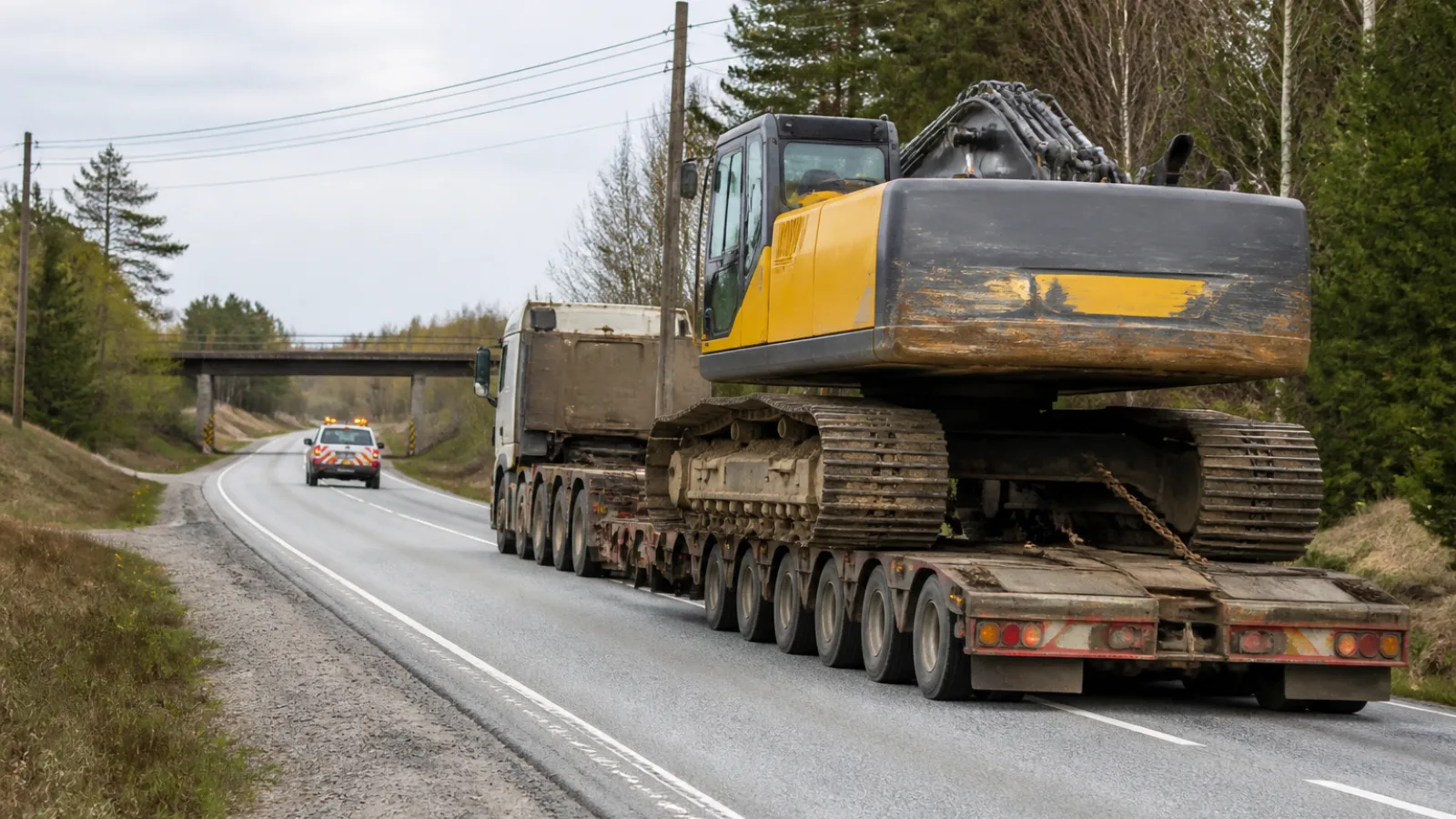
Oversized construction equipment transport is the controlled movement of machinery that exceeds applicable legal dimensions, weight limits, or both. Excavators, cranes, piling rigs, loaders, drilling equipment, and similar assets often require a documented plan covering the equipment configuration, trailer, route, permits, escorts, loading method, site access, and delivery records. Selecting a trailer and pickup time is only one part of the work.
Before booking, a project team should compare specialist providers, including the type of heavy haul trucking services available for the equipment and route. The main planning variables include dimensions, gross weight, axle configuration, route constraints, oversize load permits, escort vehicles, loading, weather, site access, insurance, and documentation. Requirements vary by state, province, country, road authority, equipment configuration, and project conditions, so the carrier and relevant authorities must confirm the final requirements.
What Makes Construction Equipment an Oversized Load?
A load may be classified in different ways. A legal-dimension load stays within the applicable limits for width, height, length, and weight. An overweight load exceeds a gross vehicle weight, axle group, or other local weight limit. An overheight load exceeds the permitted vertical clearance, while an overwidth load exceeds the legal width. A machine can fall into several categories at once, such as a loaded crane that is both overheight and overweight.
The transport profile is based on the complete moving combination, not just the machine’s data plate. It may include the tractor, trailer, loaded equipment, attachments, fuel, rigging, counterweights, removable components, and temporary supports. Suspension movement, deck height, tire size, and the position of the machine on the trailer can change the final profile.
Equipment information to collect before requesting a quote
- Operating and transport length, width, and height, measured in the proposed transport configuration.
- Empty and transport weight, including fuel, fluids, attachments, counterweights, rigging, and support frames.
- Axle loading information and the center of gravity, if available from the manufacturer.
- Attachment configuration, including buckets, booms, sticks, masts, drilling tools, blades, and other projections.
- Ground-clearance concerns, low points, fragile components, and parts that could contact ramps or road surfaces.
- Manufacturer transport instructions, approved lifting points, tie-down points, and loading limitations.
- Loading points, unloading requirements, and whether disassembly or a separate crane is needed.
- Recent photographs, dimensional drawings, equipment manuals, and a clear view of both ends and sides of the machine.
Start With a Transport and Delivery Plan
Origin and destination details affect feasibility from the beginning. A carrier needs to know where the machine will be collected, the required delivery window, its operating condition, whether it can be driven or must be loaded, and how it will be unloaded. Disassembly, counterweight removal, specialized lifting, escort coordination, and standby time can all change the plan.
Assign responsibilities before the move. The equipment owner should provide accurate machine data and instructions. The carrier should review the configuration, select suitable equipment, and coordinate transport operations. A permit coordinator may handle applications and route approvals. The project manager should align the delivery with the construction schedule, while the site supervisor and receiving crew should prepare access, unloading space, and site controls.
| Information needed before booking | Why it matters | Typical source |
|---|---|---|
| Final dimensions and weight | Determines trailer selection, permits, route clearance, and axle loading. | Equipment owner or manufacturer |
| Origin, destination, and delivery window | Supports route review, permit sequencing, traffic restrictions, and scheduling. | Project manager |
| Attachments and transport configuration | Changes the loaded profile, center of gravity, and securement method. | Owner, operator, or carrier |
| Loading and unloading method | Identifies the need for ramps, cranes, rigging, or additional personnel. | Carrier and receiving supervisor |
| Site access information | Confirms that the final entrance, ground, and laydown area can accept the load. | Site supervisor |
Conduct a Heavy-Haul Route Survey
A standard navigation app or shortest-distance route cannot confirm that a heavy-haul movement is practical. A heavy-haul route survey examines the entire path for width, height, weight, turning, traffic, and operational constraints. The review should include road width, turning radii, roundabouts, grades, hairpin turns, shoulders, soft ground, lane restrictions, construction zones, traffic controls, and safe stopping locations.
Route planning should account for the actual tractor-and-trailer combination. A road that works for a shorter lowboy may not work for an extendable trailer or a machine with a long rear overhang. Tight turns can cause trailer off-tracking, while steep grades may affect traction, braking, and recovery options. Soft shoulders, narrow bridges, or temporary traffic arrangements may require a revised route or additional controls.
Survey overhead and roadside clearances
Vertical and lateral clearance checks should include bridges, tunnels, utility lines, traffic signals, signs, trees, railway crossings, parked vehicles, barriers, and temporary works. Clearance must be measured against the loaded height, not simply the machine height. Suspension movement, road camber, uneven pavement, trailer articulation, and a suitable safety margin also need to be considered.
Utility coordination may be necessary where lines must be raised, isolated, or temporarily protected. Traffic signals and signs may require temporary adjustment or removal by authorized parties. Current field verification is particularly important where road works, vegetation, utility changes, or temporary structures may have altered older route data.
Check bridges, pavements, and axle loading
Gross vehicle weight alone does not describe the structural demand. The review should consider individual axle weights, axle groups, spacing, wheel loads, bridge ratings, pavement condition, culverts, and temporary access roads. A route may accommodate the total weight but not the proposed axle arrangement or concentrated loading at a bridge or weak section.
A qualified engineer or road authority may be required to review a bridge, pavement, culvert, or temporary haul road. Do not assume that a permit is proof that every site surface is suitable. Field verification, current mapping, carrier experience, and coordination with road authorities are more reliable than relying only on old route information.
Understand Permits, Escorts, and Traffic Controls
Oversize and overweight permits are normally route- and configuration-specific. An interstate, interprovincial, or cross-border move may require approvals from multiple authorities. Applications may need certified dimensions, axle weights, vehicle information, route details, insurance evidence, and proposed travel dates. Permit lead times vary, and engineering review or utility coordination can add time.
Permit conditions may include travel-time restrictions, holiday restrictions, daylight-only travel, weather limitations, warning signs, flags, lighting, route authorization, pilot or escort vehicles, and specific lane-use instructions. Police escorts may be required for some movements, but not others. Escort and police requirements depend on jurisdiction, dimensions, road type, traffic conditions, and local decisions. The carrier and permit coordinator should confirm the requirements with the relevant authorities rather than relying on a general rule.
| Planning item | Why it matters | Who typically coordinates it |
|---|---|---|
| Oversize or overweight permit | Authorizes the specified configuration on an approved route under stated conditions. | Carrier or permit coordinator |
| Escort or pilot vehicles | Provides advance warning, traffic observation, and assistance with constrained sections. | Carrier, subject to local requirements |
| Police escort | May control traffic or support exceptional movements where authorities require it. | Carrier or permit coordinator with the police agency |
| Utility and road-authority coordination | Addresses overhead lines, signals, closures, bridge reviews, or temporary controls. | Permit coordinator and relevant authorities |
| Traffic control plan | Defines lane control, work-zone protection, signage, and communication procedures. | Carrier, traffic contractor, or project team |
Choose the Trailer and Prepare the Equipment
Trailer selection should follow the loaded dimensions, weight distribution, route profile, and loading method. Lowboy and drop-deck trailers may reduce deck height, while extendable trailers can support longer equipment. Multi-axle and specialized trailers may distribute weight more effectively or address unusual configurations. No trailer type is correct for every machine or route.
Review axle distribution, deck height, ramp angle, loading capacity, tie-down points, and turning behavior. Attachments may need to be removed, folded, supported, or transported separately. Counterweights, booms, buckets, masts, fuel levels, batteries, fluids, and manufacturer instructions should be addressed before loading. The carrier should confirm whether the proposed configuration is stable, legal, and suitable for the route.
Loading and securement checks
- Load on stable, adequately rated ground with enough space for the tractor, trailer, machine, and support personnel.
- Use qualified operators and establish an exclusion zone around the loading operation.
- Apply blocking and chocking where appropriate and where permitted by the approved method.
- Select, inspect, and position tie-downs according to applicable regulations, equipment instructions, and the carrier’s engineered or approved securement method.
- Protect hydraulic lines, cylinders, electrical components, glass, controls, and other sensitive parts from contact or abrasion.
- Measure the complete profile after loading, including height from the actual road surface and any overhang.
- Complete and record a pre-departure inspection covering securement, tires, lights, brakes, permits, escorts, and required markings.
Securement is not a matter of choosing a few straps by appearance. The method must account for the machine’s weight, shape, center of gravity, tie-down angles, restraint capacity, and movement during braking or cornering. Applicable regulations, manufacturer instructions, and the carrier’s approved method control the final arrangement.
Plan for Weather, Timing, and Operational Risk
Wind, rain, snow, ice, flooding, extreme heat, poor visibility, soft shoulders, and reduced traction can change a safe movement into an unsafe one. High-profile or tall loads may require defined wind limits, particularly where the machine has a boom, mast, or other elevated component. Seasonal road restrictions can also affect pavement capacity, bridge access, and permitted travel times.
A delivery window should include contingency time rather than assuming uninterrupted travel. Confirm who can authorize a delay, where the load can safely park, and how a route change will be approved. The operating plan should identify communication procedures, emergency contacts, tracking arrangements, rest or stopping locations, and a stop-work process for unsafe weather, route conditions, equipment problems, or permit conflicts.
Prepare the Destination and Jobsite Access
A permitted route can still fail at the final entrance. Jobsite access planning should cover gate width, turning area, overhead obstructions, slopes, drainage ditches, bridge plates, temporary road construction, ground-bearing capacity, laydown space, unloading equipment, lighting, neighboring properties, and interaction with workers, pedestrians, and local traffic.
Arrange a receiver walkthrough or site visit before the move. Confirm a delivery appointment, a spotter, the unloading sequence, and the area where the carrier can position safely. Cranes, piling rigs, and long equipment may need additional setup room, counterweight installation, or partial disassembly before entering the site. If the receiving area is soft, congested, dark, or obstructed, the delivery plan should address those conditions before the truck arrives.
Review Insurance, Responsibilities, and Delivery Documents
Confirm cargo insurance, carrier liability, equipment value, deductibles, damage exclusions, and certificates of insurance. Coverage terms may differ for loading, unloading, storage, delay, mechanical failure, or damage caused by the owner’s instructions. The parties should agree in writing who is responsible for loading, securement, route changes, escort coordination, site damage, unloading, delays, and damage discovered at receipt.
Keep a document package that can be reviewed by the project team and receiving personnel. Useful records include permits, inspection records, bills of lading, equipment photographs, condition reports, securement checks, route instructions, escort details, and proof of delivery. Photograph the machine before loading and again at delivery, with particular attention to existing damage and vulnerable components.
Final-document checklist:
- Approved permits and route instructions.
- Equipment dimensions, weight records, and transport configuration.
- Loading, securement, and pre-departure inspection records.
- Insurance certificates and agreed responsibility statements.
- Bill of lading, delivery appointment, and emergency contacts.
- Origin and destination condition photographs.
- Signed proof of delivery and any damage or exception report.
A Practical Timeline for Oversized Equipment Moves
| Stage | Primary actions |
|---|---|
| Early planning | Collect equipment data, define the configuration, identify origin and destination, assign responsibilities, and request carrier input. |
| Route and permit development | Conduct the heavy-haul route survey, review bridges and clearances, select the trailer, and submit permit or engineering requests. |
| Pre-move confirmation | Confirm permits, escorts, weather, road conditions, site readiness, loading resources, communications, and contingency plans. |
| Loading day | Inspect the equipment, load on stable ground, complete securement, remeasure the profile, and document condition. |
| En-route monitoring | Maintain communication, monitor weather and route conditions, follow permit restrictions, and approve any necessary delay or change. |
| Delivery closeout | Complete unloading, inspect the machine, record exceptions, obtain proof of delivery, and retain the transport file. |
These stages should be sequenced early enough to accommodate local permit processing, bridge or pavement review, utility coordination, and changes to the construction schedule. There is no universal lead time because review requirements vary by jurisdiction and movement complexity.
Common Planning Mistakes to Avoid
- Providing incomplete or outdated dimensions, especially after adding attachments or counterweights.
- Requesting a quote based only on equipment type rather than the complete transport configuration.
- Ignoring buckets, booms, masts, tools, fuel, rigging, and temporary supports.
- Relying on unverified maps or assuming that a normal truck route is suitable for heavy equipment hauling.
- Applying for permits too late to accommodate engineering review, utility coordination, or corrections.
- Overlooking the final 500 feet between the public road and the unloading position.
- Failing to plan for wind, flooding, snow, soft shoulders, or other weather-related delays.
- Underestimating unloading, disassembly, crane, rigging, or laydown requirements.
- Not documenting pre-existing damage before loading or exceptions at delivery.
Focused FAQ
When does construction equipment require an oversize or overweight permit?
It generally requires a permit when the complete vehicle and load exceed a jurisdiction’s legal dimension, gross weight, or axle limits. The exact thresholds and application requirements vary, so the carrier or permit coordinator should confirm them with each relevant authority.
What information does a heavy-haul carrier need for a quote?
The carrier typically needs accurate dimensions, weight, attachments, transport configuration, origin, destination, delivery window, loading and unloading details, site constraints, and any known route or permit requirements. Photos and manufacturer drawings help identify risks that a basic equipment description may miss.
Why is a route survey necessary for an excavator or crane?
A route survey verifies turns, grades, bridges, axle loading, overhead clearance, road width, traffic controls, and final access. Excavators and cranes can have unusual heights, widths, centers of gravity, or overhangs that are not apparent from a normal map.
Are escort vehicles always required for an oversized load?
No. Escort requirements depend on jurisdiction, load dimensions, route type, traffic conditions, permit terms, and local authority decisions. The carrier should confirm whether pilot vehicles, police escorts, or other traffic controls are required.
Who is responsible for preparing the jobsite for delivery?
Responsibility should be agreed in writing, but the receiving project team commonly prepares the entrance, ground, unloading area, personnel, lighting, and site controls. The carrier should identify access and unloading requirements early so the site can be prepared properly.
How far in advance should a project team plan the move?
Begin as soon as the equipment configuration, origin, and destination are known. The necessary lead time depends on the route, permits, engineering review, utility coordination, escorts, weather, and project schedule. A carrier and relevant authorities can provide a more reliable sequence for the specific move.
Conclusion
Successful oversized construction equipment transport depends on early information gathering, a verified route, correct permits, suitable transport equipment, secure loading, coordinated escorts, weather awareness, prepared jobsite access, and complete documentation. Treat the machine, trailer, route, and receiving site as one connected system rather than separate tasks. Before committing to a delivery date, involve the carrier and the relevant road, permit, utility, and site authorities so that configuration, route, controls, and responsibilities are confirmed in advance.