Erosion Control in Construction: Site Stabilization and Environmental Compliance
Explore effective erosion control strategies for construction sites, including SWPPP planning, BMP installation, hydroseeding, site inspections, and environmental compliance to protect soil and water resources.
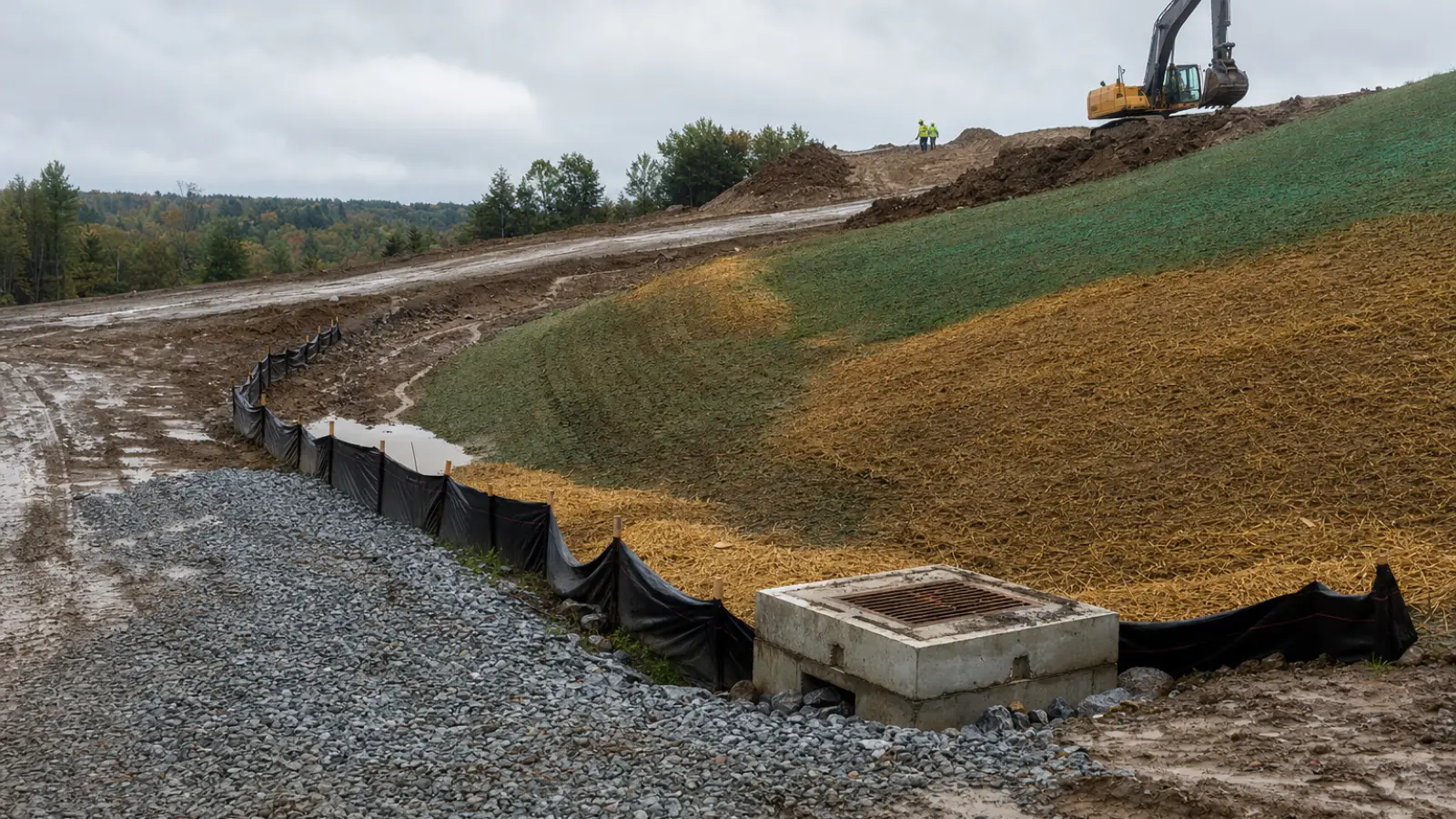
Construction contractors manage erosion control in construction through coordinated planning, installation, inspection, and stabilization rather than relying on a single product or barrier. Syman provides boise hydroseeding, SWPPP design, BMP installation, site inspections, and regulatory compliance consulting to help contractors address applicable federal and state standards while protecting soil, water, and adjacent property. Its environmental installation services can support the practical implementation of erosion and sediment controls where project conditions require professional coordination.
The central question is not simply whether a site has silt fence. It is whether stormwater is being managed from the moment soil is disturbed until the site reaches final stabilization. That requires understanding drainage patterns, sequencing earthwork, selecting suitable best management practices (BMPs), maintaining those controls, and documenting the work.
Why Erosion Control Matters on Construction Sites
Exposed soil is vulnerable to rainfall and runoff. Grading, excavation, utility installation, and material storage can create long, unprotected flow paths that carry sediment toward storm drains, streams, wetlands, neighboring parcels, and public roads. Sediment can cloud waterways, fill drainage structures, interfere with aquatic habitat, and create costly maintenance problems downstream.
Erosion control focuses on preventing soil particles from being detached and transported. Sediment control captures material after it has moved. The distinction matters. A project that depends entirely on downstream sediment barriers is often reacting to an avoidable source problem. Stabilizing slopes, reducing the area of exposed soil, slowing runoff, and directing water through protected channels are generally more reliable than treating every discharge at the property boundary.
Requirements also extend beyond environmental protection. Uncontrolled runoff can undermine embankments, damage pavement, clog inlets, flood excavations, and delay inspections or utility work. On a residential subdivision, for example, an unstabilized lot may send sediment into a newly installed street inlet. On a highway project, runoff from a cut slope can reach a ditch or culvert and compromise both water quality and drainage performance.
Understanding SWPPP Requirements and Stormwater Compliance
A Stormwater Pollution Prevention Plan, or SWPPP, identifies potential pollution sources and explains how a project will control stormwater discharges. Depending on the project and jurisdiction, the plan may address erosion and sediment controls, concrete washout, fuel and chemical storage, waste handling, dewatering, stabilization schedules, inspection procedures, corrective actions, and responsible personnel.
Federal construction stormwater requirements are administered through the National Pollutant Discharge Elimination System (NPDES), while permits and implementation details may be managed by a state environmental agency or another authorized authority. The EPA construction stormwater program provides the federal framework, but contractors must review the permit conditions that apply to the specific site, discharge location, project size, and state.
A SWPPP is not a static binder. It should reflect actual site conditions and be revised when plans, sequencing, drainage, or control measures change. A commercial project that moves from mass grading to underground utilities will have different exposed areas and runoff pathways than it had during initial clearing. A road project may require changing controls as work advances along the alignment.
What contractors should confirm before disturbing soil
- Which federal, state, and local permits or authorizations apply.
- Where runoff leaves the site and which receiving waters or municipal systems may be affected.
- Who is responsible for inspections, maintenance, reporting, and corrective action.
- Which areas can be stabilized early and which must remain exposed for construction access.
- How weather forecasts, emergency repairs, and unexpected field conditions will be handled.
BMPs support compliance, but their presence does not automatically guarantee it. Permit conditions, installation quality, maintenance, inspection records, discharge conditions, and timely corrections all matter.
Essential Best Management Practices (BMPs) for Construction Sites
Effective BMP selection starts with the site’s drainage and construction sequence. Controls should intercept water where it can be safely managed without creating concentrated flow, undermining slopes, or flooding active work areas.
Silt fences and perimeter controls
Silt fences are commonly installed along the downslope perimeter of disturbed areas to slow shallow sheet flow and retain sediment. They work best when trenched or otherwise secured according to the specified installation method, installed on the contour where practical, and kept free of bypasses. They are not designed to receive concentrated ditch flow or large volumes of runoff. A fence placed across a drainage channel may fail quickly unless the channel is treated with a more suitable conveyance or sediment-control measure.
Sediment basins and traps
Sediment basins provide temporary storage where runoff can slow and suspended soil can settle before discharge. Their performance depends on adequate storage, stable embankments, protected outlets, safe access for maintenance, and a design appropriate to the drainage area. Smaller sediment traps may serve limited catchments, but neither measure should become a substitute for stabilizing the source of erosion.
Inlet protection
Storm drain inlet protection prevents sediment from entering newly installed or existing drainage systems. Devices may include filter barriers, curb inlet protection, or other approved configurations. The selected system must allow water to pass without creating unacceptable ponding or bypassing around the structure. Inlet protection should be inspected after runoff events and whenever accumulated sediment restricts capacity.
Stabilized construction entrances
A stabilized entrance reduces the amount of mud tracked from a project onto public streets. Aggregate size, thickness, width, drainage, and subgrade conditions should reflect the traffic and soil type. If trucks continue to carry mud onto pavement, the entrance needs maintenance, supplemental material, or a more active track-out control procedure. Street sweeping should remove sediment without washing it into storm drains.
Other useful controls
Depending on the project, BMPs may include diversion berms, check dams, slope drains, fiber rolls, concrete washout areas, construction phasing, dust controls, and protected stockpiles. Erosion control blankets can protect exposed slopes and channels from raindrop impact and shallow surface flow while vegetation becomes established. Blankets must be matched to slope steepness, soil conditions, flow velocity, and the specified anchoring pattern. Poor contact with the soil or inadequate anchoring can allow water to travel beneath the blanket.
Hydroseeding and Vegetative Stabilization Techniques
Hydroseeding applies a sprayed mixture that may contain seed, water, mulch, fertilizer, tackifier, and soil amendments selected for the site. The slurry helps distribute seed evenly over large or irregular areas and can improve initial soil coverage compared with hand broadcasting. It is commonly used on graded commercial lots, residential developments, roadway slopes, utility corridors, and infrastructure sites.
Temporary vegetation may be appropriate when an area will remain idle before the next construction phase. Permanent vegetation is used when final grades are complete and the landscape or project specifications call for lasting cover. Seed selection should consider climate, soil, sunlight, slope exposure, intended use, and the time of year. Soil preparation, moisture, and post-application care are often as important as the seed mixture itself.
Hydroseeding is not an instant erosion solution. Seed may fail to germinate because of drought, unsuitable soil, poor seed-to-soil contact, washout, shading, or adverse temperatures. Heavy runoff can remove the slurry before roots develop. Steep slopes or concentrated drainage may require erosion control blankets, bonded fiber matrix, tackifiers, check structures, or other measures in addition to seed. During establishment, the site still needs inspection and protection from traffic and uncontrolled water.
How Site Inspections Prevent Environmental Violations
Inspections provide the feedback loop between the SWPPP and field conditions. A useful inspection examines whether controls are installed in the correct locations, whether runoff is bypassing them, whether sediment is accumulating, and whether construction activity has created new exposure or discharge pathways.
Inspectors should look at perimeter controls, basin outlets, inlet protection, stabilized entrances, slopes, stockpiles, drainage channels, concrete washout, material storage, and areas undergoing stabilization. They should also check for signs of failure, including undercut silt fence, rills on slopes, muddy discharge, clogged inlets, standing water behind barriers, tracked sediment on roads, and vegetation that has not established.
Inspection frequency and documentation are governed by the applicable permit and project requirements. Records typically identify the inspection date, weather or runoff conditions, areas reviewed, deficiencies found, corrective actions, responsible parties, and completion status. Photographs can supplement written records, but they should not replace clear descriptions of what must be corrected.
Responding to a control failure
When a BMP fails, the response should address both the symptom and the cause. Replacing a damaged fence may be necessary, but the underlying issue could be concentrated flow from an unprotected slope. Corrective work may involve redirecting drainage, adding stabilization, removing accumulated sediment, repairing an outlet, or revising the SWPPP and construction sequence. After repair, the area should be rechecked rather than assumed to be compliant.
Coordinating Erosion Control with Earthworks and Site Development
Erosion control performs best when included in the civil work plan before clearing and grading begin. Contractors should establish site access, perimeter controls, diversion measures, sediment storage, and initial stabilization in a sequence that does not require equipment to destroy newly installed controls.
On a commercial building site, this may mean protecting the future storm drain network before connecting it to an active discharge point and phasing parking-lot grading to limit exposed acreage. In a residential development, lot-by-lot grading and early seeding can reduce the duration of exposure. Road and utility projects may need portable or advancing controls that can be relocated as the work front moves.
Subcontractor coordination is equally important. Excavators, utility crews, concrete contractors, landscapers, and delivery drivers can all affect runoff. The project team should define who maintains each control, where washout is allowed, how spoil piles are protected, and how emergency weather preparation will be organized. A BMP that is shown on a plan but inaccessible, damaged by traffic, or omitted from the current phase is not an effective field measure.
Common Erosion Control Mistakes and How to Avoid Them
- Installing controls too late: Perimeter and drainage controls should be established before major soil disturbance where feasible.
- Using one BMP for every condition: Silt fence, inlet protection, blankets, and basins serve different purposes and have practical limits.
- Ignoring concentrated flow: Sheet-flow controls can fail when runoff is directed into a channel or ditch.
- Failing to maintain controls: Sediment must be removed, damaged materials repaired, and outlets kept functional.
- Relying on hydroseeding alone: Seed requires suitable conditions and time to establish; exposed slopes may need additional protection.
- Overlooking construction traffic: Vehicles can destroy stabilized entrances, track sediment onto roads, and damage perimeter controls.
- Treating documentation as an afterthought: Incomplete inspection and corrective-action records can make it difficult to demonstrate consistent implementation.
- Failing to update the SWPPP: Changed grades, drainage paths, staging areas, and work phases should be reflected in the plan.
Selecting an Erosion Control and Environmental Compliance Contractor
Contractors and owners should evaluate whether a service provider can connect design, field installation, stabilization, and compliance administration. Relevant capabilities may include SWPPP preparation or support, BMP selection, erosion control installation, hydroseeding, inspection services, maintenance, documentation, and communication with the project team.
Ask how the provider will adapt controls to site slope, soil, drainage, phasing, and weather rather than applying a standard package. Clarify who supplies materials, who performs inspections, how deficiencies are reported, and how quickly corrective work is initiated. The best arrangement is one that integrates with the superintendent, civil engineer, environmental manager, and subcontractors.
Experience across commercial, residential, roadway, and infrastructure work can be useful because each setting presents different constraints. A provider should also understand that regulatory compliance is project-specific. Local permit conditions, receiving waters, municipal requirements, design changes, and field observations must all be considered before selecting or approving a control measure.
Frequently Asked Questions About Construction Erosion Control
What is the difference between erosion control and sediment control?
Erosion control prevents soil from being detached or transported, while sediment control captures soil after it has moved. Stabilized surfaces, vegetation, blankets, and protected drainage reduce erosion; silt fences, basins, traps, and inlet protection manage sediment. Most construction sites need both.
Is a SWPPP required for every construction project?
Not necessarily. Coverage depends on applicable federal, state, and local rules, the nature and extent of land disturbance, the discharge pathway, and project-specific conditions. The project owner and contractor should determine permit obligations before disturbing soil rather than assuming that a small or remote site is exempt.
When should hydroseeding be used?
Hydroseeding is useful when large or irregular areas need relatively uniform seed and mulch application, particularly after final grading or during planned temporary stabilization. It should be selected according to season, soil, slope, drainage, and maintenance capacity. It may need to be combined with blankets or other controls on steep or actively eroding surfaces.
How often should erosion control measures be inspected?
Inspection frequency is set by the applicable permit and project conditions, with additional inspections appropriate after qualifying rainfall or runoff events and whenever site work changes. Regardless of the formal schedule, controls should be checked whenever they appear damaged, bypassed, clogged, or inadequate.
Who is responsible for maintaining construction BMPs?
Responsibility should be assigned in the SWPPP, contract documents, or site procedures. Owners, general contractors, subcontractors, and environmental consultants may each have defined duties. Clear ownership is essential because an unmaintained control can fail even when it was correctly designed and installed.
Conclusion: Building Responsibly Through Effective Site Stabilization
Successful construction erosion control combines sound grading decisions with practical field controls and disciplined follow-through. SWPPP requirements establish the management framework, BMPs manage runoff and sediment, inspections identify changing risks, and temporary or permanent stabilization reduces the period during which soil remains exposed.
When erosion control is coordinated with earthwork, access, drainage, vegetation, and subcontractor activities, it protects more than a permit status. It helps preserve neighboring property, maintain functioning infrastructure, reduce rework, and protect receiving waters throughout the construction process.