Australia’s Housing Push: Approvals, Materials Costs and the 1.2 Million Homes Target
Australia’s housing pipeline is expanding, but approvals are not the same as completed homes. Materials prices, planning capacity and project risk will determine whether the 1.2 million-home target is met.
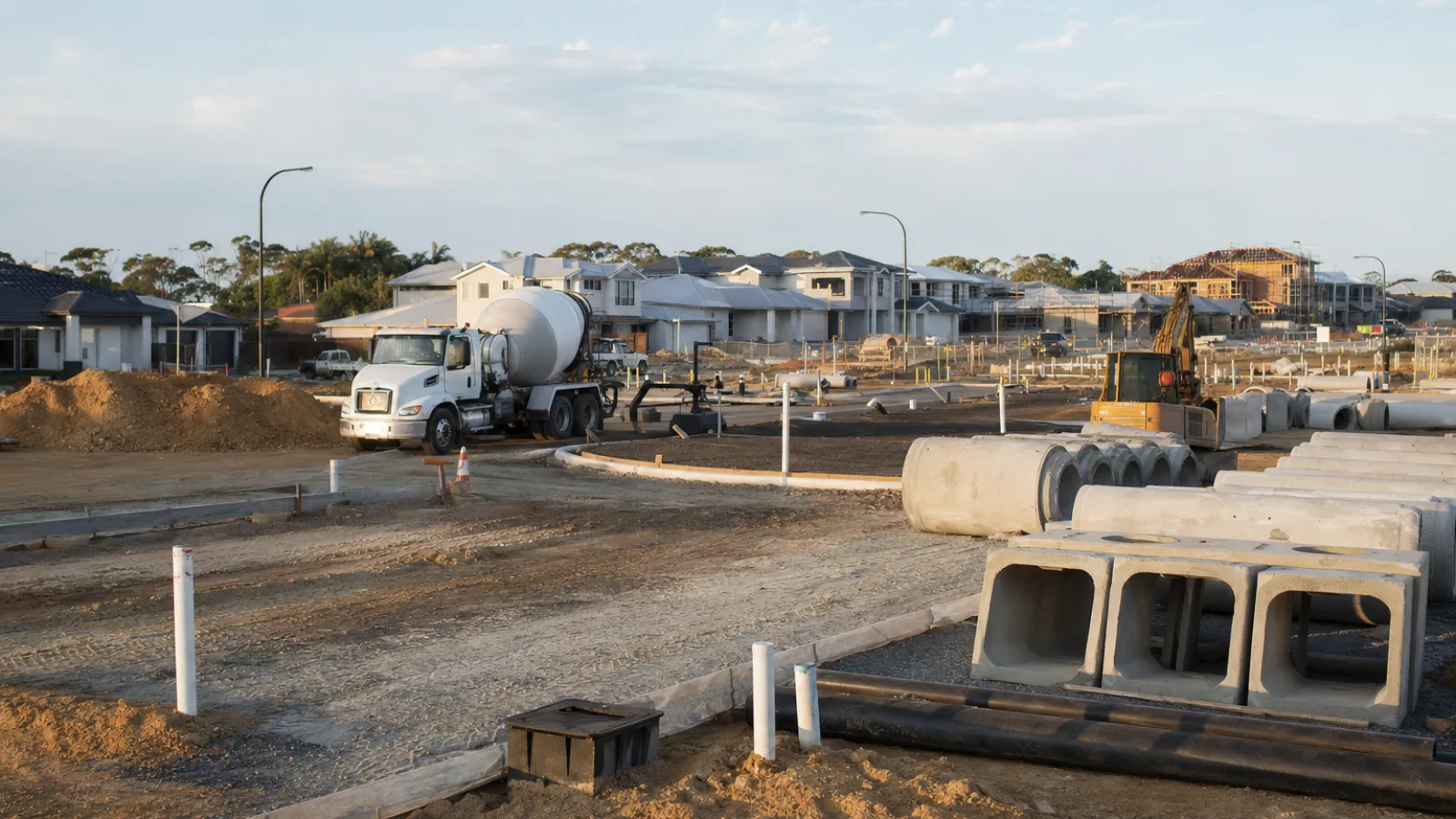
Australia’s housing supply challenge is moving through several systems at once: planning departments, subdivision networks, material suppliers, builders, environmental regulators and finance markets. The latest Australia building approvals data from the ABS provides evidence of stronger activity, but approvals alone do not guarantee that a dwelling will be built.
Total dwelling approvals rose 5.1% in September, according to the Australian Bureau of Statistics’ Building Approvals, Australia release for that month. The increase is encouraging for the supply pipeline. It does not, however, resolve the harder question facing policymakers and the construction industry: can approved projects move through land servicing, procurement, construction and settlement quickly enough to support the national goal of 1.2 million additional homes?
The answer will depend on more than demand. Construction materials costs, planning certainty, environmental assessment timeframes, contractor capacity and the way project risks are allocated will all influence the final number of completed homes.
What the 1.2 million homes target actually requires
The Australian Government’s Housing Accord target is to deliver 1.2 million new homes over the five years from July 2024 to June 2029. It is a production objective rather than an approvals target. Homes must be completed, capable of occupation and counted within the program’s measurement framework.
That distinction matters because the housing pipeline has several conversion points. A project may begin as a rezoning proposal, become a development application, receive a building approval, start construction and eventually reach completion. Delays or failures at any stage reduce the number of homes that reach the market.
The target also covers different forms of housing. Detached homes, townhouses, apartments, build-to-rent projects and social or affordable housing can all contribute, but each has different requirements for land, finance, infrastructure, design approval and construction sequencing. Increasing apartment approvals will not immediately produce homes if projects remain commercially unviable or are delayed by utility constraints.
Australia building approvals are a leading indicator, not a delivery result
Building approvals indicate that a project has received permission to proceed under the relevant building and planning framework. They are useful for tracking future construction activity, but they are not a direct count of homes under construction or homes handed over to owners and tenants.
There are several reasons for the gap between approvals and actual completions:
- Projects can be approved but not commenced. Financing conditions, presale requirements, feasibility changes or weak buyer demand may prevent a developer from proceeding.
- Construction can take years. A detached dwelling and a large apartment project have very different construction programs, procurement risks and inspection requirements.
- Approvals can be amended or lapse. Changes to design, staging or development economics can require new approvals or result in a project being withdrawn.
- Infrastructure can become the critical path. Roads, drainage, water, sewerage and electricity connections may not be available when a project is otherwise ready.
- Completion data records the final stage. A home may be substantially built but not yet certified, connected or legally available for occupation.
For this reason, policymakers and investors should read approval numbers alongside commencements, construction activity, completion data, dwelling investment and settlement figures. A rise in approvals is a positive pipeline signal, but the conversion rate is what matters for housing supply.
Construction materials costs are a direct affordability constraint
Materials are not a minor line item in housing delivery. Concrete, cement, aggregates, asphalt, reinforcing steel and precast products are embedded in subdivision roads, retaining structures, drainage, foundations, slabs, walls and apartment structures. Their cost affects both the developer’s feasibility model and the eventual price or rent of the completed home.
An industry-association claim places heavy construction materials at up to 38% of subdivision costs and says prices remain about 36% above pre-pandemic levels. These figures should be treated as an industry estimate rather than an official economy-wide measure. The precise share varies according to site conditions, geography, specification, haulage distance, project scale and whether infrastructure costs are included in the calculation.
Even so, the underlying mechanism is clear. When the cost of aggregates, concrete or precast components rises, the impact can pass through several layers of a project. A subdivision may require more expensive pavement materials, imported fill, drainage structures or retaining systems. A multi-residential project may face higher costs for concrete frames, precast panels, reinforcement and crane-intensive installation. The combined effect can reduce margins and make marginal projects fail a lender’s feasibility test.
Transport is particularly important. Aggregates and ready-mix concrete are heavy, relatively low-value materials, so long haul distances can materially affect delivered cost. Local shortages, quarry constraints, fuel prices, batching capacity and traffic restrictions can also change the price after a project has been designed.
Developers and contractors can reduce exposure by confirming material availability during early design, testing alternative compliant specifications, comparing in-situ and precast solutions, and separating commodity price risk from other construction risks in the contract. Early quantity take-offs and a realistic allowance for waste, testing, escalation and transport are more useful than relying on a generic percentage contingency.
Why Western Australia’s planning reforms matter
Western Australia has been pursuing planning reforms intended to make housing delivery more responsive, support urban infill and widen the range of housing types that can be approved in established areas. The practical focus is on reducing unnecessary procedural delay while retaining requirements for safety, infrastructure, amenity and environmental performance.
Planning reform can improve supply in two different ways. First, a clearer approval pathway can reduce the time and consultant cost required to obtain consent. Second, rules that enable townhouses, grouped dwellings and well-designed medium-density housing can allow more homes to be delivered on serviced land that is already within the urban footprint.
However, faster planning decisions do not automatically solve construction constraints. A project may receive approval and still be delayed by sewer capacity, road upgrades, community infrastructure contributions, financing or contractor availability. Reform is most effective when planning settings are coordinated with infrastructure sequencing and when applicants can understand the requirements before committing to detailed design.
For builders and developers, the important question is not simply whether a state has changed its planning rules. It is whether the new process improves certainty about allowable density, design standards, contribution obligations, appeal risk and the timing of infrastructure connections.
AI could shorten environmental assessment time, but governance will matter
The federal government has allocated $105.9 million to develop an artificial-intelligence tool intended to make environmental assessments faster and more efficient. The policy objective is relevant to housing because major land releases, transport links and infrastructure projects can depend on environmental information and regulatory decisions.
An AI assessment tool could help organise large document sets, identify recurring issues, compare mapped constraints and support initial screening. It may also reduce repetitive administrative work for agencies and proponents. Used properly, that could improve the consistency and speed of early-stage assessment.
It should not be confused with an automated approval system. Environmental decisions still require accountable officials, appropriate scientific evidence, consultation and a clear record of how risks were assessed. AI-generated outputs can contain omissions, biased classifications or errors in the interpretation of site-specific conditions. The tool will therefore need quality controls, human review, transparent decision rules and a process for correcting data.
For housing projects, the benefit will be greatest where proponents submit complete, well-structured information early. Better digital records, geospatial data and standardised environmental documentation can make assessment more efficient regardless of whether AI is used.
CEDA’s project-risk warning is relevant to housing delivery
The Committee for Economic Development of Australia has called for stronger project risk management in major infrastructure and construction delivery. The concern is directly relevant to housing because poorly allocated risk can increase tender prices, produce disputes and cause projects to be delayed or abandoned.
Risk management is not the same as transferring every uncertainty to a contractor. If a contract assigns unknown ground conditions, utility relocation, design development or approval delays to a party that cannot control them, that party will usually price a premium, seek variations or become financially exposed. In extreme cases, the risk can contribute to contractor distress and work stoppages.
More reliable delivery requires project owners to investigate site conditions, define scope clearly, coordinate design before tender, maintain realistic programs and identify who controls each major risk. Contracts should distinguish between risks that can be priced, risks that can be insured and risks that should be shared or retained by the client.
Standardised design details and repeatable procurement can help, particularly for social housing, modular construction and large land-release programs. But standardisation should not be mistaken for a universal solution. Site access, fire requirements, acoustic performance, climate, transport dimensions and local planning controls can all limit how far a design can be repeated.
Where prefab housing fits into the supply response
Prefab housing Australia can contribute to delivery when factory production solves a genuine site or labour constraint. Panelised walls, bathroom pods, precast structural elements and volumetric modules can move some work into a controlled manufacturing environment. This may improve repeatability, reduce weather exposure and make labour requirements more predictable.
Prefab is not automatically cheaper or faster. Factory tooling, transport, lifting equipment, module dimensions, connection details and site tolerances must be considered at the beginning of the project. A module that is inexpensive to manufacture may be costly to transport or difficult to install on a constrained urban site. Building approvals, fire separation, waterproofing, acoustic requirements and service connections still apply.
The strongest use cases are likely to be projects with repeatable layouts, a reliable pipeline and enough volume to justify design and manufacturing setup. Prefabrication can then work alongside more conventional construction rather than being treated as a replacement for the entire building process.
What would improve the conversion from approvals to homes?
Australia’s housing target needs a delivery system that tracks the whole pipeline. The following measures would help convert approvals into completed dwellings:
- Publish better pipeline data. Separating approvals, commencements, projects on hold, construction progress and completions would show where supply is being lost.
- Coordinate planning with infrastructure. New approvals are more valuable when water, sewerage, roads, power and public transport can be delivered on a matching schedule.
- Reduce avoidable design changes. Early engineering coordination can prevent late revisions to structure, drainage, services and fire systems.
- Improve cost visibility. Detailed estimating should track quantities, delivered material prices, escalation allowances and site-specific civil works rather than relying on broad averages.
- Allocate risk realistically. Contracts should place controllable risks with the party able to manage them and avoid pricing unknowns as if they were certain costs.
- Use prefabrication selectively. Factory-based construction should be matched to repeatable designs, suitable transport routes and a dependable project pipeline.
The 5.1% rise in September approvals is a useful sign that activity is moving in the right direction. Yet the housing affordability Australia debate will ultimately be judged by completed, occupied homes—not by permissions recorded on paper. Materials supply, planning reform, environmental assessment and disciplined project management must therefore operate as parts of one delivery chain.