Hidden Structural Damage in Buildings After War: Risks Beyond Visible Destruction
Modern conflicts inflict severe damage on buildings that and always visible. This article explores the hidden structural damage caused by blast waves, vibrations, and ground shocks, explaining why visually intact structures can be dangerously unsafe and require expert assessment.
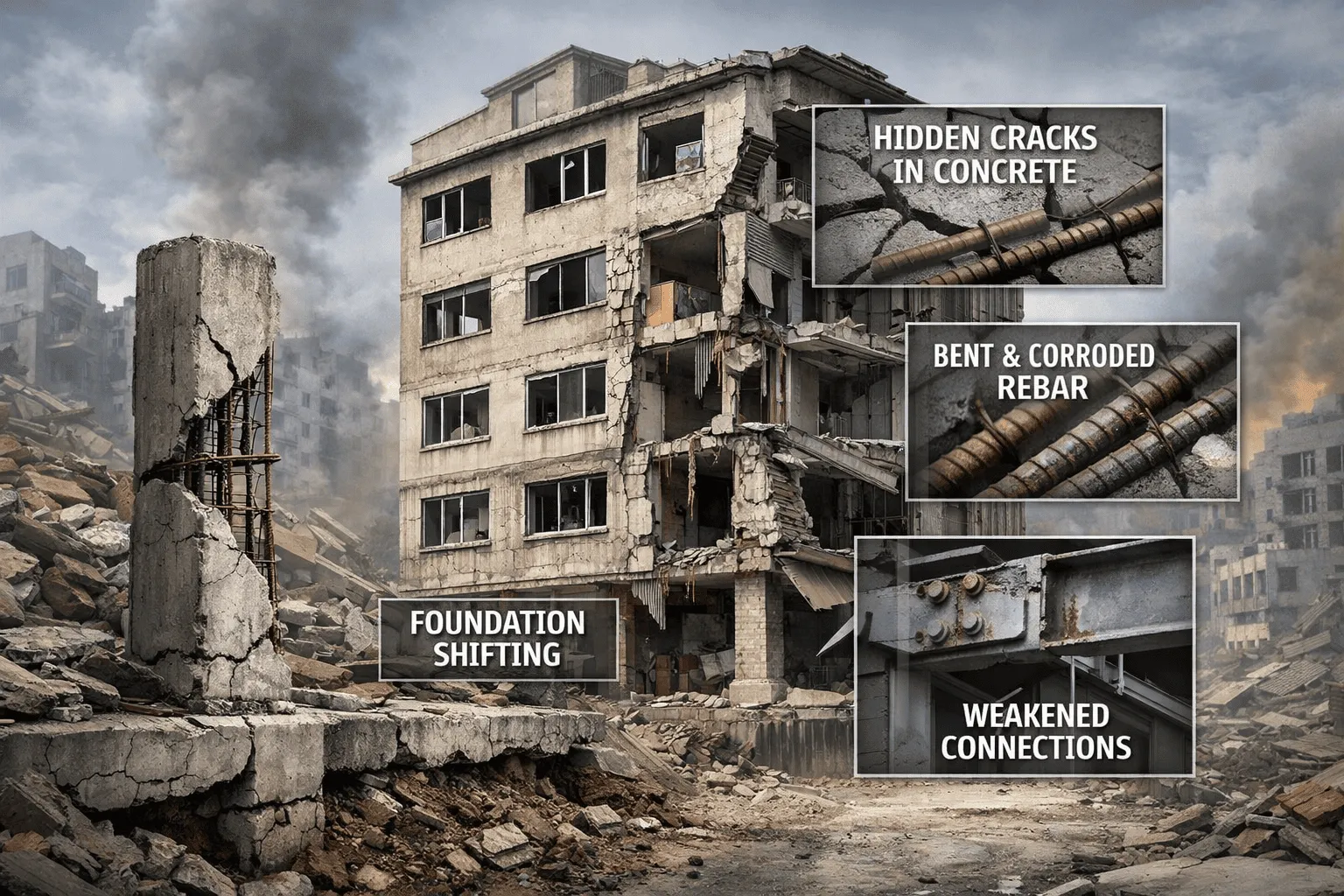
The imagery of post-conflict urban landscapes is often dominated by collapsed structures and mountains of rubble. These scenes of overt destruction, while tragic, represent a clear and understood danger. However, a far more insidious threat lurks within the buildings that remain standing. In modern warfare, where the use of high-explosive ordnance is common even in non-direct strikes, structures can suffer catastrophic failures that are not immediately apparent. As a structural engineer specializing in post-conflict environments, I have repeatedly witnessed the deceptive stability of buildings that, while visually intact, are on the verge of collapse. This article provides a technical analysis of the mechanisms behind this hidden structural damage, outlining why a standing building is not necessarily a safe building and detailing the engineering diligence required to ensure safety during reconstruction.
The fundamental challenge is that a building's ability to carry loads depends on a complex, interconnected system of columns, beams, slabs, and foundations. Armed conflict introduces extreme, abnormal loads that can compromise this system in ways that defy a simple visual check. From the overpressure of a blast wave to the violent shaking of the ground, these forces can initiate a cascade of failures that may only manifest months or years later under normal occupancy loads or minor seismic events. For civil engineers, construction professionals, and infrastructure planners tasked with rebuilding, understanding these unseen risks is the first and most critical step toward creating a safe and resilient future for affected communities.
The Deceptive Stability of Post-Conflict Structures
Why can a building that has endured nearby explosions appear stable while being structurally unsound? The answer lies in the concepts of structural redundancy and load path redistribution. Modern buildings are designed with a degree of redundancy, meaning there are multiple paths for loads to travel to the foundation. If one element, like a column, is damaged, the load it was carrying can be redistributed to adjacent elements.
During a conflict, this system is pushed to its absolute limit. A blast may damage several columns or shear walls, but the building remains standing because the remaining structure temporarily absorbs the new load distribution. However, these surviving elements are now overstressed and operating far beyond their design capacity. Connections that were meant to transfer specific loads may now be subjected to forces and moments they were never intended to resist. This creates a state of precarious equilibrium. The structure is stable only under its current, static self-weight. The addition of live loads (people, furniture), environmental loads (wind, snow), or even minor aftershocks can trigger a disproportionate or progressive collapse.
The Physics of Destruction: Blast Waves and Shockwave Propagation
The primary vector for hidden structural damage is the blast wave generated by an explosion. A detonation creates a near-instantaneous expansion of hot gases, which violently pushes away the surrounding air, forming a shock front of highly compressed air. This front travels supersonically, carrying immense energy.
When this blast wave strikes a building, it imparts a massive, short-duration pressure load. This is immediately followed by a negative pressure phase, or suction, which can be just as damaging as it pulls surfaces outward. In dense urban environments, this effect is amplified. Blast waves reflect off building faces, channel down streets (a phenomenon known as the “canyon effect”), and diffract around corners, creating complex and unpredictable loading patterns. A single detonation several blocks away can subject a building to multiple, successive shockwaves from different directions.
Shockwave Effects from Nearby Explosions
Even when a building is not directly hit, the effects of a nearby explosion are profound. The initial impact is on the building envelope. Windows shatter, and non-load-bearing cladding, facades, and infill walls are blown inward or pulled outward. This initial failure is significant because it allows the blast wave to enter the building, causing a rapid pressurization of interior spaces. This internal pressure pushes outward on walls, floors, and ceilings, creating complex stresses that the structural frame was not designed to handle. The failure of these “non-structural” elements can mask severe damage to the primary frame, as the building's exterior may appear relatively unharmed aside from broken windows.
Unseen Damage to the Structural Skeleton
The immense energy from blast loading and ground shock is absorbed by the building's structural materials, often causing damage at a microscopic level that accumulates into a significant loss of capacity.
Microcracks in Reinforced Concrete and Structural Steel
Reinforced concrete, the most common structural material globally, is particularly vulnerable. The high-strain-rate loading from a blast wave induces a web of microcracks throughout the concrete matrix. These cracks, often invisible to the naked eye, disrupt the bond between the concrete and the steel reinforcement (rebar). They reduce the material's compressive strength and shear capacity. More critically, they create pathways for moisture and chlorides to penetrate the concrete, leading to accelerated corrosion of the rebar. This corrosion causes the steel to expand, which in turn leads to spalling (chipping away) of the concrete cover, further exposing the structure to degradation. A column that appears solid may have lost a significant portion of its load-bearing capacity due to this internal damage.
Structural steel is also susceptible. While more ductile than concrete, the intense pressure can cause localized plastic deformation, particularly at connection points. Welds and bolted connections can suffer from micro-fractures that compromise their integrity under future loading cycles.
Structural Fatigue from Repeated Vibrations
Prolonged conflicts often involve repeated shelling, aerial bombardment, or the use of heavy artillery. Each detonation sends vibrations through the ground and air, subjecting buildings to thousands of low-to-moderate intensity loading cycles. This is analogous to bending a paperclip back and forth until it breaks. The repeated stress, even if below the material's ultimate failure point, causes fatigue. This is especially dangerous at connection points—where beams meet columns or trusses are joined—as these areas of high stress concentration are the first to fail under cyclic loading.
Compromised Load-Bearing Elements: Columns, Beams, and Walls
While a column might not be visibly sheared off, it can suffer significant internal damage. Blast pressure can cause spalling on the side facing the explosion, exposing and sometimes deforming the rebar. The column may also be forced into a permanent lateral displacement, however slight, which introduces a P-delta effect—where the axial load combined with the lateral deflection creates a secondary bending moment that significantly increases stress on the element. Similarly, beams can suffer from imperceptible plastic deformation (sagging), and load-bearing shear walls can develop diagonal tension cracks that severely reduce their ability to resist lateral forces like wind or earthquakes.
Below the Surface: Foundation and Utility Failures
Some of the most critical hidden structural damage occurs underground, where it is impossible to see without invasive investigation.
Foundation Instability from Ground Disturbance
Large explosions transmit a significant amount of energy into the ground, creating a ground shock that propagates like a seismic wave. This can have devastating effects on a building's foundation. In granular soils, the vibrations can cause liquefaction, a phenomenon where the soil temporarily loses its strength and behaves like a liquid. This can lead to a sudden and catastrophic loss of bearing capacity. More commonly, the ground shock causes differential settlement, where one part of the building's foundation settles more than another. This induces enormous stresses in the superstructure, causing severe cracking in beams, slabs, and walls, and potentially leading to the failure of columns as loads are unevenly distributed. A comprehensive understanding of these phenomena is crucial, as detailed in articles on Understanding Soil-Structure Interaction Analysis in Civil Engineering.
Impact on Underground Utilities and Infrastructure
The same ground shock that damages foundations can rupture buried utilities. Broken water mains can saturate the soil around foundations, reducing its bearing capacity and exacerbating settlement issues. Leaking sewer lines create serious public health hazards. Ruptured gas lines present an immediate risk of explosion and fire. Damaged electrical conduits can lead to electrocution risks and power outages that hinder recovery efforts. The failure of this subterranean network not only affects the functionality of individual buildings but also destabilizes the entire urban area.
Systemic Failures Within the Building Envelope
Beyond the primary structure, conflict-related damage creates a host of systemic failures that affect a building's safety and long-term viability.
Fire Exposure and Material Degradation
Fire is a frequent secondary effect of explosions. The intense heat from a building fire can permanently degrade structural materials. Structural steel begins to lose its strength at temperatures around 550°C (1022°F), and if not properly fireproofed, it can deform and buckle under load. Concrete is susceptible to explosive spalling at high temperatures, where trapped moisture turns to steam and blows off the outer layers of concrete, exposing the reinforcing steel to even greater heat.
Water Damage from Broken Infrastructure Systems
A building's internal systems are also highly vulnerable. A blast can rupture plumbing and sprinkler system pipes, leading to extensive water damage. This water saturates insulation, drywall, and flooring, promoting the growth of toxic mold. It can also seep into the structural system, accelerating the corrosion of steel elements and degrading wood components.
Damage to Electrical, HVAC, and Plumbing Networks
The violent shaking and overpressure from a blast can sever electrical wiring, damage HVAC ductwork, and break plumbing fixtures. Frayed electrical wires hidden within walls pose a significant fire hazard once power is restored. Damaged HVAC systems can compromise indoor air quality and prevent the building from being safely ventilated. A compromised plumbing and sanitation system renders a building uninhabitable and poses a major public health risk.
Comparative Analysis of Hidden Damage Types
To better understand these multifaceted risks, the following table summarizes key types of hidden damage, their causes, and their consequences.
| Type of Damage | Cause During Conflict | Structural Risk | Long-Term Consequences |
|---|---|---|---|
| Blast Pressure Damage | Shockwave overpressure and suction from nearby explosions. | Microcracking in concrete, deformation of steel frame, connection failure. | Reduced load capacity, accelerated material degradation, vulnerability to future loads. |
| Foundation Displacement | Ground shock from explosions causing soil settlement or liquefaction. | Loss of bearing capacity, differential settlement inducing stress in the superstructure. | Progressive structural failure, severe cracking, potential for building collapse. |
| Material Fatigue | Repeated vibrations from sustained shelling or multiple blasts. | Weakening of material at connection points and areas of high stress. | Sudden, brittle failure under normal operating loads without warning. |
| Fire-Related Structural Weakening | Secondary fires following explosions. | Reduction in strength of steel, spalling of concrete, compromised timber elements. | Permanent loss of structural capacity, requiring extensive repair or demolition. |
| Utility System Failures | Ruptured underground pipes (water, gas, sewer) due to ground shock. | Soil saturation leading to foundation failure, risk of secondary explosion or fire. | Public health crises, inhibited recovery efforts, long-term environmental contamination. |
The Critical Need for Post-Conflict Structural Assessment
The presence of these numerous and complex forms of hidden structural damage underscores a critical point: visual inspection alone is dangerously insufficient. An engineer walking through a damaged building may see cosmetic cracks and broken windows but will be completely unaware of the microcracking in the concrete, the settled foundations, or the fatigued steel connections. Relying on a superficial assessment can lead to the premature and unsafe reoccupation of buildings, putting lives at risk.
A rigorous, multi-stage assessment process is essential for any reconstruction effort. This process is a cornerstone of the work done by international organizations involved in post-conflict recovery and infrastructure rebuilding. Programs led by institutions such as UNOPS Infrastructure Reconstruction Programs demonstrate how engineering-led assessments and reconstruction planning help stabilize damaged cities and restore essential infrastructure systems in regions affected by conflict.
How Engineers Assess Buildings After Conflict
A comprehensive post-conflict building assessment is a systematic process that combines traditional methods with advanced technology to uncover hidden damage.
Structural Inspection Methods
The process begins with a Rapid Visual Screening (RVS) to quickly categorize buildings as apparently safe, requiring further inspection, or obviously unsafe. This is followed by a Detailed Visual Inspection (DVI) conducted by experienced structural engineers. They look for subtle signs of distress: patterns of cracking, building lean or tilt, evidence of foundation settlement, and damage to critical load-bearing elements. In recent years, the use of drones (UAVs) has become invaluable for safely inspecting roofs, facades, and structurally compromised areas that are too dangerous for human entry.
Non-Destructive Testing (NDT) Techniques
To peer inside the structure without causing further damage, engineers employ a range of Non-Destructive Testing (NDT) techniques. These are vital for identifying hidden structural damage.
- Ultrasonic Pulse Velocity (UPV): This method measures the speed of sound waves through concrete. Slower speeds indicate the presence of voids, honeycombing, or microcracks.
- Ground Penetrating Radar (GPR): GPR is used to locate rebar within concrete, assess its condition, and inspect the integrity of concrete slabs and foundations.
- Rebound Hammer (Schmidt Hammer): This provides an estimate of the concrete's surface hardness and, by correlation, its compressive strength.
- Acoustic Emission Monitoring: This involves placing sensitive sensors on a structure to “listen” for the high-frequency sounds of active crack growth or material distress.
Structural Monitoring
For buildings that are deemed potentially salvageable but are of high value or strategic importance, long-term structural health monitoring may be implemented. This involves installing an array of sensors—such as strain gauges, tiltmeters, and crack meters—to track the building's behavior over time. This data provides invaluable insight into whether the structure is stabilizing or if damage is progressing, informing the final decision on repair or demolition. The integration of modern technology is rapidly advancing this field, as seen in efforts for Enhancing Structural Health Monitoring: A Case Study on UAVs and Tags in the EU.
Reconstruction Planning
The data gathered from all inspections and tests forms the basis for a sound reconstruction plan. Engineers can determine if a building can be safely repaired through techniques like epoxy injection for cracks, fiber-reinforced polymer (FRP) wrapping for columns, or underpinning for foundations. In other cases, the damage is too severe, and demolition is the only safe option. This data-driven approach ensures that decisions are based on engineering principles, not assumptions, and aligns with the global imperative to “build back better” by creating infrastructure that is more resilient than what it replaced.
Conclusion: Building Resilience from the Rubble
In the aftermath of conflict, the urgency to return to normalcy is immense. However, this urgency cannot be allowed to override the need for engineering diligence. The greatest risks in a post-conflict urban environment are not always the collapsed buildings, but the ones left standing that harbor deep, hidden structural damage. Blast waves, ground shock, and repeated vibrations compromise the very skeleton of these structures, creating latent hazards that can claim lives long after the fighting has stopped. For the engineering and construction community, the path forward is clear: we must look beyond the visible destruction. Through a methodical process of expert inspection, advanced non-destructive testing, and continuous monitoring, we can uncover these unseen threats and make informed decisions that prioritize human safety above all else. It is only by acknowledging and addressing this hidden damage that we can truly and safely rebuild cities from the rubble.
Frequently Asked Questions (FAQ)
1. What is hidden structural damage in war-affected buildings?
Hidden structural damage refers to impairments to a building's load-bearing system that are not visible to the naked eye. This includes microcracks in concrete, fatigue in steel connections, foundation settlement, and loss of bond between concrete and rebar, all caused by forces like blast waves and ground shock.
2. How do blast waves from explosions damage buildings that are still standing?
Blast waves create intense, short-duration pressure that pushes and pulls on a building's surfaces. This force can cause internal micro-fractures in materials, weaken critical connections between beams and columns, and create stresses the building was never designed to handle, all without causing immediate collapse.
3. Is a building safe to enter after a war if it looks undamaged?
No, not necessarily. A building that appears visually intact can have severe hidden structural damage, such as a compromised foundation or weakened columns. It may be in a state of precarious stability, where the addition of small loads could trigger a collapse. Only a qualified structural engineer can determine its safety after a thorough assessment.
4. What does a structural inspection after an explosion involve?
It involves a multi-stage process starting with a rapid visual screening, followed by a detailed inspection by engineers. Crucially, it also includes Non-Destructive Testing (NDT) techniques like ultrasonic testing and ground-penetrating radar to assess the internal condition of materials and foundations.
5. Why can't I just look for cracks to see if a building is damaged?
While large, visible cracks are an obvious sign of damage, the most dangerous damage often begins as a network of microcracks invisible to the naked eye. These tiny cracks reduce the material's strength and allow moisture to enter, leading to long-term degradation and potential failure.
6. What is the role of a structural engineer in post-conflict reconstruction?
A structural engineer's role is to assess the safety and viability of existing structures, determine which can be repaired and which must be demolished, and design safe, resilient new buildings. They use specialized techniques to identify hidden structural damage and ensure the long-term safety of the rebuilt environment.
7. How does conflict damage a city's underground infrastructure?
Explosions send powerful shockwaves through the ground that can rupture buried water mains, sewer lines, gas pipes, and electrical conduits. This can lead to foundation damage from soil saturation, public health crises from contaminated water, and the risk of secondary explosions from gas leaks.
8. What are the first steps to ensure building safety after war?
The first steps are to secure the area and prevent unauthorized entry into potentially damaged buildings. This must be followed by a systematic assessment campaign led by qualified engineers to categorize buildings based on their level of damage and risk, starting with critical facilities like hospitals and schools.