Road Pavement Failure Diagnosis: What Cracks, Rutting, Potholes, and Bleeding Reveal
Visible pavement distress is evidence of an underlying mechanism, not a repair specification. This practical guide explains how to interpret cracks, rutting, potholes, raveling, and bleeding, confirm the cause, and select a durable treatment.
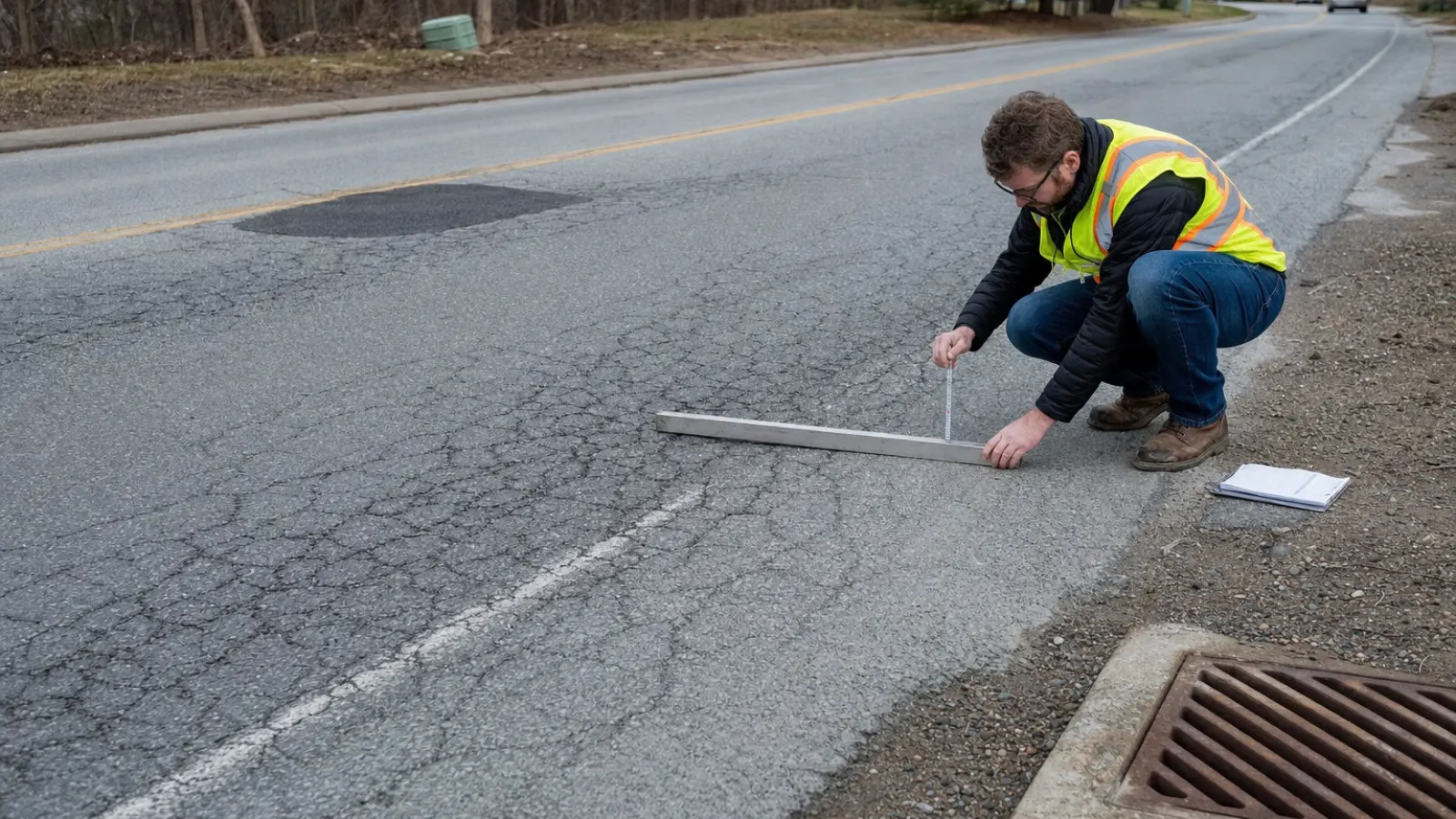
A road rarely fails for only one reason. A crack may reflect aging at the surface, water weakening the foundation, movement in an underlying layer, or repeated heavy axle loading. Effective road pavement failure diagnosis therefore means connecting the visible distress pattern with the mechanism beneath it rather than treating every defect as a maintenance nuisance.
The first question is whether the problem is surface-level, structural, drainage-related, materials-related, or linked to construction quality. Mix placement, compaction, joint construction, and the suitability of asphalt paving and road construction equipment can all influence long-term performance. A sound diagnosis combines field observations with measurements, records, and targeted testing.
Start With a Systematic Pavement Distress Inspection
Begin by recording where the distress occurs and how it is distributed. Note the lane, wheel path, centerline, edge, intersection, bus stop, turning area, bridge approach, or utility trench. Measure the affected length and width, record severity, and photograph the defect with a scale or reference object. A distress map is often more informative than a collection of isolated photographs because it reveals whether the problem is localized, repeating, or network-wide.
During a road maintenance inspection, also record shoulder condition, crossfall, ponding, blocked inlets, eroded edges, traffic direction, and evidence of heavy braking or turning. Seasonal observations matter: cracks that open in winter, potholes that appear after rain, and rutting that becomes more pronounced in hot weather point toward different mechanisms.
Visual surveys should be combined, where justified, with crack-width and rut-depth measurements, straightedge checks, cores or test pits, drainage inspection, and review of maintenance records. An isolated patch beside a sound pavement requires a different investigation from identical distress appearing in every wheel path over several kilometres.
What Common Pavement Distresses Reveal
Fatigue or Alligator Cracking
Fatigue cracking forms interconnected cracks that create small, irregular polygons, commonly in wheel paths. It usually indicates that repeated traffic has exceeded the pavement’s effective structural capacity. Contributing conditions may include insufficient layer thickness, weak or wet base and subgrade, poor drainage, overloaded traffic, inadequate compaction, or construction defects.
Early cracking may be limited to the surface or may appear as short interconnected segments. Advanced fatigue cracking is wider, more extensive, and often accompanied by pumping, rutting, loose material, and potholes. Cores, deflection testing, and examination of the base and subgrade help determine whether the distress is confined to the asphalt layer.
Sealing can limit water entry in selected early-stage cracks, but sealant alone is normally inadequate when the pavement structure has failed. A full-depth patch, structural overlay, stabilization, or reconstruction may be required depending on the extent and cause.
Thermal or Transverse Cracking
Thermal cracks run across the lane and may appear at broadly regular intervals. They develop when an asphalt layer contracts during low temperatures and the resulting tensile stress exceeds the material’s resistance. Binder aging and repeated thermal cycling can make the pavement more brittle. A crack can also reflect a joint, crack, or movement in an underlying layer.
Observe crack width, seasonality, spacing, and whether the crack continues through multiple layers. A narrow, relatively isolated transverse crack may be suitable for sealing after cleaning and preparation. Repeated wide cracks, water damage at the crack, or evidence of reflection require a broader assessment of the mix, underlying layers, and drainage.
Longitudinal Cracking
Longitudinal cracking may occur along the centerline, a lane joint, a wheel path, or the pavement edge. Its location is central to diagnosis. A poorly constructed or segregated paving joint can crack along the lane boundary, while a wheel-path crack may indicate fatigue or differential movement. Edge cracking can reflect weak shoulder support, loss of confinement, settlement, or water entering from the side.
Long cracks can also result from reflective cracking, utility trench settlement, or differential movement between materials. Check joint density, segregation, shoulder condition, drainage, and the geometry of any underlying repair before selecting crack sealing, an overlay, or deeper correction.
Rutting and Permanent Deformation
Rutting consists of depressions in the wheel paths, sometimes with raised material beside them. Surface rutting occurs mainly within the asphalt layer and may be caused by an unstable or poorly designed mix, excessive binder, inadequate compaction, high temperatures, or slow heavy traffic. Structural rutting extends into the base, subbase, or subgrade and is often accompanied by broader settlement or shoving.
A straightedge and rut-depth measurements establish the profile, but they do not identify the failing layer by themselves. Cores, test pits, deflection measurements, and layer-by-layer inspection can show whether the asphalt has sheared or the underlying support has deformed. Milling and resurfacing may address layer-specific rutting; it will not permanently correct a weak, wet subgrade.
Potholes
Potholes are areas where pavement material has progressively broken away. Water entering cracks, freeze-thaw action, traffic impact, failed patches, poor compaction, and localized base or subgrade weakness commonly interact. A pothole may be the final visible stage of fatigue cracking, stripping, or edge deterioration rather than an isolated surface defect.
Temporary patching can restore safety quickly, particularly in wet or cold conditions, but a durable repair removes loose and unstable material, creates sound edges, corrects any water source, restores support, and compacts the replacement material. Recurring potholes usually indicate that one or more of those conditions remain unresolved.
Raveling and Aggregate Loss
Raveling is the progressive loss of fine aggregate or binder from the surface. It can result from poor adhesion, aged binder, inadequate compaction, segregation, moisture damage, surface contamination, or traffic abrasion. Loose aggregate creates a safety hazard and can accelerate water entry.
A surface treatment may be suitable when the underlying pavement remains sound and the problem is shallow. If raveling is associated with stripping, widespread cracking, or loss of structural support, a superficial treatment may only conceal the problem temporarily. Cores and material testing can help distinguish surface aging from deeper moisture damage.
Asphalt Bleeding or Flushing
Bleeding, also called flushing, produces a shiny, dark, smooth surface when excess binder rises into the wheel paths. Possible causes include excessive asphalt content, low air voids, over-application of tack or seal materials, binder migration, heavy traffic, and high pavement temperatures.
The smooth surface may reduce skid resistance, especially when wet. Adding more asphalt is not an appropriate response. Depending on severity and cause, treatment may involve removing the excess surface binder, restoring texture, correcting the mix or application rate, or undertaking deeper work where the layer is unstable.
Match Visible Symptoms to Underlying Causes
The following table is a screening aid, not a substitute for engineering investigation. Similar visual symptoms can have different causes, particularly where drainage and construction history are unknown.
| Distress | Typical visual clue | Likely causes | First diagnostic action |
|---|---|---|---|
| Fatigue cracking | Interconnected polygons in wheel paths | Insufficient structural capacity, weak or wet support, heavy loading | Map extent; inspect drainage and obtain cores or deflection data |
| Thermal cracking | Transverse cracks with regular spacing | Low-temperature contraction, aged binder, reflective movement | Record width and seasonality; check layer continuity |
| Rutting | Wheel-path depressions or shoving | Unstable asphalt, poor compaction, weak base or subgrade | Measure profile and identify the deformed layer |
| Potholes | Localized loss of pavement material | Water, freeze-thaw, fatigue, failed patches, weak support | Remove loose material during inspection and check moisture and support |
| Raveling | Loose aggregate and rough surface | Aging, poor adhesion, segregation, moisture damage | Assess surface soundness and take a core if depth is uncertain |
| Bleeding | Shiny dark surface with low texture | Excess binder, low voids, high heat, over-application | Check texture, mix history, and skid-risk locations |
How to Confirm a Pavement Failure Diagnosis
Review Drainage and Moisture Conditions
Inspect crossfall, edge drains, ditches, culverts, inlets, outlets, groundwater, and areas where water ponds. Check whether shoulder settlement or vegetation is obstructing drainage paths. Moisture can reduce the bearing capacity of unbound layers, weaken subgrade support, promote stripping, and accelerate freeze-thaw damage.
A pavement that fails beside a blocked drain may not need the same treatment as an otherwise identical pavement with dry, stable support. Drainage correction should occur before a new surface is placed when water is contributing to the failure.
Investigate Materials and Layer Condition
Cores can establish asphalt thickness, layer bonding, cracking depth, stripping, segregation, and binder condition. Test pits may be needed to examine base and subbase quality, moisture, contamination, and subgrade classification. Depending on the suspected mechanism and project requirements, laboratory work may examine gradation, binder properties, air voids, moisture damage, or material strength.
Testing should answer a decision question. For example, a core taken from a rut can help determine whether the asphalt has sheared, while a test pit beside a recurring pothole may reveal a saturated granular layer. Random testing without a distress hypothesis can produce data without a useful repair decision.
Check Traffic, Climate, and Construction History
Review axle loading, traffic growth, turning and braking zones, temperature range, rainfall, freeze-thaw exposure, resurfacing records, mix design, paving temperatures, joint construction, and compaction records. The timing of distress is particularly useful: rapid rutting during hot weather suggests a different problem from cracks that develop after years of winter cycling.
Maintenance history can reveal whether a patch is masking a recurring failure or whether a previous overlay changed drainage, grade, or load distribution. Construction records may identify segregation, cold joints, unsuitable weather during placement, or inadequate compaction.
Use Non-Destructive and Network-Level Tools Where Appropriate
Falling weight deflectometer testing can help assess structural response, while ground-penetrating radar can identify layer thickness changes, voids, and moisture-related anomalies in suitable conditions. Automated cracking and rut measurements support network-level mapping, and drainage surveys can connect distress with water pathways.
These tools improve prioritization and provide useful coverage, but they do not replace engineering interpretation. Results should be checked against field observations and targeted invasive testing where a treatment decision depends on the condition of a specific layer.
Select the Repair Based on the Failure Mechanism
Repair selection should consider the distress cause, extent, traffic, climate, remaining serviceability, construction access, and applicable specifications. A visually attractive treatment can fail quickly if it leaves the mechanism untouched.
| Treatment | Suitable for | Unlikely to work when |
|---|---|---|
| Crack sealing | Selected non-structural cracks where water exclusion is the main objective | Cracking is widespread fatigue distress or support has failed |
| Localized patching | Small, stable surface defects with sound surrounding pavement | Water, unstable base, or recurring fatigue remains underneath |
| Milling and resurfacing | Surface rutting, aged surface, shallow cracking, or localized mix problems | Deformation extends into the base or subgrade |
| Surface treatments | Early oxidation, minor raveling, or preservation of sound pavement | Structural cracking, severe potholes, or deep moisture damage is present |
| Full-depth patching | Localized structural failures and potholes with defined boundaries | Failure is widespread and the remaining pavement lacks capacity |
| Drainage correction | Distress associated with ponding, clogged outlets, or wet support | Used alone where the pavement also requires structural renewal |
| Stabilization | Weak or moisture-sensitive base and subgrade where feasible | Site conditions or design requirements call for complete removal |
| Overlay | Sound or repairable pavement needing added capacity or renewed surface | Underlying cracks, deformation, or drainage problems will reflect through |
| Reconstruction | Widespread structural failure or repeated uneconomic repairs | Only a small, isolated surface defect is present |
Common Diagnostic Mistakes to Avoid
- Treating every crack with sealant without determining whether it is structural.
- Resurfacing without checking the base, subgrade, drainage, and existing layer condition.
- Patching potholes without removing unstable material or correcting water entry.
- Measuring only surface appearance instead of documenting severity, extent, and pattern.
- Ignoring lane position, traffic loading, turning movements, and seasonal changes.
- Applying a treatment before deciding whether the distress is structural, environmental, construction-related, or maintenance-related.
A Practical Road Pavement Failure Diagnosis Workflow
- Document the distress: Photograph, measure, describe severity, and record the date and weather.
- Map the pattern: Identify wheel paths, joints, edges, intersections, drainage paths, and repeated locations.
- Assess safety: Prioritize severe potholes, standing water, abrupt rutting, loose aggregate, and areas with poor skid resistance.
- Inspect drainage: Check crossfall, shoulders, ditches, inlets, outlets, and moisture beneath failed areas.
- Review history: Examine traffic, climate, construction, resurfacing, patching, and inspection records.
- Perform targeted testing: Select cores, test pits, deflection surveys, radar, or laboratory tests based on the suspected mechanism.
- Identify the failure mechanism: Decide whether the dominant problem is surface, materials-related, structural, drainage-related, or construction-related.
- Compare repair options: Consider expected performance, traffic disruption, constructability, cost, and the risk of recurrence.
- Monitor the treatment: Reinspect after construction and through relevant seasonal conditions to confirm that the mechanism has been addressed.
Frequently Asked Questions
What is the most common cause of road pavement failure?
There is no universal single cause. Traffic loading, water infiltration, weak support, aging materials, poor construction, and inadequate maintenance often interact. The dominant factor varies by location and pavement history.
Can cracked asphalt be repaired without replacing the whole road?
Yes, when cracking is limited and non-structural. Sealing or localized patching can be effective for suitable defects. Widespread fatigue cracking, saturated support, or repeated failure generally requires deeper rehabilitation.
Does rutting always mean the road base has failed?
No. Rutting may be confined to the asphalt layer because of an unstable mix, low compaction, or high temperatures. Layer-specific investigation is needed to distinguish surface deformation from base or subgrade failure.
Why do potholes keep returning after patching?
Recurring potholes may indicate unresolved moisture, an unstable base or subgrade, poor bonding, inadequate compaction, or a larger fatigue-cracking problem. Replacing the visible material without correcting the cause is often only temporary.
When is pavement reconstruction necessary?
Reconstruction is considered when distress is widespread, structural capacity is inadequate, drainage cannot be corrected through shallower work, or repeated repairs are no longer cost-effective under the applicable design requirements.
Conclusion
Reliable pavement failure analysis begins with the pattern on the road but does not end there. Cracks, rutting, potholes, raveling, and bleeding are clues to conditions involving traffic, moisture, materials, construction, climate, and structural support.
Inspect drainage, review records, examine the pavement layers, and use targeted testing before selecting a treatment. Durable road maintenance depends on early detection and repairs matched to the actual failure mechanism—not simply to the most visible symptom.