Concrete Construction Joint Waterproofing: Waterstops, Joint Sealants, and Leak Prevention
A practical guide to classifying concrete joints, selecting compatible waterproofing systems, controlling installation risks, inspecting concealed work, and repairing leaks.
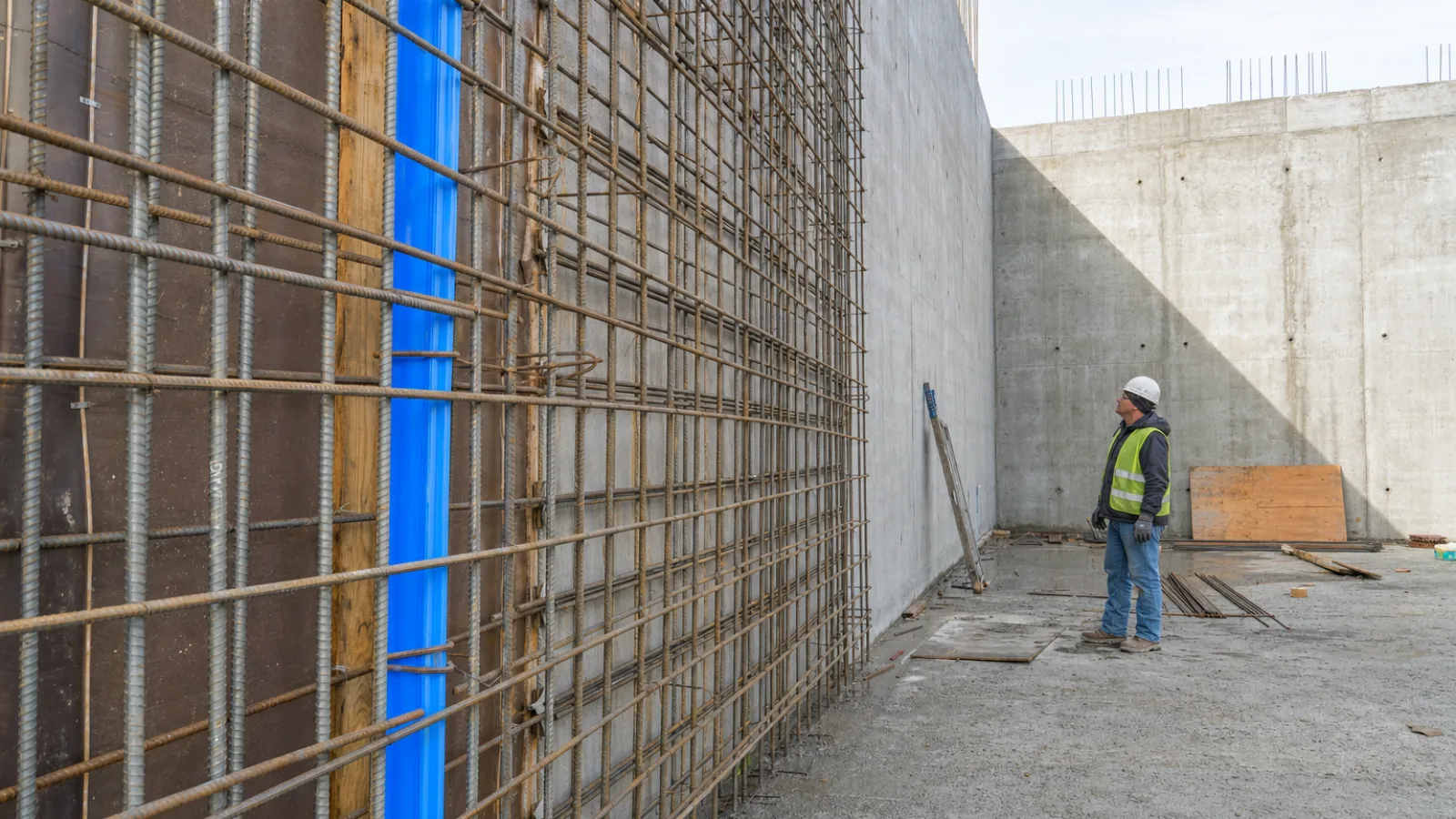
Concrete joints are deliberate discontinuities, but they are also among the most common paths for water to enter basements, tanks, tunnels, podiums, retaining walls, and water-treatment structures. Effective concrete construction joint waterproofing is not a single-product decision. It depends on correctly classifying the joint, selecting compatible details, installing them without displacement or contamination, consolidating the surrounding concrete, and inspecting concealed work before it disappears.
Waterstops, sealants, injectable systems, and membranes each have a defined role. Project teams may review waterstop and joint-sealant products during product selection, but the approved drawings, specifications, manufacturer instructions, and applicable standards must govern the final detail.
This article explains how to select, detail, install, inspect, and repair waterproofing systems at concrete joints while coordinating structural reinforcement, penetrations, liners, membranes, drainage, and finishes.
Why Concrete Joints Need Dedicated Waterproofing
A joint interrupts the continuity of the concrete mass and often changes the continuity of reinforcement, formwork, and the external waterproofing layer. Even when two pours are designed to bond, the interface can contain laitance, shrinkage gaps, honeycombing, or a narrow connected path through which pressurized water can travel.
Different risk factors require different responses:
- Hydrostatic pressure can drive water through small voids and defects, especially below the water table.
- Shrinkage can open or relax an interface as concrete loses moisture.
- Thermal movement can repeatedly compress, open, or shear a joint.
- Settlement or differential movement can exceed the movement assumed in a static construction-joint detail.
- Poor compaction and honeycombing create interconnected voids beside an otherwise correctly installed waterstop.
A surface coating alone may be inadequate where the joint contains a through-joint discontinuity or is expected to move. Coatings can supplement a detail, but they cannot reliably replace a properly designed waterstop, sealant, membrane transition, or injection provision.
Identify the Joint Before Choosing the System
Joint terminology varies between projects and standards. The engineer’s drawings, structural design, waterproofing design, and project specifications control. The following comparison is a practical starting point.
| Joint type | Purpose or expected movement | Typical locations | Common waterproofing approach |
|---|---|---|---|
| Construction joint | Stops and resumes concrete placement; normally limited designed movement, although shrinkage and minor movement may occur. | Rafts, walls, slabs, tanks, lift pits, and staged pours. | Embedded PVC or thermoplastic rubber waterstop, hydrophilic strip, injectable hose, or a specified combination; sealant may be used at exposed faces. |
| Movement or expansion joint | Accommodates intentional opening, closing, shear, or differential movement. | Building separations, long walls, decks, podiums, tunnels, and bridge-related structures. | Center-bulb waterstop, engineered membrane transition, compression or elastomeric seal, and movement-capable sealant as designed. |
| Isolation joint | Separates elements so they can move independently, often with substantial relative movement. | Columns or walls meeting slabs, equipment bases, and structures adjoining existing construction. | Movement-rated waterstop or seal assembly with compressible filler and carefully coordinated terminations. |
| Control or contraction joint | Encourages cracking at a planned location as concrete contracts; movement may be limited but is not necessarily zero. | Slabs, walls, pavements, and large panels. | Sealant, formed groove, membrane detail, or waterstop where the joint is also a water barrier; selection depends on exposure and design. |
Construction joints
A construction joint is created by the sequence of placing concrete rather than by an intended large movement gap. The interface still needs a clean, sound substrate and adequate consolidation. Where water pressure is present, a designed barrier is generally required rather than reliance on cement paste bonding alone.
Movement, isolation, and control joints
These joints must be distinguished from a simple pour stop. A movement or isolation joint needs a detail that can tolerate the specified movement without tearing, debonding, or bridging the gap. A control joint may be intended primarily to manage cracking, but it still requires waterproofing when it crosses a water-retaining or below-grade envelope.
Main Waterproofing Options for Concrete Joints
PVC and thermoplastic rubber waterstops
PVC and thermoplastic rubber waterstops are continuous profiles cast into or bonded to concrete. A center-bulb profile includes a flexible central bulb intended to accommodate movement. Dumbbell, ribbed, and similar profiles use lateral ribs or flanges to improve mechanical anchorage and the path length through the joint. Profile selection must reflect joint type, movement, pressure, chemical exposure, and the manufacturer’s tested installation requirements.
Internal waterstops are positioned within the concrete section, while externally bonded or surface-mounted waterstops are fixed to a face or transition zone. Internal profiles require sufficient concrete cover and careful support so both sides are fully encapsulated. Externally bonded arrangements require sound, prepared concrete and compatible adhesives or bonding systems.
Intersections, corners, changes in profile, and terminations are frequent weak points. Use approved prefabricated intersections where specified, or make site joints using the approved heat-welding method and equipment. The profile must remain continuous, correctly aligned, and supported during reinforcement fixing and concrete placement.
Hydrophilic waterstops
Hydrophilic waterstops are strips or profiles that swell when they contact water, helping close small gaps in a confined joint. They can be useful at construction joints where the product is continuously confined by sound concrete and the expected movement is limited.
They are not a universal substitute for a movement-rated waterstop. Premature exposure to rain, groundwater, wet formwork, or repeated wetting and drying can cause unwanted expansion or deterioration, depending on the product. Joint width, confinement, substrate condition, chemical compatibility, storage, and the manufacturer’s restrictions are critical. A hydrophilic product installed in a joint that opens significantly may lose contact or become overstressed.
Injectable hose systems
Injectable hoses are installed alongside or within a joint so grout or resin can later be introduced through access points. They can provide a planned repair or supplementary sealing route when a leak path is identified after the concrete has hardened.
Injection is not automatic protection against poor construction. Access points must remain identifiable and reachable, hose sections must be documented, and injection should be staged so the material reaches the intended path without uncontrolled pressure. The grout or resin must be compatible with the hose, concrete, water chemistry, structural movement, and repair objective. Records should identify injection locations, materials, pressures where relevant, and the observed response.
Joint sealants
Sealants are typically used at exposed joint faces, grooves, transitions, and movement gaps. Polysulfide, polyurethane, silicone, and other project-specified chemistries have different adhesion, chemical-resistance, curing, and movement characteristics. Selection should follow the exposure and the manufacturer’s compatibility data rather than product category alone.
Sealant performance depends heavily on geometry. The joint must have the specified width and depth, clean and sound bond faces, compatible primer where required, and a backer rod or bond breaker that prevents three-sided adhesion. Three-sided adhesion can restrain movement and promote cohesive or adhesive failure. Sealant must also be compatible with coatings, membranes, liners, firestopping, and adjacent materials.
Surface-applied membranes and ancillary details
Bonded sheet membranes, liquid-applied systems, swelling coatings, external collars, drainage layers, and protection boards can supplement joint waterproofing. They are especially useful at external transitions, pile heads, penetrations, and interfaces with existing construction. However, a surface system should not be treated as a replacement for a required embedded joint system unless the approved design specifically permits that approach.
How to Select a Concrete Joint Waterproofing Detail
Before installation, engineers and contractors should review:
- The joint classification and anticipated opening, closing, shear, or settlement.
- Hydrostatic pressure, water-retaining duty, groundwater chemistry, and drainage conditions.
- Whether the joint is accessible from the inside, outside, or only during construction.
- The pour sequence, reinforcement congestion, formwork, construction access, and concrete placement method.
- Chemical exposure, temperature range, ultraviolet exposure, and service environment.
- Compatibility with reinforcement, embeds, liners, coatings, firestopping, membranes, and finishes.
- Expected repair access and whether injection ports or inspection points are needed.
- Manufacturer installation requirements, approved welding methods, product limitations, and project specifications.
The selected detail should be shown clearly on drawings. It should identify the joint location, profile, intersections, corners, terminations, transitions, penetrations, changes in elevation, and provisions for repair. Structural and waterproofing designers should coordinate the detail before reinforcement and formwork make installation difficult.
Installation Practices That Prevent Leaks
- Confirm the approved product, profile, layout, and joint detail before work starts.
- Store products clean, dry, protected from damage, and within the stated temperature limits.
- Prepare formwork and reinforcement so the waterstop remains centered, continuous, and adequately supported.
- Use approved factory- or site-fabricated intersections and inspect welds or joins before placement.
- Prevent displacement, puncture, twisting, contamination, and accidental cutting. Do not use unapproved nails or tie wire through active sealing elements.
- Place and vibrate concrete carefully around the joint. Avoid creating voids, segregation, or honeycombing beside the profile.
- Prepare hardened construction-joint surfaces by removing laitance, loose material, dirt, and standing water as required by the specification.
- Install sealants only on sound, clean, properly profiled substrates with the correct backing and bond-breaker arrangement.
- Protect hydrophilic products from premature wetting and weather exposure until they are confined by concrete or otherwise protected as specified.
- Record concealed work with photographs, location references, product information, and inspection approvals before the next pour or covering operation.
Inspection and Quality-Control Checklist
Before the pour:
- Verify product identification, profile dimensions, batch information, approved submittals, and current drawings.
- Check continuity, alignment, embedment, anchorage, intersections, terminations, and penetrations.
- Confirm reinforcement and formwork do not displace, fold, puncture, or obscure the system.
- Check substrate preparation, joint geometry, backing, primer, and bond breakers where sealants are used.
During the pour:
- Observe concrete placement and consolidation around waterstops, corners, congested reinforcement, and embedded items.
- Prevent direct impact from discharge equipment and avoid excessive vibration that moves the profile.
- Record any damage, displacement, cold-joint concern, or repair before proceeding.
After the pour:
- Inspect exposed sealant joint width, depth, adhesion surfaces, primer, backer rod, finish, and continuity.
- Photograph concealed work and document nonconformances before closure.
- Distinguish visual inspection from required leak testing, flood testing, pressure testing, or other project-specific verification.
Common Failure Modes and What They Indicate
| Failure | Likely indication and preventive action |
|---|---|
| Discontinuous or poorly welded waterstop | The barrier has an open path at a join or intersection. Use approved welding procedures, inspect joints, and maintain continuity through corners. |
| Waterstop displacement during placement | Inadequate support, reinforcement interference, or uncontrolled concrete discharge. Coordinate fixing and inspect position before and during the pour. |
| Voids and honeycombing beside the joint | Insufficient consolidation, congested reinforcement, or poor mix placement. Repair concrete defects under an approved method; do not assume the waterstop closes large voids. |
| Torn, punctured, folded, or contaminated profile | Handling, fixing, or site-storage damage. Remove or repair according to the manufacturer’s approved procedure before encasement. |
| Hydrophilic strip exposed before confinement | Premature swelling or loss of shape. Protect it from rain, groundwater, and repeated wetting until installation is complete. |
| Sealant adhesion loss or cohesive failure | Contaminated substrate, incompatible primer, incorrect geometry, movement beyond capacity, or unsuitable sealant. |
| Three-sided sealant adhesion or incorrect geometry | The sealant cannot deform as intended. Replace backing and re-establish the specified width-to-depth relationship. |
| Joint detail does not accommodate movement | A static system has been used at a moving joint. Reassess movement and provide an engineered movement-rated detail. |
| Uncoordinated penetrations, tie holes, sleeves, or embeds | New leak paths have bypassed the joint system. Coordinate penetrations and use specified collars, grout, sealants, or waterstops. |
| Reliance on a coating to bridge a moving or poorly formed joint | The underlying discontinuity remains active. Repair the joint and provide a compatible movement or waterstop detail. |
Repair Options for Leaking Concrete Joints
Repair selection starts by locating the leak path, identifying whether the joint is moving, and determining whether the defect is localized or continuous. Water pressure, structural implications, concrete condition, chemical exposure, and access from each side should be assessed before choosing a repair.
Localized crack or honeycombing repairs
Small defects may be addressed with compatible crack injection, repair mortar, patching, or surface sealing under an engineer-approved method. The repair must address the actual leak path and provide adequate bond to sound concrete. Surface filling alone is unlikely to resolve a connected internal void or a joint that remains active.
Active leakage at a construction joint
Temporary water control may be needed before drilling ports or preparing the repair. Flexible injection materials can be suitable where the joint has limited movement, while staged grouting may be used to fill connected voids or redirect water before final sealing. Injection pressure, sequence, material compatibility, and access-port removal should follow the designed repair procedure.
Failed or inaccessible waterstop
If an embedded waterstop is discontinuous or inaccessible, exposed repair may require carefully controlled concrete removal, joint reconstruction, external waterproofing, or a designed combination of injection and surface sealing. Removing concrete near reinforcement or structural edges requires engineering review and a method that does not create new damage.
Failed sealant
Remove unsound sealant, clean and prepare the bond faces, replace damaged or incorrectly sized backing, apply compatible primer where required, and reseal using the specified joint geometry. Simply applying new sealant over contaminated or debonded material usually conceals rather than corrects the defect.
Practical Takeaways for Project Teams
- Classify the joint before selecting a product; construction, movement, isolation, and control joints do not have identical requirements.
- Use a continuous, compatible waterstop or seal assembly where the design requires a barrier through the concrete.
- Coordinate reinforcement, penetrations, membranes, liners, drainage, and firestopping before installation begins.
- Remember that a waterstop cannot compensate for poor concrete placement, inadequate consolidation, or an incorrectly detailed joint.
- Protect concealed work through fixing, placement, inspection, and photographic records.
- Design repair access where water pressure or restricted access could make future intervention difficult.
FAQ
What is the best waterproofing method for a concrete construction joint?
There is no universal best method. The choice depends on whether the joint is static or moving, the water pressure, chemical exposure, access, pour sequence, and required repair strategy. A PVC or thermoplastic rubber waterstop, hydrophilic strip, injectable hose, sealant, membrane, or combination may be appropriate. The approved design, specifications, manufacturer instructions, and applicable standards should determine the final system.
Can a hydrophilic waterstop replace a PVC waterstop?
Only where the design permits it. Hydrophilic waterstops rely on swelling and confinement and are generally suited to defined construction-joint conditions with limited movement. They may not accommodate the opening, closing, or shear expected at an expansion, isolation, or other movement joint. Exposure before confinement and continuous wet conditions can also affect suitability.
Where should a PVC waterstop be placed in a concrete joint?
Placement depends on the approved profile and joint detail. An internal waterstop is commonly positioned so it remains continuous, adequately supported, and fully encapsulated by sound concrete. A center-bulb profile is oriented to accommodate the designed movement, while ribbed flanges provide anchorage. Cover, reinforcement clearance, intersections, and terminations must follow the drawings and manufacturer requirements.
Do all concrete joints need sealant?
No. Sealant is commonly used at exposed faces, movement gaps, grooves, transitions, and selected construction joints, but the need depends on the joint’s purpose and exposure. A buried internal waterstop may be the primary barrier, while an exposed movement joint may require both a waterstop and a movement-capable sealant. Sealant should not be specified as a substitute for an embedded system without design approval.
How are leaking concrete construction joints repaired?
First locate the leak path and determine whether the joint is moving, whether the defect is local or continuous, and whether access is available from one or both sides. Repair options can include compatible injection, localized concrete repair, staged grouting, joint reconstruction, external waterproofing, or sealant replacement. The method must account for water pressure, structural effects, chemical exposure, and future movement.
What should inspectors check before a concrete joint is poured?
Inspectors should verify the approved product, profile, dimensions, batch information, layout, continuity, alignment, embedment, anchorage, intersections, and terminations. They should confirm that reinforcement and formwork will not damage or displace the system and that hydrophilic products are protected from wetting. Photographing concealed work and recording nonconformances before closure are essential parts of quality control.
Sources and Technical References
Project teams should consult the current project specifications, approved waterproofing submittals, manufacturer installation instructions, and applicable editions of relevant standards. Commonly referenced frameworks include ACI 301, Specifications for Concrete Construction; ACI 318, Building Code Requirements for Structural Concrete; ASTM C920, Standard Specification for Elastomeric Joint Sealants; and ASTM C1193, Standard Guide for Use of Joint Sealants. The governing contract documents and local requirements take precedence where provisions differ.